

I compared six UK copy trading platforms through funded-account testing, looking beyond headline returns at trader selection, copy allocation, risk controls, costs and withdrawals.
eToro suits social copy trading best, with trader research, risk data and copying in one FCA-regulated app. Pepperstone gives experienced forex traders raw pricing and control over how copied trades are sized. Axi offers similar MetaTrader-based copying through a dedicated mobile app.
FXCM and Tickmill suit traders who are comfortable with third-party signals. Darwinex suits investors who would rather back a risk-adjusted strategy than a person.
- CopyTrading lets you mirror experienced investors' trades
- Multi-asset access: stocks, crypto, ETFs, forex, commodities
- Beginner-friendly interface with social/community sentiment feed
Capital at risk. T&Cs apply.
How I tested and ranked these platforms
I tested each platform with a funded UK account in September 2026. I filtered for traders and strategies, set up copies with my own sizing and risk limits, and checked the fees shown before confirming each copy.
- 6 funded UK accounts
- £3,200 deposited in total (£250 to £1,000 per platform)
- 8 traders, signals or strategies copied
- 3 withdrawals tested
- Tested on iPhone, Android (Samsung and Pixel), Windows and Mac
I then weighted trader information 22%, copy and risk controls 22%, the full cost of copying 20%, who runs the copy service 14%, ease of getting started 12% and fit for small allocations 10%. FCA authorisation was a must, not a scoring factor.
What are the best copy trading platforms in the UK in 2026?
| Platform | Best for | Copy model | Minimum | Copy fee | Key risk control | UK/FCA |
|---|---|---|---|---|---|---|
| eToro | Social copy trading | Native CopyTrader, run in-house | $200 per trader | None | Copy Stop Loss | eToro (UK) Ltd, FRN 583263 |
| Pepperstone | Advanced forex copy trading | Broker-linked: CopyTrading (Pelican) and cTrader Copy | No copy minimum | Provider fee up to 50% (high-water mark) | Max drawdown (blocks new trades only) | Pepperstone Ltd, FRN 684312 |
| Axi | Dedicated copy trading app | Copy app linked to MT4/MT5 (Pelican) | No copy minimum ($100 recommended) | Provider fee, set by each provider and deducted weekly | Max Drawdown on equity | Axi Financial Services (UK) Ltd, FRN 466201 |
| FXCM | Third-party signal copying | MT4 Signals (MQL5); ZuluTrade | 50 units of account currency | Signal subscription (about $30–50 a month) | Equity stop, price-deviation limit | Stratos Markets Ltd, FRN 217689 |
| Tickmill | Low-cost MT4/MT5 copy trading | MetaTrader Signals (MQL5) | £100 account | Signal subscription, set by provider | Equity stop, price-deviation limit | Tickmill UK Ltd, FRN 717270 |
| Darwinex | Strategy-led, quantitative copying | DARWIN strategy marketplace | £200 per DARWIN | 1.2% a year + 20% performance fee | 6.5% monthly VaR target; stop loss per strategy | Tradeslide Trading Tech Ltd, FRN 586466 |
Best copy trading platforms UK reviews
Copy trading platforms vary in features, fees, and risk controls, so the reviews below focus on ease of use, copying tools, and suitability for beginners.
1. eToro – Best for social copy trading
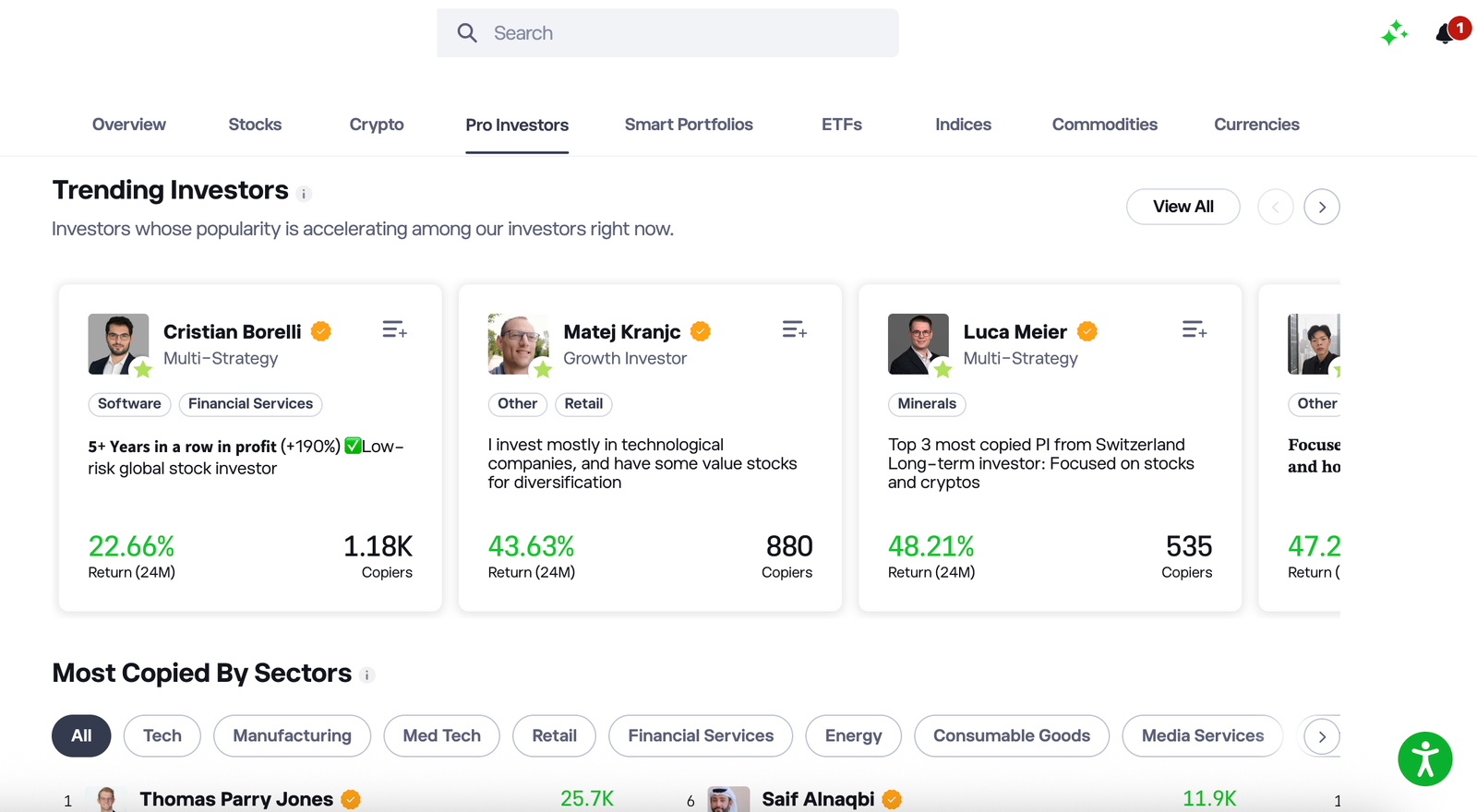
Verdict: eToro is the strongest fit for UK traders who want social copy trading in one app. CopyTrader is built into the FCA-regulated broker, and eToro charges no copy fee. The trade-off is cost on active CFD strategies. Copied trades pay the normal spreads and overnight fees, and the $200 minimum per trader makes diversifying expensive on a small account.
| Feature | Information |
|---|---|
| Copy-trading product | CopyTrader (native, in-house) |
| Best for | Beginner and intermediate social copy trading |
| Minimum to copy | $200 per trader; $1 minimum copied position |
| Maximum traders copied | 100 at once |
| Copy fee | None, from eToro or the trader |
| Underlying trading costs | Spreads (EUR/USD from 1.0 pip), overnight fees on CFDs, FX conversion on USD assets |
| Platforms | eToro web and mobile app |
| Strategy/provider data | Returns by month, risk score, max drawdown, portfolio split, trade frequency, copier numbers |
| Risk controls | Copy Stop Loss, Pause Copy, Stop Copy (Sell All / Keep All), manual close |
| Demo copy trading | Yes, $100,000 virtual portfolio |
| FCA entity | eToro (UK) Ltd, FRN 583263 (broker and copy service) |
| FSCS | Eligible claims up to £85,000; doesn’t cover trading losses |
What I tested: iPhone 16 Pro, iOS 27, eToro app v6.12, GBP account, CopyTrader, £500 deposited, September 2026.
What was it like copying traders on eToro?
eToro gave me the shortest route from finding a trader to copying one. Discovery, analysis and copying all sit in the same interface. When I tested it, I deposited £500 by debit card and spent the first week on the $100,000 demo account portfolio. That’s where I learnt how an allocation behaves before any real money moved.
To find a trader, I filtered Popular Investors for a risk score of 4 or lower, at least two years of history and a maximum drawdown under 20%. That left about a dozen names. The profiles go well beyond a headline return. I could see each trader’s monthly results, how their money was split between stocks, ETFs and CFDs, and how often they actually traded. I chose a mostly equity trader with a small index CFD position and copied at the $200 minimum.
The practical catch showed up straight away. eToro won’t open a copied position under $1, so 6 of the trader’s 41 smaller holdings weren’t copied. My copy was more concentrated than the trader’s real portfolio. You can set your own Copy Stop Loss. I went for 20%. Later I paused the copy and closed one position from the app, which took two taps each.
How much does eToro copy trading cost?
eToro doesn’t charge extra for CopyTrader. Copied positions cost the same as the equivalent manual trades. ETFs are commission-free, stock commissions vary by country and exchange, and UK-listed shares carry 0.5% Stamp Duty Reserve Tax. Crypto trades, including copied ones, cost 1% on each buy and sell.
CFDs incur spreads and overnight financing. Weekend charges are typically three times the daily rate, though the day this applies varies by asset. If you copy traders who hold leveraged CFDs for weeks or months, financing costs can add up significantly.
Copy and Smart Portfolio investments are funded in USD, so GBP-account users may pay currency conversion. Trading eligible GBP-denominated assets from the GBP account is conversion-free, and withdrawals from it are currently free.
Who is eToro best for?
eToro is best for beginners and intermediate investors who want to judge traders on evidence without leaving one app. The single FCA-regulated entity makes it the simplest UK setup on this list.
Who should avoid eToro for copy trading?
Forex traders who want raw spreads, MetaTrader, or exact control over lot sizes should look elsewhere. So should anyone who plans to spread under £1,000 across several traders, because of the $200 minimum per trader. Check our guide for the best forex brokers.
Pros and cons of eToro copy trading
- Discovery, trader data and copying in one app
- No copy or performance fee
- The $100,000 demo lets you rehearse a copy first
- Clear exit choice: Sell All or Keep All
- The $1 minimum position skips small holdings
- Overnight fees add up on long-held CFDs
- Forex spreads are wider than at raw-pricing brokers
Read the complete eToro review here.
2. Pepperstone – Best for advanced forex copy trading
Verdict: Pepperstone suits traders who care about what happens underneath the copied trade. It puts strategy copying on top of raw-spread forex pricing, with three sizing modes and a drawdown limit. The trade-off is fragmentation and fees. CopyTrading (MT4/MT5) and cTrader Copy are separate marketplaces, and providers can take up to 50% of profits.
| Feature | Information |
|---|---|
| Copy-trading product | CopyTrading by Pepperstone (Pelican technology, MT4/MT5); cTrader Copy |
| Best for | Experienced forex traders |
| Minimum to copy | No dedicated copy minimum; no account minimum |
| Copy fee | None from Pepperstone; provider fee 0–50%, calculated daily above a high-water mark |
| Underlying trading costs | Razor: EUR/USD average about 0.1 pips + £2.25 per lot per side; Standard: commission-free, wider spreads; swaps |
| Platforms | MT4, MT5, cTrader, TradingView (manual trading) |
| Strategy/provider data | Returns, drawdown, trade history, followers, fee |
| Risk controls | Fixed size, mirror master, proportional by equity; max drawdown (soft stop); copy open trades on/off |
| Demo copy trading | Restricted |
| FCA entity | Pepperstone Limited, FRN 684312 |
| FSCS | Eligible claims up to £85,000 at the UK broker |
What I tested: Windows 11 laptop, MT5 build 5200, CopyTrading web app, Razor account, CopyTrading by Pepperstone, £750 deposited, September 2026.
What was it like copying traders on Pepperstone?
Pepperstone felt like a trading platform with a copy layer added, not a social app. That’s the right fit if execution matters to you. My hands-on test started with £750 in a Razor account by bank transfer. I then had to create a separate MT5 account for CopyTrading, which added a step eToro doesn’t have.
The first thing I noticed is that CopyTrading and cTrader Copy don’t share providers. Choosing a route really means choosing a marketplace. I stayed with CopyTrading. I shortlisted providers trading mainly EUR/USD and GBP/USD with more than two years of history and a fee of 20% or less. The fee was clearly shown on the profile before the copy button.
Sizing mattered more than I expected. I chose proportional by equity, which scales each trade to my £750 against the provider’s equity. Mirror master would have copied their actual lot sizes, which is an easy way to run a small account out of margin. I also turned off copying of open trades, because the provider’s two existing positions were already well away from their entry prices.
My friction point was the maximum drawdown. I set it at 15%. Pepperstone treats it as a soft stop: when it triggers, it blocks new copied trades but leaves open ones running for you to close yourself. It’s easy to assume it works like a stop loss.
How much does Pepperstone copy trading cost?
Pepperstone doesn’t charge a separate platform fee for copy trading, although individual signal providers can charge a performance fee of up to 50%.
On a Razor account, EUR/USD currently averages around 0.1 pips according to Pepperstone’s August 2026 spread data, with a £2.25 commission per standard lot per side. That works out at £4.50 in commission for a one-lot round turn, before the spread.
Providers set their own performance fees. Pepperstone calculates these daily and applies them using a high-water mark, meaning a provider doesn’t simply charge performance fees again while recovering previous losses. For example, if you make £60 of relevant profit copying a provider charging 20%, £12 would be deducted as the performance fee, subject to the applicable high-water-mark calculation.
You should also account for normal trading costs, including spreads, commissions and overnight funding where applicable. The total cost therefore depends on both the strategy you copy and how it trades.
Who is Pepperstone best for?
Pepperstone is best for experienced forex traders who want tight pricing, MetaTrader or cTrader, and precise control over sizing and drawdown.
Who should avoid Pepperstone for copy trading?
Beginners who want plain-English risk scores, share portfolios or no provider fees will find eToro easier. Pepperstone’s global CopyTrading page also names a Bahamas entity, so check which terms you accept when you sign up.
Pros and cons
- Raw forex pricing underneath the copy
- Three sizing modes
- High-water-mark performance fees
- Choice of MT4/MT5 CopyTrading or cTrader Copy
- Provider fees of up to 50%
- The drawdown limit doesn't close open trades
- Copy routes are split across separate systems
Read the complete Pepperstone review here.
3. Axi – Best dedicated copy-trading app
Verdict: Axi has the cleanest phone-first copy workflow for MetaTrader users. It uses a dedicated app that links to your MT4 or MT5 account, with four sizing modes and an equity-based drawdown limit. The trade-off is two layers. The copy app is run by a separately authorised firm, and you still need MetaTrader for some tasks.
| Feature | Information |
|---|---|
| Copy-trading product | Axi Copy Trading app (powered by Pelican) |
| Best for | MT4/MT5 users who copy on mobile |
| Minimum to copy | No copy-specific minimum; $100 recommended account balance |
| Copy fee | Provider performance fee, shown before copying and usually deducted weekly |
| Underlying trading costs | Standard: spread only; Pro: raw spreads from 0.0 pips plus commission; swaps |
| Platforms | Axi Copy Trading (iOS/Android), MT4, MT5 |
| Strategy/provider data | Profitability, return history, markets traded, performance fee |
| Risk controls | Fixed, mirror master, proportional equity, proportional balance; Max Drawdown (on equity); copy existing trades |
| Demo copy trading | Not available |
| FCA entity | Axi Financial Services (UK) Ltd, FRN 466201; copy service via Pelican Trading, appointed representative of London & Eastern LLP, FRN 534484 |
| FSCS | Eligible claims up to £85,000 at the UK broker |
What I tested: Google Pixel 9, Android 16, Axi Copy Trading app v3.8, Pro account, Axi Copy Trading, £400 deposited, September 2026.
What was it like using the Axi Copy Trading app?
Axi was the easiest app on this list to copy from if you already use MetaTrader. It asked for my existing MT5 login instead of opening a new account. When I tested it, I deposited £400 into a Pro account, deliberately less than elsewhere, because Axi only recommends $100. Linking the app took about four minutes. Copied trades then appeared in my normal MT5 terminal next to my own.
In the Discover tab I sorted by profitability and then dropped anyone with under a year of history or a fee above 25%. I picked a provider trading mostly gold and GBP/USD. The weekly-deducted fee was shown before the copy button.
Four sizing modes sounds like too many, but the difference between equity and balance is real. Proportional equity shrinks new trades as the provider’s floating losses grow. Proportional balance doesn’t. I chose equity. On a £400 account, MetaTrader’s 0.01-lot minimum rounded two small trades up, so those copies were proportionally larger than the provider’s. That matters most on gold.
The friction was working across two tools. The app is built to copy, not to trade, so I switched to MT5 when I wanted to close a gold position manually. There’s also no demo for copy trading, so your first copy is with real money.
How much does Axi copy trading cost?
Axi doesn’t charge a separate copy-trading fee, but providers can charge performance fees of up to 50%. You also pay the underlying account’s spreads, commissions and swaps. Performance fees are generally deducted weekly from profits above the high-water mark. On smaller accounts, rounding copied positions up to Axi’s minimum trade size can make the actual position larger than the proportional allocation.
Who is Axi best for?
Axi is best for MT4/MT5 traders who want to find and manage copies from their phone without moving to a separate social platform.
Who should avoid Axi for copy trading?
Anyone who wants to try copying on a demo first, or who wants shares and ETFs rather than forex and CFD strategies. eToro is also simpler if you’d rather deal with one legal entity.
Pros and cons
- Dedicated copy app that uses your existing MT5 login
- Four sizing modes, including proportional balance
- Low recommended starting balance
- Fee shown before you copy
- Broker and copy service are separate entities
- No demo copy trading
- Manual closes need MetaTrader
4. FXCM – Best for third-party signal copying
Verdict: FXCM suits traders who want to vet strategies on hard numbers rather than follow a social feed. It’s a broker with third-party copy infrastructure on top: MetaTrader signals, with ZuluTrade also linked to FXCM. The trade-off is setup and a fixed cost. You need a separate signal account, you pay a monthly subscription whether the strategy wins or not, and copying depends on your terminal staying online.
| Feature | Information |
|---|---|
| Copy-trading product | MT4 Signals (MQL5 marketplace); ZuluTrade |
| Best for | Quantitative, data-led signal selection |
| Minimum to copy | 50 units of account currency (MT4 account minimum) |
| Copy fee | None from FXCM; signal subscription roughly 30–50 a month, paid through MQL5 |
| Underlying trading costs | Standard account: spread only (EUR/USD around 0.9 pips); rollover on overnight positions |
| Platforms | MT4 + MQL5 account; Trading Station |
| Strategy/provider data | Growth, max drawdown, profit factor, expected payoff, trading age, leverage, subscribers |
| Risk controls | Deposit-use limit, equity stop, max price deviation, copy SL/TP |
| Demo copy trading | £50,000 virtual MT4 balance |
| FCA entity | Stratos Markets Ltd (FXCM UK), FRN 217689; signal marketplace sits outside the broker |
| FSCS | Eligible claims up to £85,000 at the broker; not the signal provider |
What I tested: MacBook Air M3, macOS Tahoe 26, MT4 build 1440 (FXCM UK server), Standard account, MT4 Signals, £300 deposited,September 2026.
What was it like copying signals with FXCM?
FXCM gave me the most analytical provider search of the six, but also the most setup. My test began with a £300 deposit into an FXCM UK MT4 account. I then created a free MQL5 Community account and logged into it inside the terminal. It took close to an hour before my first signal was live.
The filtering is where FXCM earns its place. I looked only at signals with at least 18 months of trading age, a profit factor above 1.4 and a maximum drawdown under 25%. Then I opened each one’s leverage history. Two signals with smooth growth curves had occasional very large positions, so I dropped them. That’s exactly the kind of risk a leaderboard hides.
The settings are the most technical on this list. I limited the signal to 60% of my deposit, set a price deviation of 1.0 spread so trades wouldn’t copy at much worse prices, and added an equity stop at £240 to disconnect the signal. The deviation rule skipped one trade during a fast GBP/USD move. That protected my entry price but also left my results different from the provider’s.
The real friction is uptime. Signals copy through the MT4 terminal, so when my laptop slept, nothing copied. I ended up paying for MQL5 virtual hosting on top of the subscription.
How much does FXCM signal copying cost?
FXCM charges no copy fee, but the signal isn’t free. I paid a $35 monthly subscription through MQL5, plus hosting, plus FXCM’s Standard spreads (EUR/USD around 0.9 pips) and rollover on overnight positions. Because the subscription is fixed, it hits small accounts hardest. On £300, $35 (about £26) means the strategy has to make almost 9% a month just to cover the subscription.
Can you use ZuluTrade with FXCM in the UK?
FXCM is a ZuluTrade broker. However, ZuluTrade is a third-party network regulated outside the UK (by the HCMC in Greece, among others), not by the FCA.
Who is FXCM best for?
FXCM is best for experienced MetaTrader traders who want to screen strategies on profit factor, drawdown and leverage, and who don’t mind a technical setup.
Who should avoid FXCM for copy trading?
Anyone copying with a few hundred pounds, because fixed subscriptions eat small accounts. And anyone who wants a simple app. eToro or Axi remove most of this work.
Pros and cons
- The deepest quantitative strategy data here
- Granular controls: deposit limit, price deviation, equity stop
- Low 50-unit account minimum
- Monthly subscription paid whether or not the signal profits
- Terminal must stay online, or you pay for hosting
- Signal provider sits outside the FCA broker relationship
5. Tickmill – Best for low-cost MetaTrader signal copying

Verdict: Tickmill is a lower-cost MetaTrader route for traders who already understand the MT ecosystem. Its raw pricing is among the cheapest here, and it’s FCA-regulated with a £100 minimum. The trade-off is that copying is a secondary feature for UK clients. Tickmill Social runs through the offshore entity, so UK accounts rely on third-party MetaTrader signals.
| Feature | Information |
|---|---|
| Copy-trading product | MT4/MT5 Signals (MQL5); Myfxbook AutoTrade. |
| Best for | Cost-focused MetaTrader traders |
| Minimum to copy | £100 account minimum (Classic and Raw) |
| Copy fee | None from Tickmill; signal subscription set by provider |
| Underlying trading costs | Raw: from 0.0 pips + £3 per lot per side; Classic: from 1.6 pips, no commission |
| Platforms | MT4, MT5, WebTrader |
| Strategy/provider data | Via MQL5: growth, drawdown, profit factor, trading age, subscribers |
| Risk controls | MetaTrader signal settings: deposit-use limit, equity stop, price deviation |
| Demo copy trading | MT4/MT5 demo available |
| FCA entity | Tickmill UK Ltd, FRN 717270 |
| FSCS | Eligible claims up to £85,000 at the UK broker |
What I tested: Samsung Galaxy S24, Android 16, MT5 mobile build 5200, Raw account, MT5 Signals, £250 deposited, September 2026.
What was it like copy trading with Tickmill?
Tickmill felt like a good-value broker that happens to support copying, not a copy-trading platform. My hands-on test began with a £250 deposit into a Tickmill UK Raw account. The first thing I checked was the copy route. Tickmill Social is run through the Seychelles entity, so I didn’t use it from a UK account, and copied through MT5’s built-in Signals instead.
To vary from the other tests, I picked a US30 index signal with over two years of history and a drawdown under 20%. Setting it up on MT5 desktop was the same MQL5 process as FXCM: log in, cap the deposit share, set a price deviation. It works, but Tickmill adds nothing of its own. There’s no provider ranking, risk score or copy dashboard in the Tickmill client area.
Where Tickmill stood out was cost. On the Raw account, the signal’s trades paid £3 per lot per side with spreads from 0.0 pips. On a 0.05-lot copied trade, that’s about 30p in round-trip commission. Withdrawing £100 by bank transfer took one working day, with no fee.
How much does Tickmill copy trading cost?
Tickmill charges no copy fee. The Raw account costs $3 per lot per side on spreads from 0.0 pips, and the Classic account is commission-free from 1.6 pips. Signal subscriptions are paid separately to the provider through MQL5. For frequent forex or index strategies, Raw pricing keeps the underlying cost among the lowest on this list.
Who is Tickmill best for?
Tickmill is best for MetaTrader users who already know how signals work and mainly want low costs with an FCA-regulated broker.
Who should avoid Tickmill for copy trading?
Anyone for whom copying is the main reason to open an account. eToro, Pepperstone and Axi give UK clients far better copy tools.
Pros and cons
- FCA-regulated with a £100 minimum
- Low raw pricing: £3 per lot per side
- MT4 and MT5 supported
- Fast, free withdrawals
- Tickmill Social isn't offered through the UK entity
- Copying relies on third-party signals
- No Tickmill copy dashboard or trader analytics
6. Darwinex – Best for strategy-led, quantitative copying
Verdict: Darwinex is the analytical alternative to social copy trading. You don’t copy a person. You invest in a DARWIN, a trading strategy that Darwinex has risk-adjusted to a fixed volatility target. The trade-off is cost and complexity: a 1.2% annual management fee plus a 20% performance fee, and a platform built for investors who are comfortable with risk metrics.
| Feature | Information |
|---|---|
| Copy-trading product | DARWIN strategy investing |
| Best for | Investors who want risk-standardised, quantitative strategies |
| Minimum to copy | £200 per DARWIN (200 units of wallet currency) |
| Copy fee | 1.2% a year management fee (charged daily); 20% performance fee above a high-water mark, charged quarterly (15% to provider, 5% to Darwinex) |
| Underlying trading costs | Retail spreads and swaps; wholesale forex commissions on DARWIN orders |
| Platforms | Darwinex web platform, investor app, MT4/MT5 (trading), DARWIN API |
| Strategy/provider data | D-Score, investment attributes, return, drawdown, correlation, capacity, divergence |
| Risk controls | 6.5% monthly VaR target on every DARWIN; stop loss/take profit on DARWIN positions; 1x leverage by default |
| Demo copy trading | Browsing and analytics without funding |
| FCA entity | Tradeslide Trading Tech Ltd, FRN 586466 |
| FSCS | Up to £85,000, plus excess cover underwritten by Lloyd’s |
What I tested: Macbook pro, Darwinex web platform (Safari), GBP investor wallet, DARWIN investing, £1,000 deposited, September 2026.
What was it like investing in DARWINs?
Darwinex felt more like building a small fund portfolio than copying a trader. When I tested it, I deposited £1,000 into a GBP wallet and spent most of my first session in the analytics. That’s where the platform is strongest.
Because every DARWIN is scaled to the same 6.5% monthly VaR target, I could compare a quiet forex strategy with an aggressive index one on equal terms. You can’t do that on a social leaderboard. I shortlisted DARWINs with long track records and strong D-Scores, then checked correlation and capacity. I invested £300 in each of three that didn’t move together. After the third, the portfolio page showed a diversification benefit, which confirmed the spread was doing something.
I set a stop loss on each position from the Invested DARWINs page. That’s a more familiar control than eToro’s Copy Stop Loss, because it’s tied to each strategy’s price.
The friction is the learning curve. Terms like divergence (the gap between the DARWIN’s return and what investors actually get) and currency impact needed reading up. One of my DARWINs was USD-based, so its results in my GBP wallet included a currency effect I hadn’t planned for.
How much does Darwinex cost?
Darwinex charges a 1.2% annual management fee on invested equity, taken daily, and a 20% performance fee on new profits above a high-water mark, charged quarterly. The provider gets 15% and Darwinex 5%. On £1,000 invested for a year, the management fee is about £12. If the portfolio made £80, the performance fee would be £16. There’s no management fee on a DARWIN that’s had no market exposure for more than four weeks.
Who is Darwinex best for?
Darwinex is best for analytical investors who want to compare strategies on risk-adjusted terms and build a diversified portfolio of them.
Who should avoid Darwinex for copy trading?
Beginners who want a simple social feed, and anyone who objects to paying both a management fee and a performance fee. eToro charges neither.
Pros and cons
- Every strategy normalised to the same risk target
- Deep analytics: D-Score, correlation, capacity, divergence
- FSCS cover plus Lloyd's excess protection
- Stop loss and take profit on each DARWIN position
- 1.2% management fee on top of 20% performance fee
- The steepest learning curve on this list
- Currency impact when wallet and DARWIN currencies differ
Which copy trading platform should you choose?
No copy trading platform suits every UK trader. The right one depends on whether you want social copying in one app, MetaTrader copying with control over sizing, third-party signals, or strategy-led investing. Past results on any of them don’t predict what you’ll get.
| Platform | Choose it if… | Consider something else if… |
|---|---|---|
| eToro | You want to find, vet and copy traders in one app, with risk scores, portfolio data, no copy fee and broker and copy service in one FCA-authorised firm | You want raw forex pricing, MetaTrader, or to split a small budget across several traders ($200 minimum per trader) |
| Pepperstone | You’re an experienced forex trader who wants raw pricing, a choice of MT4/MT5 CopyTrading or cTrader Copy, and control over how trades are sized | You want plain-English risk scores or no provider fees, or a drawdown limit that closes open trades |
| Axi | You use MetaTrader and want a dedicated phone app with four sizing modes and an equity-based drawdown limit | You want to try copying on a demo first, or prefer a social feed and public trader profiles |
| FXCM | You want to screen MetaTrader signals on profit factor, drawdown and leverage history, and don’t mind a technical setup | You’re copying with a few hundred pounds (subscriptions are fixed) or want copying built into the broker |
| Tickmill | You already use MetaTrader signals and mainly want low raw costs with an FCA-regulated broker | Copy trading is the main reason you’re choosing a broker |
| Darwinex | You’d rather compare and allocate to risk-adjusted strategies than follow individual traders | You want conventional social copy trading, or object to paying both a management fee and a performance fee |
Copy trading platforms aren’t all the same: what you get
“Copy trading platform” can mean four quite different things. The differences decide who holds your money, who runs the copying, what you’re actually copying and which fees you pay.
| Model | Example | What you’re actually using |
|---|---|---|
| Native social | eToro | Broker, social network and copying in one firm |
| Broker + copy technology | Pepperstone, Axi | Broker account connected to separate copy technology |
| Third-party signals | FXCM, Tickmill | Broker account plus an external signal marketplace |
| Strategy marketplace | Darwinex | Investment in risk-adjusted trading strategies |
Native social (eToro). eToro (UK) Ltd holds your account and runs CopyTrader itself. You find traders in its social network and copy them in proportion, with no copy fee.
Broker + copy technology (Pepperstone, Axi). You trade through the broker, and Pelican’s technology connects your MT4 or MT5 account to strategy providers. Pepperstone also offers cTrader Copy as a separate marketplace. Axi’s copy app is provided through London & Eastern LLP, a separate FCA-authorised firm. You copy individual providers, who set their own performance fees.
Third-party signals (FXCM, Tickmill). The broker executes the trades, but the signals come from an external marketplace you subscribe to separately. In my tests both used MetaTrader’s MQL5 Signals. FXCM is also linked to ZuluTrade, and whether UK clients can use it. Tickmill’s support for Myfxbook AutoTrade. The signal provider sits outside the FCA-regulated broker relationship.
Strategy marketplace (Darwinex). You don’t follow a person’s trades. You invest in a DARWIN, a strategy that Darwinex scales to a 6.5% monthly risk target, and you pay a management fee plus a performance fee.
These models solve different problems, so the same checklist doesn’t fit them all equally. eToro’s strengths are social: trader profiles, portfolio breakdowns and copier numbers. Darwinex’s are analytical: risk-adjusted comparisons, correlation between strategies and capacity. I compare all six on the same core points (fees, risk controls, minimums and who runs the copy service), but read each review in the context of its model.
Other copy trading platforms I considered
I excluded platforms where UK availability, regulatory status, copy-trading access, product structure or first-hand testing did not make for a sufficiently comparable review. I would rather publish six platforms we could properly test and compare than inflate the shortlist with providers we couldn’t assess on the same basis.
| Platform | Why I considered it | Why it didn’t make the final shortlist |
|---|---|---|
| AvaTrade | Established international broker offering copy trading | Didn’t provide enough differentiation for the final shortlist |
| FXTM | Established broker with copy trading functionality | UK proposition and available copy-trading setup made direct comparison less straightforward |
| HFM | International broker offering copy trading | UK availability and product structure made it less comparable |
| RoboForex | Large international broker with copy trading | UK regulatory/availability considerations |
| Myfxbook | Well-known third-party trading and strategy ecosystem | Primarily a third-party service rather than a conventional UK copy-trading platform |
| CopyFX | Established copy-trading infrastructure | Less suitable for a like-for-like UK comparison |
How I scored and ranked the best copy trading platforms in the UK
This guide uses the same research process behind my full Psyfi Money platform reviews, with weights built for one reader: someone in the UK who wants to copy other traders rather than trade themselves. The weighting sets the order of platforms on this page. It’s separate from any platform’s review rating, such as eToro’s 4.7/5.
To be included, a platform had to meet three conditions. UK residents had to be able to reach a copy route through an FCA-authorised broker, I had to be able to identify the copy product available to UK clients, and its pricing had to be published clearly enough to compare.
Ranking factor | Weight | What I assessed |
|---|---|---|
| Ranking factor | Weight | What I assessed |
| Trader information before copying | 22% | Track record length, max drawdown, risk scores, portfolio split, profit factor, leverage history, copier numbers and whether the provider fee is shown before you copy |
| Copy and risk controls | 22% | Sizing modes (proportional, mirror master, fixed), copying open trades, Copy Stop Loss vs max-drawdown limits, and what each control does when it triggers (a limit that only blocks new trades counts for less than one that also closes open trades) |
| Full cost of copying | 20% | Provider performance fees (none, or up to 50% above a high-water mark), signal subscriptions, spreads, raw commission, overnight financing and FX conversion |
| Who runs the copy service | 14% | Whether the copy service sits with the FCA-authorised broker, an appointed representative, an offshore group company or a third-party signal marketplace |
| Getting started as a copier | 12% | Extra accounts needed (a separate MT5 or MQL5 account), whether the terminal must stay online or you pay for hosting, and whether there’s a demo or a dedicated copy app |
| Fit for small allocations | 10% | $200 minimum per trader, $1 minimum copied position, 0.01-lot rounding on MetaTrader, and account minimums of £100 or 50 units of the account currency |
The most useful part was running the same copy workflow on all six platforms, with deposits from £250 to £1,000. On each one I filtered for traders or strategies, copied a small allocation, then checked what the risk controls actually did. On eToro, copying at the $200 minimum skipped 6 of one trader’s 41 holdings because of the $1 minimum position.
On Pepperstone, a 15% maximum drawdown blocked new copies but left open trades running. On a £400 Axi account, two small trades were rounded up to 0.01 lots. Fixed costs showed up just as clearly: FXCM’s $35 monthly signal subscription meant a £300 account had to make almost 9% a month to cover it.
Those results are why trader information and copy controls carry 22% each. A copier hands over the trading decisions, so what they can see before copying and what happens when a limit triggers matter more than charts or market range.
I weighted who runs the copy service separately at 14% because it varied more than anything else I checked, even though every broker here is FCA-authorised. It ranged from eToro’s single FCA-regulated firm to FXCM’s and Tickmill’s third-party signal marketplaces. These weights set the order of this guide only, and each platform’s full Psyfi Money review rating.
How copy trading works in the UK
Copy trading places another trader’s trades in your account automatically, scaled to the amount you give them. You don’t approve each trade, but every position and every loss is yours.
Opening, changing and closing. When the trader opens, adds to, partly closes or closes a position, your copy does the same in proportion. If you copy trades the trader already has open, you enter at today’s price, not theirs.
Stopping a copy. The controls differ by platform. eToro’s Pause Copy blocks new trades, and Stop Copy lets you close everything (Sell All) or keep the positions (Keep All). Pepperstone’s maximum drawdown blocks new copies but leaves open trades running. On MetaTrader routes, stopping a copy can leave positions open for you to close.
Why your results differ from the trader’s. Copy delay, slippage, minimum sizes and rounding, trades skipped for lack of margin, and fees that you pay but the trader doesn’t. You may also join after their best run.
What platforms and account types support copy trading?
In the UK, copy trading usually runs through one of four routes. Some brokers run it themselves, like eToro’s CopyTrader. Others use copy technology plugged into MT4 or MT5, like Pelican at Pepperstone and Axi, or run it through cTrader Copy. You can also subscribe to third-party signal marketplaces such as MQL5 Signals, ZuluTrade and Myfxbook AutoTrade. Darwinex works differently: you invest in risk-adjusted strategies called DARWINs.
Most brokers let you copy from a standard CFD trading account, such as Axi’s Standard or Pro account, FXCM’s Standard account, or Tickmill’s Classic or Raw account. Some routes need an extra account, such as a free MQL5 account for MetaTrader signals or a separate investor wallet at Darwinex.
UK beginners should use an FCA-regulated trading platform, and check who actually runs the copy service. The copy service or signal provider may sit outside the FCA-regulated broker relationship. ZuluTrade, for example, is regulated outside the UK.
What types of assets can you copy trade?
- Forex (FX) – Major, minor, and sometimes exotic currency pairs
- Indices – Global stock indices such as the FTSE 100, S&P 500, and DAX
- Commodities – Gold, oil, silver, and other traded commodities
- Equities (Stocks) – Shares of individual companies traded as CFDs
- ETFs – Exchange-traded funds available via CFD markets
- Cryptocurrencies – Available on some platforms; however, UK retail clients cannot copy trade crypto CFDs due to FCA regulations.
How to choose a copy trading platform in the UK
- Regulation: check both the broker and the firm running the copy service on the FCA Register. They’re the same firm only at eToro.
- Trader data: look beyond returns. eToro shows risk scores and drawdown, MT4 signals show profit factor and leverage history, and Darwinex puts every strategy on the same 6.5% monthly risk target.
- Risk controls: find out what happens when a control triggers. eToro’s Copy Stop Loss closes the copy. Pepperstone’s drawdown limit only blocks new trades.
- Minimums: eToro requires $200 per trader and Darwinex £200 per DARWIN. On Pepperstone and Axi, MetaTrader’s 0.01-lot minimum can make small copies bigger than intended.
- Fees: add up spreads, commission, overnight financing and provider fees (see below).
- Execution: price-deviation limits (FXCM, Tickmill) protect your entry but can skip trades.
- Usability: eToro works in one app. Axi links a copy app to MT5. Signal routes need an MQL5 account and a terminal that stays online.
- Withdrawals: eToro is free from a GBP account ($5 from a USD account), Tickmill bank withdrawals are free, and FXCM charges for bank wires.
How to choose a trader to copy
A high return can simply mean high risk, leverage or concentration. No single metric predicts future results, so check:
- Track record: two to three years, including a volatile market.
- Maximum drawdown: a 50% fall needs a 100% gain to recover. If you wouldn’t have held on through it, don’t copy.
- Consistency: 25% with a 10% drawdown is a very different profile from 150% after a 60% fall.
- Risk score and leverage: eToro’s score only compares traders on eToro. MT4 leverage history can reveal occasional very large positions.
- Open positions: a clean closed-trade record can hide unrealised losses.
- Concentration and frequency: several traders all trading gold isn’t diversification, and frequent trading costs you more than it costs them.
- Strategy changes: bigger sizes after losses, averaging down or a restarted account.
- Copier numbers: popularity isn’t evidence of skill.
- Fees: a 20% fee on £60 of profit costs £12.
How much does copy trading cost?
A “zero copy fee” or a tight spread is only one layer of the cost.
| Cost | How it differs across these platforms |
|---|---|
| Spreads and commission | eToro EUR/USD from 1.0 pip, no commission; Pepperstone Razor about 0.1 pips + £2.25 per lot per side; Tickmill Raw from 0.0 pips + £3 per lot per side |
| Overnight financing | Daily on leveraged CFDs, tripled once a week; can cost more than the spread on long holds |
| Currency conversion | Applies when GBP is used for US-dollar assets (eToro) or USD strategies (Darwinex) |
| Provider fees | None at eToro; up to 50% above a high-water mark at Pepperstone; set per provider and deducted weekly at Axi; 1.2% a year + 20% at Darwinex |
| Subscriptions | MetaTrader signals (FXCM, Tickmill): roughly 30–50 a month, due even when the strategy loses, plus hosting |
Modelled example: on a £500 copy that makes £50, eToro deducts no provider fee but charges spreads and overnight fees. A Pepperstone provider charging 30% takes £15. A $35 monthly subscription can cost more than any spread saving. These figures are modelled, not customer results.
Is copy trading legal and regulated in the UK?
Yes. The FCA treats automatic copy trading as investment management, so the firm running it needs FCA permission. FCA-authorised brokers must cap retail CFD leverage (30:1 on major forex pairs), close positions at 50% margin, offer negative balance protection and keep client money separate from their own.
You can take unresolved complaints to the Financial Ombudsman Service, and the FSCS covers eligible claims up to £85,000 if an authorised firm fails.
None of this protects you from trading losses. And the protections apply only to the authorised firm. Check which firm runs the copy service (see the comparison table), and check who runs the copy service, where there’s no FSCS or Ombudsman route.
Who is copy trading suitable for based on risk level?
Copy trading is best suited to beginners and intermediate traders who understand the risks of CFD trading and want a hands-off way to learn from more experienced investors.
Low-risk settings work well for cautious users, while higher-risk traders will appeal to users willing to accept deeper drawdowns. UK investors should always assess a trader’s risk score, consistency and maximum drawdown before committing funds.
Copy trading: benefits and risks
| Benefits | Risks and limitations |
|---|---|
| Trades are placed automatically, without approving each one | You can lose money quickly: 65–69% of retail CFD accounts lose at Tickmill UK, Axi and FXCM |
| Access to experienced traders or packaged strategies | Deep drawdowns push many copiers to stop at the worst moment |
| Drawdown, risk and fee data shown before you copy | Leverage turns small market moves into large swings |
| You control the allocation, sizing and stop or drawdown limit | Traders can change strategy without warning |
| You can learn by watching how a trader manages risk | Delay, slippage and skipped trades make your results differ from theirs |
| Less time spent analysing markets | Fees and subscriptions reduce your returns, not theirs |
How to start copy trading on a copy trading platform?
1. Log in to the platform
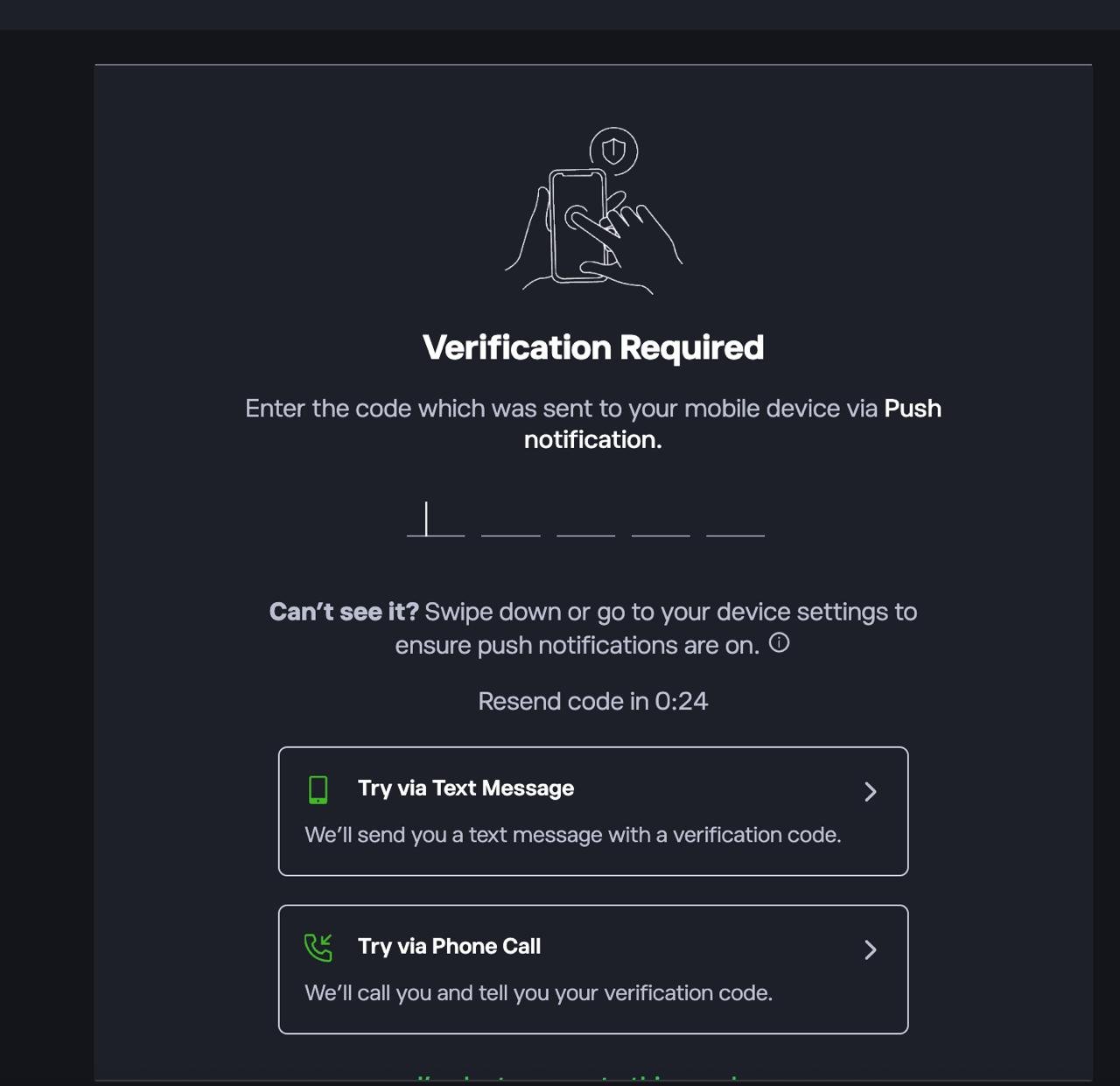
If prompted, complete 2FA by entering the code sent via push notification, SMS, or phone call.
2. Deposit funds into your account
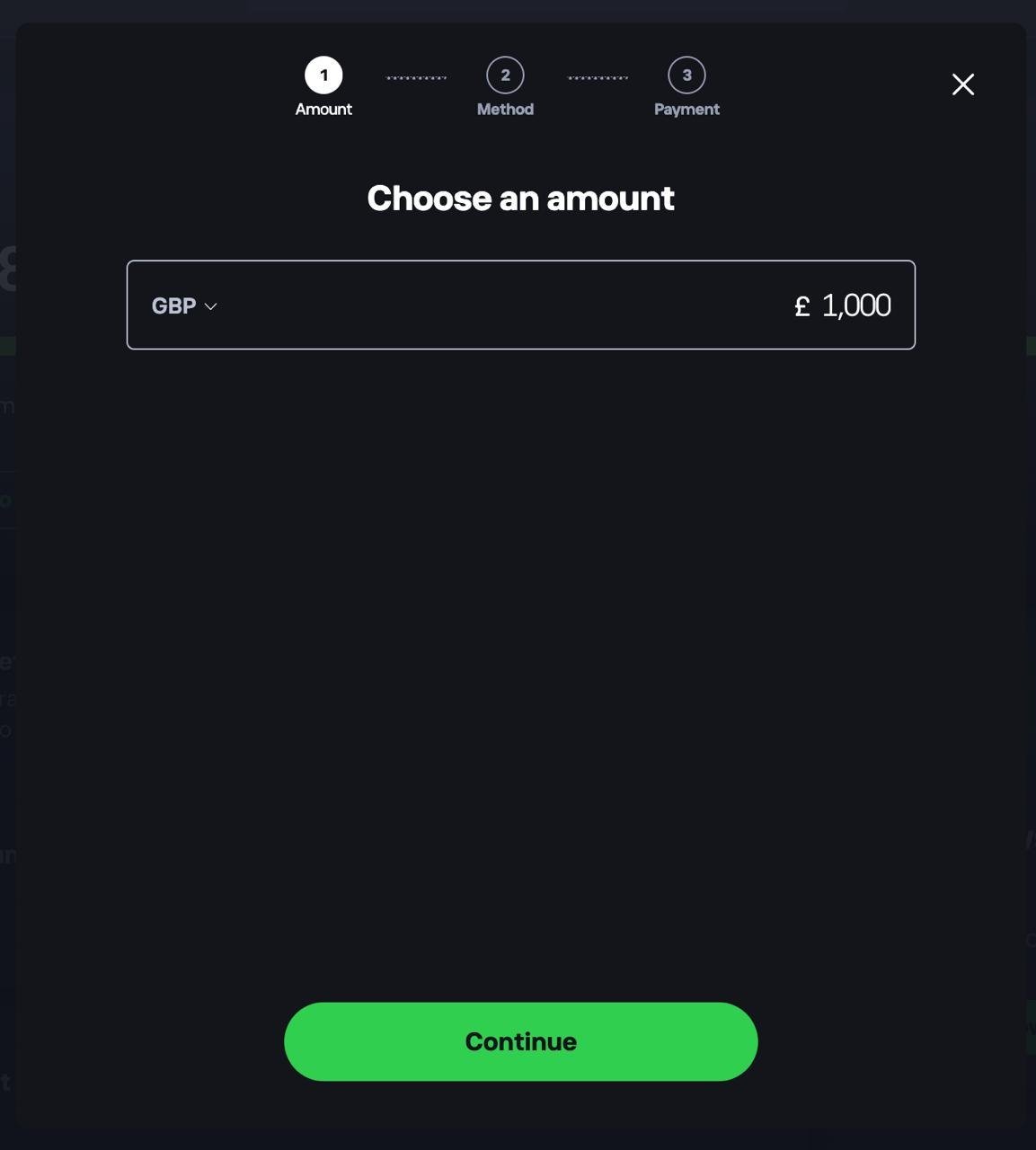
Head to your dashboard and choose to add funds. Select your currency, enter the amount you want to deposit, tap Continue, then choose a payment method.
3. Confirm your funds are available
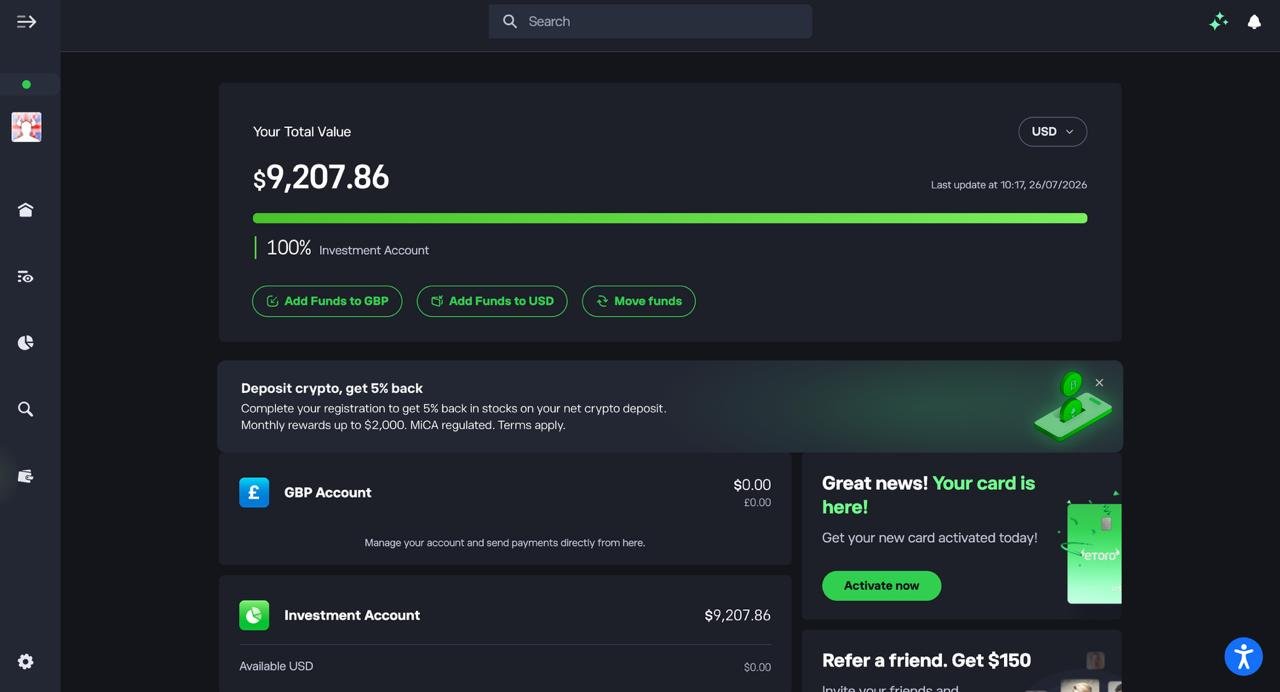
Check your dashboard to make sure your deposit has landed in your Investment Account before you start trading.
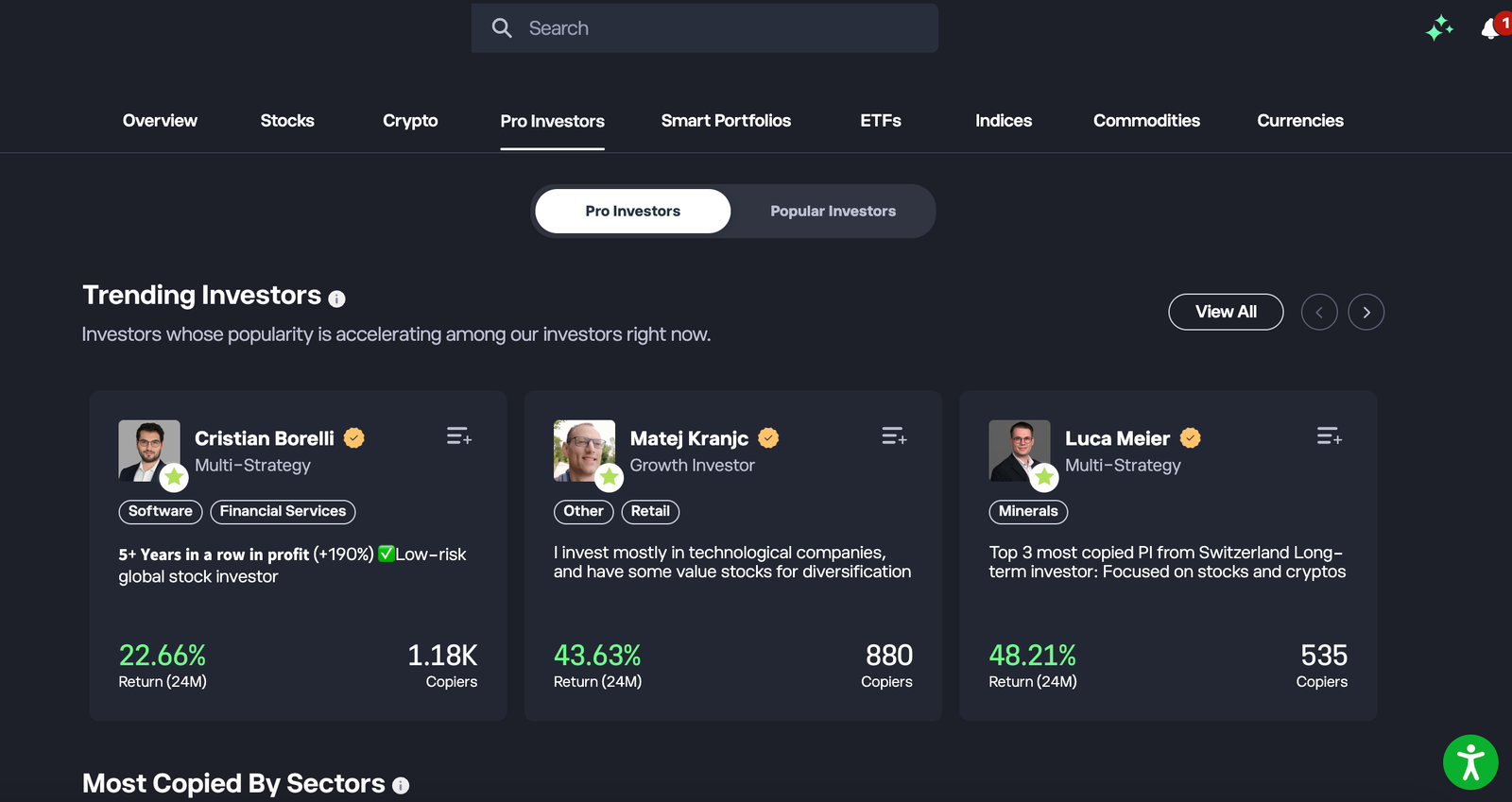
4. Search for the Pro Investors to find investors to copy
Vet a trader or strategy using the checklist above.
5. Set up and confirm your trade
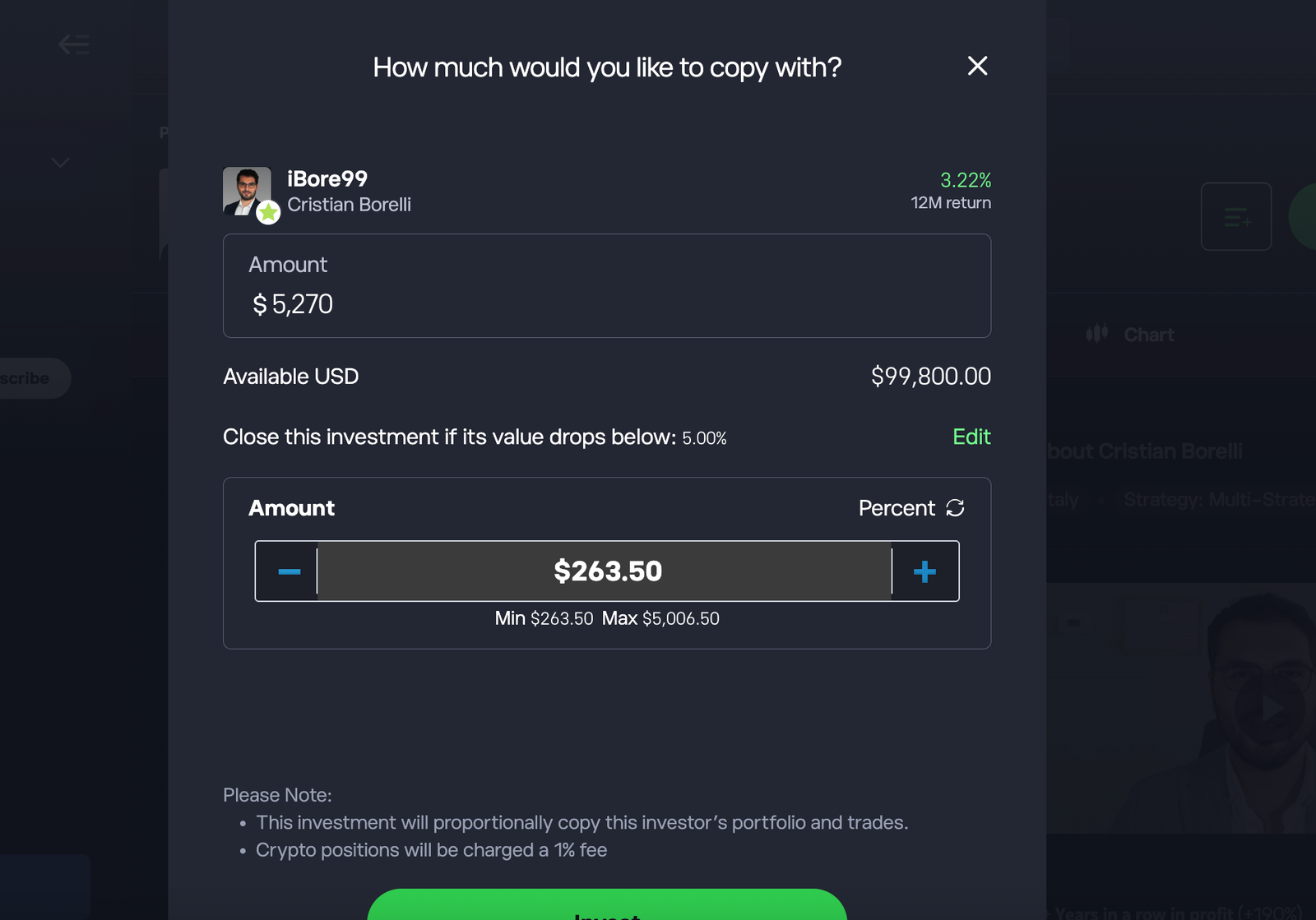
Set your allocation and sizing, and decide whether to copy trades the trader already has open.
Set a stop or drawdown limit before confirming, and check what it does when it triggers.
Monitor the copy, and know how you’ll stop it and what happens to open positions when you do.
FAQs
What is the most successful copy trading platform?
eToro is widely considered the most successful copy trading platform globally thanks to its large social community, transparent trader metrics, and strong FCA regulation.
What is the best trade copier website?
For MetaTrader users, Pepperstone and Axi are the strongest options on this page, with proportional sizing and drawdown limits. FXCM and Tickmill use third-party signal networks. Networks such as ZuluTrade and DupliTrade link to brokers but sit outside the FCA broker relationship, so check who provides the copy service before you sign up.
Is copy trading allowed in the UK?
Yes. The FCA treats automatic copy trading as investment management, so the firm running it needs FCA permission. The broker holding your money and the firm running the copy service aren’t always the same, so check both on the FCA Register.
Do I need to pay capital gains tax on copy trading?
Usually, if you copy outside a tax wrapper. CFD profits and gains on real shares generally fall under CGT above the £3,000 annual exempt amount (2026/27), taxed at 18% or 24%. Dividends above the £500 allowance are taxed as dividend income.
What is the difference between social trading and copy trading?
Social trading means viewing and discussing other traders’ activity while you make your own decisions. Copy trading places their trades in your account automatically, sized to your allocation.
Can I copy trade within a Stocks and Shares ISA?
Not with CFDs, which HMRC treats as financial futures and which aren’t ISA-eligible. Real shares and ETFs can qualify, but only if the provider builds copying into the ISA, and none of the platforms here do. eToro’s ISA is a separate product powered by Moneyfarm.
Can I copy trade within a self invested personal pension?
Not on any platform here. SIPPs are limited to approved investments such as shares, funds and ETFs, and none of these providers offers copy trading inside one.
Is copy trading profitable?
It can be, but many copiers lose money once spreads, provider fees, slippage and skipped trades are counted. Tickmill UK, Axi and FXCM state that 69%, 66.36% and 65% of their retail CFD accounts lose money. A trader’s past returns don’t predict your future ones.
What is the best copy trading platform uk for beginners?
Based on my testing, eToro. It shows risk scores and drawdown before you copy, charges no copy fee, and has a $100,000 demo and an adjustable Copy Stop Loss. The $200 minimum per trader makes it expensive to copy several traders on a small budget.
How to start copy trading in the UK?
To start copy trading in the UK, open an account with an FCA-regulated platform, complete identity verification, and fund the account in pounds sterling. After reviewing trader performance metrics such as risk score and drawdowns, choose a trader to copy and set allocation and risk limits before activating copy trading.
Can copy trading give you passive income?
Not reliably. Copying needs less time than trading yourself, but returns aren’t guaranteed and you still need to monitor your copies and risk limits. Platforms with transparent track records and controls that cap losses, such as eToro’s Copy Stop Loss, make that easier to manage.
Can I copy crypto traders in the UK?
Only in limited ways. The FCA bans crypto derivatives for retail clients, which rules out the futures-based copy trading hubs many crypto exchanges offer. On eToro, a copied portfolio can include cryptoassets. Cryptoassets aren’t FSCS-protected, and you could lose all the money you put in.
Which platform offers the best social trading tools for UK users?
eToro is the only platform here with a social feed, public trader profiles, portfolio breakdowns and native copying in one app. That makes it the best fit if you want context on a trader as well as automation.
