

There is no single best investment platform in the UK. The right one depends on what you buy, how often you trade, and whether you hold it in an ISA, a SIPP or a general account. I tested eight platforms with funded UK accounts in September 2026, placing 16 trades and reading the fees off every order ticket before confirming.
eToro was the easiest place to make a first investment. XTB paired commission-free dealing with the strongest research tools among the app-first brokers, and Trading 212 was the cheapest all-rounder. IG, Freetrade, InvestEngine, Lightyear and interactive investor each fit a narrower case, set out below.
- Social investing with real-time insights
- Ready-made portfolios for diversified investing
- Tax-free savings with a competitive 4.8% AER Cash ISA
Capital at risk. T&Cs apply.
How I Tested the Investment Platforms
I tested each platform with a funded UK account in September 2026. I bought UK and US shares and ETFs, set up recurring investments and checked the costs shown before confirming each order.
- 8 funded UK accounts
- £8,250 deposited
- 16 trades placed
- 6 recurring plans set up
- 8 withdrawals tested
- Tested on iPhone and Android
I then weighted costs 25%, ISA/SIPP 20%, app workflow 20%, automation 15%, investment choice 10% and research 10%. FCA authorisation was a must, not a scoring factor.
Best Investment Platforms UK at a Glance
Six of the eight platforms charge no platform fee and no dealing commission, so the real differences are FX, pensions and what you can buy. Fees are each platform’s standard published rate, checked in October 2026.
| Platform | Best for | Platform fee | Dealing fee | FX fee | Stocks & Shares ISA | SIPP | Fractional shares | ETFs | Funds | Investment trusts | Recurring investing | Research and tools | Key differentiator |
|---|---|---|---|---|---|---|---|---|---|---|---|---|---|
| eToro | Beginners and social investing | £0 | Shares $1–$2; ETFs £0 | 0.75% | Yes, via Moneyfarm | No | Yes | About 750 | In the ISA | Yes | Yes, from $25 | CopyTrader filters, public portfolios | Copying other investors |
| XTB | Low-cost investing with research tools | £0 | £0 up to €100,000 a month | 0.5% | Yes, flexible | No | Yes, from £1 | Yes | No | Yes | Investment Plans | xStation charts, ETF scanner | Research depth with £0 dealing |
| Trading 212 | Low-cost mobile investing | £0 | £0 | 0.15% | Yes | Yes | Yes | About 2,000 | No | Yes | Pies and AutoInvest | Basic; no comparison screener | Pies with AutoInvest |
| IG | Research and analysis | £0; SIPP £210 a year | £0 | 0.7% | Yes | Yes | Shares only | 3,000+ | No | Yes | Not tested | Fundamentals, broker sentiment, ETF screener, price alerts | Research on the dealing platform |
| Freetrade | Simplicity | £0 Basic; £4.99–£9.99 a month paid | £0 | 0.99% Basic; 0.39–0.59% paid | Yes | Yes | US shares only | Yes | Yes | Yes | Paid plans, in my test | Analyst data on paid plans | Four-tap purchase |
| InvestEngine | ETF investing | £0 DIY; 0.25% Managed | £0 | None on sterling ETFs | Yes | Yes | Yes | 700+ | No | No | Savings Plans, AutoInvest | ETF filters | Target-weight ETF portfolios |
| Lightyear | International investing | £0 | £0 | 0.1% | Yes | No | Yes | Yes | No | Yes | Repeat Orders, Plans | Moderate | Multi-currency account |
| interactive investor | Larger portfolios and SIPPs | £5.99 a month (Core) | £3.99; regular investing free | 0.75% (Core) | Yes | Yes | No | Yes | Yes | Yes | Free, from £25 a month | Search across funds, trusts, shares and ETFs | Fixed fee, widest range |
Which Investment Platform Is Right for You?
The right platform depends on what you want it to do, so this is a set of matches, not a ranking. Each row gives the evidence from my test and the trade-off that comes with it.
| If you want | Platform | Why, from my test | Trade-offs |
|---|---|---|---|
| A simple first investment | eToro | £800 arrived in about two minutes. The ticket showed every cost before I confirmed. CopyTrader filters for risk score, drawdown and holding period. | $1–$2 per share trade; 0.75% FX; no SIPP; CFDs sit beside real investments |
| Low-cost DIY investing | Trading 212 | £0 dealing, £0 platform fee, 0.15% FX. A three-ETF Pie with AutoInvest took under four minutes. ISA and SIPP. | Thin research; no company-comparison screener |
| Research with low-cost dealing | XTB | The xStation scanner found all five test ETFs. 0% commission up to €100,000 a month and 0.5% FX. A 70/30 Investment Plan took about four minutes. | No SIPP; real shares and CFDs listed together; currency easy to miss in ETF results |
| Research and analysis | IG | Fundamentals, broker sentiment and news on one page. The web ETF screener cut the list to 38. Watchlists, price alerts and a SIPP. | 0.7% FX; £210 a year for the SIPP; my £50 ETF order was rejected as whole units only |
| ETFs | InvestEngine | ETFs only, with target weights, AutoInvest, Savings Plans and one-tap rebalancing. £0 DIY platform and dealing fees. | No individual shares; orders wait for a trading window; my withdrawal took three working days |
| International investing | Lightyear | 0.1% FX and £0 dealing. Pound, dollar and euro balances in the general investment account. | No SIPP; multi-currency balances not in the ISA; 0.6% on card and wallet deposits |
| A larger portfolio or SIPP | interactive investor | One fixed fee covers the ISA, SIPP and Trading Account. Funds, investment trusts, shares and ETFs. Regular investing is free. | £71.88 a year is 2.4% of £3,000 but 0.07% of £100,000; £3.99 per one-off trade; no fractional shares |
| Simplicity | Freetrade | Four taps from the home screen to a share purchase. ISA and SIPP on the free plan. No CFDs. | 0.99% FX on Basic; recurring investing and analyst data on paid plans; fractions on US shares only |
If two rows fit you, cost usually decides it. The modelled costs further down show what each platform charges at £10,000, £50,000 and £100,000.
Investment Platform Reviews
Each review is headed by what the platform is best for. The order is not a ranking from best to worst.
1. eToro — best for beginners and social investing
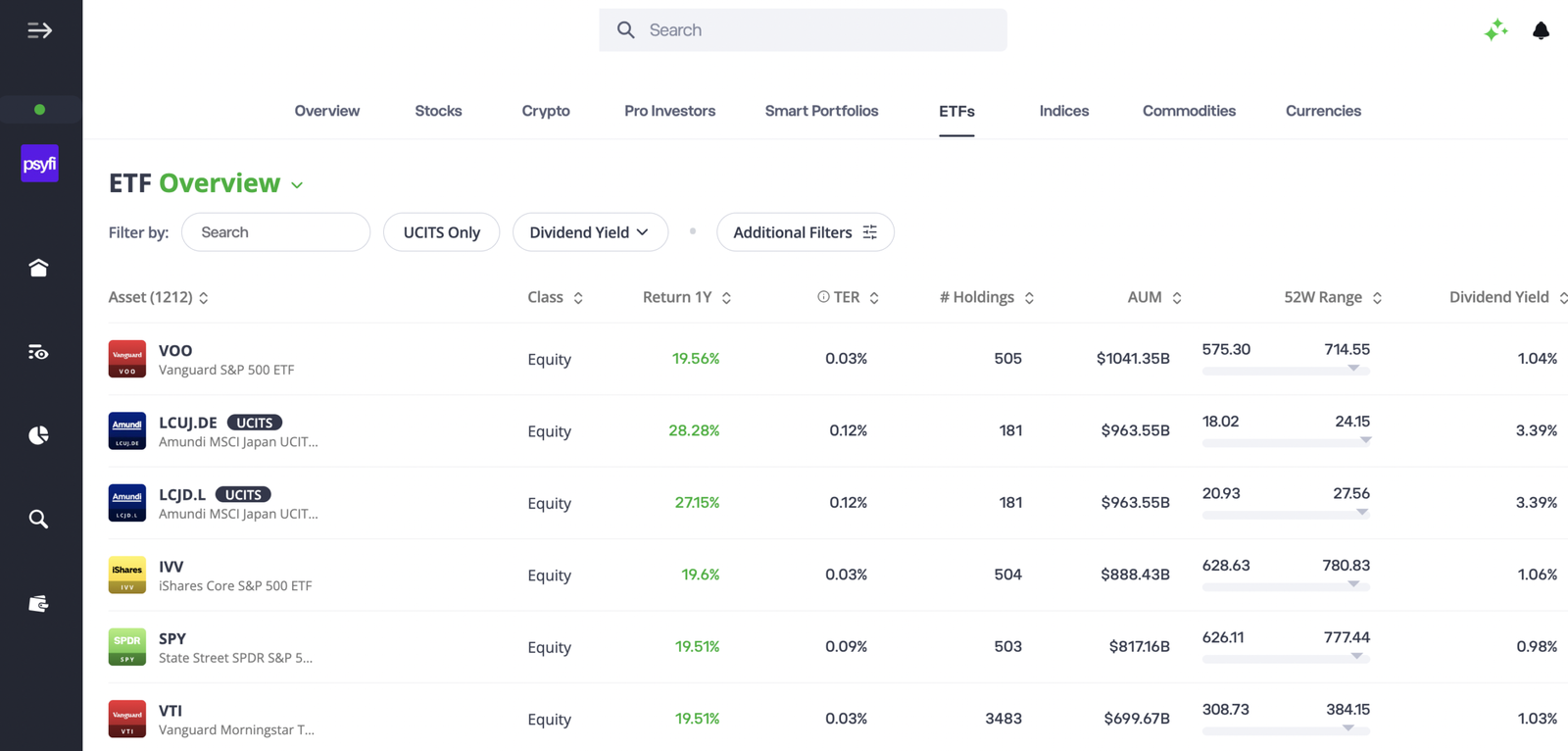
eToro is the easiest platform here for a first investment, and the only one where you can study and copy other investors’ portfolios. It suits beginners who are still learning how to invest and want shares, ETFs and CopyTrader in one app.
The trade-off is a more complicated cost structure than the low-cost brokers: $1–$2 per share trade, 0.75% on dollar conversions, and CFDs sitting beside real investments.
eToro key information
| Field | Details |
|---|---|
| Best for | Beginners, social and copy investing |
| UK entity | eToro (UK) Ltd |
| FCA status | Authorised and regulated, FRN 583263 |
| Account types | Investment account (GBP and USD); Stocks & Shares ISA powered by Moneyfarm |
| Platform fee | £0 on the investment account; £0 on the ISA since 29 July 2026 |
| Share dealing | $1–$2 per trade to open and to close, depending on the exchange |
| ETF dealing | £0 commission; market spread applies |
| FX fee | 0.75% between GBP and USD; 20–80% lower with eToro Club |
| Minimum investment | $50 first deposit; recurring investments from $25 |
| Investment range | About 750 ETFs; 1,000+ shares, ETFs, bonds and funds in the ISA |
| Fractional investing | Yes |
| Automated investing | Recurring investments, CopyTrader, Smart Portfolios |
| ISA | Yes |
| SIPP | No |
| FSCS | Eligible investments, subject to FSCS rules |
| App ratings | iOS 4.3, Android 4.2 (September 2026) |
| Key differentiator | CopyTrader and public investor portfolios |
What I tested on eToro
- Device: Samsung Galaxy S25, Android 16, eToro app v612.0.1; order ticket re-checked on desktop
- Account: GBP investment account, plus the DIY ISA sign-up journey
- Deposit: £800 by Open Banking
- Investments: £300 of Lloyds, £150 in an S&P 500 ETF and a £200 Amazon order preview
- Automation: $25 recurring investment; CopyTrader filters for risk score, drawdown and holding period
- Safety check: CFD label at 1x and 2x leverage
- Withdrawal: £100
- Test date: September 2026
My eToro test results
| Test | Result |
|---|---|
| Account opening | About seven minutes, including the ID check and appropriateness questions |
| Deposit speed | £800 by Open Banking arrived in about two minutes |
| UK share order | £300 Lloyds: £1 commission and £1.50 stamp duty on the ticket, no FX |
| US share preview | £200 Amazon: $1 commission and a £1.50 conversion charge (0.75%) shown before confirming |
| ETF order | £150 S&P 500 ETF: £0 commission, market spread only |
| ETF search | VWRP appeared first, labelled LSE/GBP; spread about 0.08% |
| CFD label | Appeared when I moved the ticket from 1x to 2x; gone again at 1x |
| CopyTrader minimum | $200 to copy an investor |
| ISA set-up | Separate Moneyfarm journey, about nine extra minutes |
| Withdrawal | £100 arrived the next working day |
| Key friction | ISA sits outside the main app; real assets and CFDs share one ticket |
| Strongest feature | CopyTrader filters built into the main app |
What is eToro like for buying shares and ETFs?
eToro makes a first purchase quick, and the order ticket shows each cost before you confirm. I deposited £800 by Open Banking and it arrived in about two minutes. My £300 Lloyds order showed a £1 commission, £1.50 of stamp duty and no currency conversion, because the account and the share are both in sterling.
Dollar investments cost more. My £200 Amazon preview showed a $1 commission plus a £1.50 conversion charge, which is 0.75% of £200. A £150 S&P 500 ETF order carried no commission. When I searched for VWRP, the London listing came up first, labelled LSE/GBP, at a spread of about 0.08%.
The check I’d ask every beginner to repeat is the CFD label. When I switched the ticket from 1x to 2x leverage, a CFD label appeared. Back at 1x it disappeared. eToro says some non-leveraged buys can also execute as CFDs, so read the ticket every time.
The ISA was the slowest part of my test. It runs on Moneyfarm’s platform, so opening it was a separate journey that took about nine extra minutes. My £100 withdrawal from the GBP account arrived the next working day.
Is CopyTrader useful for long-term investors?
CopyTrader, the feature that puts eToro among the leading copy trading platforms, is useful as a research tool, and it sits inside the main app instead of a separate product. I filtered investors by risk score, drawdown and holding period, which narrowed the list to steadier, longer-term portfolios.
The minimum to copy an investor was $200. Copying replicates the whole portfolio, so check whether that investor holds CFDs before you commit.
How much does eToro cost?
eToro charges £0 commission on ETFs, $1–$2 per share trade and 0.75% to convert between pounds and dollars. There is no platform, custody or inactivity fee, and withdrawals from the GBP account are free. On a £1,000 US share purchase, 0.75% is £7.50 each way before any Club discount. UK share purchases also carry 0.5% stamp duty, as they do on every platform.
Who is eToro best for?
eToro is best for beginners who want to buy their first shares and ETFs in sterling and learn from how other investors build portfolios.
Who should avoid eToro?
Avoid eToro if you need a SIPP, buy US shares often, or want an account where CFDs never appear on the order ticket.
Pro & cons
- £0 commission on ETFs and no platform or custody fee
- CopyTrader filters for risk, drawdown and holding period
- Fast funding and free GBP withdrawals
- $1–$2 commission on every share trade, charged on the way in and out
- 0.75% FX on dollar assets before Club discounts
- No SIPP, and the ISA is a separate Moneyfarm journey
Bottom line
eToro is the investment platform I’d point a first-time investor to if they want to see how other people invest before choosing for themselves. When you compare eToro with Trading 212 or Lightyear, it costs more once you buy US shares, and pension savers need to look elsewhere.
Read the complete eToro review here.
2. XTB — best for low-cost investing with research tools
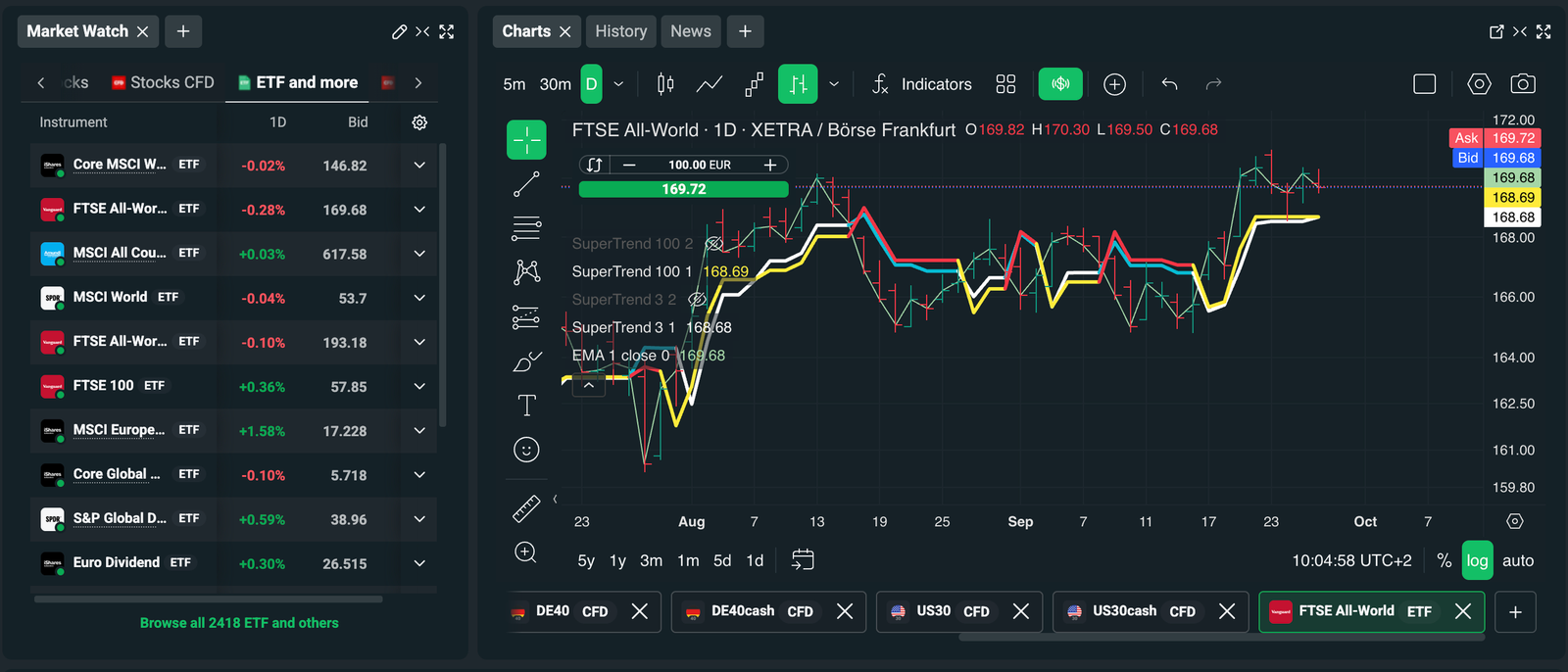
XTB pairs commission-free shares and ETFs with xStation, the strongest charting and screening among the app-first brokers on this page. It suits cost-conscious investors who want research tools and a flexible ISA that pays interest on cash. The trade-offs are a 0.5% FX fee on non-sterling investments, no SIPP, and CFDs that appear next to real shares in search.
XTB key information
| Field | Details |
|---|---|
| Best for | Low-cost investing with stronger charts and research |
| UK entity | XTB Limited |
| FCA status | Authorised and regulated, FRN 522157 |
| Account types | General investment account; Flexible Stocks & Shares ISA; Cash ISA |
| Platform fee | £0 for active clients; no custody fee up to €250,000 |
| Dealing fee | 0% on real shares and ETFs up to €100,000 monthly turnover, then 0.2% (minimum £10) |
| FX fee | 0.5% |
| Minimum investment | £0 deposit; £1 per order |
| Investment range | 9,100+ shares and ETFs in the ISA |
| Fractional investing | Yes, from £1 |
| Automated investing | Investment Plans |
| ISA | Yes, flexible |
| SIPP | No |
| Cash interest | 4% AER variable on uninvested ISA cash |
| FSCS | Eligible investments up to £85,000 |
| Key differentiator | xStation charts, research and ETF scanner |
What I tested on XTB
- Device: Google Pixel 9, Android 16, XTB app v2.84.0; xStation on desktop for research
- Account: General investment account and Flexible Stocks & Shares ISA
- Deposit: £1,000 in the app test; £2,000 by Faster Payments in the ETF test
- Investments: £400 of Nvidia as a fractional real share; VWRP, CSPX and the EUR listing of SWDA
- Search: Nvidia real share against the Nvidia CFD; ETF scanner
- Automation: 70/30 Investment Plan with a £200 first allocation
- Withdrawal: £50
- Test date: September 2026
My XTB test results
| Test | Result |
|---|---|
| Account opening | About 10 minutes, including ID verification |
| Deposit speed | £2,000 by Faster Payments arrived in 11 minutes |
| Share search | Nvidia returned the real share and the CFD next to each other, both labelled |
| Share order | £400 of Nvidia bought as a fractional real share: £0 commission, £2 FX |
| ETF search | Scanner found all five standard test ETFs; ‘iShares Core S&P 500’ returned four listings in GBP, USD and EUR |
| ETF cost | VWRP in GBP: £0 commission, about 0.06% spread. USD and EUR listings: about £5 FX per £1,000 |
| Plan set-up | 70/30 Investment Plan built in about four minutes; £200 split exactly £140/£60 |
| Withdrawal | £50 requested before 1pm arrived the same day |
| Key friction | CFDs listed beside real shares; currency easy to miss in ETF results |
| Strongest feature | xStation ETF scanner |
How easy is it to buy real shares on XTB, not CFDs?
Buying a real share on XTB takes one extra check, because the CFD version appears right beside it. When I searched for Nvidia, the real share and the CFD came back close together. Both were labelled, but a beginner tapping the first result could open the wrong one. I picked the real share and bought £400 as a fraction, with no commission and £2 of FX at 0.5%.
That distinction matters more on XTB than anywhere else on this page except eToro. CFDs cannot be held in a Stocks & Shares ISA, so the mix-up can only cost you in the general investment account.
Is XTB good for researching ETFs?
XTB is the best of the app-first brokers for finding ETFs. The xStation scanner found all five of my standard test ETFs. The catch is currency: searching ‘iShares Core S&P 500’ returned four listings across GBP, USD and EUR, and the currency is easy to miss in the results.
Picking the wrong line costs money. VWRP in sterling cost me £0 commission plus a spread of about 0.06%. A USD or EUR listing added about £5 of FX to a £1,000 order.
Automation was quicker than I expected from a platform built for traders. I built a 70/30 Investment Plan in about four minutes, and my first £200 split exactly £140 and £60.
How much does XTB cost?
XTB charges 0% commission on real shares and ETFs up to €100,000 of monthly turnover, and 0.5% on currency conversion. There is no platform fee for active clients and no custody fee below €250,000. Withdrawals are free: my £50 request before 1pm reached my bank the same day. Uninvested cash in the ISA earns 4% AER variable.
Who is XTB best for?
XTB is best for investors who want commission-free dealing with proper charts and an ETF scanner, and who will stick to sterling-listed funds where they can.
Who should avoid XTB?
Avoid XTB if you want a pension, since there is no SIPP, or if you would rather never see a CFD in your search results.
Pro & cons
- 0% commission up to €100,000 a month, with no platform fee
- xStation charts and an ETF scanner that found every test fund
- Same-day withdrawal in my test, and 4% AER variable on ISA cash
- 0.5% FX on every non-sterling buy and sell
- Real shares and CFDs appear together in general account search
- No SIPP
Bottom line
XTB bridges a simple investing app and a serious research platform. It is close to free for sterling investments, but you need to read the label on every search result and the currency on every ETF.
Read the complete XTB review here.
3. Trading 212 — best for low-cost mobile investing
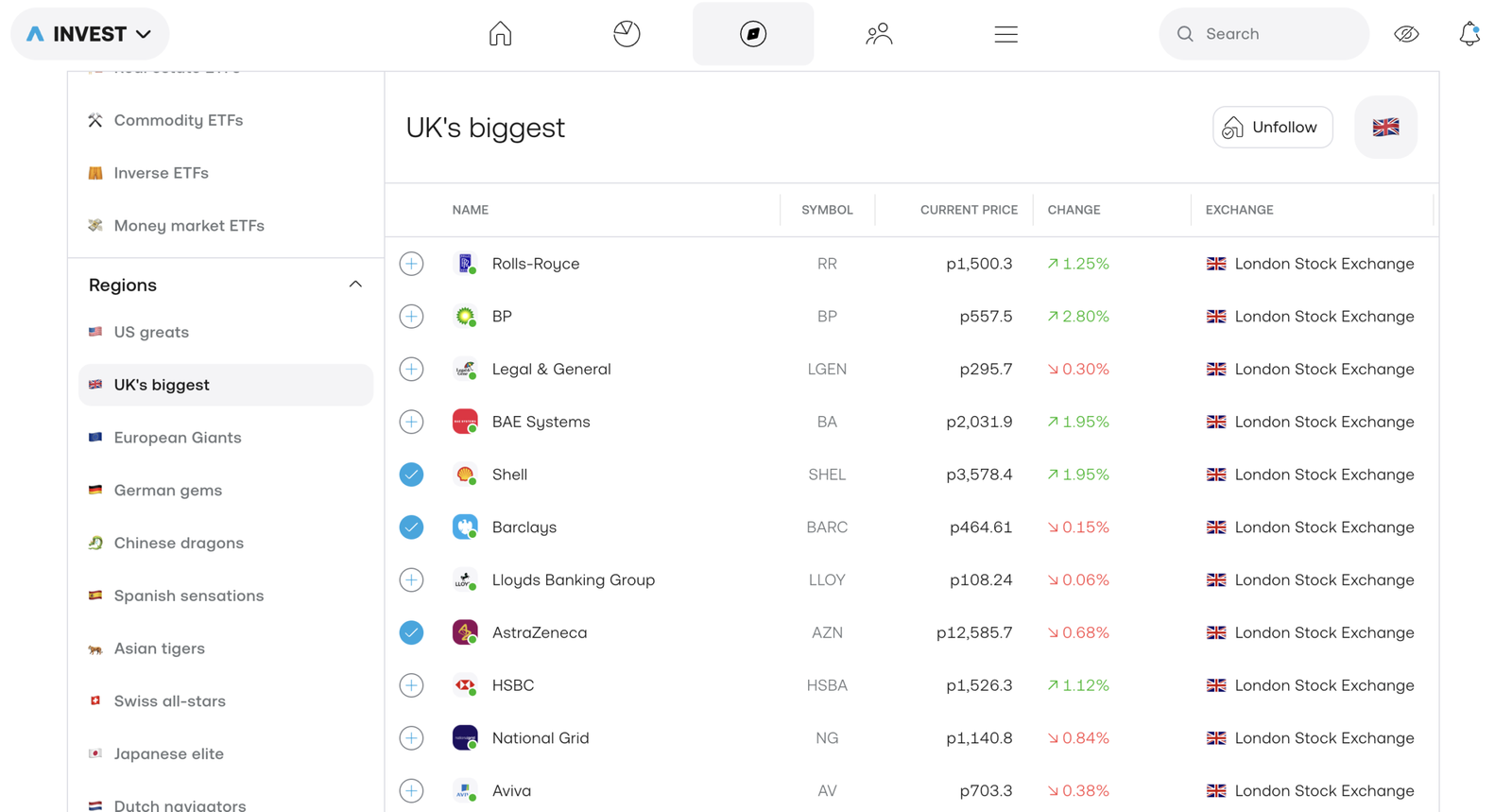
Trading 212 is the cheapest all-rounder among the top investment apps here and the cleanest way to automate a portfolio from a phone. It suits DIY investors who want shares and ETFs in an ISA or SIPP with no dealing or platform fee. The trade-off is research: there is no proper company-comparison screener, so you will choose investments elsewhere.
Trading 212 key information
| Field | Details |
|---|---|
| Best for | Low-cost, mobile-first DIY investing |
| UK entity | Trading 212 UK Ltd |
| FCA status | Authorised and regulated, FRN 609146 |
| Account types | Invest, Stocks & Shares ISA, Cash ISA, SIPP; CFD account kept separate |
| Platform fee | £0 |
| Dealing fee | £0 |
| FX fee | 0.15% |
| Minimum investment | £1 |
| Investment range | About 2,000 ETFs plus thousands of shares |
| Fractional investing | Yes |
| Automated investing | Pies and AutoInvest; automatic dividend reinvestment |
| ISA | Yes |
| SIPP | Yes |
| FSCS | Eligible investments up to £85,000 |
| App ratings | iOS 4.7, Android 4.6 |
| Key differentiator | Pies and AutoInvest |
What I tested on Trading 212
- Device: iPhone 16 Pro, iOS 26.6, Trading 212 app v26.9.2
- Account: Stocks & Shares ISA; separate CFD account opened for the trading test
- Deposit: £500 by bank transfer; a further £100 in the ETF test
- Investments: £250 of Microsoft as a fractional share; a £1,000 CSPX order preview
- Automation: Three-ETF Pie with £100 a month AutoInvest; an 80/20 Pie in the ETF test; dividend reinvestment
- Research: Stock pages and screening
- Withdrawal: £100, then £50 in the ETF test
- Test date: September 2026
My Trading 212 test results
| Test | Result |
|---|---|
| Account opening | About five minutes, including the ID check |
| Deposit speed | £500 into the ISA arrived in about two minutes; £100 in about three |
| US share order | £250 of Microsoft: £0 commission, 37p FX shown before confirming |
| Dollar-priced ETF preview | £1,000 of CSPX previewed: £1.50 FX shown; not placed, as it exceeded my £500 balance |
| Pie set-up | 60% VWRP, 25% VUAG, 15% ISF built in just under four minutes |
| Second Pie | 80/20 Pie built in 1 minute 40 seconds |
| AutoInvest | First £100 invested as £60, £25 and £15; £100 a month scheduled |
| Withdrawal | £100 and £50 both arrived the next working day |
| Key friction | Research weaker than XTB and IG; no company-comparison screener |
| Strongest feature | Pie weight sliders that always total 100% |
How well does Trading 212 automate investing?
Trading 212 automates a portfolio faster than any other app I tested. I built a three-ETF Pie of 60% VWRP, 25% VUAG and 15% ISF in just under four minutes. The weight sliders totalled 100% automatically, so I never had to do the sums myself. I then put a first £100 into the Pie, scheduled £100 a month through AutoInvest and switched on automatic dividend reinvestment.
A second, simpler Pie split 80/20 took 1 minute 40 seconds. For a monthly investor that is the whole job done: after set-up, the only thing left is funding the account.
What does Trading 212 charge when you buy US shares?
Trading 212 charges 0.15% on currency conversion and nothing else on a US share. My £500 ISA deposit arrived in about two minutes. I bought £250 of Microsoft as a fractional share, and the order showed £0 commission and 37p of FX before I confirmed. A £1,000 CSPX order preview showed £1.50; I didn’t place it, because it was larger than my £500 deposit.
Where it fell short was research. Stock pages were materially thinner than XTB’s or IG’s, and there is no screener for comparing companies side by side. I’d decide what to buy on another site, then execute here.
How much does Trading 212 cost?
Trading 212 charges no dealing commission, no platform fee and 0.15% FX. That applies across the Invest account, the Stocks & Shares ISA and the SIPP. On a £1,000 US purchase the FX is £1.50, against £5 at XTB, £7 at IG and £7.50 at eToro. Stamp duty of 0.5% still applies to UK shares.
Who is Trading 212 best for?
Trading 212 is best for investors who want to build a portfolio once, fund it monthly from their phone, and pay as little as possible to do it.
Who should avoid Trading 212?
Avoid Trading 212 if you rely on your platform for company research, analyst data or screening.
Pro & cons
- £0 dealing and £0 platform fee across the ISA and SIPP
- 0.15% FX, shown on the order before you confirm
- Pies and AutoInvest set up in minutes, from £1
- Research is thin next to XTB and IG
- No company-comparison screener
- Pies and AutoInvest set up in minutes, from £1
Bottom line
For low-cost DIY investing from a phone, Trading 212 is the strongest all-rounder on this page. Its weakness is helping you decide what to buy.
Read the complete Trading 212 review here.
4. IG — best for research and analysis
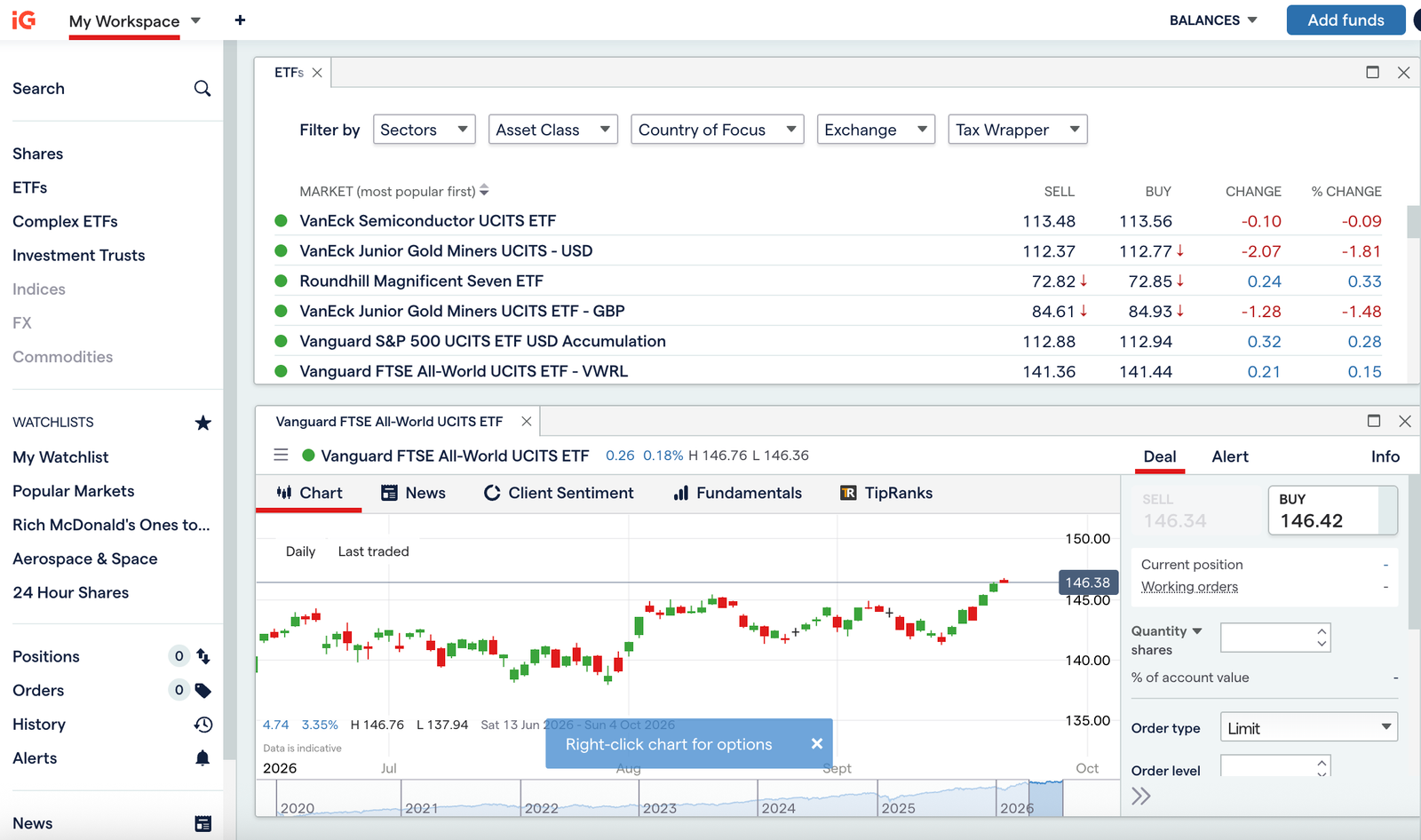
IG is the platform on this page for investors who want to research an investment before buying it, with fundamentals, broker sentiment, news and a web ETF screener in one place. It suits research-led investors who want a GIA, ISA and SIPP under one login. The trade-offs are a 0.7% FX fee, a flat £210-a-year SIPP charge and a mobile search that mixes leveraged products in with ordinary funds.
IG key information
| Field | Details |
|---|---|
| Best for | Research, analysis and advanced tools |
| UK entity | IG Trading and Investments Ltd (share dealing accounts) |
| FCA status | Authorised and regulated, FRN 944492 |
| Account types | General investment account, Stocks & Shares ISA, SIPP |
| Platform fee | £0 on the GIA and ISA; SIPP £210 a year, paid to administrator Options UK |
| Dealing fee | £0 on shares and ETFs with instant currency conversion |
| FX fee | 0.7% |
| Minimum investment | No minimum bank deposit |
| Investment range | 3,000+ ETFs published, plus UK and international shares |
| Fractional investing | Yes on eligible shares; ETFs were whole-unit in my test |
| ISA | Yes |
| SIPP | Yes |
| FSCS | Eligible investments up to £85,000 |
| Key differentiator | Research depth and web ETF screener |
What I tested on IG
- Device: iPhone 15 on iOS 26.6 for the app; MacBook Pro for the web platform
- Account: General investment account and Stocks & Shares ISA; SIPP fee journey
- Deposit: £2,000 by bank transfer; a further £1,500 by debit card in the ETF test
- Investments: £800 UK share, £700 of Alphabet, £50 of Nvidia as a fraction, and a £50 VWRP order attempt
- Research: Unilever fundamentals, broker sentiment and news; price alerts and watchlists
- Search: Web ETF screener; S&P 500 search in the app
- Withdrawal: £200
- Test date: September 2026
My IG test results
| Test | Result |
|---|---|
| Account opening | About 12 minutes, including the investor questionnaire |
| Deposit speed | £2,000 by bank transfer arrived in about 10 minutes; £1,500 by debit card credited instantly |
| UK share order | £800: £0 commission, £4 stamp duty |
| US share order | £700 of Alphabet: £0 commission, £4.90 FX |
| Fractional order | £50 of Nvidia went through, with 35p FX |
| ETF order | £50 of VWRP rejected: whole units only on that route, and one unit was about £125 |
| ETF screener (web) | ISA-eligible global accumulating ETFs narrowed to 38 |
| S&P 500 search (app) | Three leveraged or inverse ETPs among the first 10 results |
| SIPP fee | £210 a year displayed in the SIPP journey |
| Withdrawal | £200 arrived the next working day |
| Key friction | Leveraged ETPs in mobile search; no fractional ETFs on the tested route |
| Strongest feature | Fundamentals, sentiment and news on one share page |
How good is IG’s research?
IG’s research is significantly deeper than any of the simpler apps I tested. I started with Unilever and found fundamentals, broker sentiment and news on the same page, without leaving the platform. I also tested watchlists and set a price alert 5% below the current price, which helps if you would rather wait for a better entry point than buy today.
The web ETF screener was the other highlight. Filtering for ISA-eligible, global, accumulating funds cut the list to 38, a shortlist small enough to compare by cost.
What went wrong when I invested with IG?
Two things caught me out, both on ETFs. When I looked for a way to invest in the S&P 500, searching for a tracker in the app returned three leveraged or inverse ETPs among the first 10 results. Then my £50 VWRP order was rejected, because ETFs are whole-unit on that route and one unit cost about £125. A £50 fractional Nvidia order went through without a problem, so the limit applies to funds, not shares.
For anyone investing in ETFs in small monthly amounts, that whole-unit rule is the single biggest reason to choose InvestEngine or Trading 212 instead.
How much does IG cost?
IG charges £0 commission on shares and ETFs and 0.7% on currency conversion. My £800 UK share order cost £4 in stamp duty and nothing in commission. My £700 Alphabet order cost £4.90 in FX. That FX rate is in line with eToro and interactive investor, and well above Trading 212 at 0.15% or Lightyear at 0.1%.
The SIPP costs a flat £210 a year. On a £20,000 pension that is 1.05%. On £200,000 it is about 0.1%.
Who is IG best for?
IG is best for investors who want to research shares and screen ETFs on the same platform they buy on, and for larger SIPPs where a flat fee works in your favour.
Who should avoid IG?
Avoid IG if you invest small monthly amounts in ETFs, buy US shares frequently, or have a small pension pot.
Pro & cons
- Fundamentals, broker sentiment, news and price alerts on every share
- Web ETF screener with an ISA-eligibility filter
- £0 commission across the GIA, ISA and SIPP
- 0.7% FX on non-sterling investments
- Leveraged and inverse ETPs appear in mobile search results
- £210 a year for the SIPP, and whole-unit ETF orders on the route I tested
Bottom line
IG is the one I’d pick to research an investment properly before buying it. It is not the cheapest place to buy US shares or to hold a small pension, and ETF investors should use the web screener, not mobile search.
Read the complete IG review here.
5. Freetrade — best for simplicity
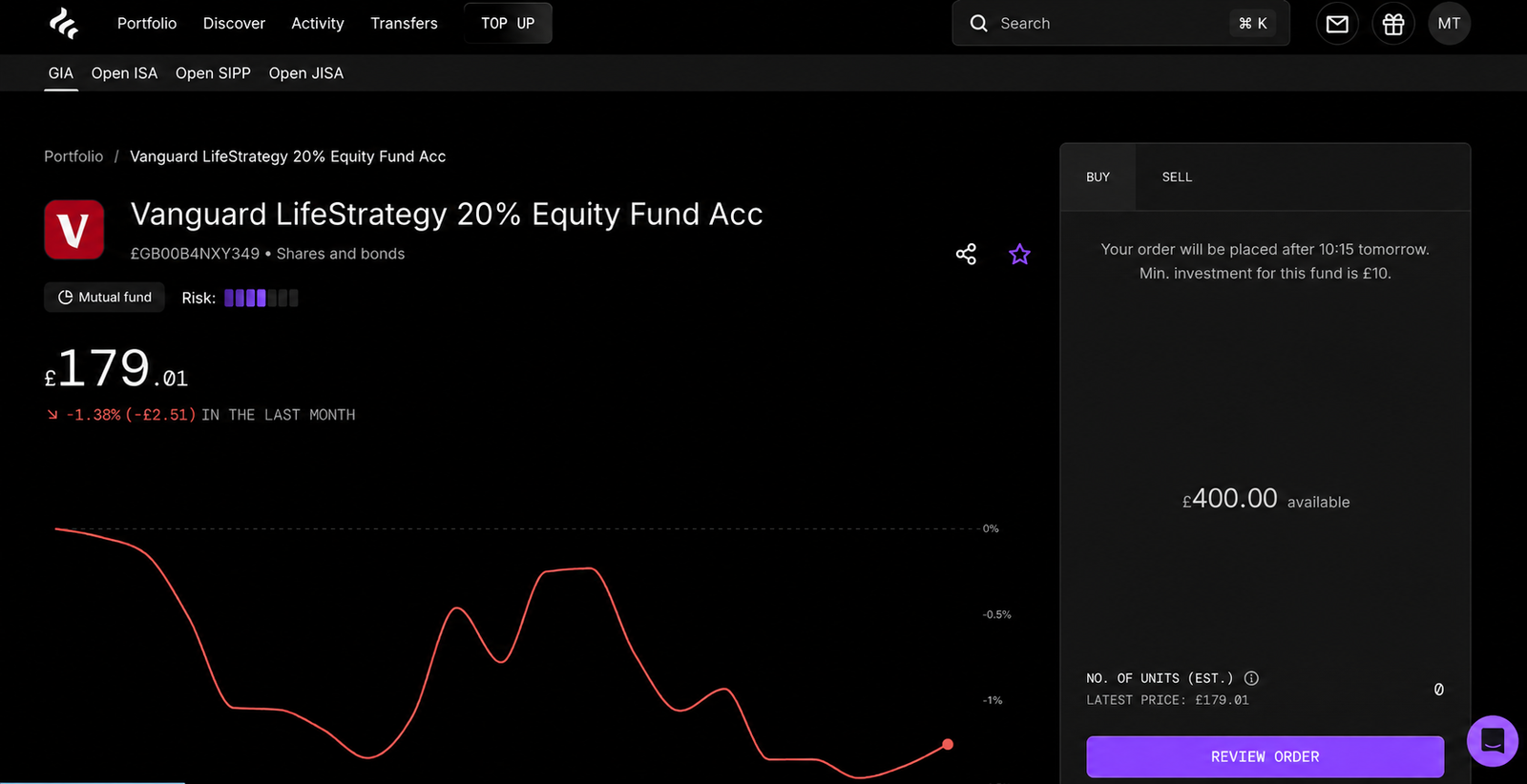
Freetrade strips investing down to the fewest steps of any platform here: four taps took me from the home screen to a completed share purchase. It suits investors who want UK shares, ETFs and investment trusts in a free ISA or SIPP without learning a trading platform. The trade-off is that the free Basic plan charges 0.99% FX and holds back features, including recurring investments in my test.
Freetrade key information
| Field | Details |
|---|---|
| Best for | Simple UK share and ETF investing |
| UK entity | Freetrade Limited |
| FCA status | Authorised and regulated, FRN 783189 |
| Account types | General investment account, Stocks & Shares ISA, Junior ISA, SIPP |
| Platform fee | Basic £0; Standard £4.99 a month; Plus £9.99 a month, billed annually |
| Dealing fee | £0 |
| FX fee | 0.99% on Basic, 0.59% on Standard, 0.39% on Plus |
| Minimum investment | £0.10 |
| Investment range | 8,600+ shares, ETFs and investment trusts |
| Fractional investing | US shares only |
| Automated investing | Recurring orders on Standard and Plus |
| ISA | Yes |
| SIPP | Yes |
| FSCS | Eligible investments up to £85,000 |
| App ratings | iOS 4.6, Android 4.4 |
| Key differentiator | Simple interface with a SIPP |
What I tested on Freetrade
- Device: iPhone 15, iOS 26.6, Freetrade app v4.112.0
- Account: Stocks & Shares ISA on the Basic plan; SIPP journey
- Deposit: £400 by bank transfer
- Investments: £150 of Rolls-Royce and £150 of Apple as a fractional share
- Automation: £100 a month recurring investment
- Research: Analyst ratings and EPS estimates; investment trust and ETF range
- Withdrawal: £100
- Test date: September 2026
My Freetrade test results
| Test | Result |
|---|---|
| Account opening | About six minutes, including the ID check |
| Deposit speed | £400 by bank transfer arrived in about three minutes |
| UK share order | £150 of Rolls-Royce in four taps from the home screen; 75p stamp duty |
| US share order | £150 of Apple as a fraction: £1.49 FX shown on the Basic plan |
| Recurring investment | £100 a month prompted an upgrade to Standard |
| Research | Analyst ratings and EPS estimates locked on Basic |
| Withdrawal | £100 arrived after two working days |
| Key friction | Recurring investing and research sit behind the paid plans |
| Strongest feature | Four-tap share purchase |
How simple is Freetrade to use?
Freetrade is the quickest platform I tested for a one-off share purchase. My £400 bank transfer reached the ISA in about three minutes, and I bought £150 of Rolls-Royce in four taps from the home screen. Unlike eToro, XTB and IG, Freetrade has no CFD products, so there is no risky version of the share to tap by mistake.
A £150 fractional Apple purchase was just as quick, but it showed where the Basic plan costs money: £1.49 of FX on the order. Fractions are limited to US shares, so UK shares and ETFs are bought in whole units.
What does the free Freetrade plan leave out?
The Basic plan left out two things I wanted in testing: recurring investments and deeper research. When I tried to set up £100 a month, the app prompted me to upgrade to Standard. Analyst ratings and EPS estimates were also locked on Basic.
That changes the maths for a monthly investor. Standard costs £59.88 a year, which is about 5% of £1,200 in yearly contributions. Set Freetrade against Trading 212 or InvestEngine, and both automate the same habit for nothing. Fees came out of each £150 order, which left exactly £100 of my deposit. Withdrawing it took two working days, slower than eToro, Trading 212 and IG, which all paid out the next working day.
How much does Freetrade cost?
Freetrade charges £0 commission on every plan and 0.99% FX on the free Basic plan. Standard costs £4.99 a month and cuts FX to 0.59%. Plus costs £9.99 a month billed annually and cuts it to 0.39%. On a £1,000 US share purchase that is £9.90, £5.90 or £3.90.
Upgrading for the FX rate alone rarely pays. Standard saves 0.4% per conversion, so you would need to convert about £15,000 a year before the saving covers the £59.88 fee.
Who is Freetrade best for?
Freetrade is best for investors who mainly buy UK shares, sterling ETFs and investment trusts, and who value a free ISA and SIPP in an app with nothing to configure.
Who should avoid Freetrade?
Avoid Freetrade if you buy US shares regularly or want free automated monthly investing.
Pros & cons
- Four taps from home screen to share purchase
- £0 commission, with the ISA and SIPP on the free plan
- Investment trusts alongside shares and ETFs
- 0.99% FX on Basic, the highest on this page
- Recurring investing and analyst data needed a paid plan in my test
- Fractions on US shares only; withdrawal took two working days
Bottom line
Freetrade’s selling point is removing friction from basic investing, and for sterling investments on the Basic plan it does that at no cost. It gets expensive quickly once you add US shares or want automation.
Read the complete Freetrade review here.
6. InvestEngine — best for ETF investing
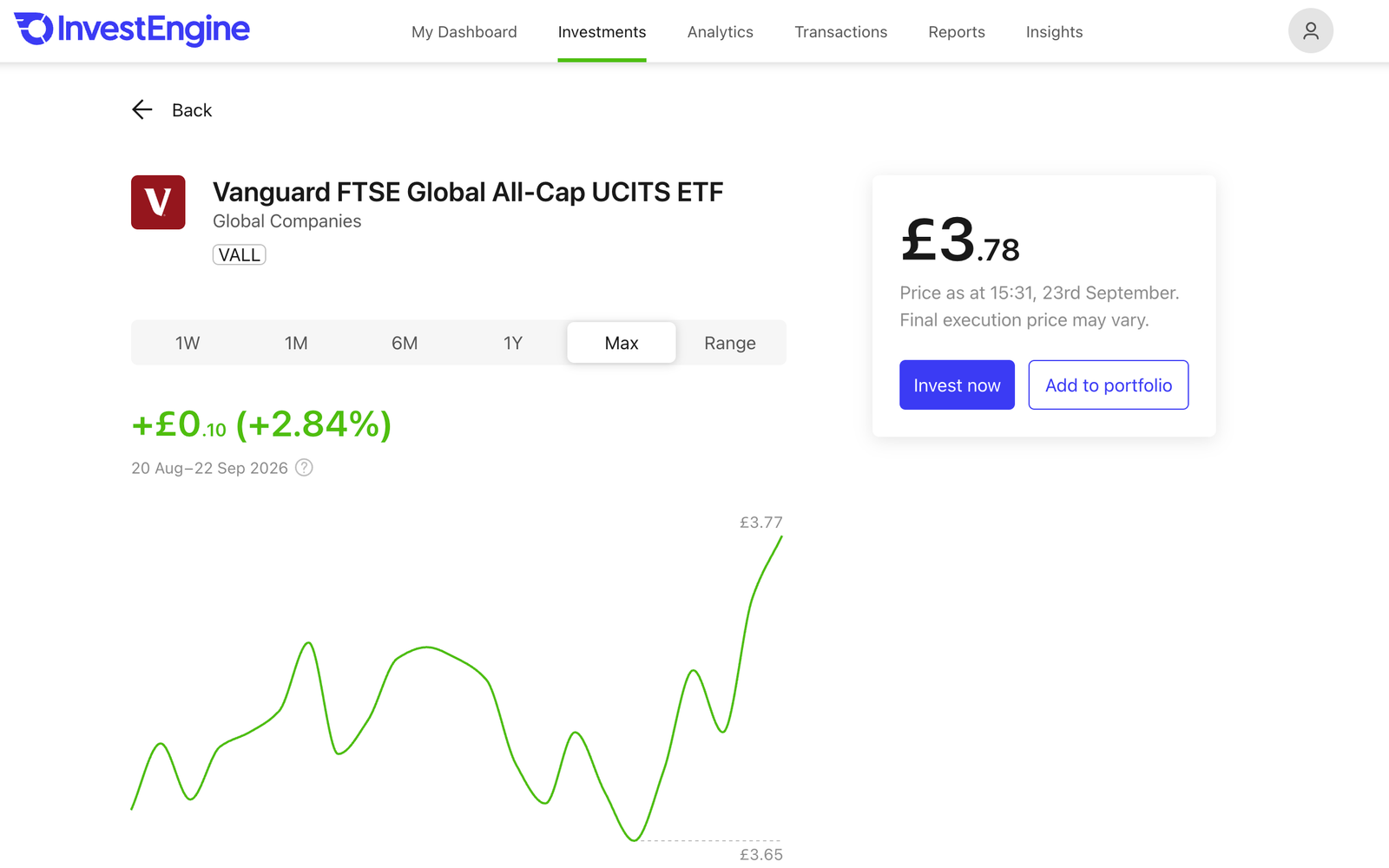
InvestEngine does one thing: automated ETF portfolios with no platform or dealing fee on the DIY service. It suits passive investors who are investing in index funds through ETFs and want to set target weights, pay in regularly and let the platform keep the portfolio balanced. The trade-off is range and speed: there are no individual shares, orders wait for a trading window, and my withdrawal took three working days.
InvestEngine key information
| Field | Details |
|---|---|
| Best for | DIY ETF portfolios and passive investing |
| UK entity | InvestEngine (UK) Limited |
| FCA status | Authorised and regulated, FRN 801128 |
| Account types | General investment account, Stocks & Shares ISA, SIPP |
| Platform fee | £0 on DIY portfolios; 0.25% a year on Managed portfolios |
| Dealing fee | £0 |
| FX fee | None on sterling-listed ETFs |
| Minimum investment | £100 per portfolio |
| Investment range | 700+ ETFs; no individual shares, funds or investment trusts |
| Fractional investing | Yes |
| Automated investing | Savings Plans, AutoInvest, one-tap rebalancing |
| ISA | Yes |
| SIPP | Yes; personal contributions only |
| FSCS | Eligible investments up to £85,000 |
| Key differentiator | Automated target-weight ETF portfolios |
What I tested on InvestEngine
- Device: iPhone 16 for the app; MacBook Air for the web platform
- Account: DIY Stocks & Shares ISA; Managed portfolio journey
- Deposit: £300 by instant bank transfer in the app test; £1,000 in the ETF test
- Investments: Four-ETF portfolio with target weights; VWRP, CSP1 and AGBP in the ETF test
- Automation: £25 weekly Savings Plan, AutoInvest and one-tap rebalancing
- Search: ETF filters for provider, region, asset class and cost
- Withdrawal: £50
- Test date: September 2026
My InvestEngine test results
| Test | Result |
|---|---|
| Account opening | About eight minutes, including the ID check |
| Deposit speed | £300 by instant bank transfer arrived in about five minutes |
| Portfolio build | 50% MSCI World, 20% Vanguard Emerging Markets, 20% Vanguard FTSE 250, 10% UK gilts |
| Fractional investing | The full £300 was invested, with no cash left over |
| Savings Plan | £25 a week set up |
| AutoInvest | New money directed towards underweight holdings |
| Rebalancing | One tap |
| Order execution | Order placed mid-morning executed that afternoon |
| Withdrawal | £50 took three working days, after selling £50 of the portfolio to raise the cash |
| Key friction | Orders wait for a trading window; slowest withdrawal I recorded |
| Strongest feature | Target weights with AutoInvest and one-tap rebalancing |
How does InvestEngine build and manage an ETF portfolio?
InvestEngine treats your account as one portfolio with target weights, not a list of separate holdings. I opened a DIY ISA with £300 and set four targets: 50% MSCI World, 20% Vanguard Emerging Markets, 20% Vanguard FTSE 250 and 10% UK gilts. Fractional units meant the full £300 went into the market, split £150, £60, £60 and £30.
I then added a £25 weekly Savings Plan. AutoInvest sends each new payment towards whichever holding is underweight, so regular contributions do most of the rebalancing for you. When the weights still drift, one tap on Rebalance puts them back.
The ETF filters were useful too. I could narrow the range by provider, region, asset class and cost.
What are InvestEngine’s limits?
InvestEngine is slower than the share-dealing apps by design. Orders execute in a trading window, not instantly: the order I placed mid-morning went through that afternoon. That is irrelevant for a monthly investor and a deal-breaker for anyone who wants to pick a price.
Getting money out was slower too. With everything invested, I had to sell £50 of the portfolio first, and the cash took three working days to reach my bank, against same-day at XTB and next-day at eToro, Trading 212 and IG. And if you want a single company share, you need a second platform.
How much does InvestEngine cost?
InvestEngine charges £0 in platform and dealing fees on DIY portfolios, and there is no FX because the ETFs are sterling-listed. The only ongoing cost is each ETF’s own fund charge, which every platform passes on. The Managed service adds 0.25% a year, or £25 per £10,000.
Who is InvestEngine best for?
InvestEngine is best for investors who do not want individual shares and want an automated ETF portfolio in an ISA or SIPP at no platform cost.
Who should avoid InvestEngine?
Avoid InvestEngine if you want shares, funds or investment trusts, instant execution, or fast access to your cash.
Pro & cons
- £0 platform and dealing fees on DIY portfolios, including the SIPP
- Target weights, AutoInvest and one-tap rebalancing
- Fractional ETFs, so every pound is invested
- ETFs only
- Orders execute in a trading window, not instantly
- Three working days for my withdrawal; £100 minimum per portfolio
Bottom line
If you only want an automated ETF portfolio, InvestEngine is a different proposition from the multi-asset apps, with no platform or dealing cost on a DIY portfolio. Anyone who wants to own individual companies should pair it with another platform or choose Trading 212.
Read the complete InvestEngine review here.
7. Lightyear — best for low-FX international investing
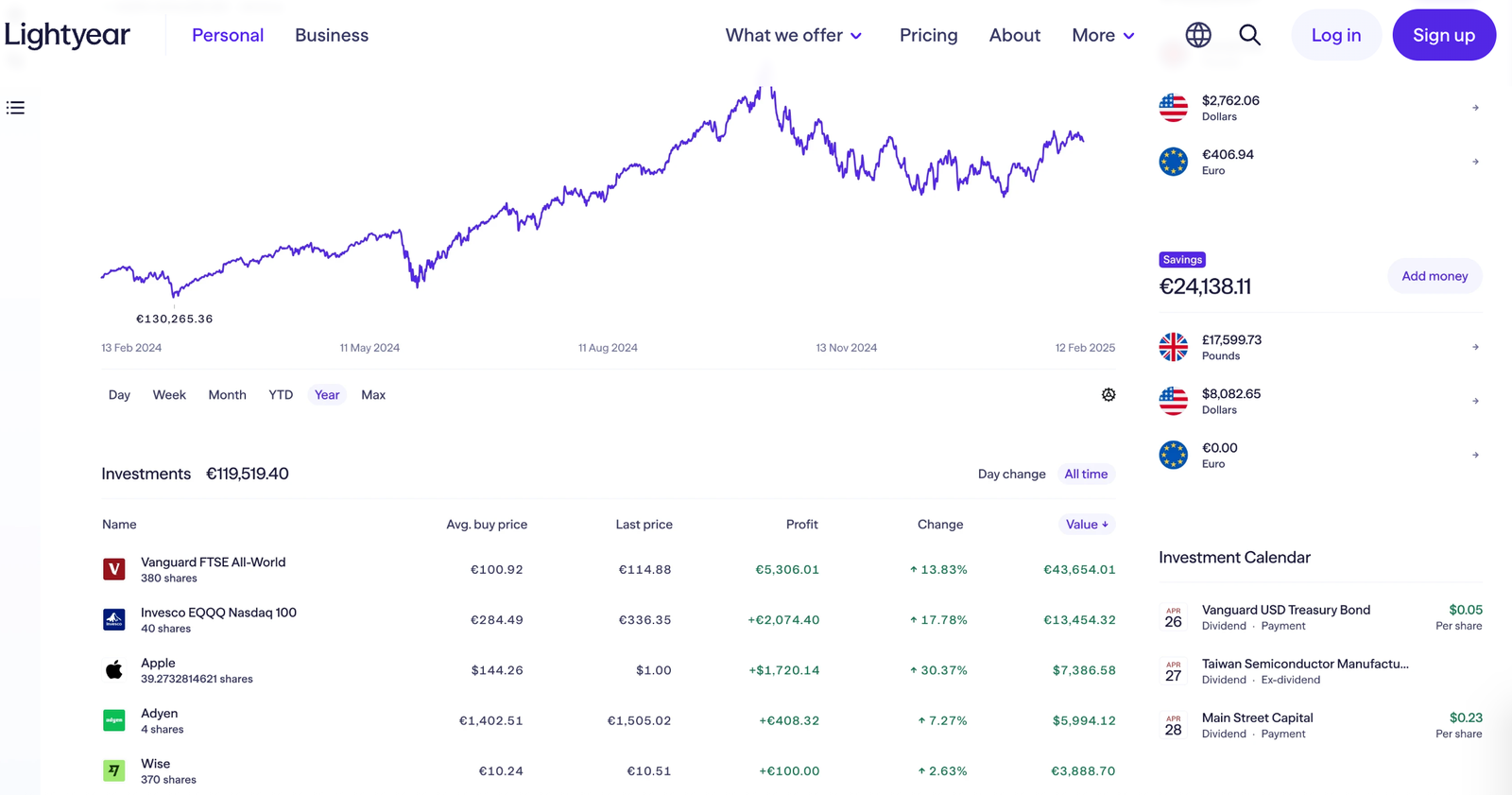
Lightyear has the lowest currency conversion fee on this page at 0.1%, with £0 dealing on UK, US and EU shares and ETFs. It suits investors who regularly buy overseas shares and want to hold pounds, dollars and euros in one account. The trade-offs are no SIPP, a 0.6% fee on card deposits, and a multi-currency feature that only works in the general investment account.
Lightyear key information
| Field | Details |
|---|---|
| Best for | Low-cost international investing |
| UK entity | Lightyear UK Ltd |
| FCA status | Authorised and regulated, FRN 987226 |
| Account types | General investment account (multi-currency), Stocks & Shares ISA, Cash ISA |
| Platform fee | £0 |
| Dealing fee | £0 on UK, US and EU shares and on ETFs |
| FX fee | 0.1% at the interbank rate |
| Deposit fee | Bank transfer free; debit card, Apple Pay and Google Pay 0.6% |
| Minimum investment | £1 |
| Investment range | About 6,000 shares and ETFs |
| Fractional investing | Yes |
| Automated investing | Repeat Orders and Plans |
| ISA | Yes |
| SIPP | No |
| FSCS | Eligible investments up to £85,000 |
| Key differentiator | Multi-currency account with 0.1% FX |
What I tested on Lightyear
- Device: iPhone 17 Pro, iOS 26.6, Lightyear app v5.22.0
- Account: Multi-currency general investment account and Stocks & Shares ISA
- Deposit: £250 by bank transfer
- Investments: £60 of Lloyds, £100 of Microsoft as a fractional share and £50 of Lufthansa
- Automation: £25 monthly Repeat Order; a Plan on a fortnightly schedule
- Withdrawal: £25
- Test date: September 2026
My Lightyear test results
| Test | Result |
|---|---|
| Account opening | About five minutes, including the ID check |
| Deposit speed | £250 by bank transfer arrived in about three minutes, with no fee |
| UK share order | £60 of Lloyds: £0 dealing, 30p stamp duty |
| US share order | £100 of Microsoft as a fraction: £0 dealing, 10p FX |
| EU share order | £50 of Lufthansa: £0 dealing, 5p FX |
| Multi-currency | GBP, USD and EUR balances available in the GIA |
| Repeat Order | £25 a month into Microsoft set up in about a minute |
| Plans | Fortnightly Plan set up in about three minutes; weekly and monthly schedules also offered |
| Withdrawal | £25 arrived the next working day |
| Key friction | No SIPP; 0.6% on card and wallet deposits |
| Strongest feature | 0.1% FX with a multi-currency balance |
How cheap is Lightyear for buying overseas shares?
Lightyear is the cheapest platform I tested for buying shares outside the UK. I deposited £250 by bank transfer, which was free and arrived in about three minutes. In the multi-currency account I bought £60 of Lloyds, £100 of Microsoft as a fractional share and £50 of Lufthansa. Dealing cost £0 in every market, and conversion cost 0.1%: 10p on Microsoft and 5p on Lufthansa. The Lloyds order carried only 30p of stamp duty.
The gap widens with size. On a £1,000 US share purchase, FX costs £1.00 at Lightyear, £1.50 at Trading 212, £5.00 at XTB and £9.90 on Freetrade’s Basic plan. The full table is in the costs section below.
Why does the multi-currency account matter?
The multi-currency account lets you convert once and trade many times. In the general investment account you can hold pounds, dollars and euros side by side. Sell a US share and the proceeds can stay in dollars for the next purchase, so you avoid paying FX twice on every round trip.
There is a catch for tax-wrapper investors. Lightyear lists the multi-currency account as available in the GIA only, so ISA trades in US shares convert each time.
For regular investing, I set up a £25 monthly Repeat Order into Microsoft in about a minute, then a Plan on a fortnightly schedule in about three. Plans can run weekly, fortnightly or monthly, which is more flexible than a single monthly date. Neither the Repeat Order nor the Plan had taken a payment by the end of the test, so £39.55 of my deposit was still in cash. My £25 withdrawal reached my bank the next working day.
How much does Lightyear cost?
Lightyear charges £0 for dealing, £0 for the account and 0.1% for currency conversion. The fee to watch is on deposits: bank transfers are free, but debit card, Apple Pay and Google Pay deposits cost 0.6%. On £250 that is £1.50, more than the FX on a £1,000 US trade. Fund by bank transfer.
Who is Lightyear best for?
Lightyear is best for investors who move between currencies and markets often and want the lowest conversion cost.
Who should avoid Lightyear?
Avoid Lightyear if you need a SIPP, or if you want deep research and screening tools alongside low fees.
Pro & cons
- 0.1% FX, the lowest on this page
- £0 dealing on UK, US and EU shares and ETFs
- Hold GBP, USD and EUR in the general investment account
- No SIPP
- 0.6% fee on card, Apple Pay and Google Pay deposits
- Multi-currency balances are not available in the ISA
Bottom line
Lightyear is the specialist choice on this page for international investing. If most of what you buy is listed in dollars or euros, nothing else here converts your money as cheaply.
Read the complete Lightyear review here.
8. interactive investor — best for larger portfolios and SIPPs
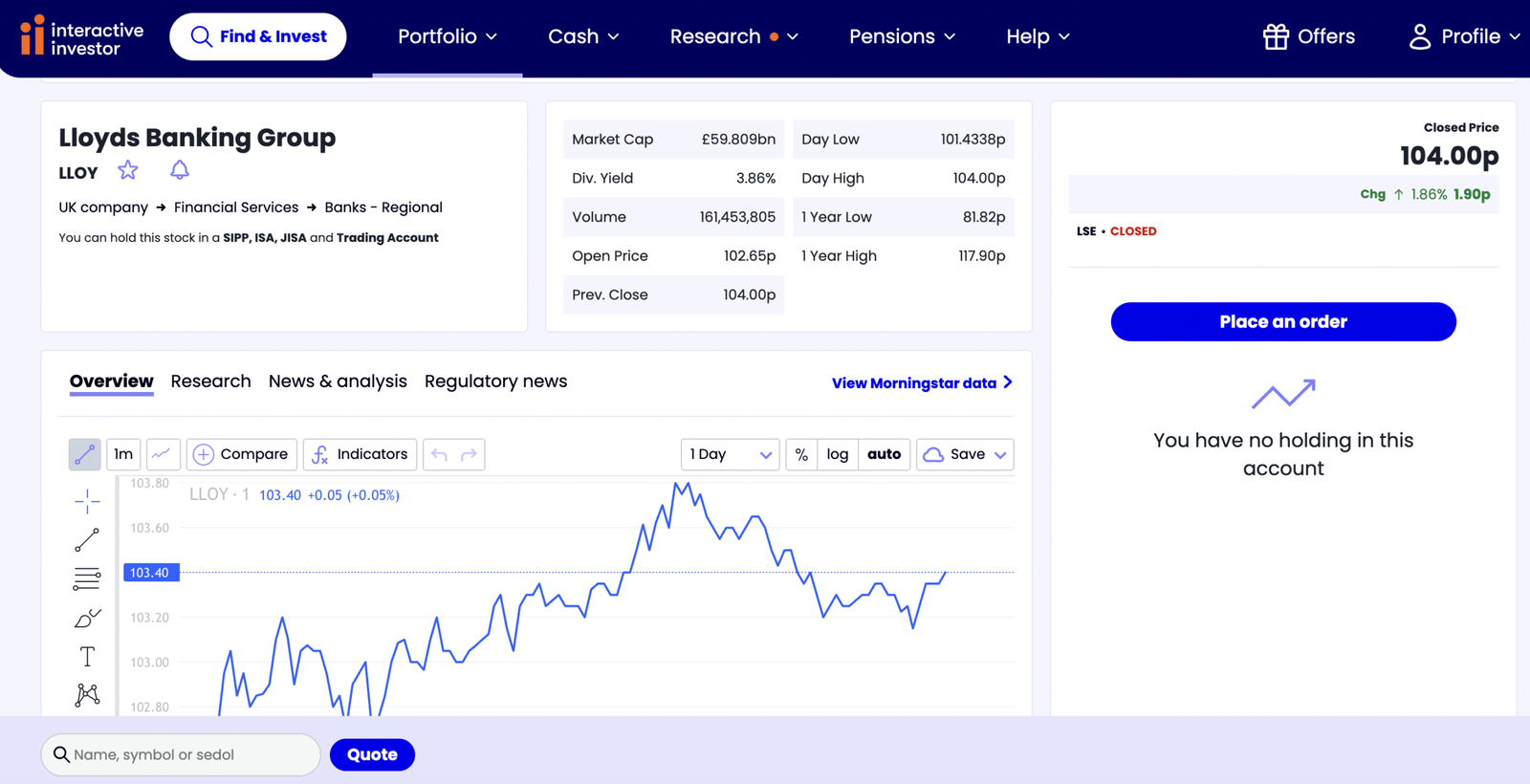
interactive investor (ii) charges a fixed monthly fee instead of a percentage, which makes it cheaper the more you hold. It suits investors with a substantial ISA or SIPP who want funds, investment trusts, shares and ETFs under one roof. The trade-off is small pots: £5.99 a month plus £3.99 a trade is poor value on a few thousand pounds, and there are no fractional shares.
interactive investor key information
| Field | Details |
|---|---|
| Best for | Larger portfolios, pensions and fund investors |
| UK entity | Interactive Investor Services Limited |
| FCA status | Authorised and regulated, FRN 141282 |
| Account types | Trading Account, Stocks & Shares ISA, SIPP; one plan covers all three |
| Platform fee | Core £5.99 a month up to £100,000; Plus £14.99 a month; Premium £39.99 a month |
| Dealing fee | £3.99 per trade on Core; regular investing free |
| FX fee | 0.75% on Core |
| Minimum investment | £1 to fund; regular investing from £25 a month |
| Investment range | About 17,800 shares, funds, ETFs and investment trusts |
| Fractional investing | No |
| Automated investing | Free regular investing |
| ISA | Yes |
| SIPP | Yes |
| FSCS | Eligible investments up to £85,000 |
| Key differentiator | Broad investment universe on a fixed fee |
What I tested on interactive investor
- Device: Samsung Galaxy S24, Android 16, ii app v8.3.1
- Account: Stocks & Shares ISA on the Core plan
- Deposit: £3,000 by debit card
- Search: Vanguard LifeStrategy 80% Equity, Scottish Mortgage, Shell and VWRP
- Orders: £1,000 of VWRP
- Automation: £100 a month regular investment
- Withdrawal: £50
- Test date: September 2026
My interactive investor test results
| Test | Result |
|---|---|
| Account opening | About 15 minutes for the ISA on the Core plan |
| Deposit speed | £3,000 by debit card credited instantly |
| Fee on my test balance | £5.99 a month is £71.88 a year, or 2.4% of £3,000 |
| Search | A fund, an investment trust, a share and an ETF all found, each labelled by type |
| ETF order | £1,000 of VWRP: £3.99 commission shown before confirming; seven whole units bought, about £121 of the £1,000 left uninvested |
| Regular investing | £100 a month set up in about three minutes, £0 dealing |
| Withdrawal | £50 arrived the next working day |
| Key friction | Fixed fee is heavy on a small balance; no fractional shares |
| Strongest feature | Funds, trusts, shares and ETFs under one fixed fee |
What is interactive investor like to use?
ii is built for breadth of choice more than speed. I opened the Core plan, paid £3,000 into the ISA and worked through the app: navigation, the dealing flow, a regular investment and a £50 withdrawal. I searched across funds, shares and ETFs, which is the point of ii. It lists about 17,800 investments, including funds and investment trusts alongside shares and ETFs.
My searches showed that breadth. Vanguard LifeStrategy 80% Equity (a fund), Scottish Mortgage (an investment trust), Shell (a share) and VWRP (an ETF) all came up, each labelled by type. I then placed a £1,000 order for VWRP. The ticket showed the £3.99 commission before I confirmed. Because ii has no fractional dealing, the order bought seven whole units at about £125 each and left about £121 of the £1,000 uninvested.
Regular investing was simpler than one-off dealing. I set up £100 a month into the LifeStrategy fund in about three minutes, with no dealing charge. My £3,000 debit card deposit had credited instantly, and my £50 withdrawal arrived the next working day.
How much does interactive investor cost?
interactive investor charges £5.99 a month on the Core plan, £3.99 per trade and 0.75% FX. Regular investing is free from £25 a month. The fee is the same whatever you hold, so the percentage cost falls as the portfolio grows:
| Portfolio on Core | Annual plan fee | As a share of the portfolio |
|---|---|---|
| £3,000 (my test deposit) | £71.88 | 2.40% |
| £25,000 | £71.88 | 0.29% |
| £50,000 | £71.88 | 0.14% |
| £100,000 | £71.88 | 0.07% |
Above £100,000 you move to Plus at £14.99 a month, or £179.88 a year. On £250,000 that is still about 0.07%. One plan covers the ISA, SIPP and Trading Account together, so adding a pension does not add a second fee.
FX is the weak point. At 0.75% on Core, a £1,000 US share purchase costs £7.50 to convert, plus the £3.99 trade.
Who is interactive investor best for?
interactive investor is best for investors with a large ISA or SIPP, or both, who want funds and investment trusts as well as shares and ETFs.
Who should avoid interactive investor?
Avoid interactive investor if your portfolio is small, you want fractional shares, or you trade US shares often.
interactive investor pros and cons
Pros
- Fixed fee: 0.07% a year on £100,000
- About 17,800 investments, including funds and investment trusts
- One plan covers ISA, SIPP and Trading Account; regular investing is free
Cons
- £71.88 a year is 2.4% of a £3,000 portfolio
- £3.99 per one-off trade and 0.75% FX on Core
- No fractional shares
Bottom line
interactive investor is the opposite of the commission-free apps, and that is why it belongs on this page. It is poor value for a small pot, but once you are managing a substantial ISA and SIPP it becomes one of the cheapest ways to hold a wide mix of investments.
Read the complete interactive investor review here.
How I tested and scored the best investment platforms in the UK
I start from the same review process I use for every platform on psyfi money, then weight it for this page: a UK investor choosing one place to buy shares and ETFs, usually inside an ISA or SIPP. That weighting decides what I say each platform is best for. It is separate from any rating a platform holds in its full psyfi money review.
| Scoring factor | Weight | What I assessed |
|---|---|---|
| Costs | 25% | Platform fee, dealing commission and FX fee, read from the order ticket and checked against published pricing; stamp duty and deposit fees where they applied |
| ISA and SIPP | 20% | Whether a Stocks & Shares ISA and a SIPP are offered, what each costs, and whether they sit inside the main app |
| App workflow | 20% | Steps and time from deposit to a completed order; how clearly fees and currency show before confirming; whether CFDs or leveraged products appear beside ordinary investments |
| Automation | 15% | Recurring investments, target-weight portfolios, rebalancing and dividend reinvestment, and whether they need a paid plan |
| Investment choice | 10% | Shares, ETFs, funds and investment trusts available; fractional dealing; access to UK, US and EU markets |
| Research | 10% | Fundamentals, screeners, analyst data, charts and price alerts |
The comparison that separated platforms most was one ordinary job: buying £1,000 of a US share. I modelled it from each platform’s standard FX rate and checked it against the order tickets from my eight test accounts. It ran from £1.00 at Lightyear and £1.50 at Trading 212 to £7.50 at eToro and £9.90 on Freetrade’s Basic plan. I also modelled interactive investor’s £5.99 monthly fee, which is 2.4% a year on £3,000 but 0.07% on £100,000.
I gave costs the most weight because FX and fixed fees are where UK platforms differ now that six of the eight charge no dealing commission. ISA and SIPP access and app workflow each got 20% because most readers here invest through a tax wrapper, from a phone. FCA authorisation was an entry requirement, and all eight meet it. These weights decide the ‘best for’ verdicts in this guide only; any wider psyfi money platform rating stays separate.
The weights do not set the order of the reviews, and that order is not a ranking from best to worst. psyfi money may earn a commission from some of the platforms on this page, and that can influence the order in which they appear. It does not change my test results or what I say each platform is best for.
How Much Do Investment Platforms Cost?
For a portfolio of sterling ETFs, seven of these eight platforms can cost nothing a year in platform and dealing fees, so the gap only opens when you buy overseas shares or pay a fixed fee. I modelled three investors from each platform’s published rates. These are modelled figures, not test results.
| Platform | A: £10,000 passive ETF investor | B: £50,000 DIY investor | C: £100,000 investor |
|---|---|---|---|
| InvestEngine | £0 | £0; ETFs only, no US shares | £0; ETFs only, no US shares |
| Lightyear | £0 | £4.00 | £10.00 |
| Trading 212 | £0 | £6.00 | £15.00 |
| XTB | £0 | £20.00 | £50.00 |
| IG | £0 | £28.00 | £70.00 |
| eToro | £0 | £30.00, plus $4–$8 commission | £75.00, plus $4–$8 commission |
| Freetrade Basic | £0, placing orders by hand | £39.60 | £99.00 |
| Freetrade Standard | £59.88 | £83.48 | £118.88 |
| interactive investor | £71.88 | £117.84 | £162.84 on Core; £254.88 on Plus |
The assumptions behind each column:
- A: £10,000 in an ISA, £200 a month into sterling-listed ETFs, no one-off trades and no currency conversion.
- B: £50,000 in an ISA, £500 a month into sterling ETFs, plus four £1,000 US share purchases a year.
- C: £100,000 across an ISA and a general account, £1,000 a month into sterling ETFs, plus four £2,500 US share purchases a year.
- All three: standard rates with no loyalty or club discounts, nothing sold during the year, and fund charges, spreads and stamp duty left out because they apply on every platform.
Three details change the reading. Freetrade Basic is free only if you place each monthly order yourself, because recurring orders needed the Standard plan in my test. interactive investor’s Core plan covers portfolios up to £100,000, so growth past that moves you to Plus, where one free trade a month covers the four US purchases. eToro’s figures use its main investment account rates; its ISA runs on Moneyfarm and may be priced differently.
What does a £1,000 US share purchase cost in FX?
Lightyear charges the least to convert £1,000 into dollars, at £1.00, and Freetrade’s Basic plan the most, at £9.90.
| Platform | FX on £1,000 |
|---|---|
| Lightyear | £1.00 |
| Trading 212 | £1.50 |
| XTB | £5.00 |
| IG | £7.00 |
| eToro | £7.50 |
| interactive investor (Core) | £7.50 |
| Freetrade (Basic) | £9.90 |
This is the FX charge alone, not the full cost of the trade. eToro adds $1–$2 commission and interactive investor adds £3.99. Selling and converting back to pounds costs the same percentage again, unless you hold the dollars in Lightyear’s general investment account.
Which investment platform is cheapest?
No platform is cheapest for every investor. The answer turns on four things:
- Asset and currency: for sterling ETFs, the six £0 platforms and eToro all cost nothing, so choose on features. For US shares, Lightyear and Trading 212 are far ahead.
- Trading frequency: each extra £1,000 US purchase adds £1.00 at Lightyear and £9.90 on Freetrade Basic. Freetrade Standard only beats Basic once you convert about £15,000 a year.
- Portfolio size: interactive investor is the dearest in pounds in all three scenarios, but its fee falls from 0.72% of £10,000 to 0.24% of £50,000 and 0.16% of £100,000. What the fee buys is funds and investment trusts, and one charge for ISA, SIPP and Trading Account.
- Account type: a SIPP costs £0 at Trading 212, Freetrade and InvestEngine, is included in interactive investor’s plan, and costs £210 a year at IG. Lightyear’s multi-currency saving applies in the general account, not the ISA.
How to invest using a UK investment platform?
1. Log in to the platform
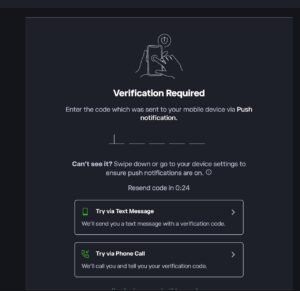
First sign up or log in to the platform. If prompted, complete 2FA by entering the code sent via push notification, SMS, or phone call.
2. Deposit funds into your account
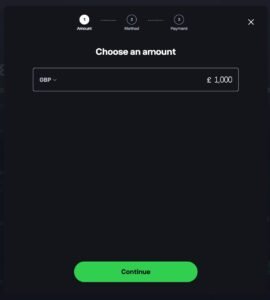
Head to your dashboard and choose to add funds. Select your currency, enter the amount you want to deposit, tap Continue, then choose a payment method.
3. Confirm your funds are available
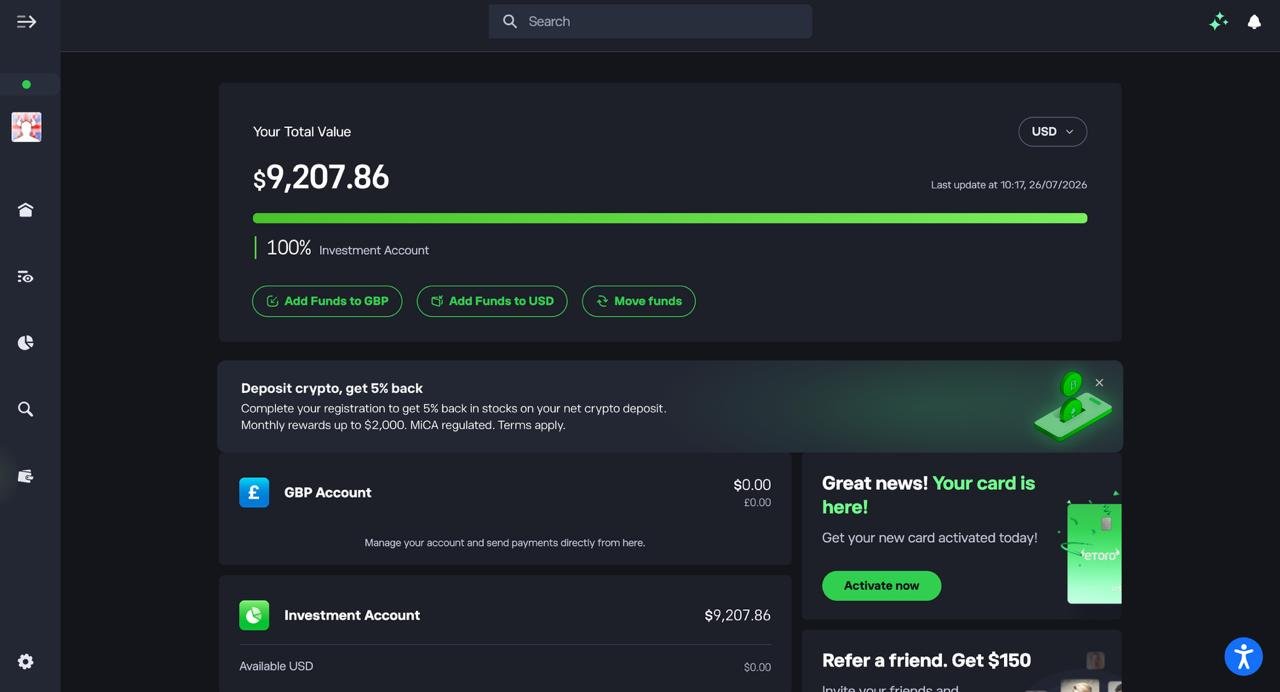
Check your dashboard to make sure your deposit has landed in your Investment Account before you start investing.
4. Find the investment you want
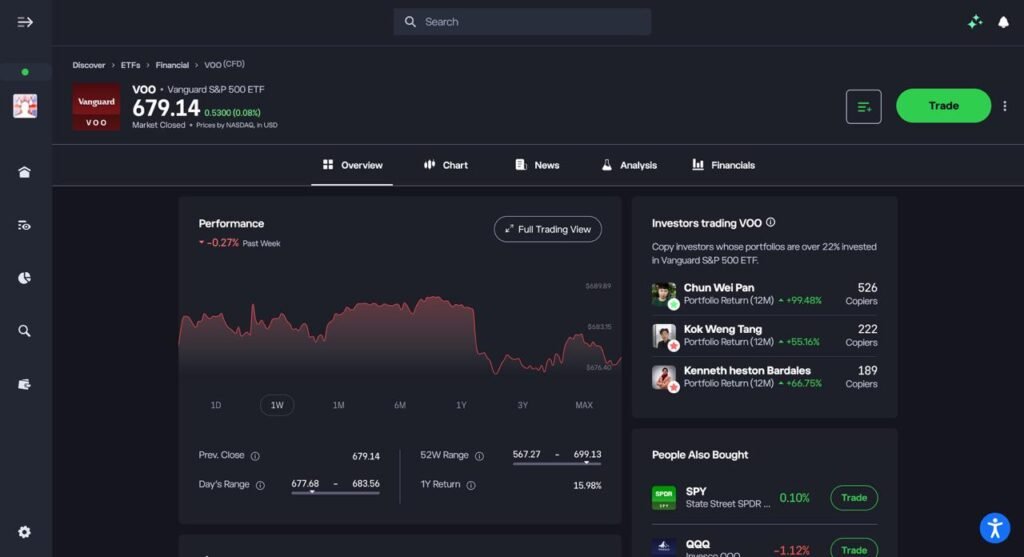
Search for the stock, ETF, or asset you want to invest in and open its overview page to check the price and performance before you commit.
5. Set up and confirm your investment
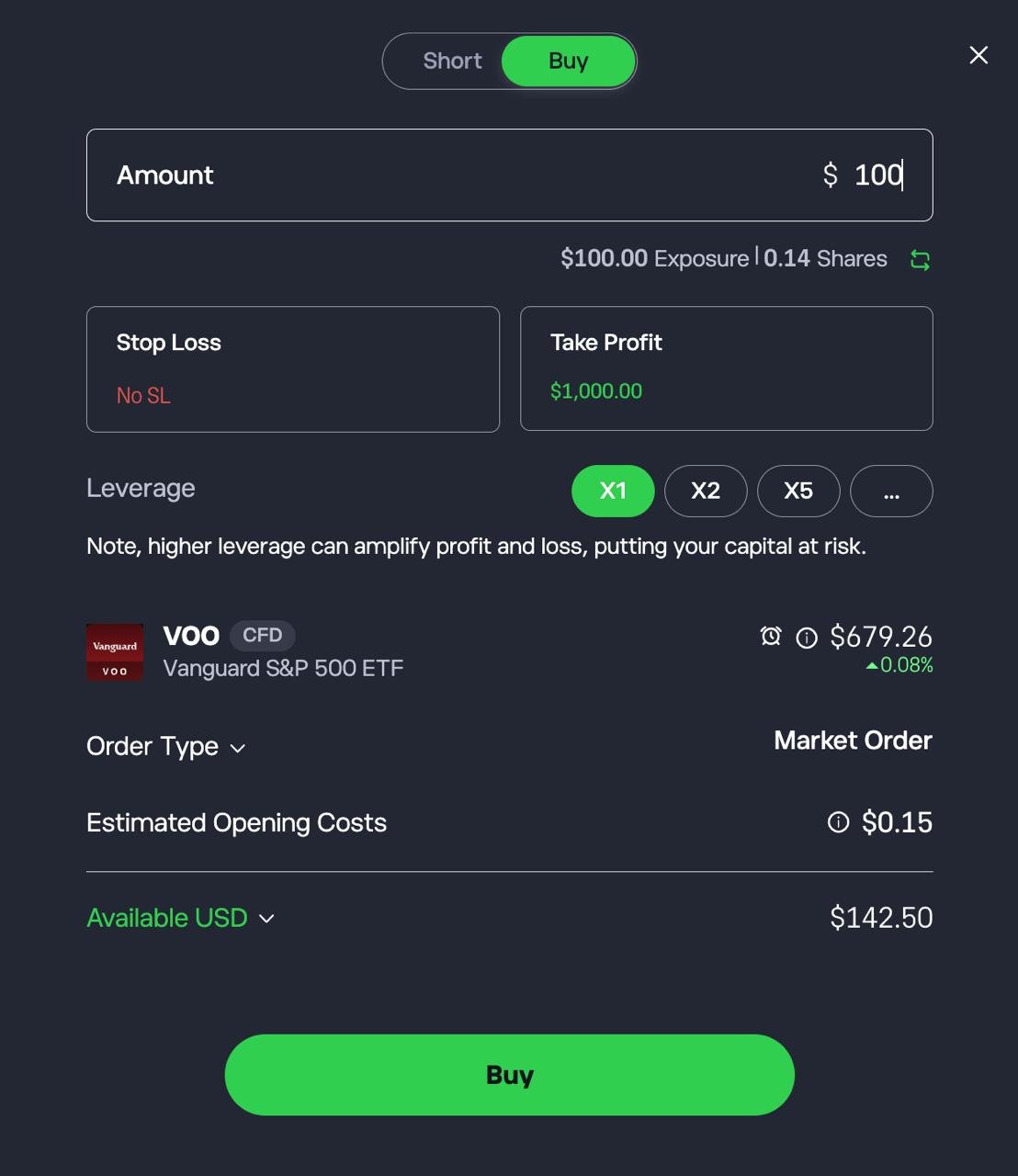
Choose Buy, enter the amount you want to invest, optionally set a Stop Loss and Take Profit, then tap Buy to confirm.
GIA vs Stocks & Shares ISA vs SIPP
The account you choose decides how your gains are taxed and when you can take the money out, which can matter more than the platform. All eight platforms offer a general investment account and a Stocks & Shares ISA. Five offer a SIPP.
What is a General Investment Account?
A general investment account (GIA) is a standard taxable account with no limit on what you pay in. In 2026/27, gains above the £3,000 capital gains allowance and dividends above the £500 dividend allowance can be taxed. Investors typically use one after filling their ISA, or for features an ISA lacks: Lightyear’s pound, dollar and euro balances work in the GIA only.
What is a Stocks & Shares ISA?
A Stocks & Shares ISA lets you invest up to £20,000 a tax year, shared across all your ISAs, with no UK tax on gains or dividends. You can withdraw at any time. All eight platforms offer one, though eToro’s runs on Moneyfarm’s platform and took me about nine extra minutes to open.
What is a SIPP?
A SIPP (self-invested personal pension) is a pension you manage yourself. Contributions get tax relief within an annual allowance of up to £60,000 or 100% of earnings, and the money is locked away until age 55, rising to 57 from April 2028. Fees differ sharply: £0 at Trading 212, Freetrade and InvestEngine, included in interactive investor’s £5.99 monthly plan, and £210 a year at IG. eToro, XTB and Lightyear have no SIPP.
| Platform | GIA | Stocks & Shares ISA | SIPP | Important fee or feature |
|---|---|---|---|---|
| eToro | Yes | Yes, via Moneyfarm | No | ISA is a separate sign-up from the main app |
| XTB | Yes | Yes, flexible | No | 4% AER variable on uninvested ISA cash |
| Trading 212 | Yes | Yes | Yes | £0 platform and dealing fees in all three |
| IG | Yes | Yes | Yes | SIPP costs £210 a year, paid to Options UK |
| Freetrade | Yes | Yes | Yes | All three on the free Basic plan; Junior ISA too |
| InvestEngine | Yes | Yes | Yes | £0 on DIY portfolios; ETFs only |
| Lightyear | Yes, multi-currency | Yes | No | Multi-currency balances in the GIA only |
| interactive investor | Yes (Trading Account) | Yes | Yes | One £5.99 monthly plan covers all three, up to £100,000 |
Four common situations:
- If you are investing long term and can use an ISA, it is usually the first account people fill, because gains and dividends stay free of UK tax. All eight platforms offer one.
- If you are investing specifically for retirement, a SIPP adds tax relief on what you pay in, in exchange for no access until 55. Trading 212, Freetrade, InvestEngine, interactive investor and IG offer one.
- If you have already used your ISA allowance, a GIA takes the overflow, with gains and dividends taxable above the annual allowances.
- If you need both ISA and SIPP under one provider, the pair costs £0 a year at Trading 212, Freetrade and InvestEngine, £71.88 at interactive investor and £210 at IG.
This is general information, not personal advice. Tax treatment depends on your circumstances and can change.
How Safe Are Investment Platforms?
All eight platforms are authorised by the Financial Conduct Authority (FCA). That governs how the firm handles your money. It does nothing to stop your investments falling in value.
What does FCA authorisation mean?
FCA authorisation means the firm has permission to carry out regulated investment business in the UK and must follow the regulator’s rules on conduct, complaints and the handling of client money and assets. I treated it as a requirement for inclusion on this page. It does not guarantee how your investments perform, and it does not mean a firm can never fail. You can check any firm on the FCA Register using its firm reference number (FRN).
What does the FSCS cover?
The Financial Services Compensation Scheme (FSCS) can pay up to £85,000 per eligible person, per firm, if an authorised investment firm fails and cannot return your money or investments. Whether you can claim depends on the circumstances and the type of claim. The FSCS does not cover losses because an investment went down. The separate £120,000 limit applies to bank deposits, not investments.
Why do client assets matter?
FCA rules require a platform to keep clients’ cash and investments separate from the firm’s own money. If the platform fails, your holdings should be identifiable and returned or transferred, with the FSCS as a backstop for an eligible shortfall. When comparing platforms, check which firm holds your assets: eToro’s ISA is run by Moneyfarm and IG’s SIPP is administered by Options UK.
Platform failure vs investment loss
These are different risks, and only one of them has a safety net.
| Risk | What happens | What protects you |
|---|---|---|
| Platform failure | The firm becomes insolvent | Segregated client assets; FSCS up to £85,000 on an eligible claim |
| Investment falling in value | The price of your shares or ETFs drops | Nothing. Neither the FCA nor the FSCS covers market losses |
CFDs carry a further risk. eToro, XTB and IG offer them alongside ordinary investing, and the firms’ own disclosures say 51%, 74% and 70% of retail accounts lose money trading CFDs with them. All three offer a practice account as well, and comparing demo trading accounts is a lower-risk way to see how leverage behaves before real money is involved.
| Platform | UK entity | FCA FRN | ISA | SIPP | Protection note |
|---|---|---|---|---|---|
| eToro | eToro (UK) Ltd | 583263 | Yes | No | Eligible investments, subject to FSCS rules; ISA run by Moneyfarm |
| XTB | XTB Limited | 522157 | Yes | No | Eligible investments up to £85,000 |
| Trading 212 | Trading 212 UK Ltd | 609146 | Yes | Yes | Eligible investments up to £85,000 |
| IG | IG Trading and Investments Ltd | 944492 | Yes | Yes | Eligible investments up to £85,000; SIPP administered by Options UK |
| Freetrade | Freetrade Limited | 783189 | Yes | Yes | Eligible investments up to £85,000 |
| InvestEngine | InvestEngine (UK) Limited | 801128 | Yes | Yes | Eligible investments up to £85,000 |
| Lightyear | Lightyear UK Ltd | 987226 | Yes | No | Eligible investments up to £85,000 |
| interactive investor | Interactive Investor Services Limited | 141282 | Yes | Yes | Eligible investments up to £85,000 |
The test in numbers
I tested eight UK investment platforms with funded accounts in September 2026, running the same checks on each: deposit, search, live order ticket, recurring investment and withdrawal.
| Test measure | Result |
|---|---|
| Funded UK accounts | 8 |
| Total deposited | £8,250 |
| Trades placed | 16 |
| Recurring plans tested | 6 |
| Withdrawals tested | 8 |
| Devices | iPhone and Android, plus desktop where the platform has one |
| Cost check | Fees read from the order ticket before confirming |
These totals cover the main test on each platform. Separate ETF tests on XTB, IG, InvestEngine and Trading 212, run to compare the top ETF platforms, added a further £4,600 of deposits and are not included.
Platforms I considered but did not include
I considered a wider group of UK investment platforms before settling on the eight in this comparison.
I chose platforms with a distinct proposition that I could test in the same way. Each had a funded UK account, live order-ticket checks and a comparable set of account, investing and withdrawal tests.
I did not include every established UK platform simply because it offers shares and funds. That would make the comparison broader, but not more useful.
Hargreaves Lansdown, AJ Bell, Vanguard Investor, Fidelity, Charles Stanley Direct, Saxo and Halifax Share Dealing were outside this eight-platform test.
That does not make them unsuitable: I assess three of them separately in my AJ Bell review, Hargreaves Lansdown review and Saxo review. I left them out because I wanted a focused group with clearly different strengths: low-cost mobile investing, research, ETF portfolios, international investing, social investing and larger portfolios.
If a platform is not listed above, do not read that as a negative verdict. This is a tested comparison of eight platforms, not a directory of every UK provider.
My verdict: which investment platform should you choose?
There is no single best investment platform for every UK investor. The right choice depends on what you invest in, how often you trade, the size of your portfolio and whether you need an ISA, a SIPP or a general investment account.
From my testing, these are the eight platforms I would shortlist, and the job each one does best:
- eToro is best for beginners who want a simple first investment and CopyTrader alongside shares and ETFs. The trade-offs are $1–$2 share commissions, 0.75% FX and no SIPP.
- XTB is best for investors who want low-cost dealing with stronger charts, research and ETF screening. The trade-offs are 0.5% FX, no SIPP and CFDs listed beside real shares.
- Trading 212 is best for low-cost mobile investing and automated portfolios. £0 dealing, 0.15% FX, Pies and AutoInvest suit regular investors, but its research is thin.
- IG is best for investors who want fundamentals, broker sentiment and an ETF screener before they buy. The trade-offs are 0.7% FX and a £210-a-year SIPP.
- Freetrade is best for simple investing in UK shares, ETFs and investment trusts. The Basic plan is free, but 0.99% FX and paid-plan features change the maths for US shares and monthly investing.
- InvestEngine is best for investors who want an automated ETF portfolio, not individual shares. Target weights, AutoInvest and one-tap rebalancing do most of the work.
- Lightyear is best for investors who regularly buy overseas shares. Its 0.1% FX and multi-currency general account stood out in my test, but there is no SIPP.
- interactive investor is best for larger portfolios, pensions and investors who want funds and investment trusts alongside shares and ETFs. Its fixed fee falls as a share of the portfolio the more you hold.
For most investors, the headline dealing fee is not the biggest decision. FX, account fees, portfolio size, tax wrapper and what you actually buy can change the result. A platform that is cheap for a £10,000 sterling ETF portfolio can be expensive for frequent US share purchases, and a fixed-fee platform becomes more competitive as a portfolio grows.
That is why I would choose from the comparison table and cost examples above, not from a ‘cheapest’ label.
My testing also showed that the platforms differ most in what happens around the trade. Trading 212 and InvestEngine make recurring investing easy. XTB and IG offer more research. eToro adds CopyTrader, Lightyear is built around low-cost international investing, and interactive investor has the widest range of funds, trusts, shares and ETFs.
The best platform is the one whose costs, account types and workflow match the way you invest.
FAQs
What is the best investment platform in the UK?
There is no single best investment platform for every UK investor. In my testing, eToro was the easiest for a first investment and social investing, XTB offered the strongest research tools among the app-first brokers, and Trading 212 was the strongest low-cost all-rounder. InvestEngine stood out for ETF portfolios, Lightyear for low-FX international investing, IG for research, Freetrade for simplicity, and interactive investor for larger portfolios and SIPPs.
Which investment platform is the cheapest in the UK?
It depends on what you invest in and how often you trade. For sterling-listed ETFs, several platforms can cost £0 in platform and dealing fees. For US shares, Lightyear had the lowest tested FX cost at 0.1%, followed by Trading 212 at 0.15%. Fixed fees can also change the calculation for larger portfolios, so compare the costs that actually apply to your investments rather than choosing on the headline dealing fee alone.
What is the best investment platform for beginners?
eToro is the platform I would point a beginner towards if they want a simple first investment and the ability to research and copy other investors. Its CopyTrader filters and straightforward order ticket make it accessible, although the 0.75% FX charge, share commissions and lack of a SIPP mean it is not the cheapest or most comprehensive choice for every investor.
Which investment platform is best for buying US shares?
Lightyear was the cheapest platform I tested for currency conversion, charging 0.1% FX with £0 dealing on US shares. Trading 212 was next at 0.15%. XTB, IG, eToro, interactive investor and Freetrade all cost more on the FX component at their standard rates. Your choice can change if you need an ISA, SIPP, research tools or other investments alongside US shares.
Which investment platforms offer a Stocks & Shares ISA and SIPP?
Trading 212, IG, Freetrade, InvestEngine and interactive investor offer both a Stocks & Shares ISA and a SIPP. eToro, XTB and Lightyear offer an ISA but not a SIPP. The cost and structure varies considerably: Trading 212, Freetrade and InvestEngine have £0 platform fees on the relevant accounts, while interactive investor uses a fixed monthly fee and IG charges £210 a year for its SIPP.
Are investment platforms safe in the UK?
All eight platforms tested for this guide are authorised by the Financial Conduct Authority. FCA regulation does not protect you from an investment falling in value. If an authorised investment firm fails and cannot return eligible money or investments, the FSCS can provide protection of up to £85,000 per eligible person, per firm, subject to its rules and the circumstances of the claim. Platform failure and investment losses are separate risks.
References
- https://www.fca.org.uk/publications/market-studies/ms17-1-investment-platforms-market-study
- https://www.fca.org.uk/firms/investment-platforms-consumers-investment-costs-good-poor-practice
- londonstockexchange.com/resources/equities-trading-resources
- https://commonslibrary.parliament.uk/the-rise-of-armchair-retail-trading-risks-and-regulation
