

After testing 8 UK CFD trading platforms, my top picks are IG for CFD trading overall, Capital.com for low-cost, accessible trading and eToro for beginners and copy trading. I compared spreads, share CFD commission, overnight funding, guaranteed stops, platform choice and how each one handles a trade from deposit to withdrawal.

- CopyTrading lets you mirror experienced investors' trades
- Multi-asset access: stocks, crypto, ETFs, forex, commodities
- Beginner-friendly interface with social/community sentiment feed
Capital at risk. T&Cs apply.
How I tested and ranked these platforms
I tested each platform with a funded UK retail account in September 2026. I traded index, forex and share CFDs, checked the spread or fee on the ticket before confirming each order and withdrew money from every account.
- 8 funded UK accounts
- £4,850 deposited
- 20 live trades placed
- 4 guaranteed stops priced
- 8 withdrawals tested
- Tested on web, desktop, iPhone and Android
I then weighted trading costs 25%, markets and platforms 20%, risk controls and practice 15%, holding and account costs 15%, getting started 15% and tools and extras 10%. FCA authorisation was a must, not a scoring factor.
What are the best CFD trading platforms in the UK in 2026?
| Platform | Best for | Platform strength | EUR/USD | Share CFDs | Guaranteed stops | Demo | Spread betting | Third-party platforms | Min. | Biggest catch |
|---|---|---|---|---|---|---|---|---|---|---|
| IG | Overall | 15,000+ markets and six platforms | From 0.6 pips | 0.10% FTSE 350 (£10 min) | ✓ (fee if triggered) | ✓ | ✓ | MT4, MT5, TradingView, ProRealTime | None by bank transfer | £10 minimum on share CFDs |
| Capital.com | Low cost & accessibility | No commission, deposit or withdrawal fee | 0.6 pips* | £0 commission | ✓ (fee if triggered) | ✓ (no time limit) | ✓ | MT4, TradingView | £20 | 4% funding fee; no MT5 |
| eToro | Beginners & copy trading | CopyTrader and social feed | 0.005% each way | 0.15% each way | Not confirmed | ✓ ($100k virtual) | ✗ | ✗ | $50 | 0.75% conversion; no MT4 or MT5 |
| Pepperstone | Active & forex traders | Raw spreads on four platforms | From 0.0 pips + £4.50 round trip (Razor) | 0.07% to 0.20% a side | Not confirmed | 30 days | ✓ | MT4, MT5, cTrader, TradingView | £10 | 1,200+ instruments; steeper start |
| CMC Markets | Advanced charting | Pattern recognition and sentiment in the charts | 0.54 pips average† | 0% UK & Europe; US $10 min | ✓ (refunded if not triggered) | ✓ (£10k virtual) | ✓ | MT4, TradingView | None | US share minimum; £10/mo dormant charge |
| XTB | Education & usability | Tutorials and costs on the trading screen | 0.8 pips | £0 commission | Not confirmed | 30 days (extendable) | ✗ | ✗ | None | xStation 5 only |
| Plus500 | Simple CFD trading | One ticket layout for every market | Dynamic (0.9 pips in my test) | Spread only | ✓ (wider spread) | ✓ (unlimited) | ✗ | ✗ | From £50 | Inactivity fee after three months; no outside tools |
| Spreadex | UK CFDs + spread betting | Same market as a CFD or a spread bet | From 0.6 points | Commission, varies by share | ✓ | ✗ | ✓ | TradingView | £5 | No demo account |
UK CFD trading platform reviews
1. IG – Best overall CFD trading platform
IG is our pick for the best overall CFD trading platform because it combines 15,000+ markets with more ways to trade them than any rival here: its own web platform and app, MT4, MT5, TradingView, ProRealTime and L2 Dealer.
When I tested it, the guaranteed stop cost nothing because it did not trigger. The trade-off is cost and complexity at small size.
Share CFDs carry a £10 minimum commission each way, and the platform takes longer to learn than Capital.com or Plus500, so pick it for breadth, not for a first £50 trade.
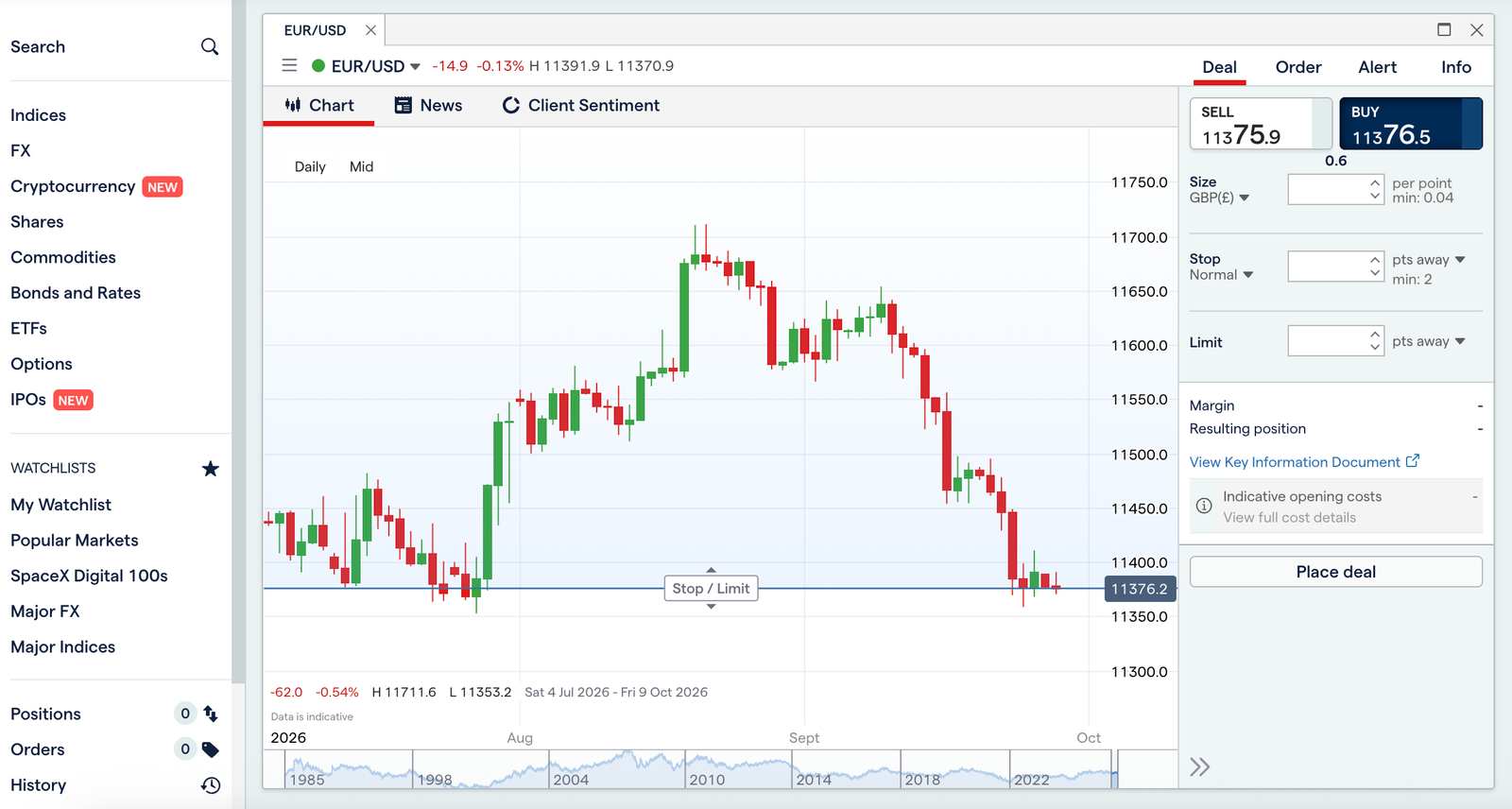
Key information
| Field | Details |
|---|---|
| Best for | Overall CFD trading; traders who want range and depth |
| Retail accounts losing money | 70% |
| Minimum deposit | None by bank transfer; IG’s deposit page gives no GBP minimum for cards |
| CFD markets | 15,000+ |
| Index, FX and commodity CFDs | Spread only: EUR/USD from 0.6 pips, FTSE 100 from 1 point (8am to 4.30pm), US 500 from 0.4 points, spot gold from 0.3 points |
| Share CFDs | Commission: FTSE 350 shares 0.10%, other UK shares 0.35%, both with a £10 minimum; US shares 2 cents a share ($15 minimum) |
| Overnight funding | Benchmark rate plus IG admin fee of 1% a year on FX and 3% on other CFDs, for positions held past 10pm UK time |
| Guaranteed stops | Yes; premium charged only if the stop triggers (0.8 points on the FTSE 100) |
| Currency conversion | 0.8% on CFDs priced in another currency |
| Other fees | No inactivity fee; no deposit or withdrawal fee |
| Platforms | IG web and app, MT4, MT5, TradingView, ProRealTime (£30 a month, refunded if you place four or more trades), L2 Dealer |
| Demo account | Yes |
| Spread betting | Yes |
| Copy trading | No |
| Retail margin | 3.33% on forex, 5% on indices and commodities, 20% on shares |
| FCA regulated | Yes (FRN 195355) |
| FSCS | Cover up to £85,000 if the firm fails |
What I tested: Web platform in Chrome on a Windows laptop and the IG app on an iPhone 15, retail CFD account, £1,500 deposited by debit card, September 2026.
What was it like using IG?
Sign-up to first trade took 26 minutes, including the ID check and appropriateness questions. I deposited £1,500 by debit card and the money showed in my CFD account in under a minute.
I searched for the FTSE 100 and opened a long position of one £2-a-point mini contract, which tied up about £1,000 of margin at IG’s 5% rate. The spread at 9am was 1 point.
I attached a guaranteed stop before confirming. IG only charges the premium if the stop is hit, and the ticket quoted it at 0.8 points. That mattered to me because an index can gap at the open, and I would rather know my maximum loss than save a point of premium.
Next I closed the index trade and bought £1,000 of Barclays as a share CFD, which needed £200 of margin at IG’s 20% rate. This is where IG gets expensive at small size. Commission on FTSE 350 shares is 0.10% with a £10 minimum, so I paid £10 to open and £10 to close on a position where 0.10% would have been £1.
That £20 round trip is 2% of a £1,000 position, and the minimum only stops biting at £10,000 a trade. EUR/USD was 0.8 pips across three checks in the London session.
I then switched on ProRealTime for the charting, which costs £30 a month and is refunded if you place four or more trades that month. A live chat question about overnight funding was answered in four minutes. I finished by withdrawing £200 to the same card, and it arrived two working days later.
How much does IG cost?
IG charges a spread on index, forex and commodity CFDs and a commission on share CFDs. Spreads start at 0.6 pips on EUR/USD, 1 point on the FTSE 100 and 0.4 points on the US 500. Share CFDs cost 0.10% a side on FTSE 350 shares and 0.35% on other UK shares, both with a £10 minimum, and 2 cents a share on US shares with a $15 minimum.
Positions held past 10pm UK time pay overnight funding: the benchmark interest rate plus an IG admin fee of 1% a year on FX and 3% on other CFDs. Trading a market priced in another currency adds a 0.8% conversion fee. IG charges no inactivity fee and nothing for deposits or withdrawals.
Who should use it?
CFD traders who want one account that covers almost every market and expect to outgrow a simpler app, and anyone who wants CFDs and tax-free spread betting with the same provider.
Who should avoid it?
Traders taking small share CFD positions, because the £10 minimum commission is charged each way. XTB and Capital.com charge no commission on share CFDs. Beginners will find Capital.com or Plus500 easier, forex traders putting through several lots a month will pay less on Pepperstone’s Razor account, and anyone who wants one of the top copy trading platforms needs eToro.
Pros & cons
- 15,000+ markets and a choice of six platforms
- Guaranteed stop premium charged only if the stop triggers
- No inactivity fee and no deposit or withdrawal fee
- £10 minimum commission each way on UK share CFDs
- Takes longer to learn than Capital.com or Plus500
Read the complete IG review here.
2. Capital.com – Suited to low-cost and accessible CFD trading
Capital.com is our pick for low-cost and accessible CFD trading because it pairs low running costs with a short path from sign-up to first trade.
It charges no commission and no deposit or withdrawal fee, and takes a £20 first deposit. When I tested it, I went from sign-up to first trade in 12 minutes.
The trade-off is depth: 5,500+ markets against IG’s 15,000+, no MT5, and a 4% a year funding fee on index and share CFDs that makes long holds dearer than at IG.
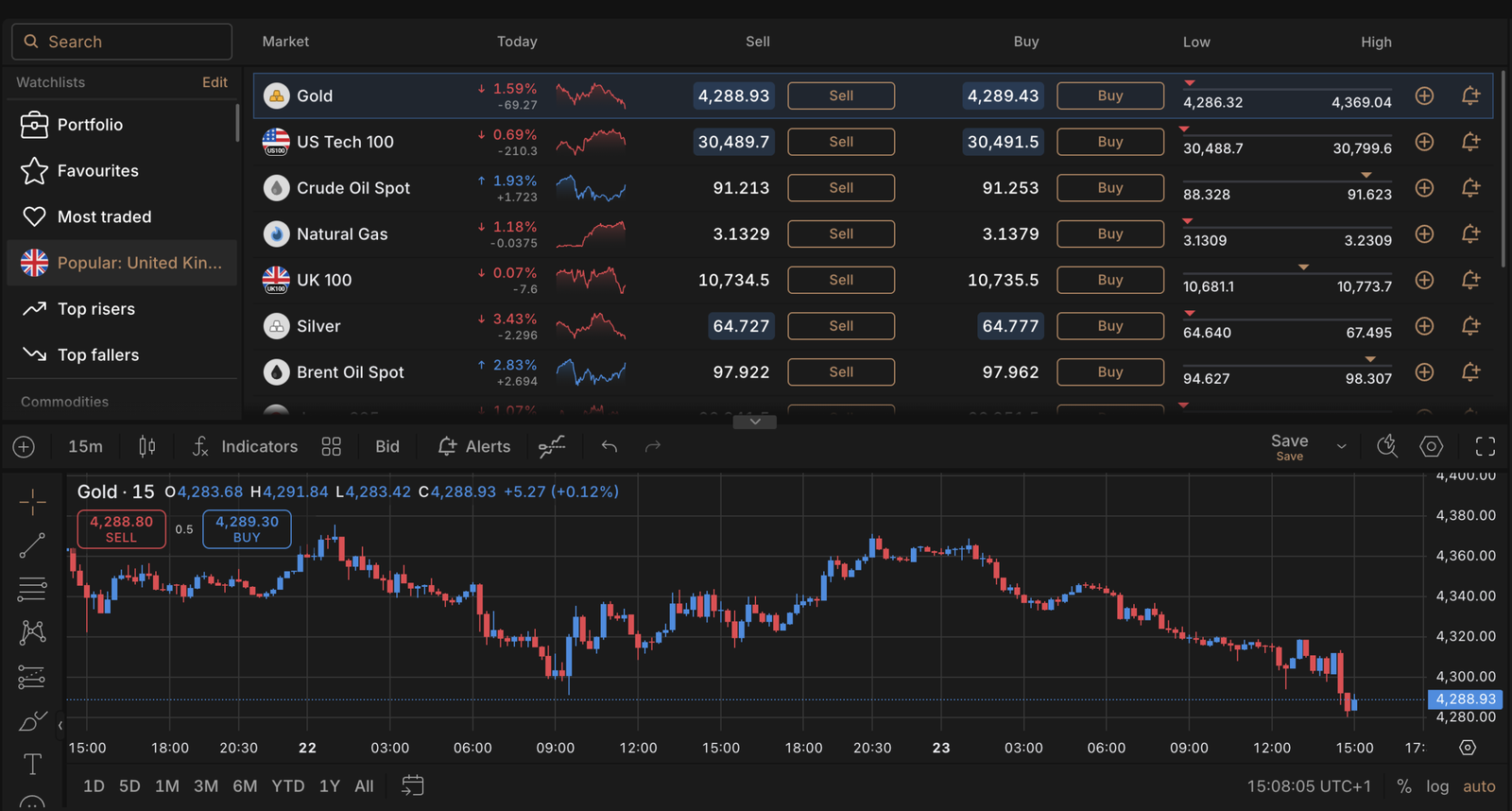
Key information
| Field | Details |
|---|---|
| Suited to | Low-cost, accessible CFD trading |
| Retail accounts losing money | 65% |
| Minimum deposit | £20 |
| Minimum withdrawal | £20 |
| CFD markets | 5,500+ |
| Trading costs | No commission; Capital.com’s pricing examples use 0.6 pips on EUR/USD and 1 point on the UK 100 |
| Overnight funding | Benchmark rate (SONIA or SOFR) plus a daily fee: 0.01096% on GBP markets and 0.01111% on USD and EUR markets, which is 4% a year |
| Guaranteed stops | Yes; fee charged only if the stop triggers (0.03% in Capital.com’s gold example) |
| Currency conversion | 0.7% of the spot rate for retail clients |
| Other fees | No deposit, withdrawal, account opening or closing fee |
| Platforms | Capital.com web and app, MT4, TradingView (no MT5) |
| Demo account | Yes, with no time limit |
| Spread betting | Yes |
| Copy trading | No |
| Retail leverage | FCA caps: 30:1 major FX, 20:1 major indices and gold, 5:1 shares |
| FCA regulated | Yes (FRN 793714) |
| FSCS | Cover up to £85,000 if the firm fails |
What I tested: Capital.com app on an iPhone 15, then the web platform in Chrome with TradingView charts, retail CFD account, £100 deposited by debit card, September 2026.
What was it like using Capital.com?
I started on the phone, because this is the platform most likely to be someone’s first CFD account. Sign-up to first trade took 12 minutes. I deposited £100 by debit card, five times the £20 minimum, and it reached my account instantly.
I searched EUR/USD and opened 2,000 units, which tied up about €67 of margin at the FCA’s 30:1 cap. At the 0.6-pip spread in Capital.com’s pricing example the whole round trip costs $0.12, with no commission on top, and 0.6 pips was the spread I was quoted.
I closed that trade, moved to the web platform and placed a small UK 100 trade worth about £1,000 from the TradingView chart, adding a guaranteed stop. The spread at 9am was 1 point and the position needed £50 of margin.
The fee for that stop is only taken if it triggers, so protecting a small index position cost me nothing on the trades that closed normally. The ticket quoted the fee at 30p for my position, which is 0.03%. A live chat question about the guaranteed stop fee was answered in under a minute.
The friction came when I left the UK 100 position open overnight. Capital.com adds its own 0.01096% a day to SONIA, which is 4% a year against IG’s 3% admin fee on the same kind of position, and my statement showed 21p for the night.
For a day trade that is irrelevant. Over a three-week hold it adds up. I finished by withdrawing £50 to my card, which arrived the next working day.
How much does Capital.com cost?
Capital.com charges no commission on CFDs and earns its money from the spread. Its pricing examples use a 0.6-pip spread on EUR/USD and a 1-point spread on the UK 100. There is no deposit fee and no withdrawal fee, and the minimum for each is £20.
Positions on indices and shares held overnight pay the benchmark interest rate plus 0.01096% a day on GBP markets, which is 4% a year. Forex positions pay the market’s tom-next rate plus or minus Capital.com’s daily fee. A guaranteed stop costs a fee only if it is triggered, and trading a market priced in another currency adds a 0.7% conversion fee.
Who should use it?
Newer and intermediate CFD traders who want to keep costs visible and low while they trade small. A £20 minimum, commission-free share CFDs and a demo account with no time limit make it cheap to learn on.
Who should avoid it?
Traders who need a much longer market list should choose IG or CMC Markets, and those who want one of the leading MT5 brokers should choose IG or Pepperstone. Swing traders who hold index or share CFDs for weeks will pay less funding at IG, and anyone who wants copy trading needs eToro.
Pros & cons
- No commission and no deposit or withdrawal fee
- £20 minimum deposit and a demo account with no time limit
- Guaranteed stop fee charged only if the stop triggers
- Funding on index and share CFDs runs at 4% a year over the benchmark, against 3% at IG
- 5,500+ markets against IG’s 15,000+
- No MT5
Read the complete Capital.com review here.
65% of retail investor accounts lose money when trading spread bets and CFDs with this provider. You should consider whether you can afford to take the high risk of losing your money.
3. eToro – Best for beginners and copy trading
eToro is our pick for beginners and copy trading because it suits people who would rather follow experienced traders than build every trade themselves.
CopyTrader lets you mirror another investor’s positions from $200 with no copy fee, on a platform built around a social feed. When I tested it, I had a working portfolio without placing a single order myself.
The trade-off is trading cost and tooling: its EUR/USD fee of 0.005% each way works out at more than 1 pip for the round trip, against a 0.6-pip minimum at IG, and there is no MT4, MT5 or spread betting.
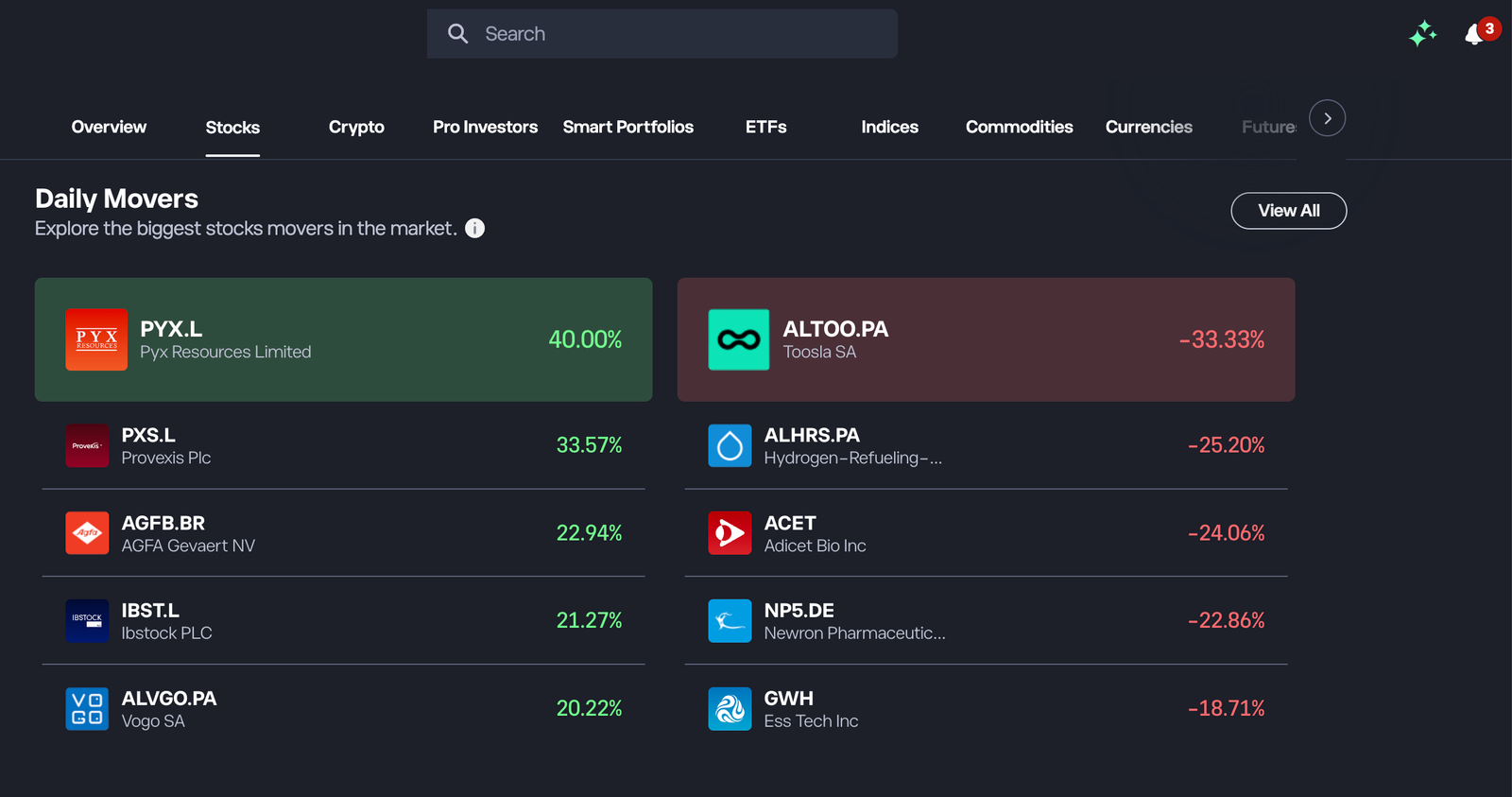
Key information
| Field | Details |
|---|---|
| Best for | Beginners; social and copy trading |
| Retail accounts losing money | 51% |
| Minimum deposit | $50 |
| Instruments | 5,000+ assets, including CFDs, real shares and ETFs |
| CFD fees per trade | Share and ETF CFDs 0.15%; EUR/USD 0.005%; SPX500 0.007%; UK100 0.01%; gold 0.01% |
| Overnight fees | Charged on open CFD positions; weekend fee is three times the nightly fee |
| Copy trading | Yes: CopyTrader, $200 minimum per trader, no copy fee, copy stop-loss required |
| Currency conversion | 0.75% between a GBP balance and USD for trades; 150 pips on GBP deposits to a USD account |
| Withdrawal fee | £0 from a GBP account; $5 from a USD account ($30 minimum) |
| Inactivity fee | None |
| Platforms | eToro web and app only (no MT4 or MT5) |
| Demo account | Yes, practice portfolio with $100,000 in virtual funds |
| Spread betting | No |
| Retail leverage | FCA caps: 30:1 major FX, 20:1 major indices and gold, 5:1 shares |
| FCA regulated | Yes |
| FSCS | Cover up to £85,000 if the firm fails |
What I tested: eToro app on a Google Pixel 8 and the web platform in Chrome, retail account with a GBP balance, £300 deposited by debit card, September 2026.
What was it like using eToro?
I started with copy trading, because that is the reason to pick eToro over the two platforms above. Sign-up to first trade took 18 minutes, including the trading knowledge questionnaire, and my £300 debit card deposit arrived within two minutes.
I opened the CopyTrader search and filtered by risk score and track record. I allocated the $200 minimum to one trader with a risk score of 4 and more than three years of history, and set the copy stop-loss that eToro requires at 40%, well inside its 95% default. Starting the copy took four steps and about three minutes.
eToro charges nothing extra for copying, but the positions I inherited were real trades with real costs. Any leveraged or short position in a copied portfolio is a CFD and pays overnight fees, tripled over the weekend.
Then I placed my own trades. I opened a short position on the US 500 with $1,000 of exposure, which needed $50 of margin at the FCA’s 20:1 cap. The fee summary sat at the bottom of the order screen before I confirmed: $0.07, which is eToro’s 0.007%, plus the nightly fee.
The most useful thing I noticed is how one ticket covers two products. Buying a US share without leverage gave me the real share. Adding leverage, or switching to sell, turned the same ticket into a CFD with a 0.15% fee each way and overnight charges. On my $500 share CFD that was $0.75 to open and $0.75 to close. Beginners should check which one they are holding.
The friction was currency: instruments are priced in dollars, so my pounds were converted at 0.75%, which was $1.50 on the $200 I put into CopyTrader. I withdrew £50 from the GBP balance at no charge and it reached my bank the next working day.
How much does eToro cost?
eToro charges a percentage fee on each CFD trade: 0.15% on share and ETF CFDs, 0.005% on EUR/USD, 0.007% on the US 500 and 0.01% on the UK 100 and gold. CFD positions left open pay an overnight fee, and the weekend fee is three times the nightly one.
CopyTrader has no separate fee. Withdrawals cost £0 from a GBP account and $5 from a USD account, with a $30 minimum. eToro charges no inactivity fee. Converting between a GBP balance and dollars for a trade costs 0.75%.
Who should use it?
Beginners who want to learn CFD trading by watching and copying other traders before going it alone, and people who want real shares and CFDs side by side in one app.
Who should avoid it?
Active and technical traders, because eToro has no MT4, MT5 or cTrader and its forex fee is higher than the minimum spreads at IG and Pepperstone. Anyone who wants tax-free spread betting should look at IG, Capital.com or Spreadex, and traders who only deal in sterling markets will find a GBP-based CFD account simpler.
Pros & cons
- CopyTrader from $200 with no copy fee
- Real shares and CFDs side by side on one ticket
- No inactivity fee, and free withdrawals from a GBP account
- Trades are priced in dollars, so a pound-funded account pays 0.75% conversion
- EUR/USD costs more than 1 pip for the round trip
- No MT4, MT5 or spread betting
Read the complete eToro review here.
4. Pepperstone – Best for active and forex traders
Pepperstone is our pick for active and forex traders because its Razor account pairs raw spreads from 0.0 pips with a fixed £2.25 a side commission, on MT4, MT5, cTrader or TradingView.
When I tested it, EUR/USD was quoted at 0.1 pips on Razor against 1.1 pips on the Standard account at the same moment. The trade-off is that it assumes you already know what you want.
There are 1,200+ instruments against IG’s 15,000+, demo accounts are removed after 30 days, and you choose an account type and platform before you place a trade.
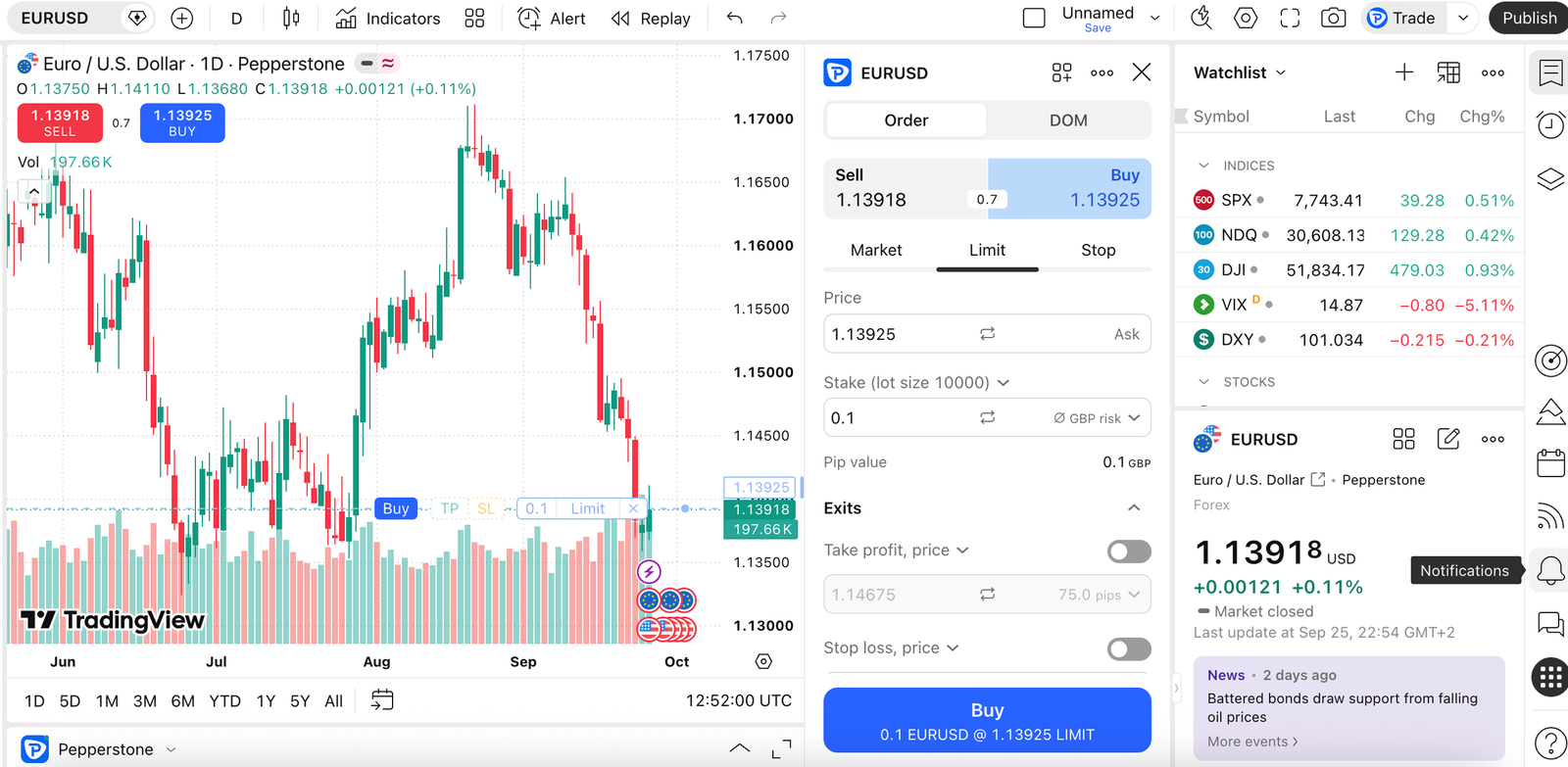
Key information
| Field | Details |
|---|---|
| Best for | Active, forex and algorithmic CFD traders |
| Retail accounts losing money | 72.9% |
| Minimum deposit | £10 |
| CFD instruments | 1,200+ |
| Razor account | Raw spreads from 0.0 pips on FX and 0.08 points on spot gold; commission £2.25 a side per lot on MT4 and MT5 (£4.50 round trip), $6 round trip on cTrader for FX, $7 round trip on TradingView |
| Standard account | No commission on FX, indices or commodities; EUR/USD from 1 pip |
| Share CFDs | Commission of 0.07% to 0.20% a side, depending on the market |
| Overnight funding | Swap rate; 2.5% admin fee on indices and commodities |
| Other fees | No deposit or inactivity fee; withdrawals free except £15 for an international bank wire |
| Platforms | MT4, MT5, cTrader, TradingView, Pepperstone web and app |
| Automated trading | Yes, through MT4, MT5 and cTrader |
| Demo account | Yes; removed from the client area after 30 days |
| Spread betting | Yes |
| Retail leverage | FCA caps: 30:1 major FX, 20:1 major indices and gold, 5:1 shares |
| FCA regulated | Yes (FRN 684312) |
| FSCS | Cover up to £85,000 if the firm fails |
What I tested: MT5 on a Windows desktop, then cTrader in the browser and TradingView on the same account, retail Razor CFD account in GBP, £1,000 deposited by bank transfer, September 2026.
What was it like using Pepperstone?
I tested Pepperstone the way an active forex trader would use it. I opened a Razor account, which was approved in 20 minutes, and funded it with £1,000 by bank transfer, which landed in about two hours by Faster Payments.
I logged in to MT5 on desktop and bought 0.2 lots of EUR/USD, which tied up about €667 of margin at 30:1. The quoted spread was 0.1 pips and the commission line showed £0.90 for the round trip.
I then pulled up the Standard account quote for the same pair, which was 1.1 pips. Standard adds at least 1 pip, which on 0.2 lots is $2.00 of extra spread against £0.90 of commission, so Razor was the cheaper way to trade forex even at this size. Nine of my 10 market orders filled at the quoted price and one slipped 0.1 pips.
Next I checked where the commission stops. Spot gold carries it too, but my UK 100 trade was spread-only on Razor, the same as on Standard, at 1 point.
I logged in to cTrader with the same account for depth of market, where FX commission is quoted in dollars at $6 a lot for the round trip, then ran a basic Expert Advisor on MT5, which opened and closed three 0.01-lot trades without errors. A live chat question about commission on TradingView was answered in three minutes.
The friction is all at the front. Sign-up asked me to pick Razor or Standard and a platform before I had seen any of them, and a demo account is removed after 30 days, so there is limited time to compare. I withdrew £300 by bank transfer and it arrived the next working day.
How much does Pepperstone cost?
Pepperstone charges in one of two ways. The Razor account has raw spreads from 0.0 pips on forex plus a commission of £2.25 a side per standard lot on MT4 and MT5, £4.50 for the round trip, on forex and spot gold. The Standard account has no forex commission and builds its fee into the spread, with EUR/USD from 1 pip.
Index CFDs are spread-only on both accounts, and share CFDs carry a commission of 0.07% to 0.20% a side. Positions held overnight pay a swap. Pepperstone asks for a £10 minimum deposit and charges no deposit or inactivity fee. Withdrawals are free unless you send an international bank wire, which costs £15.
Who should use it?
Traders who place forex or index CFD trades frequently and care about the all-in cost of each one, and anyone who trades through MT4, MT5 or cTrader, runs automated strategies or wants to execute from TradingView charts.
Who should avoid it?
Beginners who want one simple app should choose Capital.com, eToro or Plus500. Traders who want thousands of share CFDs or niche markets will find far more at IG or CMC Markets, and anyone who needs longer than 30 days on a demo should start with a platform whose demo does not expire.
Pros & cons
- Raw forex spreads from 0.0 pips with a £2.25 a side commission on Razor
- MT4, MT5, cTrader and TradingView on one account
- No deposit or inactivity fee, from a £10 minimum deposit
- Account type and platform have to be chosen before you can trade
- 1,200+ instruments against IG’s 15,000+
- Demo account removed after 30 days
Read the complete Pepperstone review here.
5. CMC Markets – Best for advanced charting
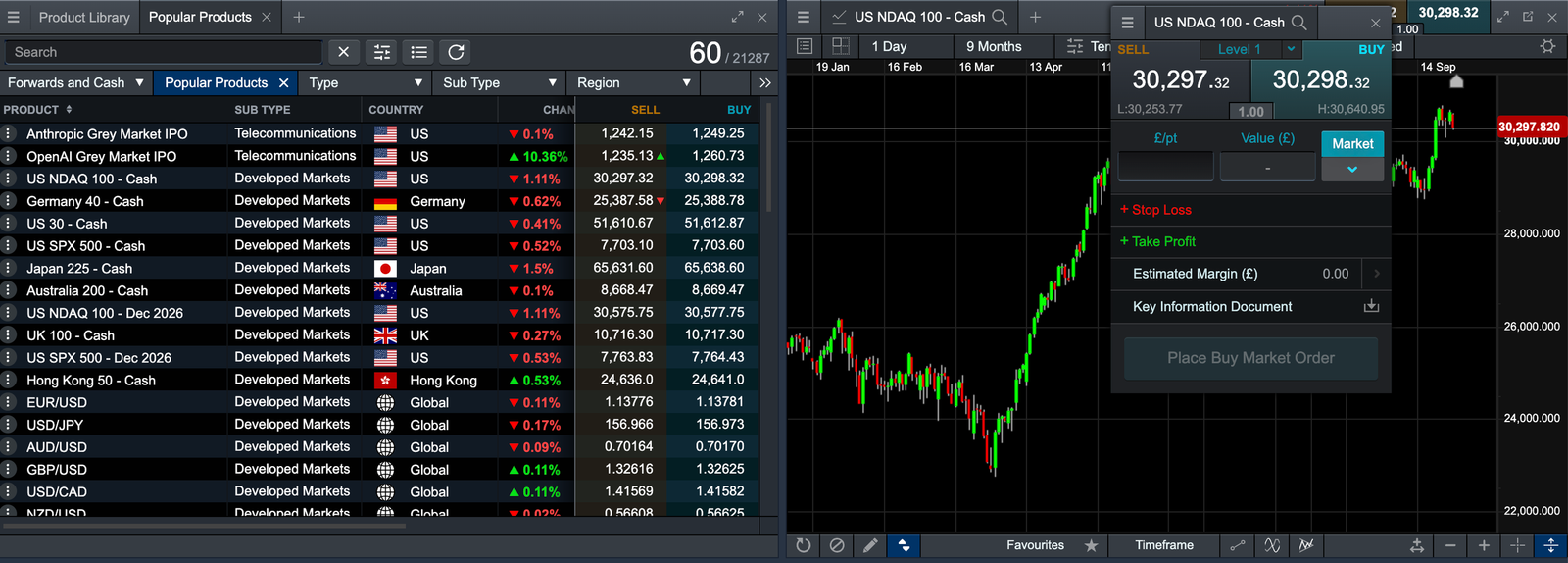
CMC Markets is our pick for advanced charting because it suits traders who do their analysis on the platform itself.
Its web platform builds pattern recognition, client sentiment and news into the charts, across 21,000 instruments, and UK and European share CFDs are commission-free. When I tested it, I did not need a second tool open to form a view.
The trade-off is in the small print: US share CFDs carry a $10 minimum commission each way, live share prices can need a market data subscription, and a dormant account pays £10 a month after a year.
Key information
| Field | Details |
|---|---|
| Best for | Advanced charting and on-platform analysis |
| Retail accounts losing money | 69% |
| Minimum deposit | None |
| Instruments | 21,000 |
| Index, FX and commodity CFDs | Spread only. CMC’s published tested averages: EUR/USD 0.54 pips, UK 100 1.47 points, gold 0.20. Germany 40 from 1.2 points |
| FX Active account | Spreads from 0.0 pips on six major pairs plus $2.50 per $100,000 a side; 25% spread discount on other pairs |
| Share CFDs | 0% commission on 2,500 UK and European shares and ETFs; US shares 2 cents a share ($10 minimum) |
| Guaranteed stops | Yes; premium paid up front (£1 a unit on the UK 100) and refunded in full if the stop is not triggered |
| Market data | Monthly subscription may apply; refunded if you place two or more trades |
| Dormant account charge | £10 a month after a year without activity |
| Platforms | CMC web platform and app, MT4 (separate account, 175+ instruments), TradingView |
| Demo account | Yes, with £10,000 of virtual funds |
| Spread betting | Yes |
| Retail leverage | FCA caps: 30:1 major FX, 20:1 major indices and gold, 5:1 shares |
| FCA regulated | Yes (FRN 173730) |
| FSCS | Cover up to £85,000 if the firm fails |
What I tested: CMC web platform in Chrome on a MacBook, then the CMC app on an iPhone 15, retail standard CFD account, £750 deposited by debit card, September 2026.
What was it like using CMC Markets?
I spent most of the time in the charts, because that is what CMC Markets does better than the brokers above. Sign-up to first trade took 22 minutes. I deposited £750 by debit card, which showed instantly, and opened the UK 100 on the web platform.
The pattern recognition scanner flagged a rising wedge on the one-hour chart and the client sentiment panel showed 62% of CMC clients long. Both sat beside the chart, so I did not need a second tool open to form a view.
I bought 1 unit of the UK 100 with a guaranteed stop, which tied up about £500 of margin. The spread at 9am was 1.5 points, and EUR/USD was 0.5 pips on the standard account in the London session.
CMC handles these stops differently from IG and Capital.com: the £1 premium came out of my account when I placed the order and was refunded when I closed without the stop triggering. That is the same net cost, but it reduces free margin while the trade is open.
Share CFDs were a mixed picture. A £1,500 Tesco position needed £300 of margin and cost nothing in commission, because CMC charges 0% on UK and European shares. I did have to switch on a market data subscription first, and the fee was refunded once I had placed two trades.
A $1,500 Apple position was different. At 2 cents a share the commission would have been pennies, so the $10 minimum applied each way: $20 for the round trip, which is 1.3%. I withdrew £250 to my card and it arrived two working days later.
How much does CMC Markets cost?
CMC Markets charges a spread on index, forex and commodity CFDs. Its own published testing puts the average spread at 0.54 pips on EUR/USD and 1.47 points on the UK 100. Share CFDs carry 0% commission on 2,500 UK and European shares and ETFs, and 2 cents a share with a $10 minimum on US shares. Live share prices can need a market data subscription, which is refunded if you place two or more trades in the period.
Forex traders can choose the FX Active account instead: spreads from 0.0 pips on six major pairs plus $2.50 per $100,000 traded, each side. Share CFDs held overnight pay the reference rate plus 0.0082% a day. A dormant account pays £10 a month after a year without activity.
Who should use it?
Experienced CFD traders who rely on technical analysis and want it inside the dealing platform. It also suits UK share CFD traders, who pay no commission, and higher-volume forex traders, who get raw pricing on FX Active.
Who should avoid it?
Traders who take small US share CFD positions should choose XTB or Capital.com, which charge no commission on them. Occasional traders should note the dormant charge after 12 months, beginners will find the platform dense, and traders who want MT5 or cTrader will find them at Pepperstone.
Pros & cons
- Pattern recognition and client sentiment built into the chart
- 0% commission on 2,500 UK and European shares and ETFs
- 21,000 instruments and no minimum deposit
- $10 minimum commission each way on US share CFDs
- £10 a month dormant account charge after a year without activity
- Live share prices can need a market data subscription
Read the complete CMC Markets review here.
6. XTB – Best for education and platform usability
XTB is our pick for education and platform usability because it lets you learn on the same screen you trade from.
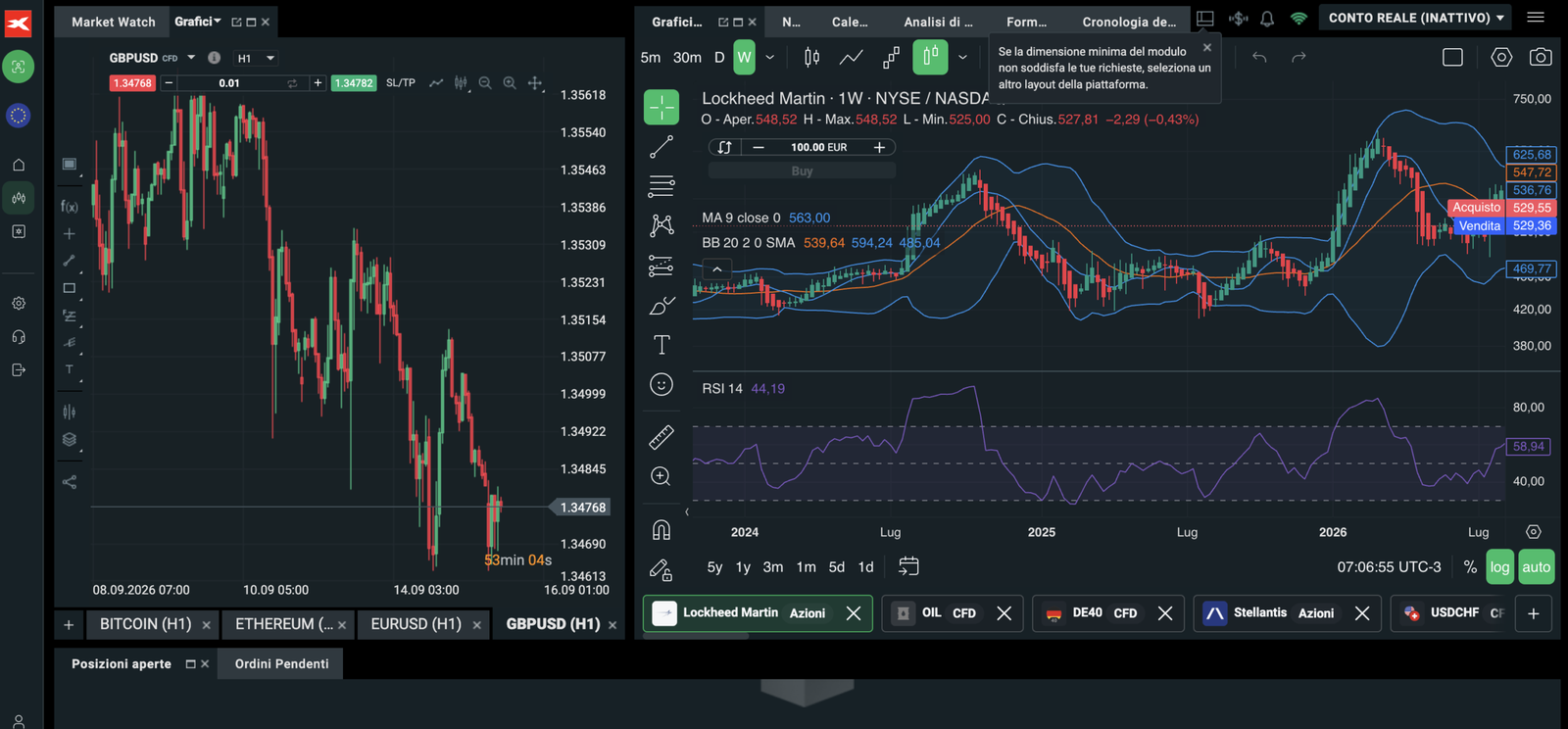
Its own xStation 5 platform puts tutorials, news, a stock scanner and a clear cost breakdown beside the order ticket, and CFDs carry no commission. When I tested it, the ticket itemised the commission at 0.00 before I confirmed.
The trade-off is that xStation 5 is the only option. There is no MT4, MT5, TradingView or spread betting, and EUR/USD is quoted at 0.8 pips against a 0.6-pip minimum at IG.
Key information
| Field | Details |
|---|---|
| Best for | Education; a single, easy-to-read platform |
| Retail accounts losing money | 74% |
| Minimum deposit | None |
| CFD markets | 2,600+, including 70+ currency pairs and 20+ indices |
| Trading costs | No commission on CFDs; EUR/USD 0.8 pips; US 500 minimum spread 0.4 points |
| Currency conversion | 0.5% built into XTB’s exchange rate |
| Inactivity fee | €10 a month after 365 days with no trade and no deposit in the last 90 days |
| Deposits and withdrawals | No XTB fee; card deposits are instant; withdrawals take 1 to 3 working days |
| Platforms | xStation 5 on web, desktop and mobile only |
| TradingView, MT4, MT5 | No |
| Demo account | Yes, with 100,000 in virtual funds; goes inactive after 30 days and can be extended |
| Education | Tutorials, webinars and market news inside the platform |
| Spread betting | No |
| Retail leverage | FCA caps: 30:1 major FX, 20:1 major indices and gold, 5:1 shares |
| FCA regulated | Yes (FRN 522157) |
| FSCS | Cover up to £85,000 if the firm fails |
What I tested: xStation 5 in Chrome on a Windows laptop, then the XTB app on an iPhone 15, retail standard account in GBP, two days on the demo, then £400 deposited by debit card, September 2026.
What was it like using XTB?
I began on the demo, since education is the reason to choose XTB. The demo was ready in three minutes. I spent two days in xStation 5 with virtual funds and worked through the beginner CFD course inside the platform.
Only then did I open the live account, which was verified in 25 minutes, and deposit £400 by debit card, which arrived instantly. The demo goes inactive after 30 days unless you ask for an extension, so I would not leave it idle.
For the first live trade I opened the smallest US 500 position the ticket allowed, 0.01 lots, at 5% margin. I expanded the quote to see the live spread, 0.6 points against XTB’s 0.4-point minimum, and the ticket itemised commission at 0.00 before I confirmed. That breakdown is what I would want as a newer trader, because it shows the cost before the trade.
I then bought a $500 Apple share CFD, which needed $100 of margin at the FCA’s 5:1 cap. There was no commission, but because the share is priced in dollars, my result was converted to pounds at a rate that includes XTB’s 0.5% margin.
Last, I placed 0.01 lots of EUR/USD, which needs about €33 of margin, to compare the spread with the brokers above. It was 0.9 pips, against 0.6 at Capital.com.
The friction is the lack of choice: when I wanted to check the same chart in TradingView, there was no way to connect it. I withdrew £150 and it arrived the next working day, with no fee.
How much does XTB cost?
XTB charges no commission on CFDs, including share CFDs, and takes its fee from the spread. It quotes EUR/USD at 0.8 pips and a minimum spread of 0.4 points on the US 500. Positions held overnight pay a daily swap.
Profit, loss and fees on instruments priced in another currency are converted at XTB’s rate, which includes a 0.5% margin. XTB charges €10 a month if you have not opened or closed a position for 365 days and have not deposited in the last 90 days. It charges nothing for deposits or withdrawals.
Who should use it?
Newer and improving CFD traders who want structured learning and a platform that explains costs as they go, and traders who mainly take share and index CFD positions and want to avoid the minimum commission at IG.
Who should avoid it?
Traders who use TradingView, MT4 or MT5 should choose Pepperstone, IG or Capital.com, because XTB supports none of them. Anyone who wants tax-free spread betting needs IG, Capital.com, CMC Markets or Spreadex, and forex-focused traders will find tighter starting spreads at IG and Pepperstone.
Pros & cons
- Costs and learning material shown on the trading screen
- No commission on CFDs, including share CFDs
- No minimum deposit and no deposit or withdrawal fee
- xStation 5 is the only platform, with no TradingView or MetaTrader
- No spread betting
- EUR/USD quoted at 0.8 pips against a 0.6-pip minimum at IG
Read the complete XTB review here.
7. Plus500 – Best for simple CFD trading
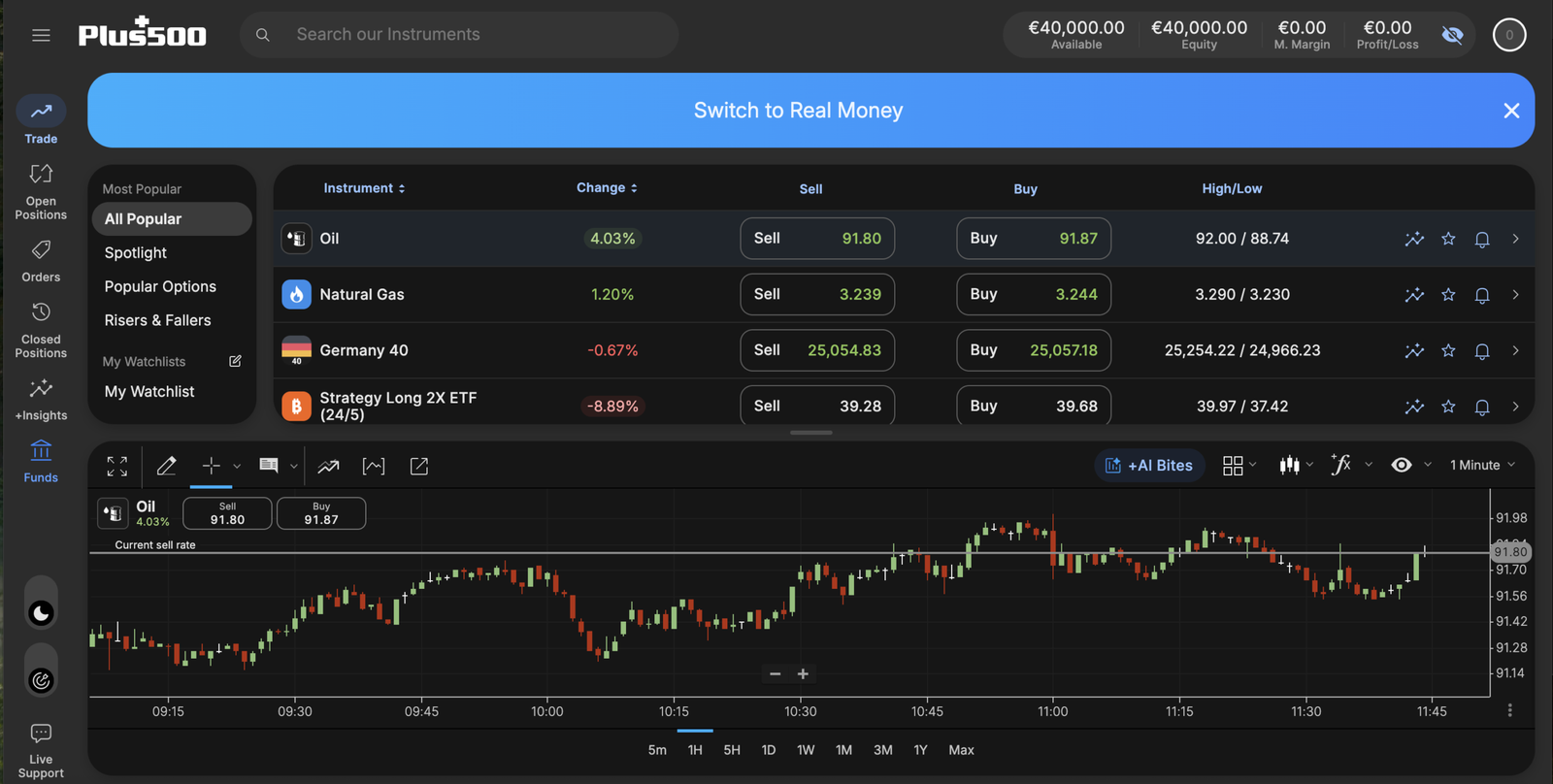
Plus500 is our pick for simple CFD trading because it is one uncluttered app that does CFDs and nothing else.
Every cost sits in the spread, the demo never expires and there is a single order ticket to learn across 2,800+ instruments. When I tested it, I went from search to an open position in four taps.
The trade-off is that simplicity is all you get: no MT4, MT5 or TradingView, no integrated news, an inactivity fee after three months without logging in, and the highest retail loss rate of the eight platforms here.
Key information
| Field | Details |
|---|---|
| Best for | Simple, CFD-only trading |
| Retail accounts losing money | 76% |
| Minimum deposit | Set per payment method inside the platform; Plus500 says you can start from £50 |
| CFD instruments | 2,800+ |
| Trading costs | Spread only, no commission; spreads are dynamic and shown in each instrument’s details |
| Guaranteed stops | Yes; paid for through a wider spread on that trade |
| Currency conversion | Up to 0.7% of the realised profit or loss on non-GBP instruments |
| Inactivity fee | Up to $10 a month after three months without logging in |
| Deposit and withdrawal fees | None from Plus500 |
| Platforms | Plus500 web and app only |
| TradingView, MT4, MT5 | No |
| Demo account | Yes, unlimited |
| Spread betting | No |
| Retail leverage | Up to 30:1 on forex; FCA caps of 20:1 on major indices and gold and 5:1 on shares |
| FCA regulated | Yes (FRN 509909) |
| FSCS | Cover up to £85,000 if the firm fails |
What I tested: Plus500 app on a Google Pixel 8, with one session on the web platform in Chrome, retail CFD account, two demo trades, then £200 deposited by debit card, September 2026.
What was it like using Plus500?
I treated Plus500 as a phone-first account and judged it as I would any of the top trading apps, because that is how most of its users trade. I placed two practice trades on the demo, which has no time limit, then deposited £200 by debit card, which arrived instantly. Sign-up to first live trade took 15 minutes.
On the live account I searched gold, set my size and reached an open position in four taps. Gold needs 5% margin at the FCA’s 20:1 cap, and the margin figure on the ticket matched 5% of the position’s value.
I wanted to know what a guaranteed stop costs here, because Plus500 does not quote a premium. It widens the spread on that trade instead.
I opened the ticket twice, once with the guaranteed stop ticked and once without, and compared the two spreads: $0.45 without it and $0.85 with it. That works, but IG and Capital.com are clearer: they show a fee and only charge it if the stop triggers.
I then opened a small EUR/USD position at a 0.9-pip spread and looked for news to explain a move. There is no integrated news feed, only +Insights sentiment data, so I went elsewhere for that. I withdrew £100 to my card and it arrived two working days later.
How much does Plus500 cost?
Plus500 charges through the spread and takes no commission. Spreads are dynamic, and the current figure is shown in each instrument’s details. Positions held overnight pay or receive overnight funding.
A guaranteed stop is paid for with a wider spread on that position. Trading an instrument priced in another currency costs up to 0.7% of the realised profit or loss. Plus500 charges up to $10 a month if you do not log in for three months. That fee depends on logging in, not on trading, so checking the account once a quarter avoids it. It charges nothing for deposits or withdrawals.
Who should use it?
Traders who want to trade CFDs from a simple app and do not need outside charting, automation or research. The unlimited demo and single ticket layout make it quick to learn.
Who should avoid it?
Traders who chart in TradingView, automate through MetaTrader or want market news in the platform should choose IG, Pepperstone or CMC Markets. Anyone who wants spread betting or copy trading will not find either here, and beginners who want teaching material as well as a simple app are better served by XTB or eToro.
Pros & cons
- One ticket layout for every market
- Demo account that never expires
- Spread only, with no commission and no deposit or withdrawal fee
- No MT4, MT5, TradingView or integrated news
- Guaranteed stop cost is hidden in a wider spread
- Inactivity fee of up to $10 a month after three months without logging in
8. Spreadex – Best for UK CFDs and spread betting
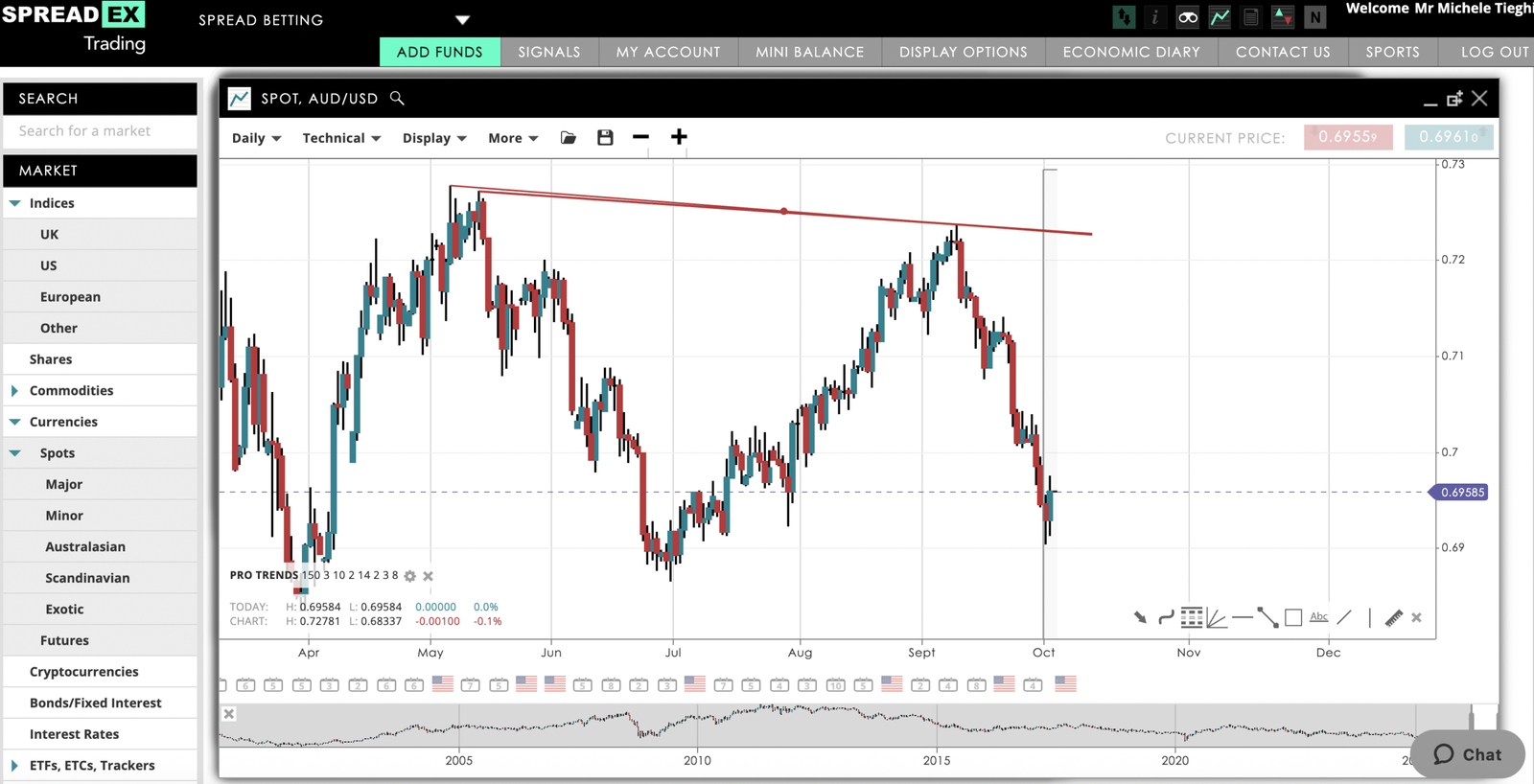
Spreadex is our pick for UK traders who want CFDs and spread betting together, because you can switch between the two on the same market from one login.
It covers 10,000+ markets with no account maintenance or inactivity fee and spreads from 0.6 points on EUR/USD and 1 point on the UK 100. When I tested it, the FTSE 100 spread was 1 point as a CFD and 1 point as a spread bet.
The trade-off is a narrower setup than the brokers above: no demo account, no MT4 or MT5, and no way to practise before your first live trade.
Key information
| Field | Details |
|---|---|
| Best for | UK traders who use both CFDs and spread betting |
| Retail accounts losing money | 61% |
| Minimum deposit | £5 |
| Minimum withdrawal | £5 |
| Markets | 10,000+ |
| Index, FX and commodity CFDs | Spread only: EUR/USD from 0.6 points, UK 100 from 1 point, gold from 0.4, Germany 40 from 1.4 points |
| Share CFDs | Commission, shown on each share’s Market Information page |
| Overnight financing | Benchmark rate plus a Spreadex charge, which is 4% in Spreadex’s share example |
| Other fees | No joining, account maintenance or inactivity fee; standard deposits and withdrawals are free |
| Platforms | Spreadex web and app, TradingView (no MT4 or MT5) |
| Demo account | No |
| Spread betting | Yes, on the same login as CFDs |
| Copy trading | No |
| Retail leverage | FCA caps: 30:1 major FX, 20:1 major indices and gold, 5:1 shares |
| FCA regulated | Yes (FRN 190941) |
| FSCS | Cover up to £85,000 if the firm fails |
What I tested: Spreadex web platform in Chrome on a MacBook, then the Spreadex app on an iPhone 15, retail account with CFD and spread betting enabled, £600 deposited by debit card, September 2026.
What was it like using Spreadex?
I built the test around the one thing the other seven do less neatly: trading the same market two ways. Sign-up to first trade took 11 minutes, and my £600 debit card deposit arrived instantly.
There is no demo, so my first order was live, and I kept it small: a FTSE 100 CFD at £1 a point. I closed it, switched the same market to a spread bet and staked the same £1 a point. Index margin is 5% of the position’s value, so £1 a point with the FTSE near 10,000 needs about £500.
The point of comparing them was tax, not price. I recorded both spreads within the same minute and both were 1 point.
Profits on the spread bet are currently free of capital gains tax and stamp duty for UK residents, but losses give no tax relief. A CFD profit is taxable, but a CFD loss can be set against other gains. Having both on one login meant I could choose per trade. Tax treatment depends on your circumstances and can change.
I then opened GBP/USD from a TradingView chart at a 0.9-point spread and rang the UK support line to ask about share CFD commission. The call was answered in two minutes and the agent pointed me to the commission line on the share’s Market Information page.
The friction is the missing demo. I would not send a first-time trader here to learn. I withdrew £100 and it was back on my card within two hours.
How much does Spreadex cost?
Spreadex charges a spread on index, forex and commodity CFDs and a commission on share CFDs. Spreads start at 0.6 points on EUR/USD, 1 point on the UK 100 and 0.4 on gold. Share CFD commission is charged as a cash debit and is shown on each share’s Market Information page.
Spread bets are commission-free, with the cost in the spread. Positions held overnight pay financing. Spreadex charges no joining fee, no account maintenance fee and no inactivity fee, and standard deposits and withdrawals are free with a £5 minimum.
Who should use it?
Experienced UK traders who already know how leverage works and want CFDs and spread bets side by side. It suits people who value a UK-based phone team, trade from TradingView charts and want no inactivity or account maintenance fee.
Who should avoid it?
First-time traders should start with one of the top demo trading accounts, such as Capital.com, Plus500 or eToro. Algorithmic traders need Pepperstone, because Spreadex has no MT4, MT5 or cTrader, and traders who want direct market access through L2 Dealer should choose IG.
Pros & cons
- The same market as a CFD or a spread bet without changing platform
- No joining, account maintenance or inactivity fee
- UK-based phone support, answered in two minutes in my test
- No demo account, so the first trade is with real money
- No MT4 or MT5
Read the complete Spreadex review here.
How I tested and ranked the best CFD trading platforms in the UK
I review every platform through Psyfi Money’s broader review process, which is where a platform’s overall rating comes from. For this guide I applied a separate weighting built for a UK retail trader choosing a CFD account, so the order here reflects fit for CFD trading, not that wider rating. Before ranking anything, I checked that each platform is FCA authorised and offers CFDs to UK retail clients; all eight are, so regulation and the FCA leverage caps earned no extra credit.
| Ranking factor | Weight | What I assessed |
|---|---|---|
| Trading costs | 25% | Spread or fee on the ticket for a forex or index trade, share CFD commission and its minimum, and the round-trip cost of a small share CFD position |
| Markets and platforms | 20% | Number of CFD markets, from 1,200+ to 21,000, and support for MT4, MT5, cTrader, TradingView and ProRealTime |
| Risk controls and practice | 15% | Guaranteed stops and how each broker charges for them, plus whether the demo account expires or exists at all |
| Holding and account costs | 15% | Overnight funding rates, currency conversion, inactivity or dormancy charges, and deposit and withdrawal fees |
| Getting started | 15% | Minimum deposit, time from sign-up to first trade, deposit and withdrawal times, and how clearly the ticket shows costs |
| Tools and extras | 10% | Built-in charting and analysis, education, copy trading, automation, and spread betting on the same login |
I opened a retail account with all eight in September 2026, deposited between £100 and £1,500, and placed small trades. The most telling comparison was a small share CFD: £1,000 of Barclays at IG cost £20 to open and close, which is 2%, while a $500 Apple position at XTB showed 0.00 commission. I also left a £1,000 UK 100 position open overnight at Capital.com, and the statement showed a 21p funding charge.
Costs carry the most weight because a CFD trader pays them on every trade, and a £10 minimum commission matters far more on a £1,000 position than another indicator does. Markets and platforms come next because this is an overall guide, not a ranking of the leading forex brokers or a beginner-only list, which is why Pepperstone can be the cheapest for forex and still sit mid-table. These weights set the order in this guide only; each platform’s Psyfi Money review rating stays separate.
Your draft contains no platform review ratings, so there were no rating conflicts to check. I can add this section to the Word file ahead of the reviews if you want it there.
Platforms We Considered but Didn’t Rank
I considered a wider group of UK CFD trading platforms before settling on the eight in this comparison.
I focused on platforms with a distinct proposition that could be assessed against the same core criteria, including trading costs, platform usability, market coverage, funding and withdrawals, research and charting tools, and suitability for UK CFD traders.
I did not include every established CFD broker simply because it offers leveraged trading. That would make the comparison broader, but not necessarily more useful.
AvaTrade, Trading 212, Admirals, City Index, Saxo and OANDA were considered but were outside this eight-platform test.
That does not make them unsuitable. Each has legitimate strengths, which the AvaTrade review, Trading 212 review, City Index review and Saxo review cover in detail, but I found the eight platforms above offered clearer and more useful propositions for this particular comparison: overall range, accessible CFD trading, copy trading, active and forex trading, advanced charting, education, simple CFD trading, and UK CFDs and spread betting.
If a platform is not listed above, do not read that as a negative verdict. This is a focused comparison of eight CFD trading platforms, not a directory of every UK broker or a ranking of the highest-rated UK trading platforms overall.
How Does CFD Trading Work in the UK?
A contract for difference (CFD) lets you speculate on whether the price of an asset will rise or fall without owning the underlying asset. You can trade markets including forex, indices, shares and commodities, and you can potentially profit from both rising and falling prices.
CFDs are leveraged products. Instead of paying the full value of the position, you deposit a percentage of its value as margin. This means a relatively small amount of capital can control a larger position — but it also means losses can build quickly.
How a CFD trade works
- Choose a market — such as EUR/USD, the FTSE 100, gold or a share.
- Choose your direction — buy if you expect the price to rise or sell if you expect it to fall.
- Choose your position size — this determines how much you gain or lose for each movement in the market.
- Set your margin and risk controls — your broker will show the margin required to open the position.
- Open the trade — the broker charges the applicable spread and, where relevant, commission.
- Hold or close the position — holding a CFD overnight can introduce additional financing costs.
- Calculate the final result — your profit or loss is affected by the market movement plus spreads, commissions, financing and other applicable charges.
Example: trading a £1,000 CFD position
Suppose you open a £1,000 long position on an index CFD and the broker requires 5% margin. You would need approximately £50 of margin to open the position.
If the index rises by 2%, the position gains £20 before trading costs. If it falls by 2%, the position loses £20.
The important point is that the £50 margin is not the maximum amount you can lose on the trade. Your profit or loss is based on the full £1,000 exposure, subject to the protections and terms that apply to UK retail CFD accounts.
For UK retail clients, FCA rules limit leverage on CFDs according to the underlying asset and require firms to apply protections including a 50% margin close-out rule and negative balance protection.
The exact margin, spread, financing cost and available markets vary between brokers, which is why comparing the platform — rather than simply choosing the lowest advertised spread — matters.
How to Choose a CFD Trading Platform
The best CFD platform depends on what you trade, how often you trade and which features you need. The lowest advertised spread does not always mean the lowest overall cost.
We compare:
1. Total trading costs
Look beyond the headline spread. Costs can include:
- spreads and commission
- overnight financing
- currency conversion
- guaranteed-stop fees
- inactivity or withdrawal fees
A low spread can still be expensive if commission or financing costs are high.
2. Markets available
More markets do not automatically mean a better broker. Choose one that offers the instruments you actually trade, whether that is forex, indices, shares, commodities or other CFDs.
3. Trading platforms
Check whether the broker supports the platform you prefer, such as:
- MetaTrader 4 or 5
- TradingView
- cTrader
- proprietary platforms
The differences can be significant. Pepperstone supports several major third-party platforms, while XTB focuses on its xStation platform.
4. Execution quality
Advertised minimum spreads are only part of the picture. We look at live pricing, execution and slippage to assess what traders are actually likely to experience.
5. Risk-management tools
Useful features include stop-losses, guaranteed stops, take-profits, margin alerts and negative balance protection. Guaranteed stops can help with market gaps but usually come at an additional cost.
6. Deposits and withdrawals
We also consider minimum deposits, payment methods, withdrawal times and fees. A trading platform needs to work well beyond the trading screen.
7. Match the platform to your style
Beginners: simple platforms, education and demo accounts.
Forex traders: competitive spreads, commissions, execution and MT4/MT5 or cTrader.
Advanced traders: broad markets, advanced charting, order types and platform choice.
CFD and spread betting traders: a broker offering both products.
There is no single best platform for every trader. Our overall ranking combines these factors, while our category winners highlight the strongest options for specific trading styles.
How to place a trade on a UK CFD trading platform?
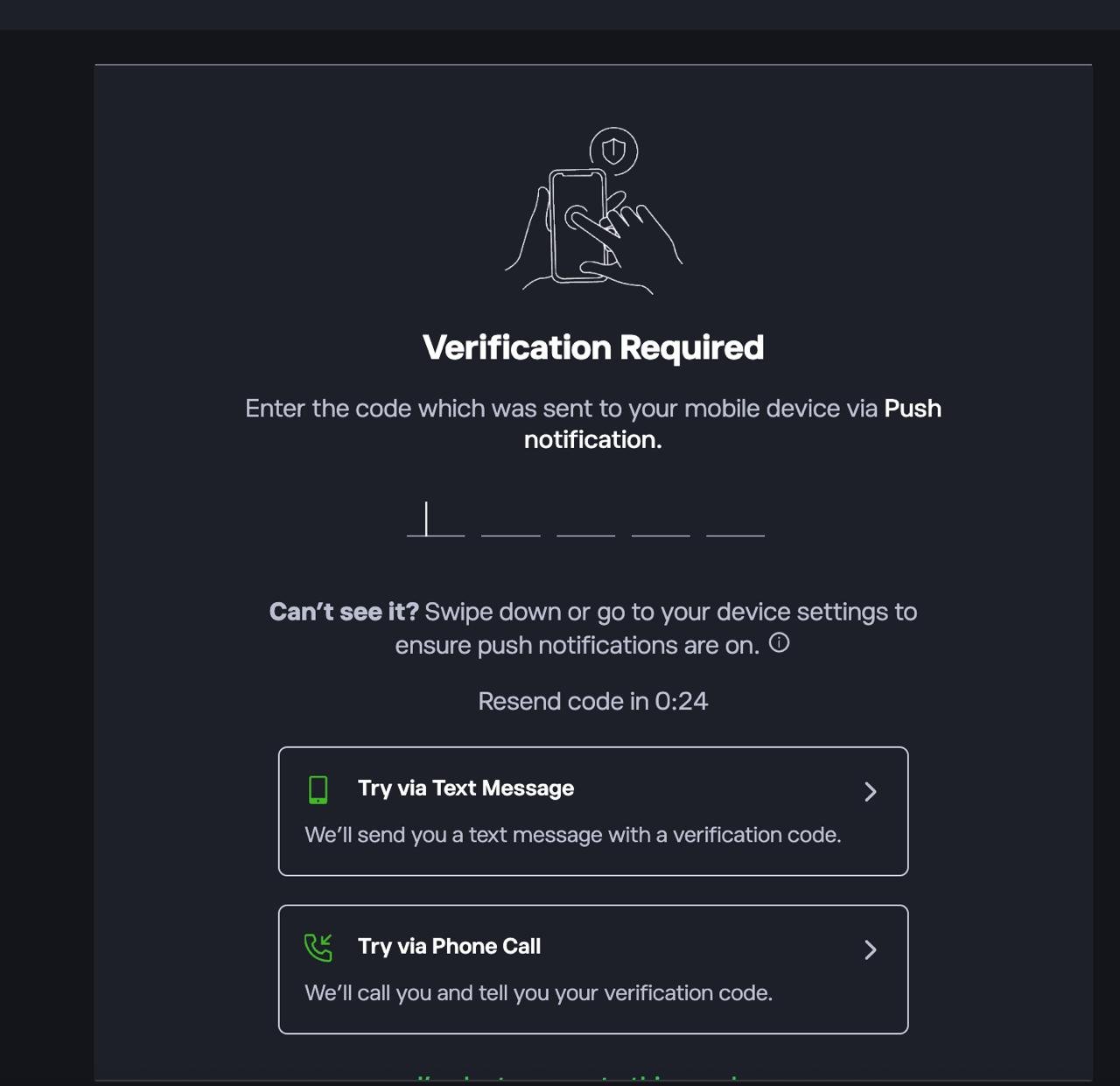
1. Log in to the platform
If prompted, complete 2FA by entering the code sent via push notification, SMS, or phone call.
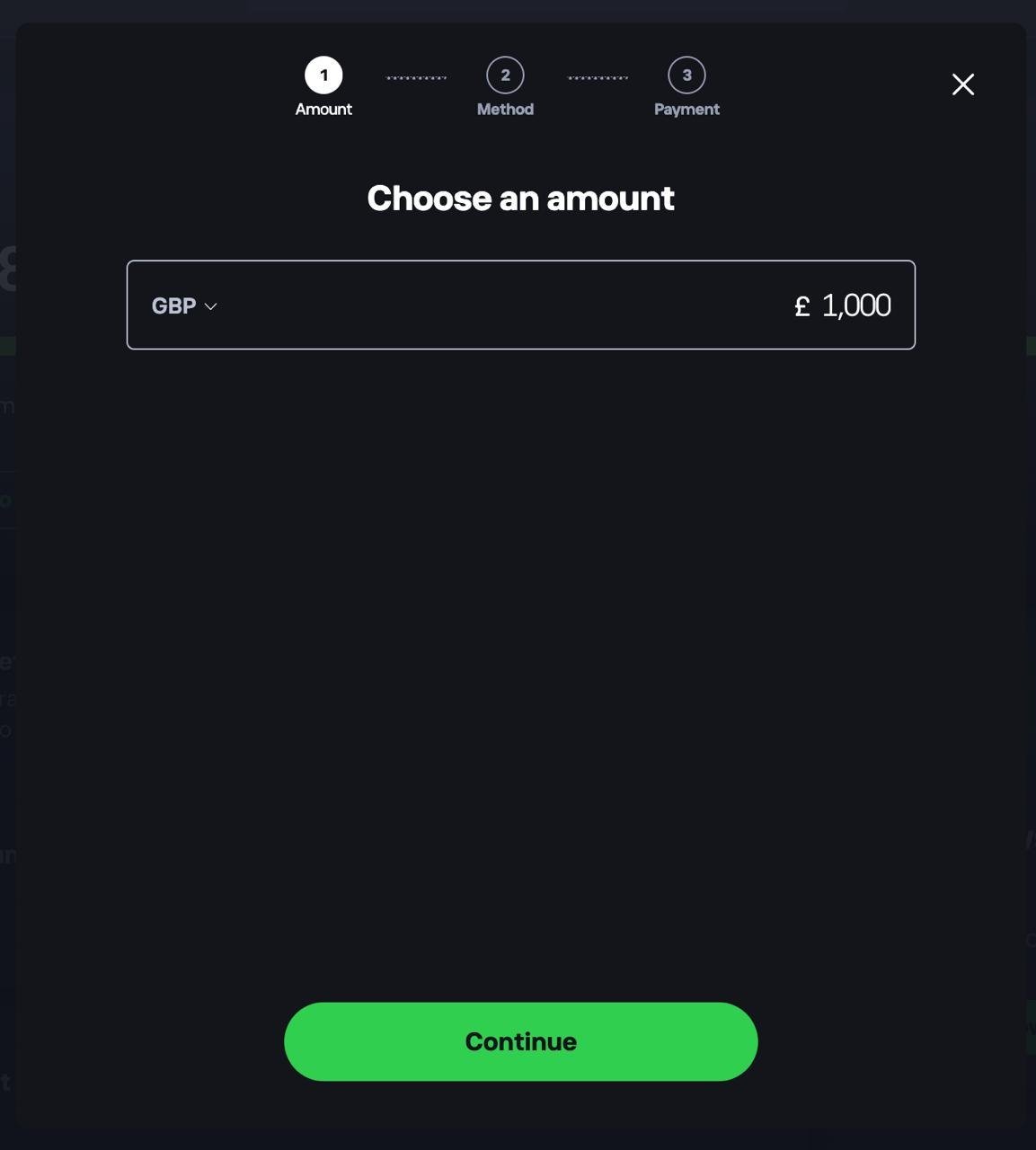
2. Deposit funds into your account
Head to your dashboard and choose to add funds. Select your currency, enter the amount you want to deposit, tap Continue, then choose a payment method.
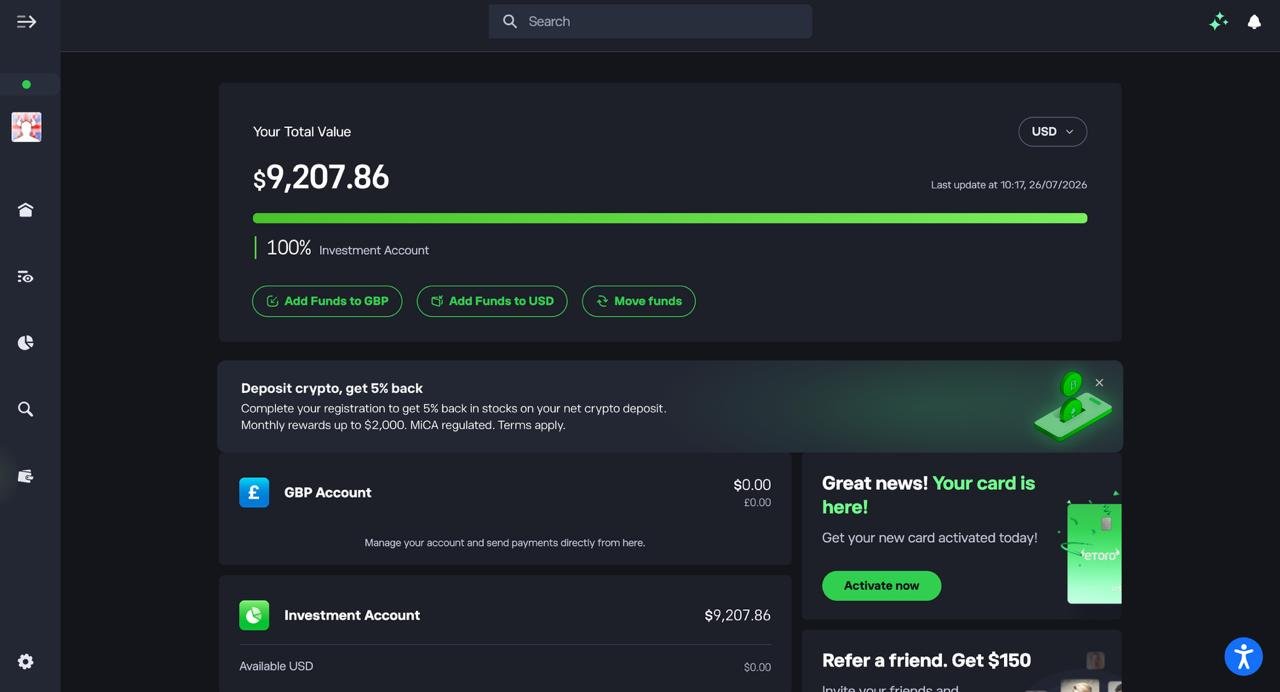
3. Confirm your funds are available
Check your dashboard to make sure your deposit has landed in your Investment Account before you start trading.
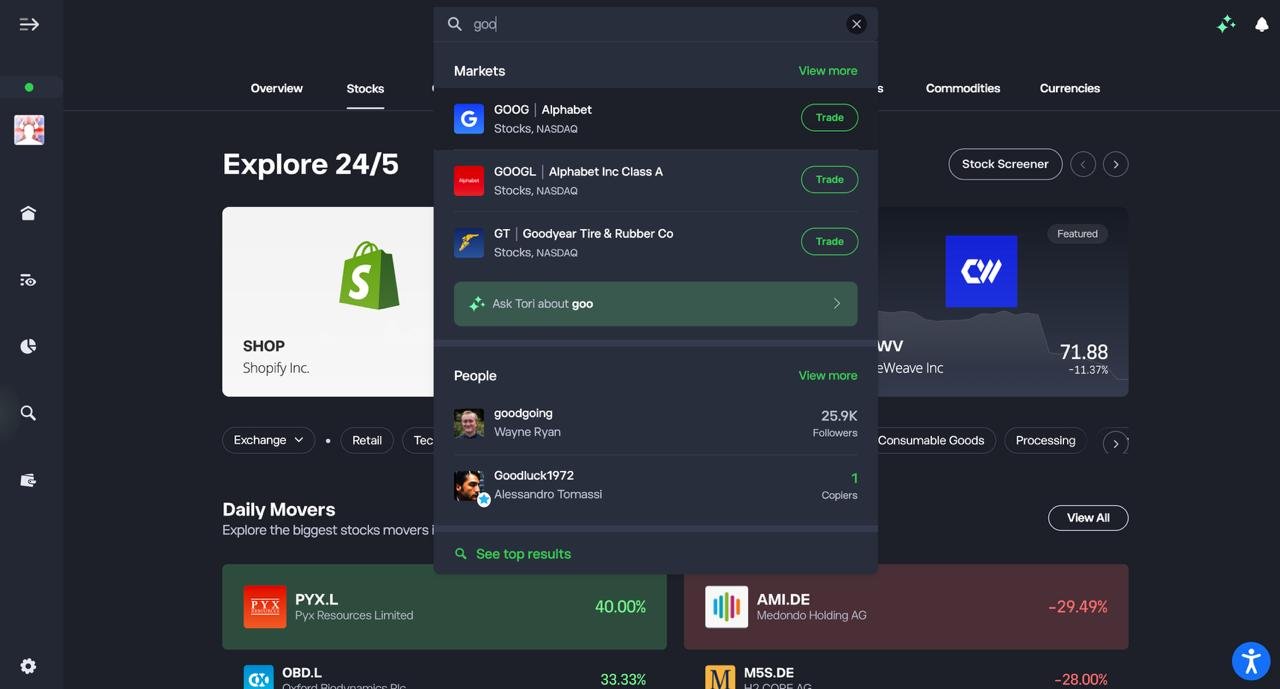
4. Search for the stock you want to trade
Use the search bar to type in the ticker or company name, then select it from the Markets results.
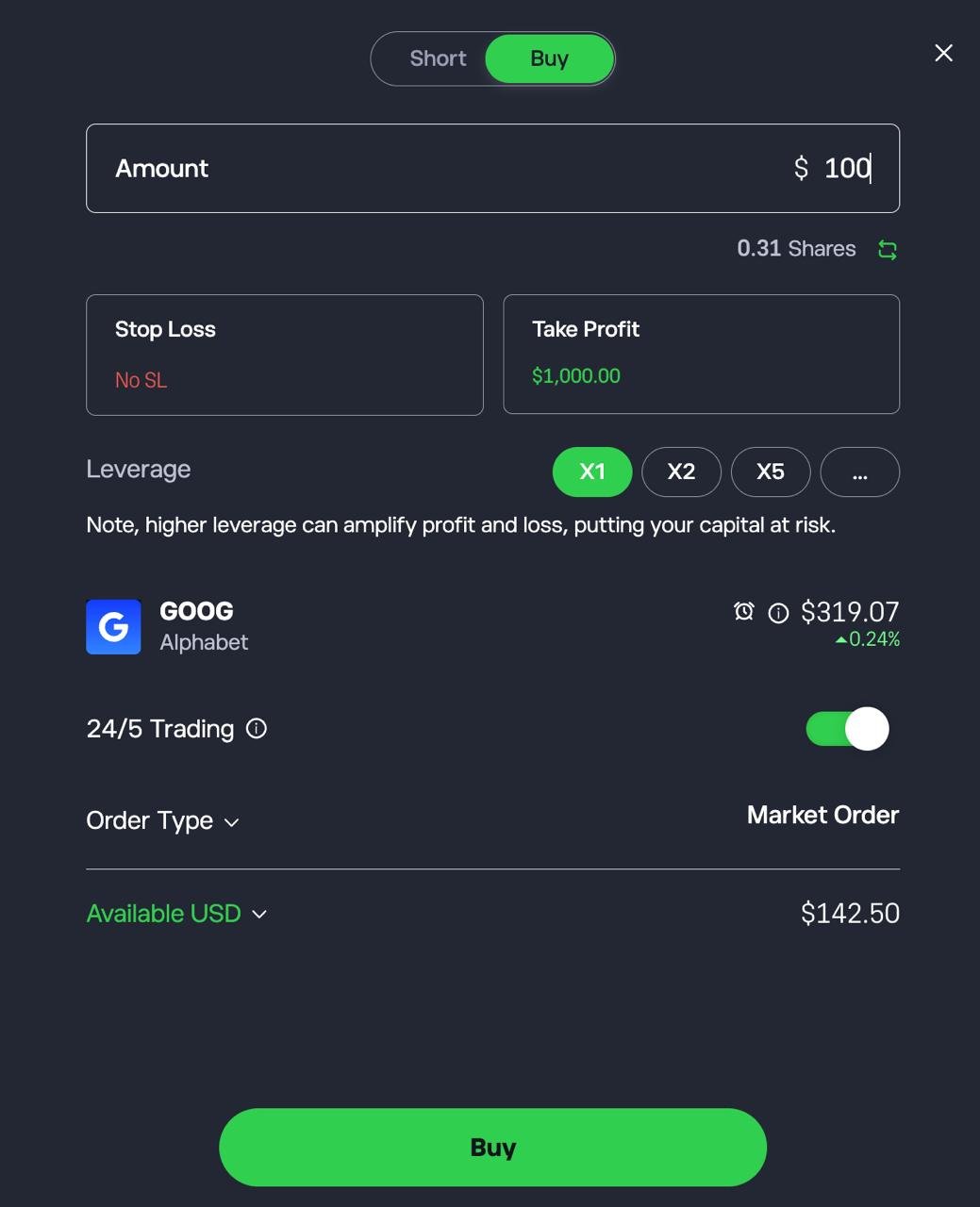
5. Set up and confirm your trade
Choose Buy or Short, enter the amount you want to invest, optionally set a Stop Loss and Take Profit, then tap Buy or Short to confirm.
CFD Trading Costs in the UK
CFD trading costs are more complicated than the spread shown beside an instrument.
The total cost of a trade can include the spread, commission, overnight financing, currency conversion and other account or platform charges.
The main CFD trading costs
| Cost | What it means |
|---|---|
| Spread | The difference between the buy and sell price |
| Commission | A separate charge applied to some CFD trades |
| Overnight funding | Financing charged when leveraged positions remain open overnight |
| Currency conversion | Applies when your account currency differs from the currency used for the trade |
| Guaranteed stop | An additional charge or wider spread for guaranteed execution at the specified stop level |
| Inactivity fee | Charged by some brokers when an account remains inactive |
| Market-data fees | May apply to certain live exchange prices |
| Deposit/withdrawal fees | Charges that depend on the broker and payment method |
Which CFD platform is cheapest?
There is no useful universal answer.
The cheapest platform for a forex trader can be different from the cheapest platform for someone trading UK share CFDs. A short-term trader choosing between the top day trading platforms can also have a completely different cost profile from someone holding index CFDs for several weeks.
Short-term vs long-term CFD costs
If you day trade, opening and closing a position during the same trading session, the spread and commission can be your main trading costs.
If you hold a leveraged CFD overnight, financing becomes more important.
For longer-term positions, compare the total cost of holding the position, rather than choosing a broker purely because it advertises a low spread.
CFDs vs Spread Betting: Which Is Better in the UK?
CFDs and spread betting both allow UK traders to speculate on price movements without buying the underlying asset. They can also both provide leveraged exposure and allow traders to take long or short positions.
The biggest differences are how the products are structured and their potential tax treatment.
| CFDs | Spread betting | |
|---|---|---|
| Product | Contract for difference | Spread bet |
| Own the underlying asset? | No | No |
| Long and short positions | Yes | Yes |
| Leverage | Yes | Yes |
| UK retail protections | FCA rules apply | FCA rules apply |
| Trading costs | Spread, commission and/or other charges | Usually incorporated into the spread and other applicable charges |
| Capital Gains Tax | Can apply depending on circumstances | Generally not subject to CGT for private UK spread betting |
| Stamp Duty | Generally not charged on CFD trades | Not applicable to the bet |
| Availability | Widely available | Particularly established in the UK |
| Best suited to | Traders who specifically want CFDs | Traders who prefer the spread-betting structure |
Tax treatment depends on your circumstances and activity, so the table should not be treated as personal tax advice.
Which should you choose?
Consider CFDs if:
- you specifically want to trade CFDs;
- you want access to a particular CFD platform or broker;
- you need a specific third-party platform such as MT4, MT5 or cTrader;
- you want the particular markets or instruments offered through CFDs.
Consider spread betting if:
- you are a UK trader who wants to use the spread-betting structure;
- the tax treatment is relevant to your circumstances;
- your preferred broker and markets are available through spread betting.
Some brokers offer both. IG, CMC Markets and Spreadex are examples in our comparison.
If you are primarily interested in spread betting, we compare the top spread betting platforms in the UK separately.
Are CFD Trading Platforms Regulated in the UK?
CFDs are high-risk, leveraged products, so UK retail traders receive specific regulatory protections when dealing with firms covered by the FCA’s retail CFD rules.
The FCA requires firms offering CFDs to retail clients to apply leverage limits, margin close-out rules, negative balance protection and standardised risk warnings.
What leverage can UK retail CFD traders use?
The FCA’s restrictions set maximum leverage according to the underlying asset.
For example, the maximum is generally:
- 30:1 for major currency pairs
- 20:1 for major indices and gold
- 10:1 for commodities other than gold and non-major equity indices
- 5:1 for individual equities and certain other reference values
- 2:1 for cryptocurrencies
There are specific rules and exceptions, so check the applicable product and broker terms before trading.
What is the 50% margin close-out rule?
For UK retail CFD accounts, firms must ensure that a client’s net equity does not fall below 50% of the margin required to maintain their open positions. Where it does, the firm must close positions as soon as market conditions allow.
This is a minimum regulatory requirement. A broker can have its own risk-management procedures that close positions earlier.
Does negative balance protection apply?
UK retail CFD rules require firms to provide protection that limits a retail client’s liability to the funds in the CFD trading account. In simple terms, a retail client should not lose more than the funds held in the relevant CFD account as a result of CFD trading.
That protection should not be confused with protection against losing your deposited money. CFD trading can still result in rapid losses of your available capital.
How can I check whether a CFD broker is FCA authorised?
Check the firm’s legal entity and permissions on the FCA’s Financial Services Register rather than relying solely on a logo or claim on a broker’s website.
We check FCA authorisation as part of our broker-selection process. It is a minimum requirement for the UK retail platforms included in our main comparison, rather than a factor that earns additional points in our ranking.
Are CFD Profits Taxable in the UK?
The tax treatment of CFD trading depends on your circumstances and the nature of your activity, so there is no single tax answer that applies to every trader.
For individuals who are subject to Capital Gains Tax, the current main CGT rates for individuals are 18% and 24% from 6 April 2026, depending on the individual’s taxable income and circumstances. The annual exempt amount for individuals is £3,000 for the 2026/27 tax year.
However, you should not assume that every CFD trade is automatically treated in exactly the same way for tax purposes.
Your circumstances, the nature of your activity and the specific product being traded can affect the treatment.
What about spread betting?
Spread betting is generally treated differently from CFDs for UK tax purposes, with profits from ordinary private spread betting generally not subject to Capital Gains Tax.
That does not mean spread betting is automatically tax-free in every conceivable circumstance. If your trading activity amounts to a trade or your circumstances are unusual, the tax position can be different.
If you trade significant amounts or are unsure how your activity should be treated, get advice from a qualified UK tax professional.
What Are the Risks of CFD Trading?
CFDs provide leveraged exposure to financial markets, which means losses can build quickly. The FCA requires brokers to show the percentage of retail accounts that lose money trading CFDs; these figures are shown in our individual reviews.
Key CFD risks
- Leverage: A small market move can produce a significant gain or loss relative to your margin.
- Market volatility: Economic data, interest-rate decisions, company results and unexpected news can cause sharp price movements.
- Stop-losses: Standard stops do not guarantee an exact exit price if the market gaps. Some brokers offer guaranteed stops for an additional cost.
- Overnight funding: Holding leveraged positions overnight can add financing costs, particularly over longer periods.
- Trading costs: Spreads, commissions, financing and currency conversion all reduce your potential returns.
- Loss of capital: UK retail clients benefit from negative balance protection, but you can still lose the money in your CFD account.
How to reduce CFD trading risk
Learn how to trade CFDs, understand leverage and margin, use sensible position sizes, consider stop-losses, check overnight costs and practise with a demo account before committing significant capital.
CFDs are high-risk products and are not suitable for everyone.
Conclusion
IG is our pick for the best overall CFD trading platform in the UK, combining the widest market choice with strong platform support, risk-management tools and spread betting.
However, the best platform depends on how you trade. Capital.com is our choice for low-cost, accessible CFD trading, eToro for beginners and copy trading, Pepperstone for active and forex traders, and CMC Markets for advanced charting.
Our rankings are based on funded-account testing, live trades, pricing, platform features, funding and withdrawals, rather than advertised spreads alone.
Before opening an account, compare the total cost of trading, available markets, platform, execution and overnight financing against your own trading style. CFDs are leveraged and high-risk, so the cheapest or most feature-rich broker is not necessarily the right one for you.
CFD Trading FAQs
What is the best CFD trading platform in the UK?
Our overall winner is based on our weighted testing methodology. We also name category winners for beginners, forex traders, advanced traders and other trading styles. See the comparison table above for the full rankings.
Which CFD platform is best for beginners?
Look for a simple platform, transparent costs, useful education, a good demo account and strong risk controls. eToro, XTB and Capital.com are our main picks for newer traders, each for different reasons.
What is the cheapest CFD trading platform in the UK?
There is no single cheapest broker. Costs vary by instrument, trade size and holding period, so compare spreads, commissions and overnight financing rather than headline spreads alone.
Which CFD broker has the lowest spreads?
It depends on the market and account type. Among low-spread forex brokers, Pepperstone’s Razor account offers raw spreads plus commission, while other brokers build their costs into the spread. A 0.0-pip spread does not mean zero trading costs.
Are CFDs legal in the UK?
Yes. CFDs are legal for UK retail traders through appropriately authorised firms, subject to FCA rules covering leverage, margin close-out, negative balance protection and risk warnings.
Can I lose more than I deposit trading CFDs?
UK retail CFD rules provide negative balance protection, limiting liability to the funds in the relevant CFD account. You can still lose your entire deposit, and leverage can accelerate losses.
Are CFD profits taxable in the UK?
Tax treatment depends on your circumstances. Where Capital Gains Tax applies, the main individual rates are currently 18% and 24%, with a £3,000 annual exempt amount for 2026/27. See our tax section for more detail.
Is CFD trading better than spread betting?
Neither is universally better. Both offer leveraged exposure, but their costs, structure and tax treatment differ. The better option depends on your trading style, preferred broker and circumstances.
What is the best CFD platform for MT4?
Pepperstone and IG are among our top MT4 brokers. Compare their spreads, commissions, markets and execution alongside platform compatibility.
What is the best CFD platform for TradingView?
Pepperstone, IG and Capital.com support TradingView for UK traders, although the available markets and account features can differ between brokers.
How much money do I need to start CFD trading?
Minimum deposits can be low, but the broker’s minimum is not the same as an appropriate trading balance. Consider the position size, margin requirement and maximum potential loss before deciding how much to deposit.
