

After comparing 6 UK options trading platforms, my top picks are Interactive Brokers for listed options and global market access, IG for the widest range of options products, and Capital.com as a beginner-friendly CFD alternative. Capital.com doesn’t offer options itself. I compared per-contract commissions, FX costs, listed versus cash-settled OTC contracts, multi-leg and analytics tools, and the margin and position-size rules that decide how much you need to place a trade.
Which are the best option trading platforms in UK right now?
| Platform | Best for | What you trade | Options cost | FX fee | Min. deposit | Smallest position | FCA FRN |
|---|---|---|---|---|---|---|---|
| Interactive Brokers | Listed options and global market access | Exchange-listed stock, ETF and index options (US, Canada, Europe, UK, Asia-Pacific) | US: $0.65/contract, $1 minimum per order and per combo leg. UK stock: £1.00 tiered / £1.70 fixed | 0.2 basis points, $2 minimum | £0 | 1 contract | 208159 |
| IG | Broad range of options products | US-listed options, plus OTC daily, weekly and monthly options via spread bet or CFD | US stock and ETF: $1/contract to open, $0 to close. OTC: spread-based | 0.5% | No minimum by bank transfer | 1 contract (US); per-point stake (OTC) | 195355 / 114059 |
| Capital.com | Beginner-friendly CFD alternative to options | No options; CFDs and spread bets only | £0 commission; dynamic spreads; guaranteed stop fee only if triggered | 0.7% | £20 | n/a (up to 20:1 leverage on major indices) | 793714 |
| Saxo | Advanced options analysis | 3,100+ exchange-listed stock and index options from 20+ exchanges | US: $2 / $1 / $0.75 per contract. UK: £3 / £2 / £1 (Classic / Platinum / VIP) | 0.25% | £0 | 1 contract | 551422 |
| CMC Markets | Options through spread betting and CFDs | Cash-settled OTC options on indices, US stocks and ETFs | 0% commission; the spread is the cost | None on spread bets; 0.5% on non-GBP CFDs | £0 | 0.01 of an option | 173730 |
| Spreadex | Spread-bet options and phone dealing | Spread-bet options on 5 indices and US stocks; bespoke strikes by phone | No commission; spreads from 4.8 pts (UK 100) and 12 pts (US equities) | None on GBP spread bets | Not stated (minimum stake £1 per point) | £1 per point | 190941 |
The best UK options trading platforms by use case
- Best for listed options and global market access: Interactive Brokers. Competitive commissions and access to US, UK and European options.
- Best for advanced options analysis: Saxo. Powerful analytics, Greeks and multi-leg strategy tools.
- Best for US-listed and OTC options: IG. Offers both through separate product routes and accounts.
- Best for small-stake, cash-settled options: CMC Markets. Fractional sizing and commission-free trading, with spread costs.
- Best CFD alternative for beginners: Capital.com. A straightforward platform for leveraged trades, but it does not offer options contracts.
Compare product types, total trading costs and account requirements before choosing a platform.
How I tested and ranked these platforms
Following our standard how we test process, I tested each platform with a funded UK account between 28 September and 9 October 2026. I bought listed calls on US ETFs and UK shares, built iron condors and traded cash-settled index options. I also checked the commission, spread and FX shown before confirming each order.
- 6 platforms funded
- £12,850 deposited
- 14 positions opened, including 3 four-leg iron condors
- 2 phone-dealing quotes requested
- 6 withdrawals tested
- Tested on iPhone 17 Pro and MacBook Pro
I then weighted trading costs 25%, contract type and exercise rights 20%, options tools 20%, market and expiry range 15%, position size and account access 10%, and holding costs 10%. FCA authorisation and availability to UK retail clients were musts, not scoring factors.
UK options trading platform reviews
Below, I go through each of the six platforms in ranking order. For each one I cover what you actually trade (listed options, OTC options or a CFD alternative) and what it costs per contract or in spread. I also cover which accounts you need, and the main trade-off to know before you open one.
1. Interactive Brokers – Best for listed options and global market access
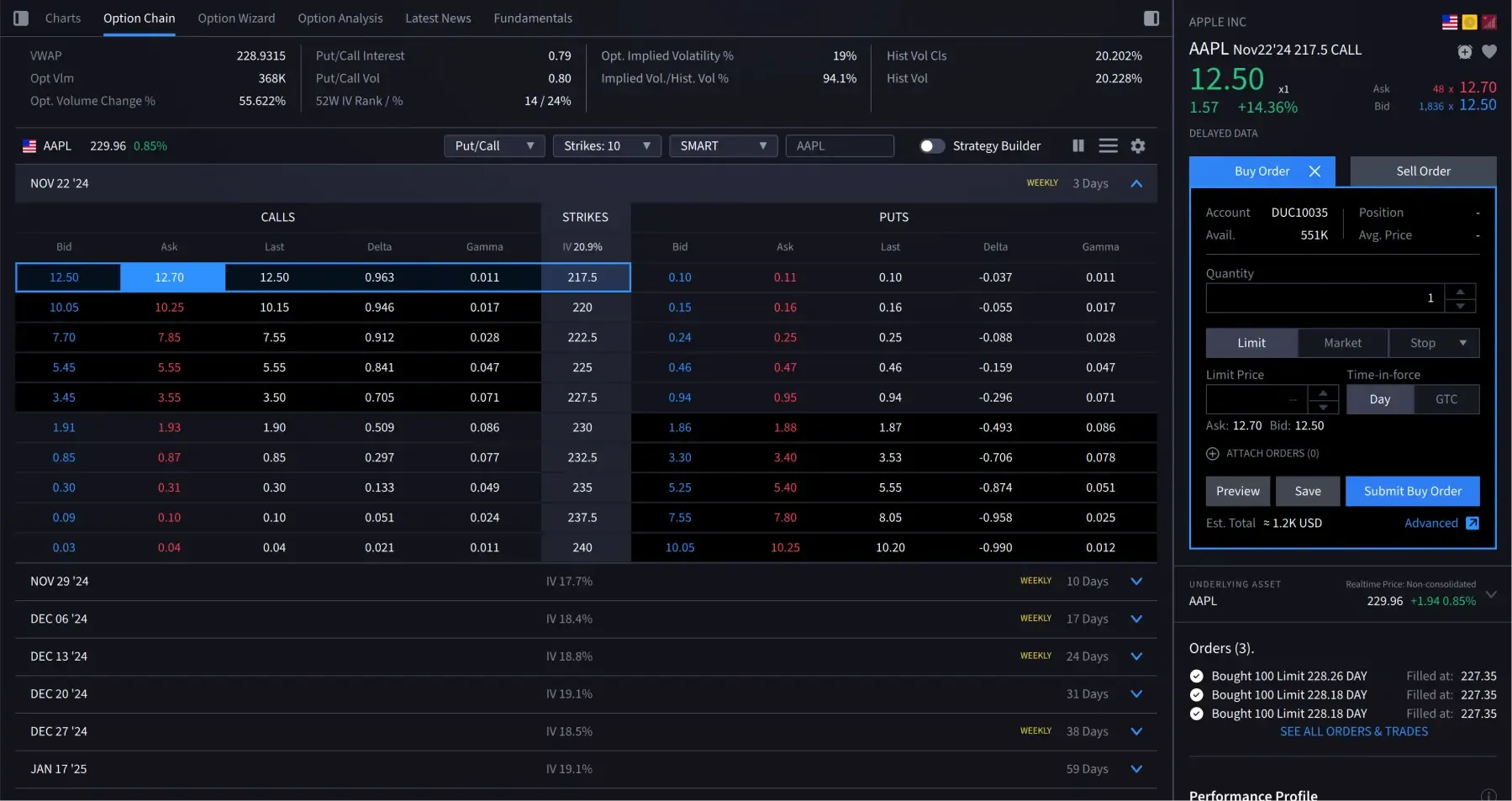
Interactive Brokers is our pick for trading genuine exchange-listed options. It gave me US, UK and European option chains in one account, at $0.65 a contract on US options and £1.40 all-in on a UK stock option. No other platform in this test came close on both cost and market access.
The trade-off is set-up. Options permissions, a paid market data feed and a per-leg order minimum all got in the way before my first trade. If you want options-style trades without that admin, I’d choose IG or CMC Markets instead.
Key information
| Field | Details |
|---|---|
| Best for | Experienced traders who want listed options across several markets |
| Options product | Exchange-traded stock, ETF and index options |
| Account types | Individual cash or margin account; options trading permissions requested separately |
| Options commission | US: $0.65/contract (premium ≥ $0.10), $0.50 ($0.05–$0.10), $0.25 (< $0.05), $1.00 minimum per order and per combo leg. UK stock options: £1.00 tiered / £1.70 fixed. UK index options: £0.60 tiered / £1.70 fixed |
| Other trading costs | Exchange, clearing (OCC $0.025/contract) and regulatory fees; no commission on US exercise/assignment; 0.5% UK stamp duty passed through on UK stock option exercise; US options market data $1.50/month |
| FX fee | 0.2 basis points, $2 minimum |
| Minimum deposit | £0 (no account minimum) |
| Markets | Option exchanges in the US, Canada, Europe, the UK and Asia-Pacific |
| Smallest position | 1 contract (100 shares on US options, 1,000 on UK stock options) |
| Multi-leg and analytics | Strategy Builder, Greeks in the chain, risk/payoff view |
| Platforms | Trader Workstation, IBKR Desktop, Client Portal, IBKR Mobile |
| FCA regulated | Yes, Interactive Brokers (U.K.) Limited, FRN 208159 |
| FSCS | Covered only in limited circumstances; some assets are held with Interactive Brokers LLC (SIPC member) |
What I tested: MacBook Pro (IBKR Desktop) and iPhone 17 Pro (IBKR Mobile), individual margin account with options permissions, £3,000 deposited by bank transfer with £1,500 converted to USD, 1–8 October 2026.
What was it like using Interactive Brokers?
My hands-on test started with £3,000 by bank transfer. I converted £1,500 to dollars first, which gave me about $1,995. At IBKR’s FX rate that cost the $2 minimum, about £1.50. On a platform with a 0.5% FX charge, the same conversion would have cost £7.50.
Options aren’t switched on by default. On Thursday 1 October I requested them in the account’s trading permissions. I answered six questions about my trading experience and how long I’d traded options. Approval came through about 22 hours later, at lunchtime on Friday. The option chain then showed delayed prices until I subscribed to US options market data at $1.50 a month.
When I placed my first US options trade, I bought 2 one-month SPY calls at $5.00 premium, $1,000 in total. The commission came to $1.30, matching IBKR’s published example, and clearing and regulatory fees added $0.10. I then bought one BP call under tiered pricing. Each UK stock option covers 1,000 shares, so at 14p the premium was £140.
The confirmation showed £1.00 commission, £0.37 exchange and £0.03 clearing: £1.40 in total, against a flat £1.70 on fixed pricing.
The costs caught me out on the iron condor. I built it in Strategy Builder on SPY, $5 wide for a $1.40 credit, so the margin held was $360. Strategy Builder showed net premium, maximum profit and loss, and the payoff before I sent the order. At $0.65 a contract the four legs should cost $2.60. Because IBKR applies its $1 minimum to each leg of a combo, it cost $4.00 to open, plus $0.20 in third-party fees.
Going from the chain to a submitted condor took 6 clicks on IBKR Desktop and 11 taps on IBKR Mobile. The mobile app makes you confirm each leg on its own screen. With the calls, the condor and fees paid, I still had about $765 of my dollar balance free.
I closed the SPY calls on Thursday 8 October for the same $1.30 commission. On Monday 5 October I’d withdrawn £100 from the sterling balance, and it was in my bank on Tuesday. There was no fee, because it was my first withdrawal of the month.
How much does Interactive Brokers cost?
Interactive Brokers charges $0.65 per US option contract, with a $1 minimum per order that also applies to each leg of a combo. UK stock options cost £1.00 a contract plus exchange and clearing fees on tiered pricing, or £1.70 fixed. There are no platform or account fees, FX costs 0.2 basis points with a $2 minimum, and US exercise and assignment are free.
On the same one-lot SPY iron condor, IBKR cost $4.00 to open and $4.00 to close. IG cost $4.00 to open and $0 to close, and Saxo Classic $8 each way. If you exercise a UK stock option, the 0.5% stamp duty is passed through to you.
Who should use it?
Experienced traders who want real exchange-listed calls and puts at low per-contract cost, especially anyone trading both US and UK options from one account.
Who should avoid it?
Beginners who want to place a first options trade the day they sign up, and anyone trading one-lot spreads often, where the per-leg minimum lifts the cost.
Read the complete Interactive Brokers review here.
Pros & cons
- Lowest listed-options commissions in the test: $0.65 a US contract, £1.40 all-in on a UK stock option
- US, UK and European option chains in one account
- Near-interbank FX at 0.2 basis points
- Permissions approval and a paid data feed before live quotes
- $1 minimum applies to every leg of a multi-leg order
- Four separate interfaces to choose between
Capital at risk. Options are not suitable for all investors.
2. IG – Best for a broad range of options products
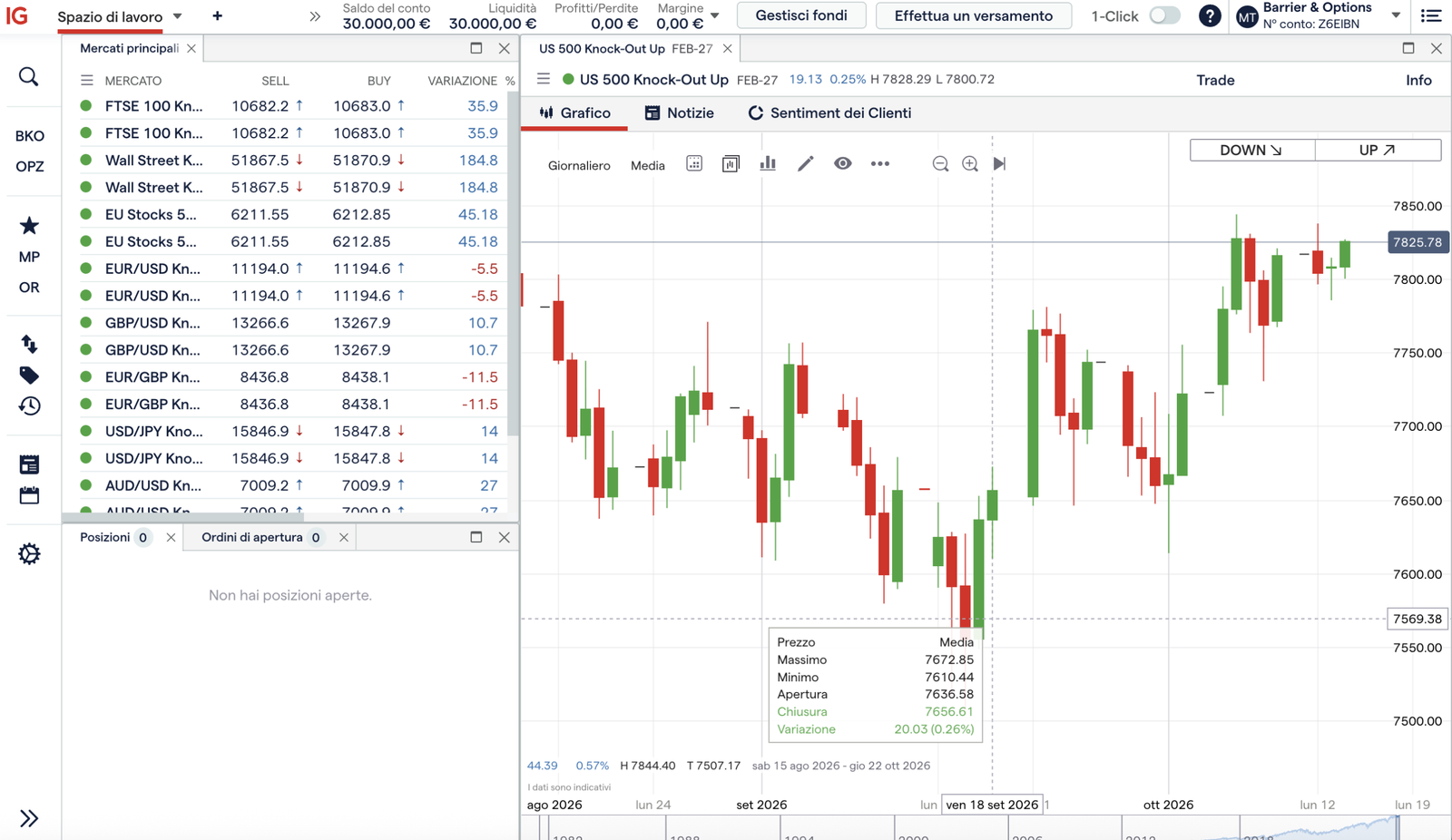
IG is our pick for the widest choice of options routes from one login. US-listed options run through a separate tastytrade-powered account, and IG’s own OTC options sit in its spread betting and CFD accounts. In my testing, the $0 closing commission on US options made it the cheapest round trip on a one-lot iron condor.
The trade-offs are structure and currency. The two routes have different accounts, costs and risk rules, and every pound going into the US account is converted to dollars at 0.5%. If you only want listed options outside the US, I’d choose Interactive Brokers or Saxo instead.
Key information
| Field | Details |
|---|---|
| Best for | Traders who want US-listed options and short-dated OTC options in one place |
| Options product | US-listed stock, ETF, index and futures options; OTC daily, weekly and monthly options via spread bet or CFD |
| Account types | US options and futures account (cash or margin), which needs an existing IG CFD, spread betting or share dealing account. The cash account allows covered calls and cash-secured puts only |
| Options commission | US stock and ETF options: $1.00/contract to open ($10 max per leg), $0 to close. US index options: $1.00 to open, $0 to close. Options on futures: $1.25 each way. OTC options: spread-based; share option CFDs from US$5 per lot per side |
| Other trading costs | Clearing and regulatory fees; margin interest 11% on debit balances under $25,000 |
| FX fee | 0.5% (US options account, charges page dated 8 Sept 2026; the deposit help page says 0.8%) |
| Minimum deposit | No minimum by bank transfer |
| Markets | US-listed options; OTC options on indices including the FTSE 100, Germany 40 and US 500, plus forex, gold, silver and oil |
| Smallest position | 1 contract (US); per-point stake on OTC options |
| Multi-leg and analytics | tastytrade option chain, Greeks, curve/payoff view; IG OTC deal ticket |
| FCA regulated | Yes, IG Markets Ltd (FRN 195355) and IG Index Ltd (FRN 114059) |
| FSCS | Up to £85,000 for UK IG entities (position on the US options account to be confirmed) |
What I tested: MacBook Pro (IG web platform) and iPhone 17 Pro (IG US options app). I used my existing spread betting account plus new US options cash and margin accounts. I deposited £2,500 by debit card and moved £2,000 to the US account. Test dates: 2–9 October 2026.
What was it like using IG?
I already had an IG spread betting account, which IG requires before you can add a US options and futures account. I topped it up with £2,500 by debit card. On Friday 2 October, adding the US account from My IG took about six minutes. I moved £2,000 across, and the statement showed a 0.5% conversion charge of £10, leaving me about $2,647.
I picked a cash account first, and it was live the same afternoon. I bought one QQQ call at $4.20, $420 in total, for $1.00 commission plus $0.14 in clearing and regulatory fees. Then I tried to build an iron condor and found the cash account only allows covered calls and cash-secured puts. I had to add a margin account, which was approved on Monday morning.
On Monday I opened a one-lot iron condor on SPY, $5 wide for a $1.30 credit, which held $370 of margin. It cost $4 to open, the same as IBKR’s per-leg minimum, and nothing to close. Clearing and regulatory fees of about $0.56 applied each way. With about $1,980 of my dollar balance still free, I kept the condor fully cash-covered rather than paying 11% margin interest.
Back in the spread betting account, where £500 was left, I tried IG’s OTC options. They’re spread bets on option prices: cash-settled, impossible to exercise and never rolled over. I bought a weekly FTSE 100 call expiring Friday 9 October at £2 a point at 38. The quoted spread on that near-the-money strike was 2 points, or £4 at my stake. The deal ticket showed £76 of margin, which IG states is also my maximum loss as a buyer. IG also lists daily options on indices, forex and gold, which no listed-options broker here offers.
On Tuesday I moved $100 back to the spread betting account, converted to sterling at the same 0.5%. I then withdrew £100 to my card, and it arrived two working days later.
How much does IG cost?
IG charges $1.00 per contract to open US stock, ETF and index options and nothing to close, capped at $10 per leg on stock and ETF options. Options on futures cost $1.25 each way. OTC options carry no commission except on share options; the cost is the spread. The real cost for UK traders is 0.5% FX on the way into the dollar account and again on the way out.
On a 20-lot iron condor, the $10 cap per leg would keep opening commission at $40 instead of $80. On my £2,000 transfer, FX cost £10.
Who should use it?
Traders who want genuine US-listed options and short-dated OTC options on UK and European indices from one login, especially anyone already spread betting with IG.
Who should avoid it?
Anyone who wants listed UK or European options, which IG’s US account doesn’t cover, and traders who would lose more to the FX charge than they save on closing commission.
Read the complete IG review here.
Pros & cons
- $0 closing commission on US stock, ETF and index options
- Daily and weekly OTC options that listed brokers don't offer
- $10-per-leg cap keeps larger spreads cheap
- 0.5% FX on every conversion into and out of the US account (the help page says 0.8%)
- The cash account blocks spreads, so a margin account is needed
- Two products with different rules, accounts and costs
Spread bets and CFDs are complex instruments and come with a high risk of losing money rapidly due to leverage. 69% of retail investor accounts lose money when trading spread bets and CFDs with this provider.
3. Capital.com – Best beginner-friendly CFD alternative to options
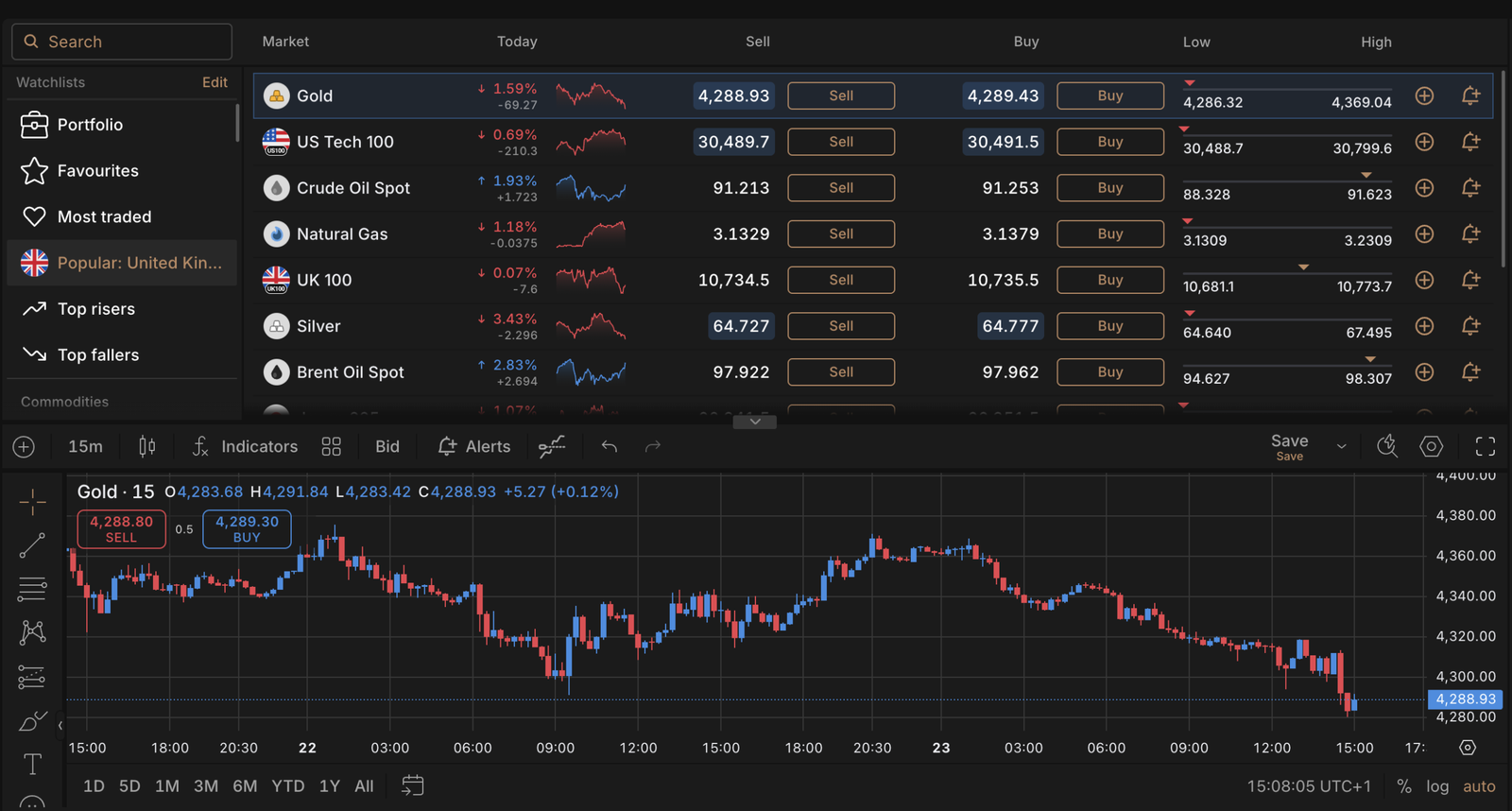
Capital.com doesn’t offer options. It’s on this list for beginners who want short-term leveraged trades with costs shown clearly upfront. In my testing, the deal ticket showed the guaranteed stop fee before I confirmed, and that stop gave me the capped loss most beginners want from buying an option.
The trade-off is that a CFD isn’t an option. It moves point for point with the market from the first tick, and overnight funding is charged every night you hold. If you need actual calls, puts or spreads, I’d choose Interactive Brokers, IG or Saxo instead.
Key information
| Field | Details |
|---|---|
| Best for | Beginners who want a simple, capped-risk alternative to buying options |
| Options product | None. CFDs and spread bets only |
| Account types | CFD, spread betting, unleveraged 1X CFD account |
| Commission | £0; spreads are dynamic |
| Other trading costs | Overnight funding: 4% a year ± SOFR (USD) or SONIA (GBP). Not charged on most 1:1 positions, but charged regardless of leverage on the VIX, natural gas, US cocoa and TRY pairs. Guaranteed stop fee charged only if triggered |
| FX fee | 0.7% of spot rate (retail) |
| Minimum deposit | £20 |
| Markets | Index, share, forex, commodity and bond CFDs |
| Retail leverage | Up to 20:1 on major indices (5% margin) |
| Risk tools | Guaranteed stop-loss with the fee shown on the ticket; TradingView and MT4 |
| Deposit and withdrawal fees | None; minimum withdrawal £20 (varies by method) |
| FCA regulated | Yes, Capital Com (UK) Ltd, FRN 793714 |
| FSCS | Up to £85,000 |
What I tested: iPhone 17 Pro (Capital.com app), then the web platform on a MacBook Pro. Retail CFD account in GBP, £1,000 deposited by debit card, 1–7 October 2026.
What was it like using Capital.com?
I deposited £1,000 by card on Thursday 1 October and was ready to trade 14 minutes after starting the application. The first thing I checked was whether Capital.com offers any options for UK clients. A search for “options” returned no option contracts, only CFDs and spread bets on the underlying markets.
Then I tested whether a CFD can do the job of a bought option. I opened a 0.5-contract long on the US Tech 100 at about 24,800, roughly $12,400 of exposure. At the 20:1 retail limit, the ticket asked for $620 of margin, about £466. I set a guaranteed stop 400 points below entry. The ticket showed a $2.48 fee before I confirmed, charged only if the stop is triggered. That fixed my maximum loss at about $202 including the fee, the closest thing here to an option buyer’s capped premium.
The position was charged $3.10 a night in funding. That’s in line with Capital.com’s own example of $3.03 on $12,084 of exposure.
Next I opened a small short VIX CFD, the nearest thing here to a volatility trade without options. I set it to 1:1 leverage, so the full $300 or so of exposure was held as margin. That left about £310 free in the account, more than the US Tech 100’s worst case. An overnight funding adjustment was still applied from the first night. Capital.com lists the VIX as an exception on its fees page, but it’s easy to miss if you assume a 1:1 position is always funding-free.
I closed both positions on Monday 5 October and withdrew £100. The withdrawal was processed the same day and was on my card on Tuesday.
How much does Capital.com cost?
Capital.com charges no commission and no deposit or withdrawal fees. Your costs are the spread, overnight funding at 4% a year plus or minus the benchmark rate, 0.7% FX on non-GBP markets and the guaranteed stop fee if a stop is hit.
Held for 30 nights, my US Tech 100 position would have cost about $93 in funding. Adding the $202 worst case under the stop, a month could cost around $295. A one-month at-the-money Nasdaq 100 call on the same exposure would cost roughly $280. The difference is that the option’s cost is fixed upfront, while the CFD’s funding keeps growing.
Who should use it?
Beginners who want a simple, low-minimum way to take short-term directional positions with every cost on the ticket, and who don’t need an options contract.
Who should avoid it?
Anyone searching for an options platform to trade calls, puts or spreads, and anyone planning to hold leveraged positions for weeks.
Read the complete Capital.com review here.
Pros & cons
- Guaranteed stop fee shown on the ticket before you trade
- £20 minimum deposit and no commission
- Account opening to first trade in 14 minutes
- No options contracts of any kind
- Overnight funding builds up on longer holds
- 0.7% FX on non-GBP markets
Spread bets and CFDs are complex instruments and come with a high risk of losing money rapidly due to leverage. 65% of retail investor accounts lose money when trading spread bets and CFDs with this provider.
4. Saxo – Best for advanced options analysis
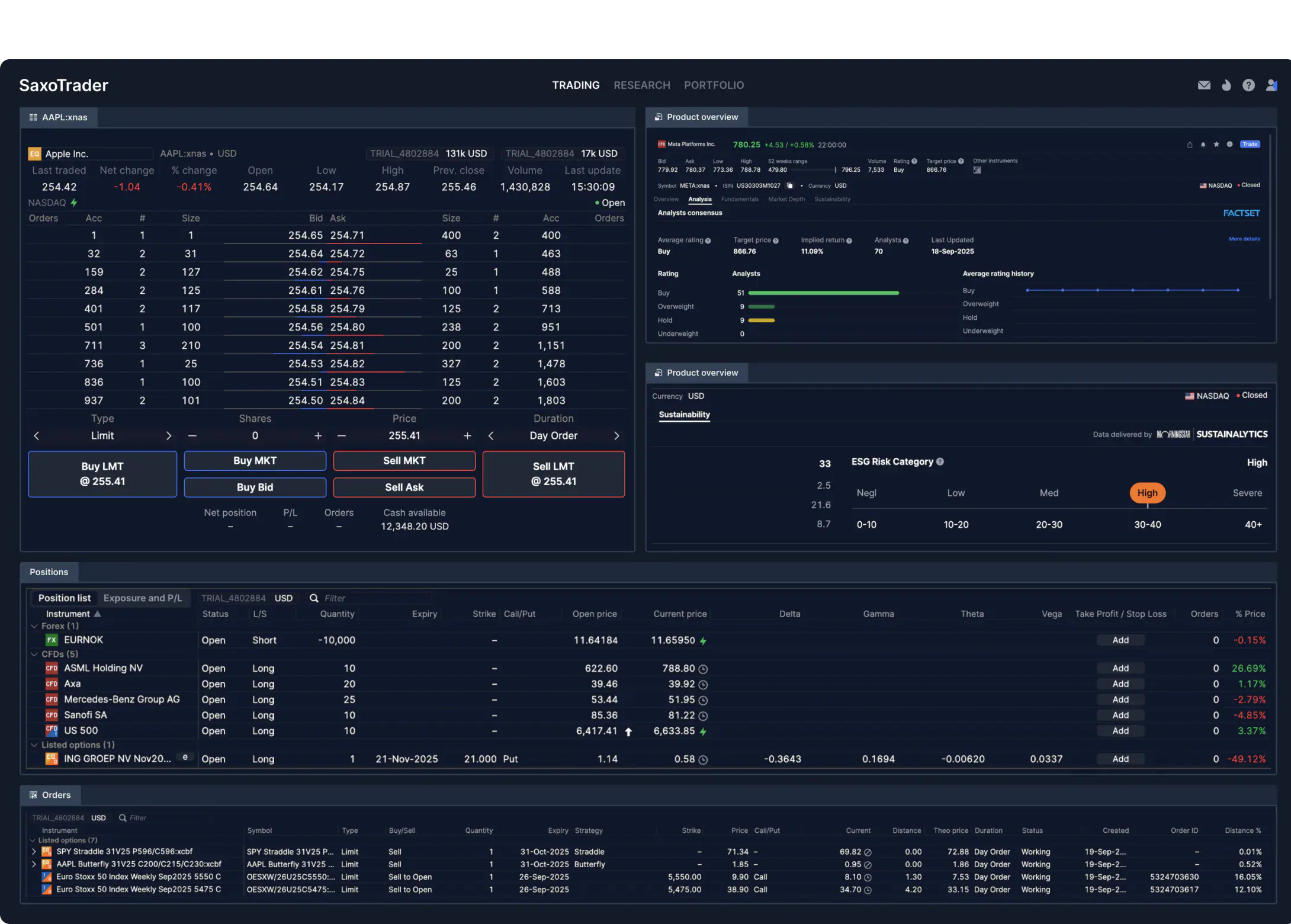
Saxo is our pick for planning complex listed-options trades. SaxoTrader’s pre-filled multi-leg tickets, probability envelope and live risk graph made building an iron condor quicker than anywhere else in the test. It also covers 3,100+ listed options across 20+ exchanges.
The trade-off is cost at the entry tier. Classic accounts pay $2 per US contract, roughly three times IBKR’s rate, and £3 per UK contract, about twice IBKR’s all-in cost. Short options also carry a daily carrying cost. If cost matters more than analytics, I’d choose Interactive Brokers instead.
Key information
| Field | Details |
|---|---|
| Best for | Experienced traders building multi-leg listed-options strategies |
| Options product | Exchange-traded stock and index options, 3,100+ from 20+ exchanges |
| Account types | Saxo account at Classic, Platinum or VIP tier |
| Options commission | Per contract, Classic / Platinum / VIP: US $2 / $1 / $0.75; UK £3 / £2 / £1; EUR €0.75 on all tiers. No minimum commission |
| Other trading costs | Carrying cost on short options: margin × days held × rate (Classic 2.5%, Platinum 1.5%, VIP 0.5% a year); market data subscriptions |
| FX fee | 0.25% |
| Minimum deposit | £0 (no minimum funding) |
| Markets | Options from exchanges in the US, Europe and Asia-Pacific |
| Smallest position | 1 contract |
| Multi-leg and analytics | Pre-filled strategies (straddle, ratio spread, iron condor), Greeks and implied volatility in the chain, probability envelope, 3D volatility chart, risk graph |
| Demo account | 20 days, simulated $100,000 |
| FCA regulated | Yes, Saxo Capital Markets UK Ltd, FRN 551422 |
| FSCS | Up to £85,000 |
What I tested: MacBook Pro (SaxoTrader) with an iPhone 17 Pro for monitoring. Classic-tier account after first using the 20-day demo. £5,000 deposited by bank transfer. Test dates: 28 September–9 October 2026.
What was it like using Saxo?
I started in the 20-day demo, which gives you a simulated $100,000. I’d recommend doing the same, because SaxoTrader has a lot of panels. The live account was approved nine minutes after I uploaded my documents on Monday 28 September, and my £5,000 bank transfer was credited the next day.
I opened the option chain for Shell, added delta and implied volatility columns and saved the layout. The next chain I opened loaded the same way. I bought one Shell call at 45p, a £450 premium on 1,000 shares, for £3 commission.
The strongest part of the test was the iron condor. I picked “iron condor” from the strategy menu on the chain for SPY, the S&P 500 ETF, and the ticket pre-filled all four legs. I used SPY because a single condor on the full-size S&P 500 index ties up thousands of dollars of margin. I dragged the short strikes out until the probability envelope showed a range I was comfortable with. The risk graph redrew as I moved each strike, which made the trade-off between premium and probability easy to see.
Getting from the chain to a submitted condor took 4 clicks, against 6 in IBKR’s Strategy Builder. The condor was $5 wide for a $1.30 credit, held $370 of margin and cost $8 to open.
The friction was the short Nvidia put. I sold one out-of-the-money put on Tuesday 29 September and held it to Friday 9 October. Saxo charged a daily carrying cost based on the roughly £2,000 margin requirement, £1.37 over the 10 days at Classic’s 2.5% rate. With all three positions open, about £2,730 of my £5,000 was committed. I requested a £200 withdrawal on Thursday 8 October and it reached my bank the next working day.
How much does Saxo cost?
At Classic tier, Saxo charges $2 per US option contract, £3 per UK contract and €0.75 per EU contract, with no minimum ticket. FX costs 0.25%. Short options carry a carrying cost: at Classic, 2.5% a year on the margin requirement. With volume, Saxo’s tiers drop to $0.75 and £1 a contract.
My one-lot SPY condor cost $8 to open at Saxo, against $4 at IBKR and IG. With no per-order minimum, though, a single cheap contract can cost less at Saxo than at a broker with a $1 floor per order.
Who should use it?
Experienced options traders who build multi-leg strategies and want probability and volatility analytics on the ticket.
Who should avoid it?
Cost-focused traders placing occasional single-leg trades, and anyone who sells options regularly at Classic tier, where the carrying cost adds up.
Read the complete Saxo review here.
Pros & cons
- Pre-filled multi-leg tickets with a live risk graph and probability envelope
- 3,100+ listed options from 20+ exchanges
- 0.25% FX and no minimum commission
- Classic-tier commissions are roughly three times IBKR's on US options
- Carrying cost on short options
- SaxoTrader takes time to learn; start in the demo
CFDs are complex instruments and come with a high risk of losing money rapidly due to leverage. 60% of retail investor accounts lose money when trading CFDs with this provider.
5. CMC Markets – Best for options through spread betting and CFDs
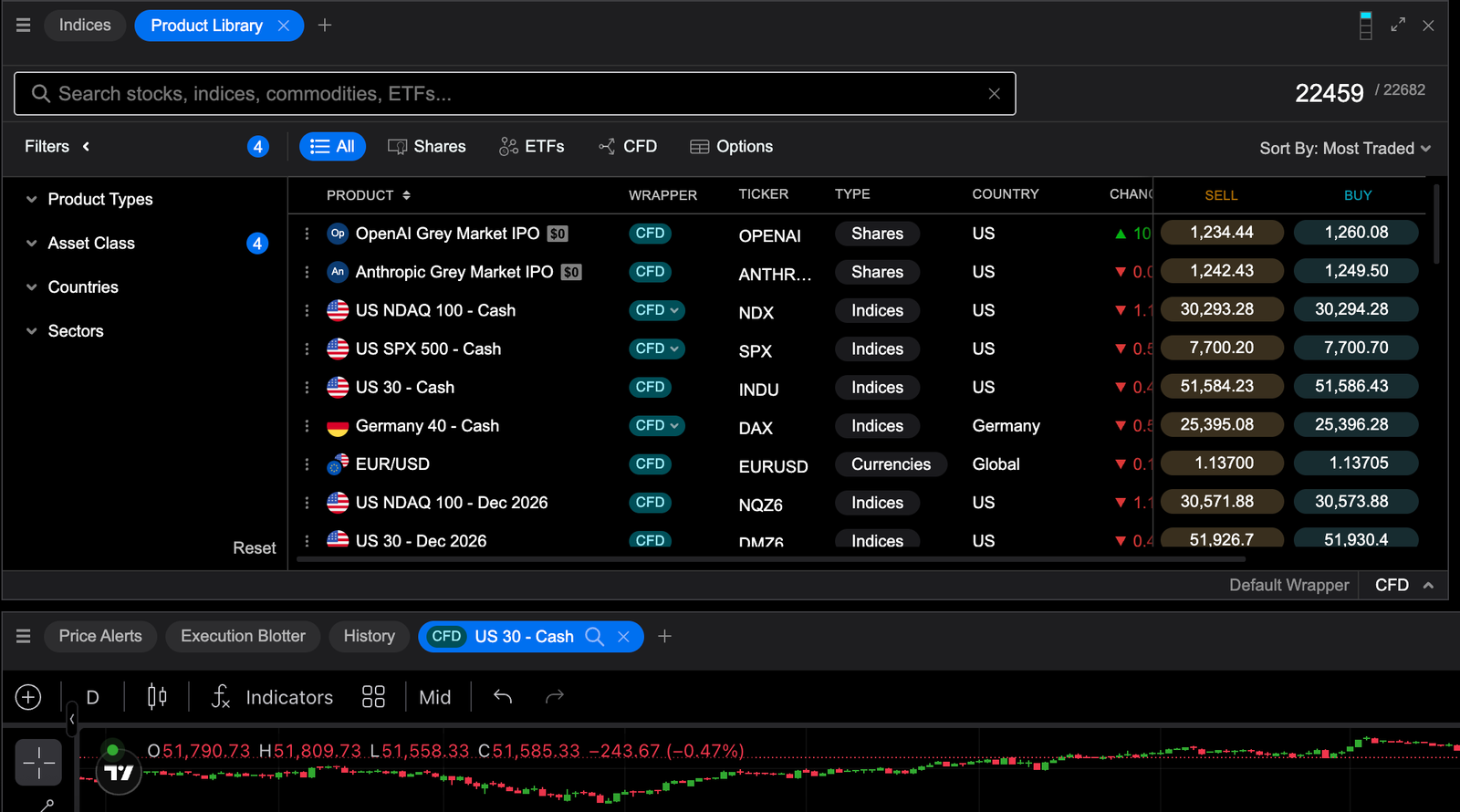
CMC Markets is our pick for small, capped-risk option trades inside a spread betting account. There’s no commission and no holding costs, and you can trade as little as 0.01 of an option. In my test that meant a hedge with £4.20 at risk.
The trade-off is that these are cash-settled OTC options, not exchange-listed contracts, and the spread is the whole cost. On the S&P 500 put I tested, CMC’s spread was wider than the listed option’s. If you want real listed contracts or exercise rights, I’d choose Interactive Brokers or Saxo instead.
Key information
| Field | Details |
|---|---|
| Best for | UK spread bettors who want small, defined-risk option trades |
| Options product | OTC options via spread bet or CFD account; all cash-settled |
| Account types | Spread betting, CFD |
| Commission | 0% |
| Other trading costs | Spread only; no holding costs |
| FX fee | CFD account only, on non-GBP instruments: 0.5% of realised P&L (page footnote; the costs section says 0.7%). Spread bets are staked in GBP |
| Minimum deposit | £0 |
| Markets | Indices including the S&P 500, Nasdaq 100, FTSE 100, DAX 40 and Russell 2000; the “Magnificent Seven” and other US stocks; gold, silver, emerging-market and 20+ year Treasury ETFs |
| Smallest position | 0.01 of an option |
| Multi-leg and analytics | Options chain, real-time Greeks, price alerts |
| Demo account | £10,000 virtual funds |
| FCA regulated | Yes, CMC Markets UK plc, FRN 173730 |
| FSCS | Up to £85,000 |
What I tested: CMC web platform on a MacBook Pro, then the mobile app on an iPhone 17 Pro. Spread betting account, £600 deposited by debit card, 5–9 October 2026.
What was it like using CMC Markets?
I deposited £600 into a CMC spread betting account on Monday 5 October. Buying an option only ties up the premium, so that was far more than these trades needed. I chose spread betting over CFDs because spread bet profits are currently free of capital gains tax for most UK traders, though tax treatment depends on your circumstances. Before options appeared on the platform, I answered five appropriateness questions about leverage and option pricing, which took about three minutes.
My first trade was a hedge. I bought 0.05 units of an S&P 500 put at 84, so the premium at risk was £4.20 (0.05 × 84). On a listed exchange, the smallest trade is a full contract covering 100 shares or the index multiplier. CMC’s fractional sizing is the reason it’s on this list.
The chain showed bid and ask premiums and Greeks for each strike, so I could see the spread before trading. I checked the same strike and expiry against a listed S&P 500 chain at the same moment. CMC’s spread was 1.4 points against 0.8 points on the listed option. At 0.05 units that 0.6-point difference is 3p. On regular, larger trades, it matters more than a commission would.
On Tuesday I bought 0.1 units of a Nvidia call expiring that Friday for £3.40 and held it to expiry. It finished just in the money and settled at its intrinsic value of £1.90, credited that evening, a £1.50 loss. There’s no exercise, no shares delivered and no stamp duty. You also can’t use CMC’s options for strategies that rely on taking delivery, such as wheeling into shares.
Because spread bets are staked in pounds, neither trade triggered a currency conversion. I requested a £100 withdrawal on Wednesday 7 October and it reached my card the next working day.
How much does CMC Markets cost?
CMC Markets charges no commission and no holding costs on options; the only trading cost is the spread. In a CFD account, dollar-priced options also carry a currency conversion charge. CMC’s page quotes it as both 0.5% of realised P&L and 0.7%. Spread bets in pounds avoid it.
My S&P 500 put spread was 1.4 points at CMC against 0.8 on the listed contract. That’s tiny on a fractional hedge, but worth comparing before you trade larger sizes regularly.
Who should use it?
UK spread bettors who want small, capped-risk option trades on major indices and US tech stocks, with no commission and a tax-efficient wrapper.
Who should avoid it?
Traders who want real listed contracts, exercise rights or delivery-based strategies, and anyone trading large sizes where a wider spread costs more than a listed broker’s commission.
Read the complete CMC Markets review here.
Pros & cons
- Fractional options down to 0.01 of a unit
- 0% commission and no holding costs
- Real-time Greeks in the chain
- Spread was wider than the listed equivalent in my test
- Cash-settled only, so no exercise or delivery
- CMC's page gives two different FX rates for CFDs
Spread bets and CFDs are complex instruments and come with a high risk of losing money rapidly due to leverage. 69% of retail investor accounts lose money when spread betting and/or trading CFDs with this provider.
6. Spreadex – Best for spread-bet options and phone dealing
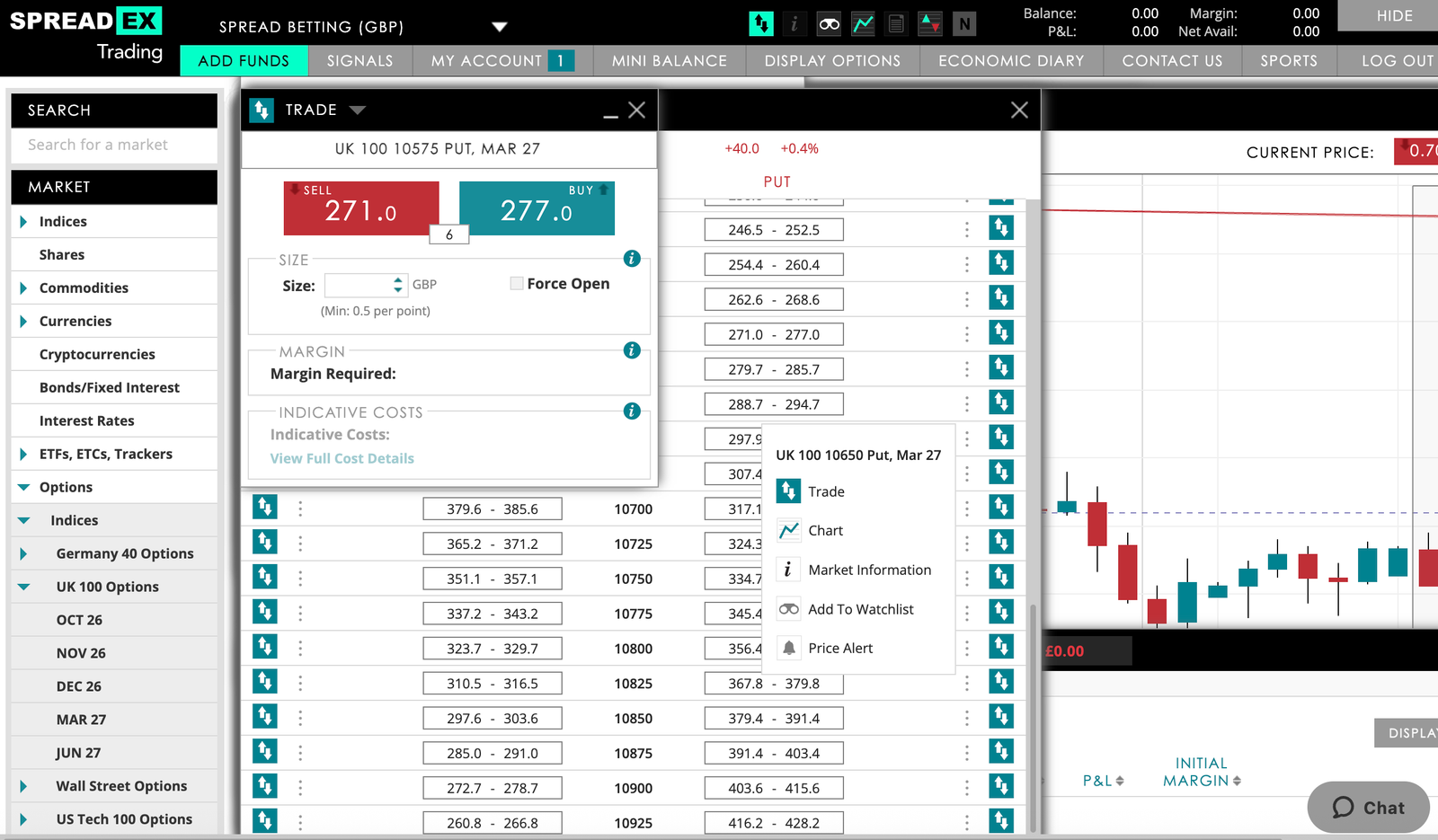
Spreadex is our pick for spread bettors who want a real trading desk on the end of the phone. It offers options on five major indices and a list of US stocks from £1 a point. In my testing, the desk answered in about 40 seconds and priced a bespoke Tesla strike within two minutes.
The trade-offs are a narrow market list, no daily options and published spreads that don’t match between sections of its own pricing page. If you want daily options or a wider choice of underlyings, I’d choose IG or CMC Markets instead.
Key information
| Field | Details |
|---|---|
| Best for | Experienced spread bettors who value phone dealing |
| Options product | Options via financial spread betting; cash-settled online. Bespoke options by phone, which may involve delivery |
| Account types | Financial spread betting |
| Commission | None; the spread is the cost |
| Spreads from | UK 100 4.8 pts; Germany 40 4.8 or 6 pts; SPX 500 0.6 or 1 pt; US Tech 100 6 or 8 pts; Wall Street 28 or 40 pts; US equities 12 pts (the pricing page gives two figures for several markets) |
| Other trading costs | Spreads fixed up to 3 months to expiry (sometimes 6); monthly charges after that |
| FX fee | None on GBP spread bets |
| Minimum stake | £1 per point |
| Markets | UK 100, Germany 40, SPX 500, US Tech 100, Wall Street; US equity options including Nvidia, Tesla, Apple, Amazon, Meta and Palantir |
| Margin | Buying: 100% of premium. Selling: same as the underlying (e.g. 5% of UK 100 exposure) |
| Daily options | Not offered |
| Phone dealing | Yes, 08000 526 570 |
| FCA regulated | Yes, Spreadex Ltd, FRN 190941 |
| FSCS | Up to £85,000 |
What I tested: Spreadex desktop platform on a MacBook Pro, the iPhone app on an iPhone 17 Pro and the phone dealing desk. Financial spread betting account, £750 deposited by debit card, 6–9 October 2026.
What was it like using Spreadex?
I funded a Spreadex spread betting account with £750 on Tuesday 6 October and went to the UK 100 options. The online platform lists calls and puts by strike and expiry. There are no daily expiries, because Spreadex only offers options that also trade on an underlying exchange.
The October call I picked was quoted at 40.2–45, exactly the published 4.8-point spread. I bought at £2 a point at 45. The margin taken was £90, my maximum loss as the buyer, which left £660 free. At my stake, the spread was worth £9.60, the cost of buying and selling straight back. Held to expiry, the FTSE would need to finish 45 points above the strike to break even. The October expiry fell after my test window, so I closed the position on Friday 9 October.
The phone desk was the best part of the test. On Wednesday I called and was answered in about 40 seconds. I asked for a Tesla option at a strike that wasn’t on the platform, and the dealer priced it within two minutes at a 14-point spread. That’s a little wider than the 12 points published for listed US equity options, which seems fair for a bespoke strike. I also asked for a quote on one of the listed UK 100 options, and the phone spread matched the online price exactly.
The friction was Spreadex’s own pricing page. It shows different “from” spreads in different sections for four of the five indices, so I checked the live quote every time. I requested a £100 withdrawal on Thursday and it reached my card the next working day.
How much does Spreadex cost?
Spreadex charges no commission on options; the cost is the spread, from 4.8 points on UK 100 options and 12 points on US equity options. Spreads are fixed for options up to three months to expiry, sometimes six, and Spreadex adds a monthly charge beyond that. As spread bets are in pounds, there’s no FX charge.
At £2 a point, the UK 100 spread cost me £9.60. Buying an option takes 100% of the premium as margin, so my £90 margin was also my maximum loss.
Who should use it?
Experienced UK spread bettors who trade index options at £1 a point or more and want to deal with a real desk for bespoke strikes.
Who should avoid it?
Anyone who wants daily options, a wide choice of underlyings or listed contracts, and anyone holding long-dated options beyond the fixed-spread period.
Read the complete Spreadex review here.
Pros & cons
- Phone desk that prices bespoke strikes quickly
- Phone and online spreads matched on listed options
- No FX charge on GBP spread bets
- Narrow market list and no daily options
- Published spreads conflict between sections of the pricing page
- Extra monthly charges on longer-dated options
Spread bets and CFDs are complex instruments and come with a high risk of losing money rapidly due to leverage. 61% of retail investors lose money when trading spread bets and CFDs with this provider.
How I scored and ranked the best options trading platforms in the UK
I started from Psyfi Money’s broader research into the top UK trading platforms, then applied a weighting built for UK traders who want to trade calls, puts and spreads. Any review rating a platform carries elsewhere on Psyfi Money stays separate from the order in this guide. Before ranking, I checked FCA authorisation, availability to UK retail clients and access to an options product. I treated these as entry requirements rather than awarding points for them.
| Ranking factor | Weight | What I assessed |
|---|---|---|
| Options trading costs | 25% | Per-contract commission, per-order and per-leg minimums, closing commission, OTC spreads and FX on dollar accounts, compared on the same modelled trades |
| Contract type and exercise rights | 20% | Exchange-listed versus cash-settled OTC options, exercise and assignment terms, delivery, and the 0.5% UK stamp duty passed through on stock option exercise |
| Options tools and analytics | 20% | Option chain with Greeks and implied volatility, multi-leg tickets, pre-filled strategies, risk and payoff graphs, probability tools |
| Market and expiry range | 15% | Listed exchanges covered (US, UK, Europe), OTC underlyings such as major indices and US shares, and daily, weekly and monthly expiries |
| Position size and account access | 10% | Smallest position (from 0.01 of an option to one full contract), minimum stake, minimum deposit, buyer and seller margin rules, cash-account limits on spreads |
| Holding and short-option costs | 10% | Carrying cost on short options, margin interest on debit balances, and charges once a spread bet passes its fixed-spread period |
The comparison that separated the platforms most was a modelled one-lot, four-leg iron condor on a US ETF, costed from each provider’s published fees. Interactive Brokers’ $1 per-leg minimum makes it $4 to open and $4 to close. IG charges $4 to open and nothing to close, and Saxo Classic charges $8 each way at $2 a contract. I then added the cost of converting sterling to dollars: IG’s 0.5% charge adds £10 to a £2,000 deposit, while IBKR’s minimum FX charge is $2.
I gave costs the largest weight because options traders open and close positions often. Per-leg minimums and FX charges also change the real cost more than a headline commission does. Contract type carries 20% because a cash-settled OTC option and an exchange-listed contract you can exercise are different products, even though both are called options. These weights set the order of platforms in this guide; any broader Psyfi Money rating for a platform is a separate assessment.
Listed options vs OTC options vs spread betting vs CFDs
Options trading platforms in the UK don’t all offer the same product. Some provide exchange-listed contracts, while others offer cash-settled OTC options, spread bets or CFDs. The difference affects your trading costs, rights, potential losses and how positions are settled.
Exchange-listed options
Listed options are standardised contracts traded on an exchange. Calls give the holder the right to buy the underlying asset at a specified price, while puts give the right to sell it.
Depending on the contract, options can be exercised or allowed to expire. Settlement may involve delivery of the underlying asset or cash settlement. Costs can include per-contract commissions, exchange fees, FX conversion and market data.
Best for: Traders who want genuine options contracts, defined contractual rights and access to listed markets.
OTC options
Over-the-counter (OTC) options are contracts offered directly by a provider rather than traded as standardised exchange contracts. In the UK retail market, some brokers offer options-style exposure through cash-settled products linked to indices, shares or other markets.
These products may not be exercisable and generally settle in cash according to the provider’s terms. Trading costs are often built into the spread, and contract specifications can differ between providers.
Best for: Traders who want options-style exposure with flexible stakes or access to specific markets, without necessarily needing exchange-listed contracts.
Spread betting
Financial spread betting lets you speculate on price movements by staking an amount per point of movement. Some of the top spread betting platforms also offer spread-bet options, where the stake is linked to an option’s quoted price.
Positions are generally cash-settled rather than involving ownership or delivery of the underlying asset. Costs are usually reflected in the spread, although additional charges may apply to certain products or holding periods. Leverage can magnify losses.
Best for: UK traders who want to speculate in sterling and prefer stake-based trading rather than buying standardised exchange contracts.
CFDs
Trading CFDs (contracts for difference) lets you speculate on price movements without owning the underlying asset. Unlike options, a standard CFD does not give you the right to buy or sell an asset at a specified strike price.
CFDs are generally settled in cash when the position closes. Costs can include spreads, overnight financing and currency conversion. Leverage can lead to rapid losses, and a stop-loss does not always guarantee the closing price unless specific guaranteed-stop terms apply.
Best for: Traders seeking leveraged directional exposure who don’t specifically require options contracts.
Which product should you choose?
| Product | Can it be exercised? | Typical settlement | Main costs |
|---|---|---|---|
| Listed options | Yes, subject to contract terms | Physical delivery or cash | Commission, exchange fees, FX |
| OTC options | Depends on contract; many retail products are not exercisable | Often cash | Spread and any applicable fees |
| Spread betting | Depends on the product; spread-bet options are generally cash-settled | Cash | Spread and possible holding charges |
| CFDs | No option-style exercise right | Cash | Spread, financing and possible FX |
The right choice depends on what you want to trade. If you specifically need calls, puts, exercise rights or multi-leg listed strategies, check that the broker offers the relevant exchange-traded contracts. If you only need leveraged exposure to price movements, spread betting or CFDs may be alternatives, but they are different products with different risks.
Always check the provider’s contract specifications, costs and risk disclosures before opening an account.
How much does options trading cost in the UK?
The cost of options trading in the UK depends on the broker, contract type, trade size and how long you hold a position. A low advertised commission doesn’t necessarily mean the cheapest trade: exchange fees, bid–ask spreads, currency conversion and short-option carrying costs can all affect your total.
When comparing platforms, calculate the cost of opening, holding and closing a position rather than looking at commission alone.
What fees do options traders pay?
| Cost | What it means | When it matters |
|---|---|---|
| Commission | Fee charged per contract or order | Opening and closing listed options |
| Bid–ask spread | Difference between the buy and sell price | Every trade, particularly OTC options |
| Exchange and clearing fees | Charges associated with executing and clearing listed contracts | Exchange-traded options |
| Currency conversion | Cost of converting GBP into USD or another currency | Trading foreign-currency contracts |
| Financing and margin interest | Interest charged on borrowed funds or leveraged exposure | Positions held using margin |
| Short-option carrying costs | Charges associated with maintaining short listed-option positions | Selling options and holding them overnight |
| Market data | Subscription fees for live option prices | Accessing certain real-time exchange data |
Not every broker charges every fee. Some OTC options and spread-bet options have no separate commission or holding charge, but their spread remains a trading cost. Always check the product-specific fee schedule.
How much do listed options cost?
Exchange-listed options commonly charge commission per contract, with additional fees depending on the broker, exchange and contract.
For example, Interactive Brokers publishes US options commissions starting at $0.65 per contract for premiums of at least $0.10, subject to a $1 minimum per order. Its tiered UK stock-option pricing starts at £1 per contract, with exchange and clearing charges potentially added.
Saxo’s published Classic-tier commissions are $2 per US contract, £3 per UK contract and €0.75 per European contract. Higher account tiers can have lower commissions, subject to eligibility.
These headline rates aren’t directly comparable without considering minimums, third-party fees, currency conversion and the number of contracts traded.
Worked example: the cost of a four-leg iron condor
An iron condor uses four option legs. The example below compares the commission component of opening and closing a one-contract-per-leg US options position.
Assumptions: four legs opened and subsequently closed; standard published commission rates; no currency conversion included; exchange, clearing and regulatory fees excluded where applicable. The figures are modelled, not a guarantee of the cost of a live execution.
| Broker | Opening commission | Closing commission | Total commission |
|---|---|---|---|
| Interactive Brokers | $4 | $4 | $8 |
| IG | $4 | $0 | $4 |
| Saxo Classic | $8 | $8 | $16 |
Interactive Brokers’ $1 minimum per order also applies to individual legs of combination orders. IG publishes a $1 opening commission and $0 closing commission for US stock and ETF options, subject to a $10 maximum per leg. Saxo Classic charges $2 per US contract on each side.
Sources: Interactive Brokers, IG US options charges and Saxo listed-options commissions.
This comparison covers commission, not the complete cost of the strategy. Exchange and clearing charges, bid–ask spreads and any currency conversion must be considered separately. A multi-leg order can also incur execution costs that differ from the theoretical calculation.
How much does currency conversion cost?
UK traders buying US options may need to convert sterling into dollars. Depending on the provider and account, the conversion charge may be a percentage of the amount converted or a minimum fee.
For example, a 0.5% FX charge on £2,000 equals £10 for one conversion. If you later convert the proceeds back into sterling, another conversion charge may apply.
Interactive Brokers publishes a $2 minimum for its standard currency conversion service, while IG’s US options account publishes a 0.5% conversion charge. Check the relevant account’s current pricing before comparing them: a broker’s general CFD or spread-betting FX rate may differ from its separate US options account.
For frequent US options traders, FX costs can outweigh a small difference in per-contract commission.
How much do OTC options and spread-bet options cost?
OTC options and spread-bet options often have no separate options commission, but the spread between the buying and selling price is a key cost.
CMC Markets states that its options products have no commission or holding fees, with the spread and applicable currency conversion charges making up the main trading costs. Its products are cash-settled, so they don’t provide the same exercise and delivery rights as exchange-listed options.
Spreadex also uses spread-based pricing for its options products. The actual cost depends on the instrument, quoted spread, stake and expiry. For example, at a £2-per-point stake, a 4.8-point spread represents £9.60 of spread exposure when measured as the quoted spread multiplied by the stake. This is a spread-cost illustration, not a universal fee for every Spreadex option.
To compare these providers fairly, use the same underlying market, expiry, quote time and stake wherever possible. A zero-commission product can still cost more than a listed option if its spread is wider.
What are financing and short-option carrying costs?
Costs can increase when a position is held for longer, but the rules depend on the product.
- Listed options: buying an option generally involves paying its premium upfront. Selling options can require margin and may incur carrying costs, depending on the broker.
- OTC options and spread-bet options: providers may charge a spread without a separate overnight holding fee, although individual product terms vary.
- CFDs: overnight funding can apply to leveraged positions. This is one reason a CFD shouldn’t be treated as a direct cost equivalent to buying an option.
Saxo publishes a carrying-cost formula for short listed options based on the margin requirement, holding period and applicable rate. IG also publishes margin-interest charges for debit balances in its US options account.
Before selling options or using margin, calculate the potential holding cost over the intended period, not just the entry commission.
How to compare the total cost of options trading
Before opening an account, compare brokers using the same assumptions:
- Opening cost: commission, spread and applicable exchange or clearing fees.
- Closing cost: the same charges on the exit transaction.
- Currency conversion: include both conversions if you expect to return foreign-currency proceeds to GBP.
- Holding costs: include financing, margin interest, market data and short-option carrying charges where applicable.
- Contract terms: check exercise rights, settlement, minimum trade size and margin requirements.
For exchange-listed options and multi-leg strategies, Interactive Brokers is worth comparing on per-contract commissions and minimums. Saxo is worth considering if its analytics justify the additional cost. IG offers different routes to US-listed and OTC options, while CMC Markets and Spreadex offer cash-settled alternatives with spread-based costs.
Capital.com is different: it offers CFDs rather than options contracts. Its spread, overnight funding, currency conversion and any guaranteed-stop fee should therefore be compared with the costs at other leading CFD brokers, not with the price of buying an option.
How to choose an options trading platform in the UK
Choosing the right platform depends on the contracts you want to trade, the markets you need and the total cost of each trade.
1. Market access
Check which exchanges, underlying assets and expiry dates are available. If you trade US options, factor in currency conversion and live market data costs.
2. Contract type
Confirm whether the broker offers listed options, OTC options, spread-bet options or CFDs. These products have different rights, settlement methods and risks. CFDs are not options contracts.
3. Trading costs
Compare opening and closing commissions, spreads, exchange fees, FX conversion, market data and any financing or short-option carrying costs. Multi-leg strategies can incur additional per-leg minimums.
4. Trading tools
Look for options chains, Greeks, implied volatility, strategy builders and payoff charts if you trade complex strategies. For simpler trades, prioritise clear pricing and easy order execution.
5. Account requirements
Check options permissions, experience assessments, margin-account requirements, minimum deposits and whether live data requires a subscription.
6. Position sizing and risk
Compare contract sizes, minimum stakes, margin requirements and maximum potential losses. A low minimum deposit doesn’t necessarily mean a trade is affordable or low risk.
7. UK availability and regulation
Verify that the specific provider entity is authorised to serve UK retail clients and offers the product you need. Check applicable client-money and compensation protections rather than assuming every account is covered.
Which platform should you choose? Compare Interactive Brokers and Saxo for listed options, IG for US-listed and OTC options, and CMC Markets or Spreadex for cash-settled options-style products. Capital.com is a CFD alternative.
Platforms we considered but didn’t rank
Several other brokers offer options or options-style products to UK traders. We focused our shortlist on platforms where the product type, costs, market access and account requirements could be compared meaningfully.
- Plus500: Worth considering for its options-style trading products, but its exact UK product availability and contract terms need to be verified before comparing it directly with listed-options brokers.
- AvaTrade: AvaTrade’s trading platforms include options-related products worth investigating, subject to confirming which instruments are available to UK retail clients and how they are structured.
- StoneX: Worth further assessment for its options offering, market access and UK account eligibility before inclusion in a like-for-like comparison.
- tastytrade: Relevant for active US options traders, but UK eligibility, account access and the practical costs of funding and withdrawing internationally need to be established.
We haven’t ranked these providers because they weren’t assessed to the same depth as the six platforms above. Their inclusion here isn’t a negative verdict, and we haven’t treated them as hands-on tested platforms.
We may add them in a future update once their UK availability, product terms and total trading costs have been verified against the same criteria.
Conclusion: Which is the best options trading platform in the UK?
The best options trading platform depends on the contracts you want to trade and the costs you’re prepared to pay. Interactive Brokers is our top choice for listed options and global market access, while Saxo stands out for advanced analytics and IG offers access to both US-listed and OTC options through separate accounts and products.
CMC Markets and Spreadex are worth considering if you prefer cash-settled, options-style trading through spread betting or CFDs. Capital.com is a different proposition: it offers CFDs rather than options contracts, making it an alternative for leveraged directional trading rather than a direct options platform.
Before opening an account, compare total trading costs, including commissions, spreads, currency conversion and any holding charges. Check contract specifications, exercise rights, margin requirements and UK account eligibility too.
Ultimately, choose the platform that fits your strategy, not simply the one advertising the lowest commission. Options, spread betting and CFDs carry significant risks, so learn how to trade the product you choose and understand the potential losses before opening a position.
Frequently asked questions
Can you trade options in the UK?
Yes, UK residents can access certain options products through providers that accept UK retail clients. Availability depends on the broker, account eligibility and the type of options contract offered.
What is the best options trading platform in the UK?
Interactive Brokers is our pick for listed options and global market access, Saxo for advanced options analysis, and IG for access to US-listed and OTC options through separate product routes. Capital.com is a CFD alternative, not an options broker.
How do you trade options in the UK?
First, choose a broker that offers the specific options contracts you want, and consider practising on one of the top demo trading accounts. Then open an eligible account, complete any required permissions checks, understand the contract’s expiry and strike price, and review the premium, fees and potential loss before placing an order.
How can you buy call options in the UK?
A call option gives you the right to buy the underlying asset at a specified strike price, subject to the contract terms. To buy one, choose a broker offering the relevant options market, select the contract and expiry, review its premium and place your order. The premium and applicable fees are generally your maximum loss on a conventional long call.
How can you buy put options in the UK?
A put option gives you the right to sell the underlying asset at a specified strike price, subject to the contract terms. Choose an eligible broker, select the underlying, strike and expiry, and check the premium and fees before buying. A conventional long put generally limits your loss to the premium and applicable costs.
Can you trade US options from the UK?
Yes, some brokers offer UK clients access to US-listed options. Interactive Brokers provides access to US options, while IG offers US-listed options through a separate US options account. Check account eligibility, live market data fees, contract specifications and currency conversion costs.
What is the best broker for multi-leg options strategies?
Interactive Brokers and Saxo are worth comparing for strategies such as iron condors and butterflies. Look at strategy-building tools, order routing, per-leg commission minimums, exchange fees and payoff analysis before choosing.
Can you trade options on UK stocks?
Access depends on the broker and the specific underlying. Check whether the platform offers listed options on the UK shares you want, as well as the contract size, expiry dates, exercise terms and associated charges.
How much does options trading cost in the UK?
Costs may include the option premium, opening and closing commissions, exchange and clearing fees, currency conversion and market data. Selling options can also involve margin requirements and carrying costs. Compare the total cost of your intended trade rather than commission alone.
What is the difference between options, spread betting and CFDs?
Listed options are contracts with defined strike prices and expiry dates. OTC options have provider-specific terms and may be cash-settled. Spread betting lets you speculate through a stake per point, while CFDs track price movements without giving you an option-style exercise right. Their costs, settlement rules and risks differ.
