

After comparing 7 UK futures brokers and futures-style trading platforms, my top picks are Interactive Brokers for direct futures trading overall, Saxo for broad futures market access and IG for futures-style spread betting. I compared per-contract commissions and futures spreads, overnight and carrying costs, contract range, how each platform handles expiry and rolls, and whether you trade a real exchange-listed contract or an OTC product priced from futures.
How I tested and ranked these platforms
I tested each platform with a funded UK account in October 2026; eToro’s futures weren’t enabled on my account, so its review relies on eToro’s published data. I traded listed futures, futures spread bets, CFDs and forwards, held positions overnight to see the real holding cost, and checked the costs shown before confirming each order.
- 7 funded UK accounts
- £21,500 deposited
- 12 trades placed across index, commodity and FX futures markets
- 2 positions held overnight to check carrying costs and financing
- 6 trading platforms used, including Trader Workstation, SaxoTraderPRO, MT5, cTrader, Next Generation and TradingView
- Tested on Windows, Mac, iPhone, Android and iPad
I then weighted futures product type 25%, all-in holding cost 25%, contract and market range 15%, expiry and roll handling 15%, order tools and platform choice 12% and barriers to entry 8%. FCA authorisation and UK access to a futures or futures-priced product were musts, not scoring factors.
Direct futures vs CFDs and spread betting at a glance
| Feature | Direct futures | CFDs and spread bets |
|---|---|---|
| Providers here | Interactive Brokers, Saxo, eToro (limited beta) | IG, Pepperstone, CMC Markets, Capital.com |
| What you trade | An exchange-listed contract | An OTC product priced from futures |
| Counterparty | The clearing house, acting as central counterparty between buyer and seller | The provider |
| Main costs | Commission plus exchange fees | The spread, plus funding on some markets |
| Position size | Fixed contract sizes | Flexible stake per point |
| Best for | Experienced traders who want real contracts | Flexible sizing, and spread betting for UK residents |
Quick answer: What are the best futures trading platforms in the UK?
- Interactive Brokers: best for direct futures trading, at $0.85 per US contract ($0.25 on micros) plus exchange fees, across CME, Eurex, ICE and more
- Saxo: best for broad futures market access, with 250+ contracts on 25+ exchanges and a 2.5% carrying cost on Classic accounts
- IG: best for futures-style spread betting, with funding built into futures spreads and a separate US-listed futures account
- Pepperstone: best for futures-priced CFDs on MT5 and cTrader, with forwards from a 1-point published minimum spread on US500
- CMC Markets: best for charting and commodity forwards, with rolls filled at the mid-price
- Capital.com: best for low-cost futures-style CFDs on TradingView, though its dated CFDs still carry overnight funding
- eToro (conditional option): small CME futures from about $200 of margin, but only if futures are enabled on your account
Direct futures brokers
These platforms let you buy and sell real exchange-traded futures contracts, cleared through the exchange’s clearing house, which acts as central counterparty by stepping in between buyer and seller. They’re still margined products: you post initial margin, can face margin calls, and can lose more than your deposit, and each contract has its own size, tick value, expiry and settlement rules.
1. Interactive Brokers: best for direct futures trading
Interactive Brokers is the best option on this list if you want to trade real exchange-traded futures rather than a CFD or spread bet that tracks one. US contracts cost $0.85 ($0.25 on micros) plus exchange fees and GBP contracts start at £0.65, but the trade-off is set-up friction: live market data is a separate cost, and the platform assumes you already understand contract specifications.
Key information
| Field | Details |
|---|---|
| Best for | Active, experienced traders who want listed futures on several exchanges |
| Product type | Direct exchange-traded futures and futures options |
| UK entity | Interactive Brokers (U.K.) Limited, FCA-authorised |
| Markets | CME Group (CME, CBOT, NYMEX, COMEX), Eurex, ICE and other international exchanges |
| US futures commission | $0.85 per contract plus exchange, clearing and regulatory fees |
| GBP futures commission | Tiered: £0.65 per contract (up to 1,000 contracts a month), falling to £0.45, £0.30 and £0.15. Fixed: £1.70 per contract |
| Market data | Paid subscriptions. The US Securities Snapshot and Futures Value Bundle costs $10 a month, waived once you generate $30 in monthly commissions |
| Minimum deposit | None |
| Platforms | Trader Workstation, IBKR Desktop, Client Portal (web), IBKR Mobile, API |
| Demo | Free paper trading account that mirrors your live permissions and data subscriptions |
| FSCS | IBKR states its products are covered by the FSCS only in limited circumstances; FSCS never covers trading losses |
| Main drawback | Market data fees and a steep learning curve |
What I tested
I tested an IBKR Pro account on desktop and mobile with a £5,000 deposit, trading Micro E-mini S&P 500 and Micro WTI futures.
What is it like trading futures on Interactive Brokers?
Trading futures on Interactive Brokers is precise and cheap per contract, but it needed more preparation than any other platform here before I could place an order. My hands-on test started with a £5,000 bank transfer into a GBP-based IBKR Pro account. Futures aren’t enabled by default, so I added futures trading permissions in the account settings and answered the experience questions, and approval came through the next working day.
The next catch was market data. IBKR classifies every user as a professional data subscriber until you change it, so I switched my status to non-professional before subscribing to the US futures bundle. Skip that step and you pay professional rates.
I rehearsed a bracket order on MES in the paper account first, which mirrors the live account’s permissions. In the live account, I bought one Micro E-mini S&P 500 contract with a take-profit and stop-loss attached, and the order preview showed the margin impact and commission before I submitted. I then sold one Micro WTI contract. The contract-month selector made it obvious which expiry I was trading, which matters here because rolling a position before expiry is your job, not the broker’s.
How much does Interactive Brokers charge for futures?
Interactive Brokers charges $0.85 per contract on standard US futures and $0.25 on micros, plus exchange, clearing and regulatory fees, and from £0.65 per contract on its tiered GBP schedule (or £1.70 fixed). Its own worked example puts one E-mini S&P 500 contract at $2.24 per side ($0.85 commission, $1.38 exchange fee and $0.01 regulatory fee), so a round trip costs $4.48 before data fees. That all-in figure, not the headline commission, is the number to compare against a CFD or spread bet spread.
Who is Interactive Brokers best for?
Interactive Brokers is best for experienced UK traders who want to trade listed contracts across several exchanges at the lowest per-contract cost on this list. Compared with Saxo, it’s cheaper per contract and doesn’t charge a carrying cost on margin. Compared with IG or CMC Markets, you trade the real contract rather than an OTC product, but fixed contract sizes mean even a micro contract is a meaningful exposure for a small account.
Read the complete Interactive Brokers review here.
Pros & cons
- Direct access to exchange-traded futures on CME Group, Eurex, ICE and other exchanges
- Low published commissions: $0.85 per US contract and from £0.65 per GBP contract
- Free paper account mirrors your live permissions and market data
- Live market data is a monthly cost unless commission waivers apply
- Futures permissions and data status need manual setup before the first trade
- Fixed contract sizes make position sizing less flexible than spread betting
Our verdict on Interactive Brokers
Interactive Brokers is the strongest direct futures broker for UK traders on this shortlist. It beats Saxo on cost and matches it on market access, but beginners will find the set-up slower than any futures-style alternative.
2. Saxo: best for broad futures market access
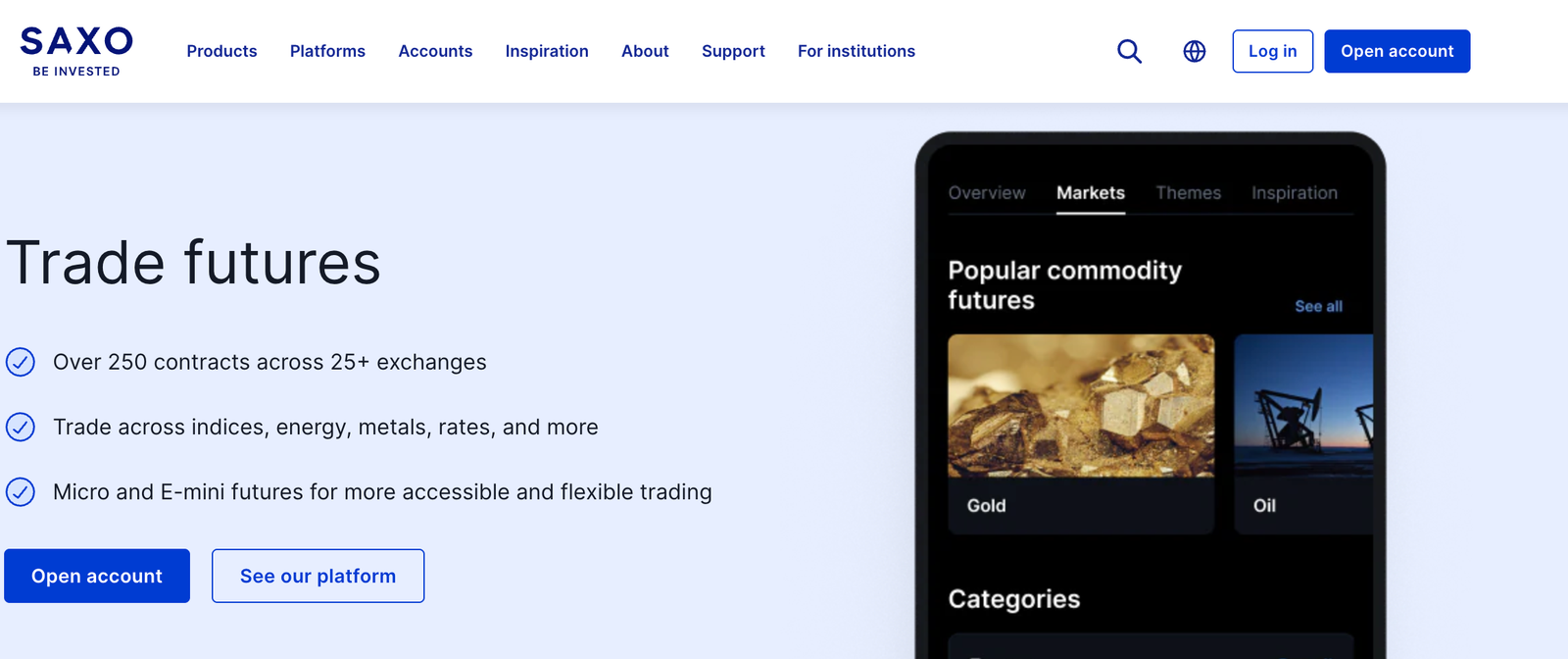
Saxo gives UK traders more than 250 listed futures contracts across 25+ exchanges in the same account they can use for shares, bonds and options, on one of the most polished platforms here. The catch is cost at entry level: Classic-tier commissions sit well above Interactive Brokers, and Saxo charges a carrying cost on futures held overnight.
Key information
| Field | Details |
|---|---|
| Best for | Multi-asset traders who want listed futures alongside shares, ETFs and options |
| Product type | Direct exchange-traded futures (CFDs and options also available) |
| UK entity | Saxo Capital Markets UK Ltd, FCA-authorised (FRN 551422) |
| Markets | 250+ futures contracts across 25+ exchanges, including micro and E-mini contracts |
| Commission | Per contract, per trade, excluding exchange fees. Tiered by account; reported at about $3 (Classic), $2 (Platinum) and $1 (VIP) per US contract; my Classic ticket showed $3 per contract |
| Carrying cost | Charged on futures held overnight: margin requirement × days held × tier rate ÷ 365. Published rates: 2.5% Classic, 1.5% Platinum, 0.5% VIP |
| Account tiers | Classic: no minimum. Platinum: £200,000+. VIP: £1,000,000+ (or qualify through trading volume) |
| Platforms | SaxoTraderGO (web and mobile), SaxoTraderPRO (desktop), TradingView integration |
| Demo | Free demo account, including listed futures |
| FSCS | FSCS may cover eligible clients up to £85,000 if Saxo fails; it doesn’t cover trading losses |
| Main drawback | Classic-tier commissions plus overnight carrying costs |
What I tested
I tested a Saxo Classic account on SaxoTraderGO, SaxoTraderPRO and mobile with £10,000, trading Euro Stoxx 50 and Micro E-mini Nasdaq-100 futures.
What is it like trading futures on Saxo?
Saxo makes finding the right futures contract easier than any other broker I tested, and the trade ticket shows the full commission before you commit. When I tested Saxo, I funded a Classic account with £10,000 by bank transfer, then typed “Euro Stoxx” into the search bar. The result listed each contract month with its exchange and a link to the full specification, so I could check tick value and expiry without leaving the ticket.
I bought one December Euro Stoxx 50 future on SaxoTraderGO, then rebuilt the same order in SaxoTraderPRO to compare. PRO is the better tool for active trading, with more screen space for charts and order management, but GO was quicker for a one-off trade. I held the Euro Stoxx position overnight specifically to see the carrying cost, which Saxo applies to listed futures and bills at the end of each month. On roughly €3,000 of margin, one night at the Classic rate of 2.5% came to about €0.21.
My second trade was one Micro E-mini Nasdaq-100 contract, placed on my phone with a stop-loss attached. The friction point came with currency: on a Classic account I couldn’t open separate EUR or USD sub-accounts, which Saxo reserves for Platinum and VIP clients, so margin and profit on non-GBP contracts went through currency conversion.
How much does Saxo charge for futures?
Saxo charges a per-contract commission on every futures trade, plus exchange fees, plus a carrying cost on positions held overnight. The carrying cost is the margin requirement × days held × your tier’s rate ÷ 365, at 2.5% for Classic accounts. As an illustration, a position with £2,000 of margin held for one night on Classic costs about £0.14, or roughly £4.10 over a month. That is small per trade but it’s a cost Interactive Brokers doesn’t charge, so it adds up for swing traders who hold futures for weeks.
Who is Saxo best for?
Saxo is best for traders who value platform quality and range over the lowest possible cost, especially those who already hold shares or bonds and want futures in the same account. Larger accounts benefit most, because Platinum and VIP tiers cut both commission and the carrying-cost rate sharply.
Read the complete Saxo review here.
Pros & cons
- More than 250 listed futures across 25+ exchanges in one account
- Clear contract search with specifications linked from the trade ticket
- Choice of web, mobile, professional desktop and TradingView
- Classic-tier commissions are higher than Interactive Brokers
- Carrying cost charged on futures held overnight
- Multi-currency sub-accounts reserved for Platinum and VIP
Our verdict on Saxo
Saxo is the best direct futures alternative to Interactive Brokers for traders who want a cleaner platform and multi-asset convenience. On a Classic account it’s the more expensive of the two, so frequent traders with smaller balances should compare all-in costs before choosing it.
Futures-style derivatives: spread bets, CFDs and forwards
These leading CFD trading platforms give you exposure to futures prices through over-the-counter products, with the provider as your counterparty You don’t own an exchange-traded contract.
3. IG: best for UK futures-style spread betting
IG is the most complete UK option for futures-style trading: you can spread bet or trade CFDs on futures prices with funding built into the spread, and existing clients can add a separate account for US-listed futures at $1.00 per standard contract and $0.75 per micro, each way. Be clear which one you’re using, because the spread bets are OTC products with IG as counterparty, while listed futures sit in a USD account held by US clearing firm Apex.
Key information
| Field | Details |
|---|---|
| Best for | UK traders who want futures-style spread betting, with listed US futures as a separate add-on |
| Product type | Spread bets and CFDs on underlying futures prices (OTC); separate US-listed futures and options account |
| UK entity | IG Markets Limited, FCA-authorised |
| Markets | Index, commodity and bond futures via spread bets and CFDs; US-listed futures on the tastytrade-powered platform |
| Futures spreads (UK account) | Standard spreads previously published by IG: FTSE 100 4 points, Wall Street 6, Germany 40 6, light crude 6. IG’s current funding page doesn’t list fixed figures |
| Overnight costs | UK account: funding is built into the futures spread, so no separate overnight charge |
| Listed futures commission | $1.00 per standard contract and $0.75 per micro, each way, on IG’s latest costs page (an older IG page still shows $0.85) |
| Minimum deposit | UK spread betting account: IG says you can deposit any amount. US account: funded separately in USD |
| Platforms | UK account: IG web platform, IG app, MT4. US account: separate IG US options and futures platform and app |
| Demo | Available for spread betting and CFDs |
| Investor protection | UK account: FSCS may cover eligible clients up to £85,000 if IG fails, but never trading losses. US account: assets held by Apex under SEC and FINRA rules, with SIPC protection |
| Main drawback | Futures spreads are wider than IG’s undated cash markets |
What I tested
I tested an IG spread betting account with £2,500, trading FTSE 100 and US crude futures, and opened its separate US options and futures account.
What is it like trading futures on IG?
Trading futures-style markets on IG is straightforward because the futures sit right next to the cash version of each market. My test began with a £2,500 debit card deposit into a spread betting account. Searching “FTSE 100” brought up the undated cash market alongside the quarterly futures, each showing its expiry date on the ticket.
The key comparison was cost. The FTSE 100 future showed a 4-point spread on my ticket, wider than the cash market, but IG builds overnight funding into that spread. For a trade I planned to hold for several weeks, that made the future the more predictable choice, since I knew my break-even level from the moment I opened it. I placed a £2-per-point long on the December contract with a stop-loss, then repeated the comparison on oil, where IG’s undated US crude starts from 2.8 points against a 6-point futures spread.
For listed futures, I added a US options and futures margin account through My IG. It isn’t an extension of the main platform: the app prompted me to download a separate IG US options and futures app, the account is denominated in USD, and the money is held by Apex in the US rather than by IG in the UK.
Does IG offer real futures trading in the UK?
Yes, but only through its separate US options and futures account. IG’s main futures offering is spread bets and CFDs on underlying futures prices, which are OTC products rather than exchange-traded contracts. The listed account covers US futures only (in a margin account), so UK traders wanting FTSE or Euro Stoxx contracts on an exchange would still need Interactive Brokers or Saxo.
Who is IG best for?
IG is best for UK traders who want futures-style exposure through spread betting, which is usually outside capital gains tax for UK residents, on a platform that also leaves room to move into listed US futures later. Its futures spreads are not the tightest here, but the range of futures-based markets and the funding-inclusive pricing are hard to match.
Read the complete IG review here.
Pros & cons
- Futures-priced spread bets and CFDs with funding built into the spread
- Separate US-listed futures account at $1.00 per standard contract and $0.75 per micro, each way
- Demo account for spread betting and CFDs
- Futures spreads are wider than IG's cash markets and no longer published as fixed figures
- Listed futures need a separate USD account and app
- Listed access is limited to US futures
Our verdict on IG
IG is the best all-round futures-style platform for UK traders. It offers more futures-based markets than Capital.com or Pepperstone, and unlike CMC Markets it also provides a route into listed US contracts, though that route sits outside its main platform.
4. Pepperstone: best for futures-priced CFDs on MT5 and cTrader

Pepperstone is the pick for platform-driven traders: its CFD and spread bet forwards are priced from front-month futures on 12 markets, including the US500 from a 1-point published minimum spread, with no overnight funding and automatic rolls. The limitation is where you can trade them, because forwards run on MT5 and cTrader, with TradingView support still listed as forthcoming.
Key information
| Field | Details |
|---|---|
| Best for | Technical and automated traders who want futures-priced CFDs on MT5 or cTrader |
| Product type | CFD forwards and spread bet forwards priced from front-month futures (OTC), plus cash CFDs |
| UK entity | Pepperstone Limited, FCA-authorised |
| Forward markets | AUS200, GER40, HK50, JPN225, UK100, US30, NAS100, US500, US crude, Brent, gold, silver |
| Published minimum forward spreads | US500: 1. UK100, GER40, NAS100, AUS200: 3. US30: 5. Crude and Brent: 5. Gold: 0.5. Silver: 3 |
| Commission | None on index and commodity CFDs; Razor commission applies to forex and spot gold |
| Overnight costs | None on forwards (built into the price); swaps apply to cash CFDs |
| Rolls | Automatically rolled before expiry, with a cash adjustment for the price difference |
| Minimum deposit | None |
| Platforms | CFDs generally: MT4, MT5, cTrader, TradingView and the Pepperstone platform. Forwards: MT5 and cTrader only, according to Pepperstone’s forwards page |
| Demo | Free demo account |
| Main drawback | Forwards limited to 12 markets and two platforms |
What I tested
I tested a Pepperstone Razor account with £1,500 on MT5 and cTrader, trading the US500 and Brent forwards.
What is it like trading futures-priced CFDs on Pepperstone?
Pepperstone’s forwards feel like trading futures on a retail CFD platform: futures pricing and no overnight funding, but flexible sizing and MetaTrader tools. I started by depositing £1,500 by bank transfer into a Razor account and logging into MT5. The forwards are listed with an “-F” suffix, so I added US500-F and its cash equivalent, US500, side by side in Market Watch to compare spreads.
I opened the minimum size of one contract on US500-F using one-click trading, then attached a stop-loss and take-profit from the chart. Holding it overnight confirmed the main benefit: no swap charge appeared, because Pepperstone factors funding and dividends into the forward price. The other thing to understand is the roll. Pepperstone rolls forwards automatically shortly before the underlying contract expires and makes a cash adjustment for the price step, so if you don’t want to carry the position into the next month, you have to close it yourself.
I repeated the trade on Brent-F in cTrader, where the depth-of-market view was more useful than MT5 for seeing liquidity before entering. My friction point was platform choice. Pepperstone promotes TradingView and its own platform heavily, but the forwards were only on MT5 and cTrader, which is a real limitation if TradingView is your main charting tool.
How much does Pepperstone charge for futures-style trading?
Pepperstone charges no commission on index and commodity forwards; the cost is the spread, from a published minimum of 1 point on US500-F and 3 points on UK100-F; live spreads can be wider. There is no overnight funding on forwards, and the cost of rolling is the spread at the moment of the roll. Razor account commission applies only to forex and spot gold, so for futures-style trading, Standard and Razor accounts cost the same.
Who is Pepperstone best for?
Pepperstone is best for MT5 and cTrader users, including those running automated strategies, who want futures pricing without exchange contract sizes. Traders who need a wider range of futures markets will find IG and CMC Markets more comprehensive.
Read the complete Pepperstone review here.
Pros & cons
- Futures-priced forwards with no overnight funding
- Low published minimum spreads, including 1 point on US500-F
- Works with algorithmic trading on MT5 and cTrader
- Only 12 forward markets
- Forwards not listed for TradingView or the Pepperstone platform, which support its other CFDs
- Positions roll automatically unless you close them
Our verdict on Pepperstone
Pepperstone has the sharpest futures-priced CFDs for MetaTrader and cTrader users, with low published minimum spreads on US indices. Its narrow market list and platform restrictions keep it behind IG for most futures-style traders.
5. CMC Markets: best for charting and commodity forwards

CMC Markets is the strongest choice for traders who want futures-style commodity exposure with serious charting. Its forwards span commodities, indices and treasuries, and rolling a forward fills at the mid-price, halving the spread cost. Just don’t mistake them for futures: CMC itself describes forwards as non-standardised contracts that work like futures but aren’t exchange-traded.
Key information
| Field | Details |
|---|---|
| Best for | Commodity and index traders who rely on advanced charting |
| Product type | Spread bets and CFDs, including non-standardised forward contracts (OTC) |
| UK entity | CMC Markets UK plc, FCA-authorised |
| Markets | 100+ cash and forward commodities; forwards also on indices and treasuries |
| Pricing | Spread-based; from 0.3 points on gold and 1 point on the UK 100 (cash) |
| Rolling | Manual roll, auto-roll or cash settlement; rolls fill at the mid-price, saving 50% of the spread |
| Minimum deposit | None |
| Platforms | Next Generation (web), mobile and tablet apps, MT4 |
| Charting | 115 technical indicators and drawing tools, 12 chart types, pattern recognition. Mobile: 25+ indicators and 15 drawing tools |
| Demo | Free demo account |
| Main drawback | Next Generation has a steep learning curve |
What I tested
I tested a CMC Markets spread betting account with £1,000 on Next Generation and the iPad app, trading the Brent forward and gold.
What is it like trading forwards on CMC Markets?
Trading forwards on CMC Markets gives you more control over expiry and rolling than any other OTC provider here, but it takes time to learn. For this test I deposited £1,000 by debit card into a spread betting account and searched the Product Library for Brent. It returned the cash market and several forward months, so I could compare their spreads and see the price difference the forward builds in.
I placed a £1-per-point spread bet on the December Brent forward and set the stop to trigger on the mid-price rather than the sell price. That matters on oil, where spreads can widen outside main hours and trip a stop even when the market hasn’t really moved. I then turned on auto-roll. CMC lets you roll manually, auto-roll or let the forward cash settle, and because rolls fill at the mid-price, rolling costs half the normal spread.
On the gold chart, the pattern recognition scanner flagged formations I’d have missed scanning manually, and I set a price alert on the iPad app. The friction is the sheer number of settings: between stop trigger types, roll options and order variants, it took me longer to configure my first trade than on IG or Capital.com.
Are CMC Markets forwards the same as futures?
No. CMC Markets forwards work in a similar way to futures, with an expiry date and pricing derived from the underlying futures market, but they are non-standardised OTC contracts with CMC as counterparty. You don’t trade on an exchange, and contract terms, last trading dates and sizes are set by CMC rather than by the exchange.
Who is CMC Markets best for?
CMC Markets is best for experienced traders who trade commodities or indices on technical analysis and want flexible control over expiry and rolling. Beginners may prefer IG’s simpler ticket, even at the cost of less charting depth.
Read the complete CMC Markets review here.
Pros & cons
- Forwards on commodities, indices and treasuries
- Rolls fill at the mid-price, halving the spread cost
- Advanced charting with pattern recognition and mid-price stop triggers
- Next Generation takes time to learn
- Forwards are OTC contracts, not exchange-traded futures
- No route to listed futures
Our verdict on CMC Markets
CMC Markets is the best futures-style platform for commodity traders and chartists. It offers more roll control than IG or Pepperstone, but IG remains the better all-rounder because it also offers listed futures.
6. Capital.com: best for low-cost futures-style CFDs on TradingView
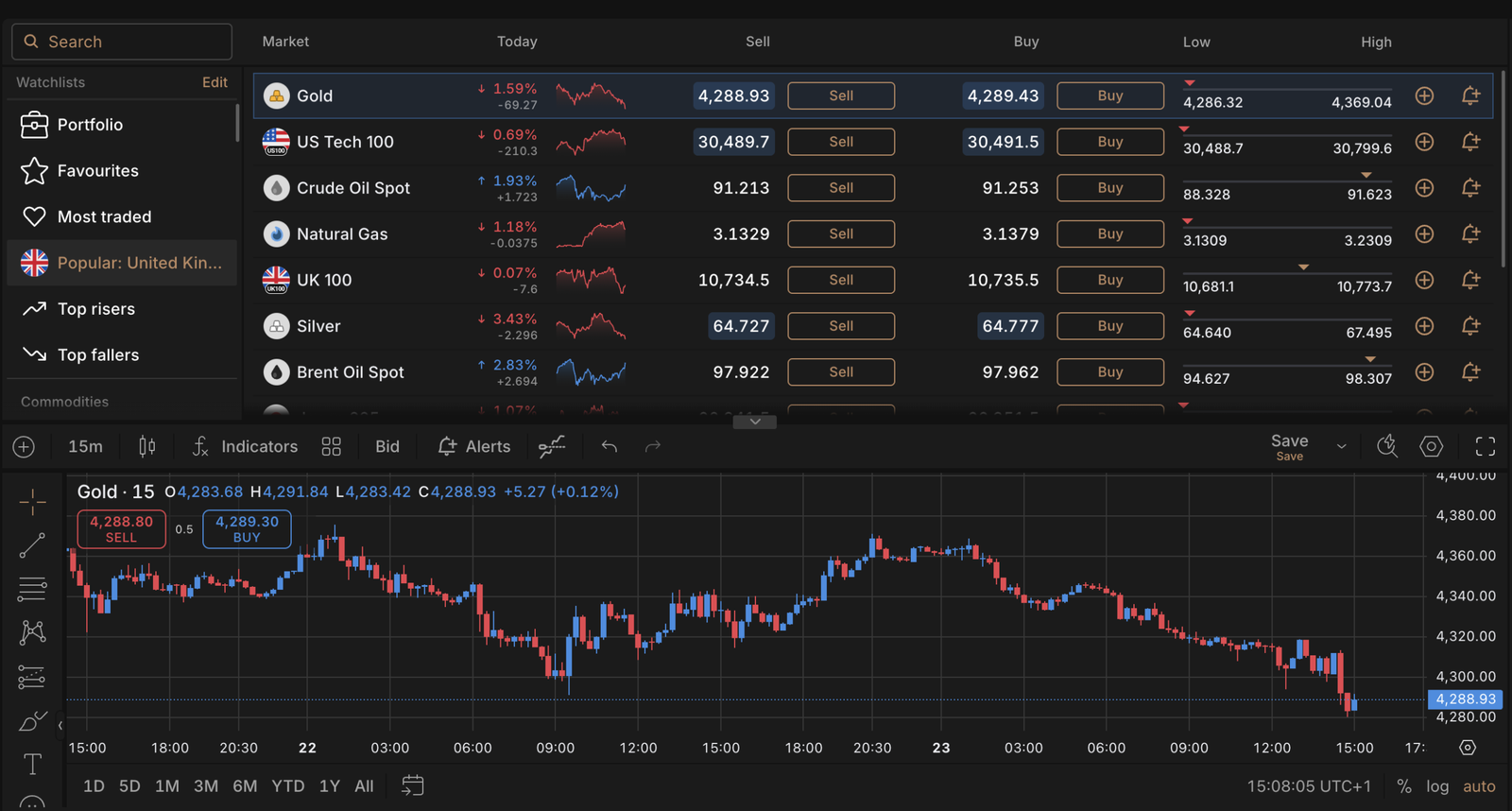
Capital.com suits traders who want futures-style exposure from a small balance, with a reported £20 minimum deposit, spread-only pricing and the option to trade straight from TradingView charts. It isn’t a futures broker, though: most of its markets are undated cash CFDs, and its futures-dated contracts are a small set of commodities that still carry an overnight funding adjustment.
Key information
| Field | Details |
|---|---|
| Best for | Smaller-balance traders who want futures-style CFD exposure with TradingView charting |
| Product type | CFDs and spread bets (OTC), including a few futures-dated commodity CFDs |
| UK entity | Capital Com (UK) Limited, FCA-authorised |
| Markets | Indices, commodities, forex and shares as CFDs and spread bets. Futures-dated CFDs on a few soft commodities such as London wheat and UK sugar, according to Capital.com’s market pages; the wheat page showed the market as unavailable when last captured in July 2026 |
| Pricing | No commission; spread-based |
| Overnight costs | Capital.com’s market pages show an overnight funding adjustment on its futures-dated CFDs (0.01096% a day on the wheat and sugar pages), applied at 21:00 UTC |
| Minimum deposit | Reported at £20 by card in third-party reviews, higher for bank transfer; not confirmed on Capital.com’s own site |
| Platforms | Web platform, mobile app, TradingView, MT4 |
| Demo | Free demo account |
| Guaranteed stop | Premium charged only if the guaranteed stop is triggered |
| Main drawback | Very limited futures-dated range, and financing still applies to it |
What I tested
I tested a Capital.com CFD account with £500 on the app and TradingView, trading a futures-dated UK sugar CFD alongside US 500 and Brent.
What is it like trading futures-style markets on Capital.com?
Capital.com is quick and cheap to start on, but a futures trader will notice how few dated markets it has. When I tested it, I deposited £500 by debit card and searched the market list for “future”. The results were a handful of soft-commodity CFDs, such as UK sugar and London wheat, each tied to a specific exchange contract month. There were no futures-dated index markets, so for the S&P 500 I had to use the undated US 500 cash CFD.
I opened a small position in the UK sugar CFD and checked the ticket. Unlike the futures markets at IG and Pepperstone, it still showed an overnight funding adjustment, at the same -0.01096% daily rate listed on Capital.com’s market page. Its own example puts that at about £1.10 a night on a £10,000 position, or roughly £33 over a month, on top of the spread.
The best part of the test was TradingView. I linked my Capital.com account to TradingView, opened a Brent CFD straight from the chart and dragged the stop-loss line to adjust it, which is faster than retyping levels on a ticket. I also added a guaranteed stop to a US 500 trade; the premium is only charged if the stop is triggered.
Who is Capital.com best for?
Capital.com is best for newer or smaller-balance traders who want leveraged exposure to the markets futures traders follow, without commissions and with strong charting. It’s a weak fit if you specifically want futures pricing, because its dated range is small and doesn’t remove overnight funding.
Read the complete Capital.com review here.
Pros & cons
- Low reported £20 minimum deposit and no commission
- Trade directly from TradingView charts
- Guaranteed stop premium only charged if triggered
- Only a handful of futures-dated markets, with no dated index contracts
- Overnight funding applies even to futures-dated CFDs
- No route to exchange-traded futures
Our verdict on Capital.com
Capital.com is a good low-cost entry point to futures-style trading, but not a substitute for futures pricing. If your strategy depends on futures-dated contracts with financing built in, IG, Pepperstone or CMC Markets are stronger choices.
7. eToro: listed CME futures in a beginner app (if your account has access)
Note: eToro’s fee page says futures are in beta for a limited audience and that users are notified when futures reach their region, so they aren’t available to all UK users. Futures weren’t enabled on my UK test account, so the futures details below come from eToro’s published product and fee pages.
eToro is the most beginner-friendly way to trade real CME-listed futures on this list, with Spot-Quoted Futures from roughly $200 of margin and a flat per-contract fee shown on the ticket. The big caveat is access: eToro says futures are still in beta for a limited audience, so a UK account may not see them yet, and UK retail rules rule out the crypto contracts it promotes.
Key information
| Field | Details |
|---|---|
| Best for | Newer futures traders who want small CME contracts in a simple app |
| Product type | Exchange-traded CME futures: Spot-Quoted Futures (SQFs) and micro futures, all cash-settled on eToro |
| UK entity | eToro (UK) Ltd, FCA-authorised (FRN 583263) |
| UK availability | Beta for a limited audience; eToro notifies users when futures go live in their region |
| Markets | SQFs on the S&P 500, Nasdaq-100, Dow Jones and Russell 2000; micro futures on indices, gold, silver, copper, WTI crude, natural gas, FX and the 10-year yield |
| Commission | Micro futures: $0.75 eToro fee plus exchange and clearing fees (e.g. $0.77 on the Micro E-mini S&P 500), charged on open and close. SQFs: $1.22 per contract on open and close |
| Overnight costs | None on micro futures; SQFs carry a daily financing adjustment |
| Margin | SQFs from about $200; leverage set by CME margin (roughly 1:10 to 1:20) |
| Platforms | eToro web platform and app |
| Demo | $100,000 virtual account |
| Main drawback | Limited beta availability and a narrow contract list |
What I tested
I funded an eToro UK account with £1,000 and checked the Futures section, which wasn’t enabled, so I reviewed its Spot-Quoted and micro futures from eToro’s published product and fee pages.
How do eToro’s futures work?
Where it’s available, eToro offers the simplest futures experience on this list, though the contract range is narrow. I deposited £1,000 by bank transfer into my GBP account, but the Futures section wasn’t enabled on my UK account, which matches eToro’s limited-beta wording. According to eToro’s futures pages, a stop-loss is required on futures, and the estimated-cost tooltip shows the flat per-contract fee before you confirm.
Spot-Quoted Futures apply a daily financing adjustment, which eToro shows as an overnight fee, and they expire once a year rather than quarterly, so there’s no roll to manage. Micro futures such as Micro Gold cost eToro’s $0.75 plus exchange and clearing fees per side, with no overnight fee.
Two limitations stand out in eToro’s terms. Contract sizes are fixed, so unlike eToro’s CFDs you can’t trade a specific pound amount; and contracts settled by physical delivery are closed automatically on eToro’s last trading day, typically the day before first notice. Futures are also priced in USD, so trading from a GBP account adds a conversion step.
Can UK residents trade futures on eToro?
Possibly, depending on your account. eToro (UK) Ltd publishes futures risk disclosures for UK and EU clients, but its fee page says futures are in beta for a limited audience and that users will be notified when futures reach their region. Even with access, FCA rules bar UK retail clients from crypto derivatives, so expect the Bitcoin and Ether contracts to be unavailable.
Who is eToro best for?
eToro is best for existing eToro users who want a first, small step into real exchange-traded futures without learning a professional platform. Traders who need more contracts, UK or European exchanges, or advanced order types should choose Interactive Brokers or Saxo.
Pros & cons
- Real CME-listed contracts in a beginner-friendly app
- Spot-Quoted Futures start from about $200 of margin with annual expiry
- Per-contract fee shown before you confirm the trade
- Futures still in limited beta, so UK access is not guaranteed
- Narrow list of contracts, all on CME
- CopyTrader does not support futures
Our verdict on eToro
eToro has the most accessible listed futures product here, and its micro futures fees are competitive with Interactive Brokers on a per-contract basis. Until futures are fully available to UK accounts, treat it as a conditional pick rather than a direct alternative to Interactive Brokers or Saxo.
Which product is right for you?
- Want exchange-listed contracts? Compare Interactive Brokers and Saxo first. Interactive Brokers is cheaper per contract ($0.85, or $0.25 on micros, plus exchange fees), while Saxo adds a carrying cost on overnight positions but keeps futures in the same account as shares and bonds. eToro’s CME futures are only an option if they’re enabled on your account.
- Want UK spread betting? Compare IG, Pepperstone, CMC Markets and Capital.com, all among the top spread betting platforms, on total holding cost, not just the spread. IG, Pepperstone and CMC build funding into their futures or forward prices, while Capital.com’s dated CFDs still charge overnight funding.
- Want MT5 or cTrader? Even among the top MT5 brokers, check that the specific futures-priced instrument is supported on that platform. Pepperstone’s forwards run on MT5 and cTrader, but its forwards page doesn’t list TradingView or its own platform, even though both support its other CFDs.
- Want to hold for weeks? Compare financing and roll costs, not just the opening spread. Over 30 nights, a £10,000 Capital.com dated CFD costs about £33 in funding, Saxo Classic charges 2.5% a year on margin, and listed futures cost another round trip at each roll ($4.48 for an E-mini S&P 500 at Interactive Brokers).
- Want a small starting position? Compare the contract’s exposure and margin, not the advertised minimum deposit. A Micro E-mini S&P 500 moves $5 per index point and eToro’s Spot-Quoted Futures need about $200 of margin, while a spread bet lets you choose your own stake per point.
How I scored and ranked the best futures brokers UK
I start from Psyfi Money’s broader research into the top trading platforms. For this guide, I then reweighted it for a UK trader who specifically wants futures exposure, whether through exchange-listed contracts or futures-priced spread bets and CFDs. Any existing Psyfi Money review rating stays separate from the order on this page.
Before scoring, every provider had to pass three entry checks. It needed an FCA-authorised UK entity, a futures or futures-priced product available to UK clients, and published pricing I could evaluate. I treated eToro’s beta futures access as conditional rather than ranking it alongside fully available products.
| Ranking factor | Weight | What I assessed |
|---|---|---|
| Futures product type | 25% | Whether you trade a real exchange-listed contract (Interactive Brokers, Saxo, eToro (limited beta), IG’s US account) or an OTC product priced from futures, such as IG’s futures spread bets, Pepperstone’s forwards or CMC’s forwards |
| All-in holding cost | 25% | Per-contract commission plus exchange fees, futures spreads, Saxo’s carrying cost, overnight funding on dated CFDs, and market data charges |
| Contract and market range | 15% | Number of exchanges and contracts, micro and E-mini availability, and futures-dated index, commodity and bond markets |
| Expiry, roll and margin handling | 15% | Roll options (manual, automatic, mid-price), how close to expiry positions are closed, and margin shown before you confirm a trade |
| Order tools and platform choice | 12% | Bracket orders, stop-trigger options, depth of market, and which platforms actually carry the futures products (for example MT5 and cTrader only for Pepperstone forwards) |
| Barriers to entry | 8% | Minimum deposit, smallest contract size, futures permissions and market data set-up |
The most useful comparison was modelling a one-month hold instead of comparing headline commissions. On listed futures, Interactive Brokers’ own example puts one E-mini S&P 500 contract at $4.48 per round trip, while Saxo adds a 2.5% annual carrying cost on Classic accounts, about £4.10 a month on £2,000 of margin. On the OTC side, IG’s futures spread bets and the forwards at Pepperstone and CMC Markets build funding into the price, whereas Capital.com’s dated CFDs still charge about £1.10 a night on a £10,000 position, roughly £33 over 30 nights. That financing drag is why Capital.com sits below Pepperstone and CMC Markets here.
I gave product type and holding cost half the weight because they decide what a futures trader actually owns and what it costs to keep a position open. A beginner app’s ease of use matters less here than whether futures pricing removes financing drag. These weights set the order of this guide only; each provider’s wider Psyfi Money rating is assessed separately.
Platforms I considered but didn’t rank
| Platform | What it offers UK traders | Why I didn’t rank it |
|---|---|---|
| Robinhood UK | 40+ CME futures across indices, energy, metals and FX at $0.75 per contract plus exchange and regulatory fees, with free real-time data | Futures access was rolling out to approved, eligible customers rather than every UK account, and the range is CME-only. Competitive on published pricing, so it’s the first platform I’ll revisit |
| NinjaTrader | A US futures broker and trading platform | Regulated in the US by the NFA and CFTC, with no FCA-authorised UK entity I could find, so it failed my UK eligibility check |
| Plus500 | CFDs for UK clients; listed futures only through its US business for US customers | Its UK offer is CFDs only, which adds nothing the ranked CFD providers don’t already cover |
How much does futures trading cost in the UK?
What you pay depends on the product. On a listed futures contract you pay commission and exchange fees each way, and the cost of carry is already in the contract price. When you trade CFDs or spread bets, you pay the spread, plus overnight funding on some markets. To make costs comparable, I used one standard example per product type, priced from fees published on 14 October 2026, with one round trip (open and close) and no market movement. Spreads marked as published minimums come from provider pages; live spreads can be wider, especially outside main trading hours.
| Example and size | Spread to open and close | Commission and fees | FX and market data | 1-night hold | 30-night hold |
|---|---|---|---|---|---|
| Listed micro: Micro E-mini S&P 500 ($5 a point) at Interactive Brokers | Market bid/ask; not published | $0.25 each side ($0.50 round trip) plus CME exchange and regulatory fees | USD contract, so conversion cost if funded in GBP; US futures data bundle $10 a month, waived at $30 commissions | No financing charge | No financing charge; a quarterly roll costs another round trip |
| Listed micro: Micro E-mini S&P 500 ($5 a point) at eToro (limited beta) | Market bid/ask; not published | $1.52 each side all-in ($3.04 round trip) | USD contract, so conversion applies from a GBP account; data cost not stated | No overnight fee | No overnight fee; roll before expiry |
| Listed standard: E-mini S&P 500 ($50 a point) at Interactive Brokers | Market bid/ask; not published | $2.24 each side all-in ($4.48 round trip), per IBKR’s worked example | As above | No financing charge | No financing charge |
| Listed standard: E-mini S&P 500 ($50 a point) at Saxo Classic | Market bid/ask; not published | About $3 each side (third-party reports) plus exchange fees | Conversion on non-GBP contracts for Classic clients | Margin × 2.5% ÷ 365 | Margin × about 0.21% (30 days at 2.5%) |
| Futures spread bet: IG FTSE 100 future at £2 a point | Not published by IG, which says futures funding is built into a wider spread, so check the live spread for the actual market and account. My test ticket showed 4 points (£8) [hypothetical test observation] | No commission | GBP market, so no conversion; separate data fee not confirmed | None; funding is in the spread | None; funding is in the spread |
| Futures-priced OTC: Pepperstone US500 forward CFD at $5 a point | Published minimum 1 point ($5); live spread may be wider | No commission | Conversion if your account isn’t in USD; no separate data fee identified | None; funding is in the forward price | None; automatic roll costs the spread at the roll |
| Dated CFD with funding: Capital.com futures-dated commodity CFD, £10,000 position | Published on each market page (for example 0.8 points on UK sugar when captured) | No commission | GBP-priced market, so no conversion; no separate data subscription in its published fee schedule | About £1.10 (0.01096%) | About £33 |
Rolling a contract adds cost if you want to stay in a position past expiry. With listed futures you close the expiring contract and open the next one, so at Interactive Brokers rolling one E-mini S&P 500 costs about another $4.48, plus the bid/ask spread on both legs.
Pepperstone rolls its forwards automatically and the cost is the spread at the moment of the roll, while CMC Markets fills rolls at the mid-price, so you pay half the usual spread. eToro’s Spot-Quoted Futures expire once a year, which removes quarterly rolls but adds a daily financing adjustment.
Margin isn’t a fee, but it ties up your capital. eToro’s Spot-Quoted Futures start from about $200 of margin, while a standard E-mini contract needs far more, so check the requirement on the order ticket before you trade.
How to choose a futures trading platform
Start with the job you need the platform to do. The right choice for a beginner testing small positions is rarely the right one for a hedger or an algorithmic trader.
Beginner: Keep your exposure small and practise on a demo trading account first. eToro’s Spot-Quoted Futures start from about $200 of margin if futures are enabled on your account, and IG lets you spread bet on futures prices at a small stake per point, with a free demo. Leave standard contracts until you understand how margin calls work.
Active intraday trader: Cost per trade and order tools matter most. Interactive Brokers charges $0.85 per US contract plus exchange fees and supports bracket orders, while Pepperstone’s forwards start from a 1-point spread on US500 with no commission. If you trade listed futures, add market data to your costs.
Longer-term trader: Holding cost matters more than entry cost. Futures and forward pricing at IG, Pepperstone and CMC Markets builds funding into the price, and listed futures at Interactive Brokers carry no financing charge. Cash CFDs and Capital.com’s dated CFDs charge overnight funding, and Saxo’s Classic tier adds a 2.5% carrying cost on margin.
Systematic trader: Check that the platform supports automation for the exact product you want. Interactive Brokers offers an API for listed futures, and Pepperstone’s forwards run on MT5 and cTrader, which both support automated strategies.
Hedger: You usually need the specific exchange contract that matches your exposure. Interactive Brokers and Saxo give access to CME, Eurex, ICE and other exchanges. OTC products are priced from futures but don’t give you the exchange contract itself.
Futures vs CFDs vs spread betting
All three let you trade price moves with leverage, but they differ in who you trade with, how positions are sized, what holding them costs and how profits are taxed.
| Feature | Futures | CFDs | Spread betting |
|---|---|---|---|
| Where you trade | On a regulated exchange such as CME or Eurex | Over the counter, with the provider | Over the counter, with the provider |
| Counterparty | The clearing house, acting as central counterparty between buyer and seller | The provider | The provider |
| Contract specifications | Standardised size, tick value and expiry set by the exchange | Flexible size; the provider sets terms for cash and dated markets | Stake per point; the provider sets terms for cash and dated markets |
| Margin and risk | Set by the exchange and broker, outside the FCA’s retail CFD leverage caps. Margin calls apply, losses can exceed your deposit, and each contract’s size, tick value, expiry and settlement rules add risk | FCA retail rules cap leverage between 30:1 and 2:1 by asset (for example 20:1 on major indices and 10:1 on most commodities), close positions at 50% of required margin and limit losses to your account balance | The same FCA retail protections as CFDs |
| Financing | Cost of carry is in the contract price; no overnight funding (Saxo adds a carrying cost on margin) | Overnight funding on cash CFDs; some dated CFDs and forwards build it into the price | Overnight funding on cash bets; futures and forward bets build it into the spread |
| UK tax (depends on your circumstances) | Gains are usually subject to capital gains tax for individuals, but HMRC can treat frequent trading as income | Gains are usually subject to capital gains tax, losses can usually offset other gains, and there’s no stamp duty | Profits are usually outside capital gains tax and stamp duty because HMRC treats spread betting as betting; losses get no tax relief, and very high-volume trading could be treated differently |
FSCS protection, where it applies, covers eligible clients if an FCA-authorised firm fails; it never covers losses from trading or investment performance. Tax treatment depends on your circumstances and can change, and HMRC may treat very frequent trading differently, so check current HMRC guidance or speak to a tax adviser if you’re unsure.
FAQs
Can I trade futures in the UK?
Yes. You can trade exchange-listed futures through brokers such as Interactive Brokers and Saxo. You can also trade futures-priced spread bets, CFDs and forwards with providers such as IG, Pepperstone and CMC Markets. They aren’t the same product. With listed futures, the exchange’s clearing house stands between buyer and seller. With spread bets and CFDs, the provider is your counterparty.
Is futures trading legal in the UK?
Yes. It’s legal when you use an FCA-authorised firm for UK clients. Retail CFDs and spread bets also fall under the FCA’s restrictions on CFD products: leverage is capped between 30:1 and 2:1 depending on the asset, positions are closed out at 50% of required margin, and you can’t lose more than your account balance.
Are futures brokers regulated in the UK?
It depends on the entity you open your account with, so check the FCA Register before depositing. Some popular futures platforms, such as NinjaTrader, are regulated only in the US. IG’s US-listed futures account is held by Apex in the US under SEC and FINRA rules, not by IG’s UK entity. FSCS protection, where it applies, covers you if a firm fails. It never covers trading losses.
Do you pay tax on futures trading in the UK?
Usually, yes, but it depends on the product and your circumstances. Gains on listed futures and CFDs are usually subject to Capital Gains Tax. HMRC can treat very frequent trading as income. Spread betting profits are usually outside Capital Gains Tax and stamp duty because HMRC treats spread betting as betting, but losses get no tax relief. Check gov.uk for the current tax year’s annual exempt amount and rates, or speak to a tax adviser.
What is the best futures trading platform for beginners in the UK?
IG is the easiest starting point for most beginners. You can practise on its free demo, then spread bet on futures prices at a small stake per point, with funding built into the spread. If you want real exchange contracts, Interactive Brokers’ free paper trading account lets you rehearse orders first. eToro’s small CME futures are beginner-friendly, but they’re only an option if futures are enabled on your account, because they’re still in limited beta.
Which app is best for futures trading in the UK?
For exchange-listed futures, Interactive Brokers is the strongest all-rounder. It charges $0.85 per standard US contract and $0.25 per micro, plus exchange fees, across CME, Eurex, ICE and more. For futures-style spread betting, IG is the most complete option. Pepperstone suits MT5 and cTrader users, and CMC Markets suits commodity traders who want flexible rolls.
What is the best futures broker for small accounts in the UK?
Look for micro contracts or flexible stake sizes rather than a low minimum deposit. A Micro E-mini S&P 500 moves $5 per index point and costs $0.25 a side in commission at Interactive Brokers, or $0.75 a side at IG’s US account, plus exchange fees. Spread bets let you choose your own stake per point. If eToro futures are enabled on your account, its Spot-Quoted Futures start from about $200 of margin. Compare total costs, including market data and currency conversion, not margin alone.
Do I need a margin account to trade futures?
Yes. Listed futures are traded on margin: you post initial margin and must meet margin calls, and losses can exceed your deposit. At IG, futures are only available in the margin version of its US options and futures account. Spread bets and CFDs are also margined, but within the FCA’s retail leverage caps and negative balance protection.
Why trade futures?
Futures give efficient, leveraged exposure to major markets such as indices, commodities, rates and currencies, often with near-24-hour trading. They’re used for both short-term speculation and hedging. A futures contract is a standardised agreement, cleared through a central counterparty, to buy or sell an asset at a set price on a future date. Most retail traders close or roll before expiry rather than taking delivery.
What is the 80% rule in futures trading?
It’s a Market Profile idea. If price opens outside the previous day’s value area, then re-enters and holds inside it for two consecutive 30-minute periods, there’s a high chance it moves across to the other side of that value area. Traders use it as an intraday setup with a clear exit if it fails. It’s a tendency, not a guarantee.
Can I trade futures in an ISA?
No. Listed futures, CFDs and spread bets can’t be held in a Stocks and Shares ISA. For futures-linked exposure inside an ISA, you’d need to invest in ETFs or ETCs instead, such as one tracking a commodity or futures index. That’s also how most people invest in gold or invest in the S&P 500 inside an ISA. Check that the specific product is ISA-eligible
