

I tested 6 UK spread betting brokers on spreads, platform experience, market range, execution, overnight financing, withdrawals and risk management tools. My current picks are IG for overall spread betting, Pepperstone for low-cost active trading, Capital.com for beginners and CMC Markets for advanced charting and research. Spreadex is my pick for a UK-focused service and Trade Nation for fixed spreads.
How I tested and ranked these platforms
I tested each platform with a funded UK spread betting account in GBP in September 2026. I placed bets on EUR/USD, the FTSE 100 and gold, and checked the spread, margin and overnight cost before confirming each one.
- 6 funded UK spread betting accounts
- £2,250 deposited
- 300 EUR/USD market orders placed to test execution (50 per platform)
- Spreads checked at set times across the day and during NFP and the Bank of England decision
- 6 withdrawals tested
- Tested on iPhone, Android, Mac and Windows, including TradingView, MT4, MT5 and cTrader
I then weighted all-in trading costs 25%, risk management tools 20%, pricing consistency 15%, market access 15%, platforms and charting 15%, and account access and funding 10%. FCA authorisation and a UK spread betting account were a must, not a scoring factor.
What are the best spread betting platforms in the UK in 2026?
| Broker | Best for | EUR/USD spread | FTSE 100 | Markets | Platforms | Min deposit | Demo | FCA |
|---|---|---|---|---|---|---|---|---|
| IG | Overall | From 0.6 pts | From 1 pt (08:00–16:29) | 17,000+ | IG web/app, MT4, ProRealTime, TradingView | £0 bank transfer; £1 card | Yes | Yes (FRN 195355) |
| Capital.com | Beginners | From 0.6 pts | From 1 pt | 5,500+ | Web/app, TradingView (MT4 is CFDs only) | £20 | Yes | Yes (FRN 793714) |
| Pepperstone | Low-cost active trading | From 0.6 pts | From 1 pt | 1,350+ | Pepperstone, MT4, MT5, cTrader, TradingView | £10 | Yes | Yes (FRN 684312) |
| CMC Markets | Charting and research | Around 0.7 pts | From 1 pt | 21,000+ | Next Generation, MT4, TradingView | £0 | Yes | Yes (FRN 173730) |
| Spreadex | UK-focused spread betting | 0.6 pts | From 1 pt | 10,000+ | Web/app, TradingView | £0 bank transfer; £5 card | No | Yes (FRN 190941) |
| Trade Nation | Fixed spreads | 0.5 pts fixed (07:00–21:59) | 0.8 pts fixed (08:00–16:29) | Thousands (no total published) | TN Trader, TradingView, MT4 (variable pricing) | None | Yes | Yes (FRN 525164) |
Quick answer: which spread betting platform should you choose?
| If you want… | Consider | Why |
|---|---|---|
| The best all-round platform | IG | 17,000+ markets, plus MT4, ProRealTime and TradingView on one account |
| A simple start | Capital.com | £20 minimum deposit, no funding fees and a demo that doesn’t expire |
| MT4, MT5 or cTrader | Pepperstone | The only broker here with spread betting on MT5 and cTrader, from 10p a point on EUR/USD |
| Charting, research and UK shares | CMC Markets | 21,000+ markets, 115+ indicators and pattern recognition |
| A UK-focused firm and small stakes | Spreadex | 10p minimum stakes on EUR/USD and the UK 100, with 24-hour UK phone support |
| Predictable costs for day trading | Trade Nation | Fixed spreads of 0.5 pts on EUR/USD and 0.8 pts on the UK 100 in main sessions |
UK spread betting platform reviews
UK spread betting platforms differ in market coverage, pricing, and trading tools, so the reviews below focus on regulation, platform quality, and suitability for UK traders.
1. IG – Best for range of markets and professional-grade tools
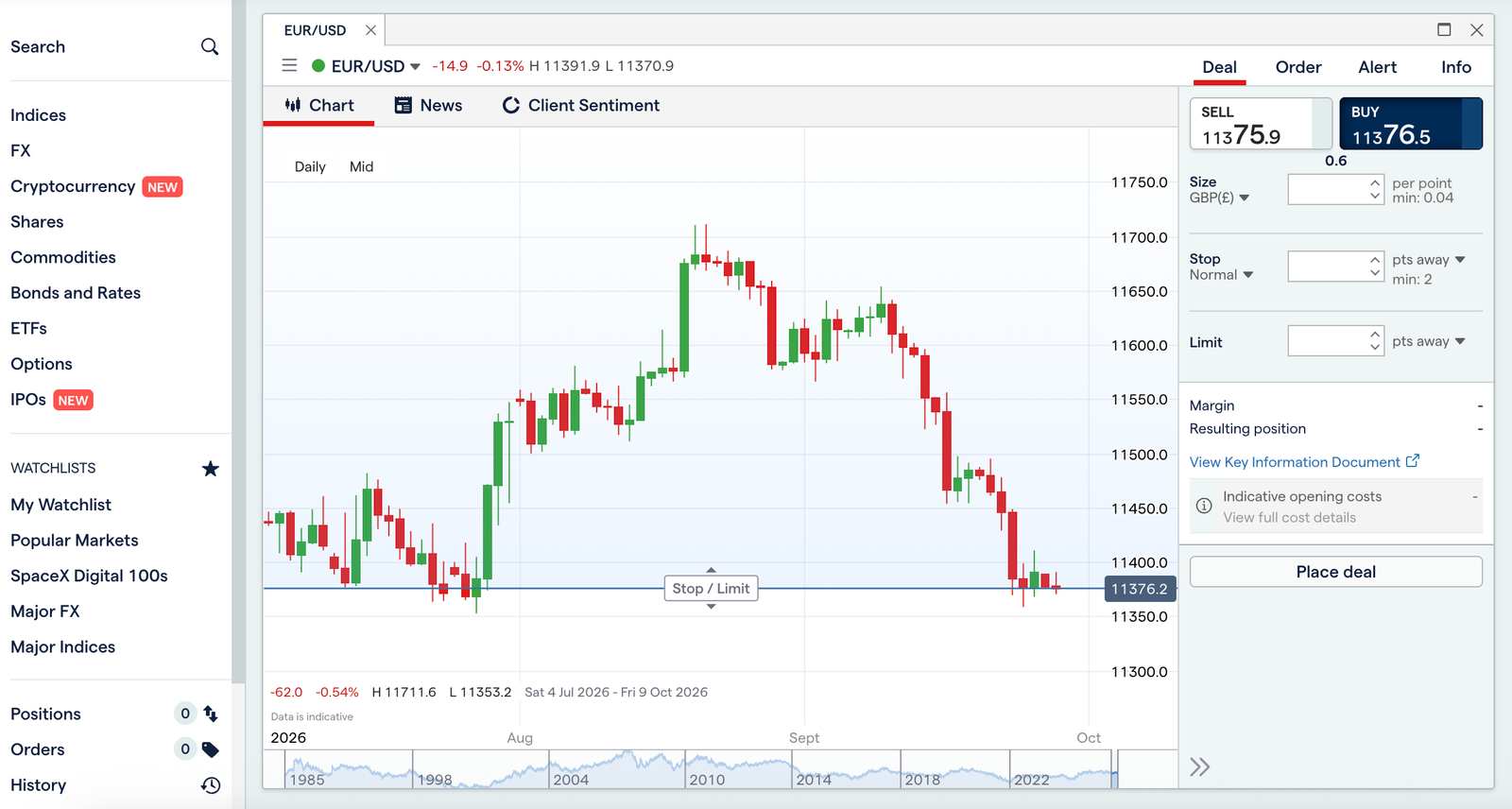
IG is the best all-round UK spread betting platform because it combines 17,000+ markets, commission-free pricing (EUR/USD from 0.6 points, FTSE 100 from 1 point) and the widest choice of platforms, including ProRealTime and TradingView. The trade-off is that it isn’t the cheapest place to hold positions overnight, and the depth of the platform is more than a first-time spread better needs.
Key information
| Feature | Information |
|---|---|
| Best for | Overall spread betting and widest market access |
| Markets | 17,000+ |
| Spreads | EUR/USD from 0.6 pts; GBP/USD from 0.9 pts |
| FTSE 100 DFB spread (UK time) | 1 pt 08:00–16:29; 2 pts 07:00–07:59 and 16:30–20:59; 4 pts 21:00–00:59; 3 pts 01:00–06:59 |
| Commission | £0 on standard spread bets |
| Minimum stake / margin | £0.50 per point on FTSE 100 DFB (5% retail margin); lower on some products |
| Overnight funding | Benchmark rate ± 1.5% admin fee (FX) or 3.4% (other markets) |
| Guaranteed stops | Yes; premium charged only if triggered |
| Other fees | No inactivity fee; free card and bank withdrawals |
| Platforms | IG web and app, MT4, ProRealTime, TradingView |
| Retail leverage | FCA caps: 30:1 major FX, 20:1 major indices and gold |
| FCA entity | IG Markets Ltd, FRN 195355 |
| FSCS | Eligible claims up to £85,000; doesn’t cover trading losses |
What I tested: IG spread betting account (GBP), £500 debit card deposit, IG web on MacBook Pro and IG app on iPhone 16, September 2026.
What was it like spread betting with IG?
IG felt like the most complete spread betting setup of the six, and also the one with the most to learn. My hands-on test started with a £500 card deposit, which was credited instantly. The account was open and funded in 19 minutes, with the appropriateness questions taking the longest.
I placed my first bet on the FTSE 100 daily funded bet at £2 per point, mid-morning, on a 1-point spread. The deal ticket showed the margin required, the stop distance in points and the maximum loss at my stop in pounds before I confirmed. That last figure is what a spread better actually needs, and not every platform on this list shows it. I added a guaranteed stop 40 points away. IG showed the premium on the ticket but only charges it if the stop is triggered.
The friction came in the evening. When I checked the same FTSE 100 bet at 19:30, the spread was 2 points, and at 22:00 it was 4. Both match IG’s published schedule, which steps from 1 point in cash hours to 2 from 16:30, 4 from 21:00 and 3 from 01:00. It’s normal for an out-of-hours index, but a £2 bet that costs £2 to open mid-morning costs £8 at 22:00. Anyone who trades after work should know that before they start.
I ran my 50 EUR/USD market orders through the web platform with a median of 88ms and no requotes. I then connected TradingView, which worked in a couple of minutes, and opened ProRealTime for the automated backtesting. ProRealTime is free once you place a set number of trades a month; otherwise there’s a monthly charge.
How much does IG spread betting cost?
IG charges no commission on spread bets; the cost is in the spread. A £3-per-point EUR/USD bet at 0.6 points costs £1.80 to open and close. A £2 FTSE 100 DFB costs £2 between 08:00 and 16:29, £4 from 16:30 to 20:59, and £8 from 21:00 to 01:00. Those are daily funded bet spreads; IG’s FTSE 100 futures bet is priced separately, at 4 points from 07:00 to 21:00 and 8 points outside those hours. Holding overnight adds the benchmark rate plus a 1.5% admin fee on FX or 3.4% on indices: on £10,000 of FTSE exposure, the admin element alone is about 93p a night. There’s no inactivity fee.
Who is IG best for?
IG is best for spread betters who want one account that covers almost everything: FX, indices, UK and US shares, commodities and out-of-hours markets, with professional charting when they need it.
Who should avoid IG?
Complete beginners who’ll only bet on a handful of markets may find Capital.com or Spreadex simpler. Traders who hold index bets for weeks should compare IG’s 3.4% admin fee with cheaper alternatives.
Read the complete IG review here.
Pros & cons
- 17,000+ markets, the widest here after CMC
- Guaranteed stop premium only charged if triggered
- IG, MT4, ProRealTime and TradingView on one account
- Maximum loss at stop shown in pounds on the ticket
- FTSE 100 spread rises to 2–4 points outside cash hours
- 3.4% admin fee on non-FX overnight funding
- ProRealTime isn't free for low-activity traders
Verdict: IG earns first place because nothing else on this list matches its combination of market access, mature spread betting infrastructure and platform choice. It isn’t the cheapest for every trade, but it’s the platform you’re least likely to outgrow.
2. Capital.com – Suited to beginners who want low-cost spread betting
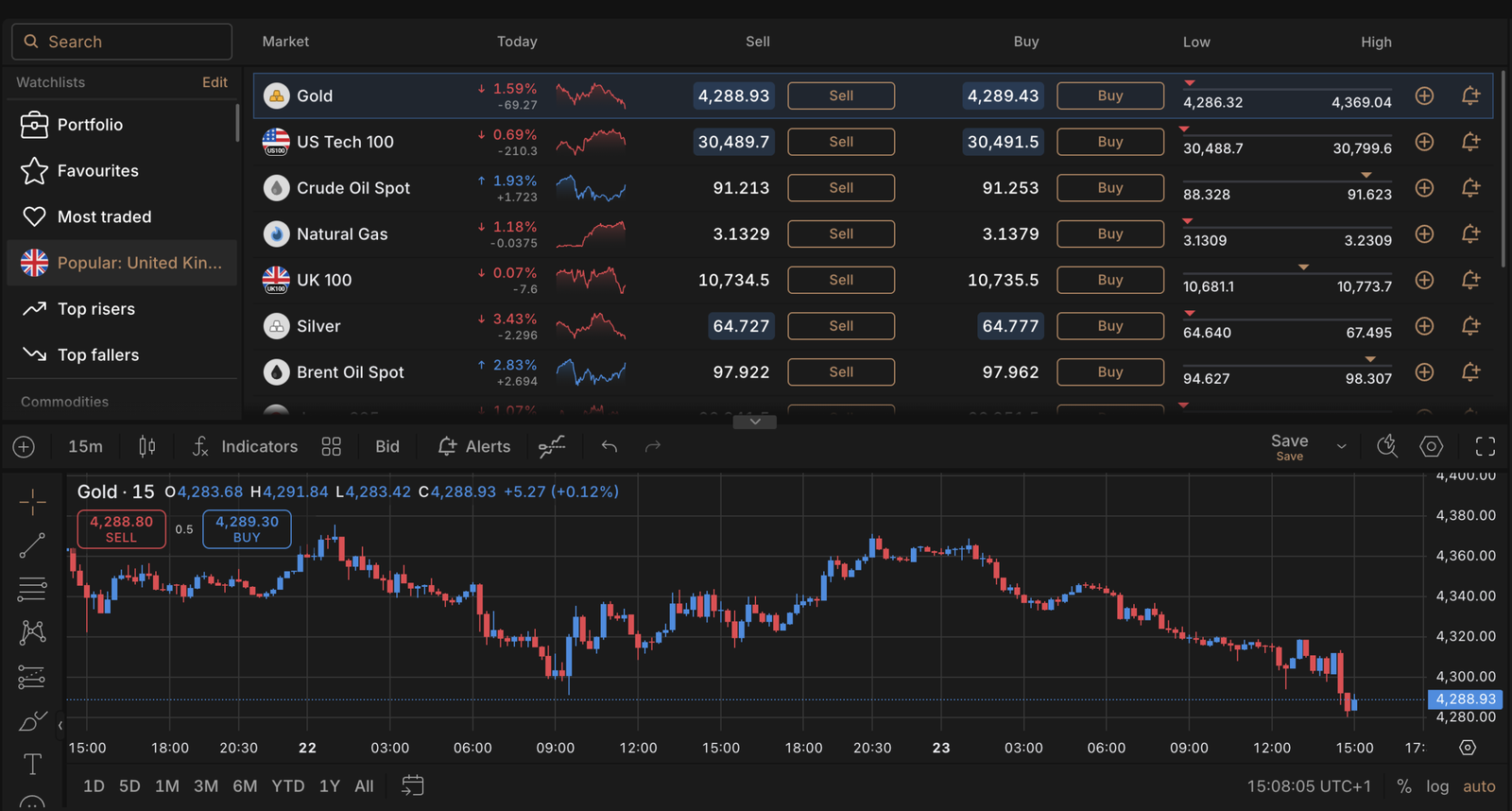
Of the six platforms I tested, Capital.com was the easiest to start spread betting on. The minimum deposit is £20, there are no account, deposit or withdrawal fees, and I went from sign-up to first bet faster than anywhere else. The trade-off is depth: 5,500+ markets is a third of IG’s, and the research tools are lighter than IG’s or CMC’s.
Key information
| Feature | Information |
|---|---|
| Suited to | Beginners and mobile-first spread betting |
| Markets | 5,500+ |
| Spreads | EUR/USD from 0.6 pts; dynamic pricing |
| Commission | £0 |
| Minimum deposit | £20 |
| Deposit/withdrawal fees | None; £20 minimum withdrawal (depends on method) |
| Overnight funding | Daily fee ± SONIA/SOFR benchmark |
| Guaranteed stops | Yes; premium charged only if triggered |
| Platforms | Capital.com web and app, TradingView (spread betting supported); MT4 (CFDs only) |
| Demo | Yes, no expiry |
| Support | 24/7 |
| FCA entity | Capital Com (UK) Ltd, FRN 793714 |
| FSCS | Eligible claims up to £85,000 |
What I tested: Capital.com spread betting account (GBP), £20 debit card deposit topped up to £250, Capital.com app on Google Pixel 9 and web on Windows 11, September 2026.
What was it like spread betting with Capital.com?
Capital.com was the only platform where I could start with the kind of money a nervous beginner might risk. When I tested it, I deposited just £20 by debit card and placed my first EUR/USD bet 12 minutes after signing up with a Gmail address.
The app’s order ticket is where it earns its beginner ranking. When I entered 10p a point on EUR/USD, it showed the margin, the potential loss at my stop in pounds and the overnight fee before I confirmed, with no need to hunt through a separate costs page. I set a stop 30 points away and a take-profit at 45, both by dragging lines on the chart.
After topping up to £250, I added a guaranteed stop to a US 500 bet. Like IG, Capital.com shows the premium upfront but only charges it if the stop is hit. I also checked whether US shares carry a currency charge. Spread bets are settled in pounds per point, so Capital.com’s 0.7% conversion fee didn’t apply to my Apple bet. It only affects CFDs in other currencies.
The friction was during NFP on 4 September. EUR/USD widened from 0.6 to 1.2 points for a few minutes around the release, which doubled the cost of anything I opened then. My 50-order test still had a median of 27ms, the fastest here. I connected my spread betting account to TradingView in a few minutes and could place bets from the chart. MT4 is a different story: Capital.com’s MT4 connection is for CFDs only, so MetaTrader users can’t spread bet through it.
How much does Capital.com spread betting cost?
Capital.com charges no commission, deposit, withdrawal or account fees; you pay the spread and overnight funding. At £2 per point, EUR/USD at 0.6 points costs £1.20 a round trip, rising to £2.40 during a release like NFP. Overnight funding is Capital.com’s daily fee plus or minus the SONIA or SOFR benchmark, and it’s shown on the ticket before you bet.
Who is Capital.com suited to?
Capital.com is suited to first-time spread betters who want to start with £20 to £250, trade mainly from a phone and see every cost before confirming.
Who should avoid Capital.com?
Traders who want UK small caps, deep research or advanced charting tools, and MT4 users who want to spread bet, since Capital.com’s MT4 is CFD-only. IG and CMC offer three to four times as many markets.
Read the complete Capital.com review here.
Pros & cons
- £20 minimum deposit and no funding fees
- Costs and loss-at-stop shown on the ticket
- Fastest execution in my test
- Demo with no expiry
- 5,500+ markets, far fewer than IG or CMC
- Spreads doubled around NFP
- Lighter research than IG or CMC
- MT4 is CFD-only, so no spread betting on MetaTrader
Verdict: Capital.com is the platform I’d give a beginner. It isn’t the deepest, but it removes the barriers of cost, minimums and confusing tickets that put new spread betters off, without charging for the privilege.
65% of retail investor accounts lose money when trading spread bets and CFDs with this provider. You should consider whether you can afford to take the high risk of losing your money.
3. Pepperstone – Best for low-cost forex spread betting and fast execution
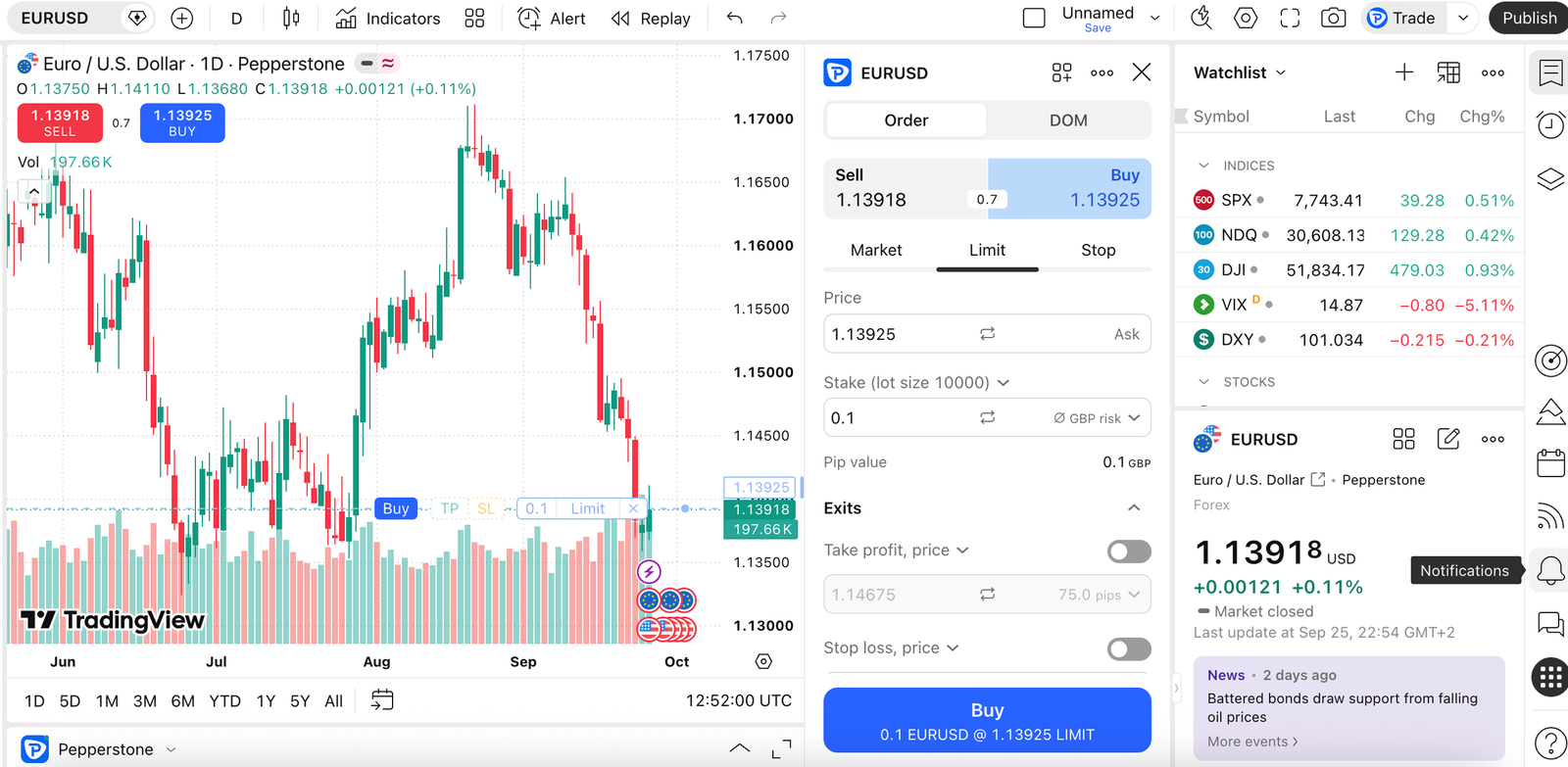
Pepperstone is the best spread betting platform for active traders who care about execution and platform choice: its spread betting account runs on MT4, MT5, cTrader and TradingView, commission-free. The trade-off is that it offers no guaranteed stops, and the headline “0.0 pips” pricing belongs to its Razor CFD account, not spread betting.
Key information
| Feature | Information |
|---|---|
| Best for | Active forex and index spread betters |
| Markets | 1,350+ (90+ FX pairs, 1,100+ shares, 20+ indices, 40 commodities) |
| Spreads | FX from 0.6 pts (EUR/USD around 0.5 pts); gold from 0.1 pts |
| Commission | £0 on spread bets (Razor CFD: 0.0 pips + £2.25 per lot per side) |
| Minimum funding | £10 |
| Minimum stake | From £0.10 per point on selected markets (0.1 on EUR/USD); varies by instrument |
| Overnight funding | Swap charged on positions held past 22:00 UK |
| Guaranteed stops | No |
| Platforms | Pepperstone web and app, MT4, MT5, cTrader, TradingView |
| Demo | Yes: MT4/MT5 demos expire after 60 days; cTrader and TradingView demos stay open if you log in at least every 90 days |
| Inactivity fee | None |
| FCA entity | Pepperstone Ltd, FRN 684312 |
| FSCS | Eligible claims up to £85,000 |
What I tested: Pepperstone spread betting account (GBP) compared with a Razor CFD account, £400 bank transfer deposit, MT5 and cTrader on Windows 11 plus the Pepperstone app on iPhone 16, September 2026.
What was it like spread betting with Pepperstone?
Pepperstone felt built for traders who already know what they want from a platform. My test began with a £400 bank transfer, but onboarding was the slowest here. The application asked more about my trading experience and finances than the others, and approval came the next morning.
The first thing I checked was the account type. It’s easy to open a Razor CFD account by mistake, because that’s where Pepperstone’s 0.0-pip marketing points. I opened the spread betting account and a Razor account side by side to compare. At the same London-session moment, the spread bet showed EUR/USD at 0.6 points with no commission, and Razor showed 0.1 pips plus £2.25 per lot per side.
I then ran my 50 EUR/USD orders from MT5, with a median fill of 51ms. Three fills came in 0.1 points better than requested, and none worse. On cTrader I set limit orders on USD/JPY and moved them on the chart. On TradingView, the EUR/USD spread bet ticket stated a minimum stake of 0.1, which is £0.10 per point on a GBP account. When I tried 0.05, the order was rejected. That’s small enough to trade a £400 account sensibly, but it isn’t a broker-wide minimum, so check the ticket for each market. Having spread betting on MT5 and cTrader matters if you already use their indicators or automated strategies, and most spread betting providers don’t offer either. If you want to practise first, choose the platform carefully: my MT5 demo was set to expire after 60 days, while cTrader and TradingView demos stay open as long as you log in at least every 90 days.
The limitation came when I tried to protect a UK 100 bet before a data release. There are no guaranteed stops at Pepperstone, so my ordinary stop could have been filled beyond its level if the market gapped.
How much does Pepperstone spread betting cost?
Pepperstone charges no commission on spread bets; you pay the spread and overnight swaps. A £10-per-point EUR/USD bet at 0.6 points costs £6 a round trip. The closest Razor CFD equivalent (one lot) costs about £4.50 in commission plus a 0.1-pip spread, so it’s often slightly cheaper. But CFD profits are liable to Capital Gains Tax, while spread betting profits currently aren’t for most UK residents. For a profitable UK trader, the spread bet is usually the better deal.
Who is Pepperstone best for?
Pepperstone is best for active forex and index traders who use MT4, MT5, cTrader or TradingView and want spread betting on the platform they already know.
Who should avoid Pepperstone?
Beginners, who’ll find onboarding demanding, and anyone who wants guaranteed stops for trading around news.
Read the complete Pepperstone review here.
Pros & cons
- Spread betting on five platforms, including MT5 and cTrader
- £10 minimum funding; no inactivity fee
- Tight gold pricing
- Occasional positive slippage in testing
- cTrader and TradingView demos don't expire with regular log-ins
- No guaranteed stop-loss orders
- Stricter onboarding; approval wasn't same day
- 1,350+ markets, the smallest range here
Verdict: Pepperstone is the pick for traders who choose a broker by platform and execution. Its spread betting pricing isn’t dramatically cheaper than IG’s or Spreadex’s, but no one else offers spread betting across MT5, cTrader and TradingView together.
4. CMC Markets – Best for advanced charting and research
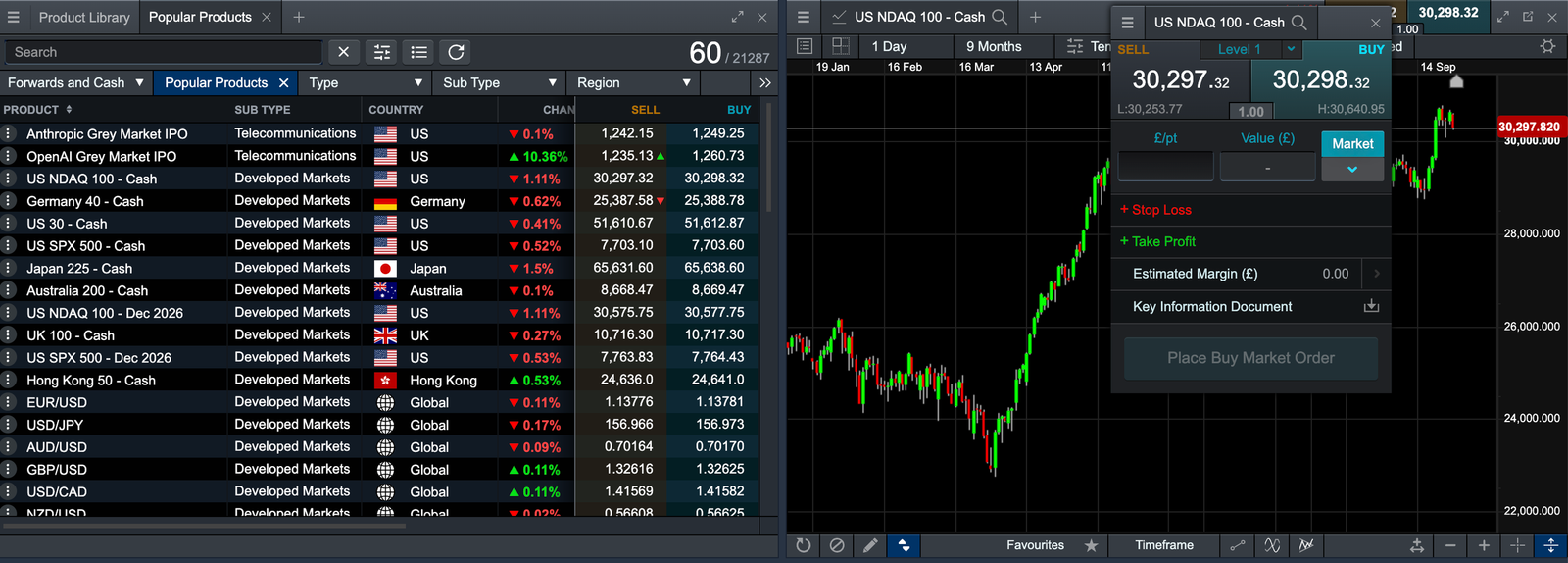
CMC Markets is the best spread betting platform for traders who analyse before they bet. It offers 21,000+ spread betting instruments, 115+ indicators and a pattern-recognition scanner on its Next Generation platform. The trade-off is cost for active forex traders: EUR/USD sat around 0.7 points in my test and widened further around the Bank of England decision.
Key Information
| Feature | Information |
|---|---|
| Best for | Advanced charting and research |
| Markets | 21,000+ spread bet instruments (15,000+ shares, 300+ FX pairs, 80+ indices, 100+ commodities) |
| Spreads | From 0.2 pts; EUR/USD around 0.7 pts |
| Commission | £0 on spread bets |
| Minimum deposit / stake | £0 / from 1p per point on some instruments |
| Overnight funding | Holding cost charged at 22:00 UK |
| Guaranteed stops | Yes (GSLO); 100% of the premium refunded if not triggered |
| Inactivity fee | £10 a month after 12 months without trading |
| Platforms | Next Generation web, mobile app, MT4, TradingView |
| Research tools | 115+ indicators, pattern recognition, Reuters news, economic calendar |
| Demo | Yes, £10,000 virtual funds |
| FCA entity | CMC Markets UK plc, FRN 173730 |
| FSCS | Eligible claims up to £85,000 |
What I tested: CMC Markets spread betting account (GBP), £600 debit card deposit, Next Generation web platform on a MacBook Air and the CMC app on iPhone 15, September 2026.
What was it like spread betting with CMC Markets?
CMC was the platform where I spent most of my time before placing a bet, which is the point of it. I deposited £600 by debit card and was trading 24 minutes after starting the application.
I began with the pattern-recognition scanner on GBP/USD. It flagged four emerging patterns on the four-hour chart, each with a target zone. It’s a useful way to generate ideas, but it doesn’t predict anything, so I used it as a starting point and checked each pattern against RSI and moving averages. With 115+ indicators and saved chart layouts, I didn’t feel any need to open TradingView, although CMC offers it.
I then searched for an AIM-listed small cap that IG and Capital.com didn’t list, and found it available for spread betting at 1p per point. Breadth like that matters if you bet on UK shares rather than just indices.
On the UK 100, I added a GSLO. The premium was shown on the ticket, and CMC refunds it if the stop isn’t triggered, so protection cost me nothing on a bet that closed in profit.
The friction was pricing on forex. EUR/USD averaged 0.7 points in London, and when I checked during the 17 September Bank of England decision, it widened to 1.6 points. My 50 orders filled at a median of 97ms, among the slower results here.
How much does CMC Markets spread betting cost?
CMC charges no commission on spread bets, and no currency conversion or market data fees. At £5 per point, EUR/USD costs about £3.50 a round trip at 0.7 points, compared with £3 at IG or Spreadex. Holding costs are charged at 22:00 UK time. CMC charges £10 a month once an account has had no trading for 12 months.
Who is CMC Markets best for?
CMC Markets is best for spread betters who do their own analysis and want charting, pattern recognition and 21,000+ instruments, including UK small caps, in one place.
Who should avoid CMC Markets?
High-volume forex scalpers, for whom a tenth of a point matters on every trade. Beginners may also find the Next Generation layout overwhelming at first.
Read the complete CMC Markets review here.
Pros and cons
- 21,000+ spread bet instruments, the widest here
- 115+ indicators and a pattern-recognition scanner
- GSLO premium refunded in full if not triggered
- Stakes from 1p per point on some markets
- EUR/USD wider than IG, Capital.com and Spreadex in my test
- Busy interface for beginners
- £10 monthly inactivity fee after 12 months
Verdict: CMC is the platform for spread betters who want to research and bet in the same place. It’s not the cheapest for frequent forex trading, but for UK shares, analysis and market coverage it’s the strongest here.
5. Spreadex – Best UK-focused spread betting platform

Spreadex is the most UK-centric spread betting platform on this list: a British firm built around spread betting rather than CFDs, with 10,000+ markets, stakes from 10p per point and 24-hour phone support. The trade-off is platform choice. You get Spreadex’s own platform and TradingView, with no MT4, MT5 or cTrader, and only 35+ indicators.
Key Information
| Feature | Information |
|---|---|
| Best for | UK-focused spread betting and small stakes |
| Markets | 10,000+ (60+ FX pairs, 30+ indices, 200+ ETFs, UK and US shares) |
| Spreads | EUR/USD 0.6 pts |
| Commission | £0 on standard spread bets |
| Minimum stake | £0.10 per point on EUR/USD and UK 100 daily |
| Minimum deposit | £0 by bank transfer; £5 by card |
| Overnight funding | Interest differential ± 1.5% (FX) |
| Guaranteed stops | Yes, on eligible markets (set when opening only) |
| Platforms | Spreadex web and app, TradingView |
| Indicators | 35+ |
| Demo | No proprietary demo for financial spread betting |
| Support | 24-hour, UK-based |
| FCA entity | Spreadex Ltd, FRN 190941 |
| FSCS | Eligible claims up to £85,000 |
What I tested: Spreadex financial spread betting account (GBP), £300 debit card deposit, Spreadex app on Samsung Galaxy S25 and web on Windows 11, September 2026.
What was it like spread betting with Spreadex?
Spreadex felt the most like a dedicated spread betting firm rather than a CFD broker with a spread betting option. I deposited £300 by debit card and placed my first bet 10 minutes after my ID was verified.
I started small on purpose. Spreadex has no proprietary demo for financial spread betting, so there’s no practice account to rehearse on first. Instead, I placed a EUR/USD bet at 10p per point, the minimum, which means a 20-point move against me costs £2. That makes Spreadex one of the cheapest places to learn how spread bets behave with real money, and the small stake does much of the job a demo would. My 50 EUR/USD orders filled at a median of 60ms with no requotes.
On the UK 100 I wanted a guaranteed stop, and this is where I hit Spreadex’s main quirk: you can only add one when you open the bet. I’d already opened mine, so I had to close and reopen it to add protection, paying the spread twice.
The support was the standout. I called three times, once at 21:30, and never waited more than two minutes. The agent answered my question about guaranteed-stop premiums on AIM shares without transferring me. I also connected TradingView for charting, because Spreadex’s own 35+ indicators felt limited after using CMC.
One practical note: Spreadex also runs sports spread betting, and the same login shows sports markets. You can ignore them, but a first-time user may find that confusing.
How much does Spreadex cost?
Spreadex charges no commission on standard spread bets; you pay the spread and overnight funding. At 10p per point, a EUR/USD round trip at 0.6 points costs 6p. At £5 per point it costs £3. Overnight FX funding is the interest differential plus or minus 1.5%, the same admin margin as IG’s FX rate. There’s no inactivity fee.
Who is Spreadex best for?
Spreadex is best for UK spread betters who want small stakes, UK shares and fast human support, and who are happy with a proprietary platform plus TradingView.
Who should avoid Spreadex?
MetaTrader and cTrader users, beginners who want to practise on a demo before risking money, and anyone who likes to add guaranteed stops to trades that are already open.
Read the complete Spreadex review here.
Pros & cons
- 10p minimum stakes on EUR/USD and UK 100
- Fastest withdrawal and phone support in my test
- 10,000+ markets, including UK small caps
- Zero requotes
- No MT4, MT5 or cTrader
- Guaranteed stops only when opening a bet
- Only 35+ built-in indicators
- No financial spread betting demo
Verdict: Spreadex is the best choice for UK traders who want a firm built around spread betting. It doesn’t match IG’s platform range, but its support, small stakes and fast withdrawals make it the most practical UK-first option.
6. Trade Nation – Best for fixed spreads
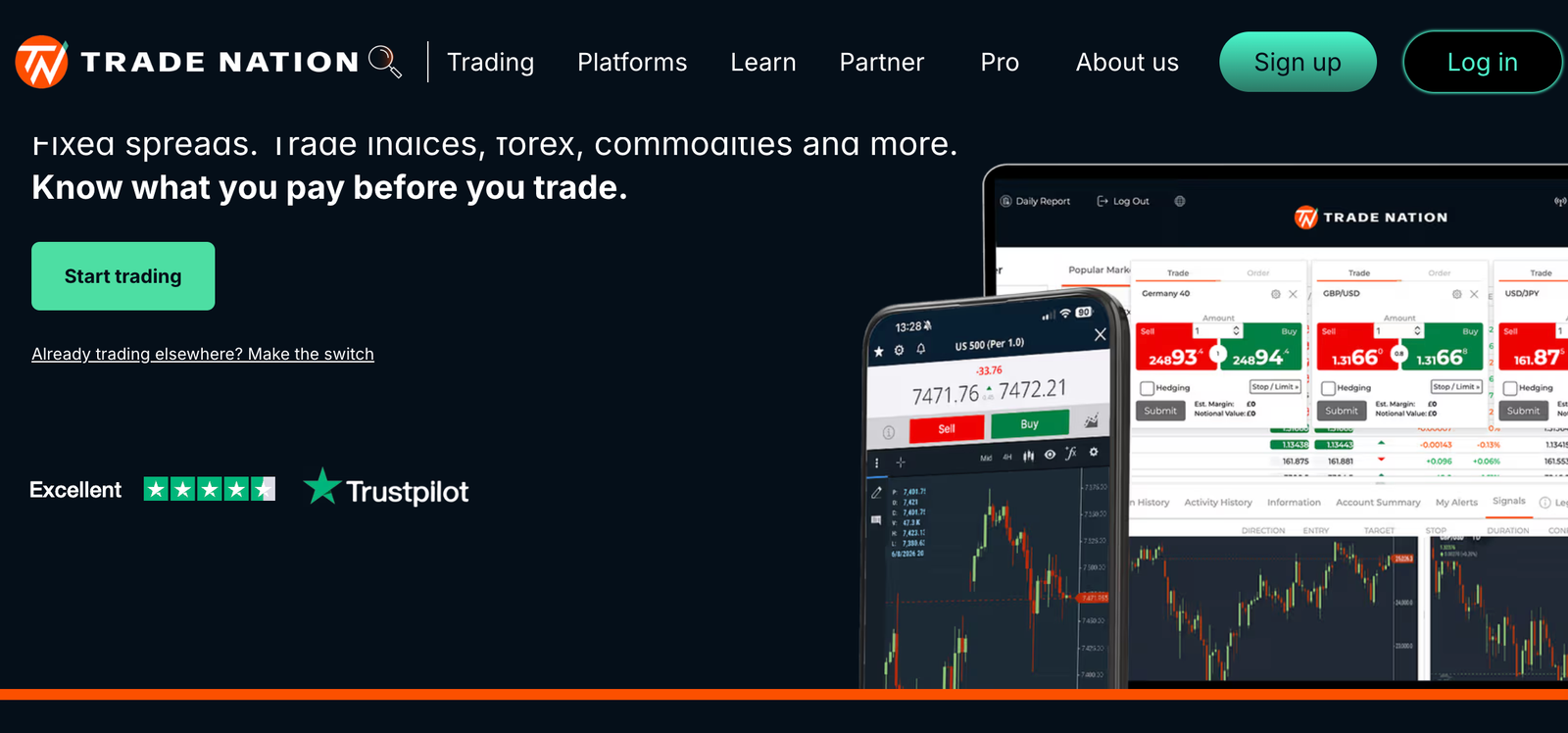
Trade Nation is the fixed-spread specialist, publishing spreads such as 0.5 points on EUR/USD and 0.8 points on the UK 100 during main sessions. The trade-off is that fixed doesn’t mean the same spread 24 hours a day: spreads switch to wider fixed bands at set times outside core hours, and MT4 uses variable pricing.
Key information
| Feature | Information |
|---|---|
| Best for | Traders who want published fixed spreads |
| Main-session fixed spreads | EUR/USD 0.5; GBP/USD 0.8; UK 100 0.8; Germany 40 1; US 500 0.4 |
| EUR/USD bands (UK time) | 0.5 pips 07:00–21:59; 5.0 pips 22:00–22:59; 0.6 pips 23:00–06:59 (daily break 22:00–22:05) |
| UK 100 bands (UK time) | 1.0 pt 07:00–07:59; 0.8 pts 08:00–16:29; 1.0 pt 16:30–20:59; 5.0 pts 21:00–06:59 |
| How pricing works | Pre-set bid-offer bands that switch at set times between core and out-of-hours levels; they don’t move with volatility |
| Commission | £0 |
| Minimum deposit | None as such; payment-method minimums of £0.01–£5 |
| Minimum stake | From 10p per point |
| Overnight funding | Rate differential + 2.5% a year (3% commodities) |
| Guaranteed stops | Yes, with a premium |
| Platforms | TN Trader, TradingView (fixed spreads); MT4 (variable spreads); no MT5 |
| Demo | Yes |
| Withdrawals | No fee; typically 1–2 working days |
| Inactivity fee | None |
| FCA entity | Trade Nation Financial UK Ltd, FRN 525164 |
| FSCS | Eligible claims up to £85,000 |
What I tested: Trade Nation spread betting account (GBP), £200 debit card deposit, TN Trader web on a MacBook Air, TradingView desktop and MT4 on Windows 11, with timestamped spread checks across 24 hours, September 2026.
Do Trade Nation’s fixed spreads really stay fixed?
They don’t move with volatility, but they aren’t one spread around the clock. Trade Nation sets fixed bid-offer bands that switch at set times of day between core-hours and out-of-hours levels. My hands-on test was built around that schedule, so after depositing £200 I checked the EUR/USD spread at six timestamps across a day. It was 0.5 pips at 08:00, 10:30, 14:30 and 21:59. After the daily 22:00–22:05 break, it reopened at 5.0 pips, ten times the headline rate, because 22:00–22:59 is the rollover band. By 02:00 it was back to 0.6. Each change happened on the clock, not in response to a price move.
The UK 100 follows the same logic. I checked it six times and it matched the published band every time.
So “0.5 pips on EUR/USD” and “0.8 points on the UK 100” are main-session spreads, not round-the-clock ones. The useful part is that the bands are published, so you know the cost of an evening trade before you place it.
The more useful result came during news. On NFP day, EUR/USD stayed at 0.5 points on Trade Nation while it widened to 1.2 on Capital.com. It held again through the Bank of England decision on 17 September, when CMC was showing 1.6. If you trade releases, that predictability is worth more than a tight variable spread in quiet hours.
In quiet London hours, though, fixed isn’t automatically cheapest. At 10:30 on the same day, IG and Spreadex were both at 0.6 points on EUR/USD, only 0.1 wider than Trade Nation. On the UK 100 at 19:00, Trade Nation’s spread was 1.0 point against 2 points on IG’s FTSE 100 daily funded bet. At 21:30, though, Trade Nation was at 5 points and IG at 4, so the late-evening advantage flips.
What was it like using Trade Nation’s platforms?
TN Trader is plain but clear: the ticket showed the fixed spread, margin and stop distance, and I placed a 10p-per-point UK 100 bet in three taps. I then opened the same account in TradingView and saw the same fixed prices. MT4 was different. At 10:30 EUR/USD showed 0.7 points there, because MT4 uses variable spreads. If fixed pricing is why you’re choosing Trade Nation, stay on TN Trader or TradingView.
How much does Trade Nation cost?
Trade Nation charges no commission; you pay the fixed spread and overnight funding. A £5-per-point EUR/USD bet costs £2.50 a round trip between 07:00 and 21:59, compared with £3 at IG or Spreadex, but £25 if you open it in the 22:00–22:59 band. A £2 UK 100 bet costs £1.60 in cash hours and £10 between 21:00 and 06:59. Overnight funding is where it costs more: the rate differential plus 2.5% a year, against 1.5% on FX at IG and Spreadex. On £10,000 of EUR/USD exposure, that admin element is about 68p a night against 41p. There are no deposit, withdrawal or inactivity fees.
Who is Trade Nation best for?
Trade Nation is best for day traders and news traders who want to know their cost before they bet, and who close positions before the evening.
Who should avoid Trade Nation?
Swing traders who hold positions for days or weeks, because the 2.5% overnight admin fee is the highest here, and MT4 or MT5 users who want fixed pricing.
Pros
- Fixed spreads held through NFP and the BoE decision
- EUR/USD 0.5 and US 500 0.4 points in main sessions, with every time band published
- 10p minimum stake; no real minimum deposit
- Fast withdrawal approval
Cons
- EUR/USD jumps to 5.0 pips from 22:00 to 22:59; UK 100 to 5 points from 21:00 to 06:59
- Fixed pricing not available on MT4; no MT5
- 2.5% overnight admin fee
Verdict: Trade Nation is the right choice when predictability matters more than the lowest possible spread. For intraday and news trading it’s the most transparent option here; for overnight holds, IG and Spreadex are cheaper.
Which spread betting platform is best for you?
| If you want… | My pick | Why |
|---|---|---|
| Best overall | IG | 17,000+ markets and four platforms on one account |
| Beginners | Capital.com | £20 minimum deposit, no funding fees, costs shown on the order ticket |
| Lowest spreads | Trade Nation | EUR/USD 0.5 pts and UK 100 0.8 pts fixed in main sessions |
| Forex | Pepperstone | 90+ FX pairs on MT4, MT5, cTrader and TradingView |
| UK shares | CMC Markets | 15,000+ shares, including AIM small caps from 1p per point |
| FTSE 100 | Trade Nation | 0.8 pts fixed from 08:00 to 16:29, against 1 pt elsewhere |
| Advanced charting | CMC Markets | 115+ indicators and pattern recognition |
| MT4/MT5 | Pepperstone | The only one here offering spread betting on MT5 and cTrader |
| TradingView | Trade Nation | Its fixed spreads also apply on TradingView |
| Mobile trading | Capital.com | App-first, fastest sign-up to first trade in testing |
| Day trading | Trade Nation | Fixed spreads held through NFP and the BoE decision |
| Large market range | CMC Markets | 21,000+ spread bet instruments |
| Demo account | Capital.com | No expiry and no deposit needed |
| Fixed spreads | Trade Nation | Published time bands that don’t move with volatility |
| Small stakes and phone support | Spreadex | 10p per point minimum, 24-hour UK support |
How much spread betting actually cost?
| Broker | EUR/USD spread | £10/point FTSE trade (spread cost) | Overnight cost | Withdrawal | Estimated round-trip cost |
|---|---|---|---|---|---|
| IG | From 0.6 pts | £10 (08:00–16:29); £20 (16:30–20:59); £40 (21:00–01:00) | Benchmark ± 1.5% (FX) / 3.4% (indices): about 41p / 93p a night per £10,000 | Free; 3 working days | £16 |
| Capital.com | From 0.6 pts | £10 | Benchmark ± daily admin fee, shown on the order ticket | Free; 2 working days | £16 |
| Pepperstone | From 0.6 pts | £10 | Indices: benchmark + 2.5%, about 69p a night per £10,000; or forward contracts with no overnight fee | 2 working days | £16 |
| CMC Markets | Around 0.7 pts | £10 | Holding cost charged at 22:00 UK | 3 working days | £17 |
| Spreadex | 0.6 pts | £10 | Benchmark ± 1.5% (FX): about 41p a night per £10,000 | 1 working day | £16 |
| Trade Nation | 0.5 pts (07:00–21:59) | £8 (08:00–16:29); £10 (16:30–20:59); £50 (21:00–06:59) | Benchmark + 2.5% (3% commodities): about 68p a night per £10,000 | Free; next day | £13 |
What is the best spread betting platform for beginners?
Capital.com is our pick for beginners. It has a £20 minimum deposit, no funding fees and a demo that doesn’t expire, and the order ticket shows margin, loss at your stop and overnight cost before you confirm. Spreadex suits beginners who want to start with real money at 10p per point, although it has no demo.
What is the best spread betting platform for day traders?
Trade Nation is our pick for day traders. Its EUR/USD spread is fixed at 0.5 points and its UK 100 at 0.8 points during main sessions, and its spreads held through NFP and the Bank of England decision. Five £10-per-point EUR/USD round trips cost about £25 there, against £30 at most rivals. Pepperstone is the alternative if you trade on MT5 or cTrader.
What is the best spread betting platform for forex?
Pepperstone is our pick for forex, with 90+ FX pairs from 0.6 points on MT4, MT5, cTrader and TradingView. CMC Markets has the widest choice, with 300+ pairs, but EUR/USD was wider at around 0.7 points. For overnight forex positions, IG and Spreadex charge the lowest admin fee here, at 1.5%. Check our guide on the best forex brokers here.
What is the best spread betting platform for UK shares?
CMC Markets is our pick for UK shares. It offers 15,000+ shares, including AIM small caps from 1p per point, with research and pattern-recognition tools. IG is close behind on range. Spreadex offers simple UK share betting with 24-hour phone support.
What is the best spread betting platform for MT4/MT5?
Pepperstone is our pick for MetaTrader: it’s the only broker here that offers spread betting on MT5, as well as MT4 and cTrader. IG and CMC also offer spread betting on MT4. Trade Nation’s MT4 uses variable rather than fixed spreads, and Capital.com’s MT4 is for CFDs only.
Which spread betting platform has the lowest spreads?
Trade Nation had the lowest fixed EUR/USD spread in our test at 0.5 points during its main session. Pepperstone, IG, Capital.com and Spreadex started around 0.6 points.
How I scored and ranked the best spread betting platforms UK
I tested each provider specifically for this guide, using the same criteria across the six accounts. The weights below determine the order of this guide only and were built for one reader: a UK trader choosing where to open a spread betting account.
Before ranking, each provider had to pass three checks: an FCA-authorised UK entity, a spread betting account open to UK retail clients (not CFDs only), and published pricing I could compare. FCA status and the spread betting tax position are the same for all six, so I didn’t award extra points for them.
| Ranking factor | Weight | What I assessed |
|---|---|---|
| All-in trading cost | 25% | Published spreads on EUR/USD, GBP/USD, FTSE 100 and gold; overnight admin fees (1.5% FX at IG and Spreadex, 3.4% non-FX at IG, 2.5% at Trade Nation); inactivity fees such as CMC’s £10 a month |
| Risk management tools | 20% | Guaranteed stop availability and when the premium is charged; whether stops can be added after opening; minimum stakes (10p at Spreadex and Trade Nation); loss-at-stop shown on the ticket |
| Pricing consistency | 15% | Fixed versus variable spreads, published out-of-hours spreads, evidence of widening around NFP and BoE releases |
| Market access | 15% | Number of spread bet markets (21,000+ at CMC down to 1,350+ at Pepperstone), UK shares and small caps, out-of-hours markets |
| Platforms and charting | 15% | Proprietary platform, TradingView, and whether MT4, MT5 or cTrader carry spread bets; indicator counts (115+ at CMC, 35+ at Spreadex) |
| Account access and funding | 10% | Minimum deposit (£0 to £20), deposit and withdrawal fees, demo availability, support hours |
The most useful comparison was a cost model for a trader betting £5 per point on EUR/USD: at published main-session spreads, a round trip costs £2.50 at Trade Nation, £3 at IG, Capital.com, Pepperstone and Spreadex, and £3.50 at CMC.
I then mapped the FTSE 100 across a full day from the published time bands, because an after-work trader pays very different prices: IG’s daily funded bet goes from 1 to 2 to 4 points, and Trade Nation’s UK 100 from 0.8 to 1 to 5. Holding overnight reverses part of the order too, since on £10,000 of exposure Trade Nation’s 2.5% admin fee is about 68p a night against about 41p at IG’s and Spreadex’s 1.5%.
I gave cost and risk tools 45% between them because spread betting is leveraged, and stake size and stop protection affect a reader’s outcome more than another 5,000 markets would. Market range and platforms still count, which is why IG’s breadth and four platforms keep it first despite not having the lowest spreads. These weights set the order of this guide only; any broader Psyfi Money platform rating is a separate assessment.
Platforms I considered but didn’t rank
| Platform | FCA entity (FRN) | Spread betting platforms | EUR/USD spread | Min deposit | Guaranteed stops | Key strength | Why it’s not in our top picks | Might suit |
|---|---|---|---|---|---|---|---|---|
| ActivTrades | ActivTrades Plc (434413) | ActivTrader, MT4, MT5 | 0.5 pips (target only) | £0 | No | Spread betting on MT5; quick support and next-day withdrawals | Publishes target spreads only; no guaranteed stops; £10/month inactivity fee after 18 months | MT5 users who don’t need guaranteed stops |
| FXCM | Stratos Markets Ltd (217689) | Trading Station, MT4 (TradingView to be confirmed) | 0.9 pts | £50 | No | Stakes from 7p a point; 41 FX pairs; £50,000 demo | No guaranteed stops; 26-hour account approval and slow email support | Forex traders who want small stakes on MT4 |
| OANDA | OANDA Europe Ltd (542574) | OANDA web/app, TradingView, MT4 | From 0.6 pips | £0 | Yes | Fast execution | No published minimum stake; inactivity fee up to £20/month; 76.6% of retail accounts lose money | Active forex traders who prioritise execution speed |
| Spread Co | Spread Co Ltd (446677) | SATURN web platform, mobile app | 0.8 pts | Not stated | Yes | 1p minimum stake | Widest average spreads of 14 brokers tested; slow execution (234ms); own platform only | Beginners with small accounts learning to size positions |
| StoneX Trading (formerly City Index) | StoneX Financial Ltd (446717) | Web Trader, app, TradingView | 0.8 pts (typical) | £0 | Yes | Fast execution (112ms); guaranteed stops on TradingView | Typical spreads at or above average; mid-rebrand (City Index retired Sept 2026); £12/month inactivity fee | Existing City Index clients |
| ThinkMarkets | TF Global Markets (UK) Ltd (629628) | ThinkTrader, TradingView | 1.1 pips (target only) | £0 | Not confirmed | Spread betting on TradingView; Traders’ Gym backtesting |
What is spread betting and how does it work?
Spread betting lets you bet on whether a market, such as a share, index or currency, will rise or fall, without owning it. You choose a stake per point, such as £1 or £5, and your profit or loss is your stake multiplied by the number of points the price moves. For example, a £5 bet on a move of 20 points in your favour wins £100, while a move of 20 points against you loses £100.
The broker makes money from the spread, the gap between the buy and sell price. If you keep a bet open overnight, you’ll usually pay a financing fee too.
Who is spread betting suitable for?
Spread betting is primarily suited to active traders who understand leverage, margin and the risks of short-term trading. It can be useful if you want to speculate on rising or falling markets from a single account, but it isn’t generally designed as a replacement for long-term investing.
How to choose a spread betting broker
- FCA authorisation: check the firm’s FRN on the FCA register and that the UK entity is the one you’re signing up with. It’s a minimum requirement.
- Spreads: compare spreads on the markets you’ll actually trade, at the times you’ll trade them. A 1-point FTSE spread in London hours can be 4 or 5 points after 21:00.
- Overnight financing: check the admin fee added to the benchmark rate. It runs from 1.5% on forex to 3.4% on indices at the brokers on this page, and it matters more than spreads if you hold positions for weeks.
- Execution: look for published fill-speed or requote data, and test market orders around news releases if you can.
- Markets: a large number only matters if the broker covers the markets you trade, such as AIM shares, out-of-hours indices or minor FX pairs.
- Platform: decide whether you want a broker’s own platform or MT4, MT5, cTrader or TradingView. Not every third-party platform supports spread bets.
- Mobile: check that the app shows margin, loss at your stop and overnight cost before you confirm a bet.
- Risk controls: look at guaranteed stops (and when the premium is charged), minimum stakes, and whether you can add a guaranteed stop to an open bet.
- Customer service: check the support hours and whether you can reach someone by phone during market hours.
- Withdrawal process: check the fees, the minimum withdrawal and the processing time. At the brokers here, withdrawals range from same-day approval to 3 working days.
Is spread betting safe in the UK?
Spread betting with an FCA-authorised broker is well regulated, but it’s high risk: most retail accounts lose money. The FCA applies the same retail rules to financial spread bets as to CFDs:
- Leverage limits: 30:1 on major FX pairs, 20:1 on major indices and gold, 10:1 on other commodities and 5:1 on shares.
- Margin close-out: the broker must close your positions when your funds fall to 50% of the margin needed to keep them open.
- Negative balance protection: retail clients can’t lose more than the money in their account.
- Risk warnings: brokers must publish the percentage of retail accounts that lose money. At the brokers on this page that publish it, the figure ranges from 61% (Spreadex) to 72.9% (Pepperstone).
- Client money: your money must be kept separate from the firm’s own funds. If an FCA-authorised firm fails, the Financial Services Compensation Scheme (FSCS) can cover eligible claims up to £85,000. It doesn’t cover trading losses.
Is spread betting legal in the UK?
Yes. Financial spread betting is legal in the UK and regulated by the FCA. It’s only offered in a few countries, mainly the UK and Ireland.
Is spread betting tax-free in the UK?
For most people, yes. HMRC says that “no assets are acquired or disposed of and no chargeable gains or allowable losses arise from spread betting”, so profits aren’t subject to Capital Gains Tax. There’s no stamp duty either.
There are two caveats:
- Losses: you can’t offset them against other capital gains.
- Spread betting as a business: HMRC may treat profits as taxable trading income if they “arise from the carrying on of that trade”, depending on the terms of the contract and what you actually do.
Tax treatment depends on your circumstances and can change, so check with a tax adviser if you’re unsure.
Spread betting vs CFDs
| Spread betting | CFDs | |
|---|---|---|
| How you size a trade | £ per point | Number of contracts or shares |
| Tax on profits | Usually no CGT or stamp duty | CGT applies; losses can be offset |
| Commission | Usually built into the spread | Often charged on share CFDs |
| Currency | Settled in GBP | Settled in the market’s currency, with conversion fees |
| Availability | Mainly UK and Ireland | Widely available |
| FCA protections | Same leverage limits, close-out rule and negative balance protection | Same |
Spread betting vs share trading
| Spread betting | Share trading | |
|---|---|---|
| Ownership | You don’t own the shares | You own the shares |
| Leverage | Yes, up to 5:1 on shares | No |
| Going short | Yes | Not usually |
| Tax | Usually no CGT or stamp duty | CGT applies, and 0.5% stamp duty on UK shares; ISAs and SIPPs can shelter gains |
| Ongoing costs | Overnight funding on open positions | Usually none after buying, apart from platform fees |
| Dividends | Cash adjustment | Paid to you as the shareholder |
| Maximum loss | Your account balance | What you invested |
| Suited to | Short-term trading | Long-term investing |
Spread betting vs options
| Spread betting | Options | |
|---|---|---|
| Payoff | Linear: you gain or lose your stake for every point the market moves | Depends on strike, expiry and volatility |
| Maximum loss | Your account balance (with negative balance protection) | The premium, when you buy an option |
| Time decay | None, but overnight funding applies | The option loses value as expiry approaches |
| Costs | Spread plus overnight funding | Premium plus commission |
| Tax | Usually CGT-free | CGT applies on standard options |
| Complexity | Lower | Higher |
Spread betting vs CFDs vs investing
| Spread betting | CFDs | Shares/ETFs | |
|---|---|---|---|
| Own the underlying asset? | No | No | Yes |
| Go short? | Yes | Yes | Usually no |
| Leverage | Yes (up to 30:1 for retail) | Yes (up to 30:1 for retail) | Usually no |
| Typical UK tax treatment | Usually no CGT on profits | CGT may apply; losses can be offset | CGT may apply, unless held in an ISA or SIPP |
| Stamp duty | No | No | 0.5% on UK shares; UK-listed ETFs exempt |
| Overnight financing | Yes | Yes | No |
| Settled in | GBP per point | The market’s currency | The market’s currency |
| Maximum loss | Your account balance | Your account balance | What you invested |
How can you manage risk with spread betting?
- Risk a small, fixed percentage of your capital per trade (many active traders stay within 0.5–2%).
- Use stop-loss orders, and consider guaranteed stops where available to avoid gap risk.
- Keep leverage conservative, avoid holding large positions over major news unless you fully understand the risk, and diversify across markets rather than betting everything on one idea.
- Regularly review drawdowns and be willing to scale back if performance deteriorates.
FAQs
Which platform has the best spreads?
Trade Nation has the lowest headline spreads here, with fixed spreads of 0.5 points on EUR/USD and 0.8 points on the UK 100 in its main sessions. IG, Capital.com, Pepperstone and Spreadex all start from 0.6 points on EUR/USD. Trade Nation’s spreads step up at set times outside core hours, so check the time bands if you trade in the evening.
Is spread betting gambling in the UK?
Only for tax purposes. HMRC doesn’t treat a spread bet as buying or selling an asset, so profits usually aren’t subject to Capital Gains Tax. For regulation, financial spread betting is a financial product overseen by the FCA, not the Gambling Commission.
Is spread betting legal in the UK?
Yes. Financial spread betting is legal in the UK and regulated by the Financial Conduct Authority (FCA).
Is spread betting tax-free?
For most UK residents, yes. There’s no Capital Gains Tax or stamp duty on spread betting profits, but you can’t offset losses against other gains. Profits can be taxable if spread betting is your business, and tax rules can change.
Can beginners use spread betting platforms?
Yes, but spread betting is high risk, and most retail accounts lose money. Start on a demo account, then use small stakes: Spreadex, Trade Nation and Pepperstone accept 10p per point on selected markets.
Spread betting vs CFD trading, what’s the difference?
Both let you trade price movements with leverage, under the same FCA protections. The main difference is tax: UK spread betting profits are usually free of CGT, while CFD profits are taxable. Spread bets are also sized in pounds per point and settled in GBP, while CFDs are sized in contracts and settled in the market’s currency.
Can you lose more than your deposit?
No, not as a retail client. FCA rules require brokers to provide negative balance protection, so you can’t lose more than the money in your account. You can still lose everything in it, and brokers must close your positions if your funds fall to 50% of the margin required.
Which spread betting platform is best for MT4/MT5?
Pepperstone. It’s the only broker here that offers spread betting on MT5, as well as MT4, cTrader and TradingView. IG and CMC Markets offer spread betting on MT4. Capital.com’s MT4 is for CFDs only.
How to avoid spread betting tax in the UK?
For most individuals there’s no tax to avoid. HMRC says no chargeable gains arise from spread betting, so profits usually aren’t subject to CGT. The trade-off is that losses can’t be deducted. Profits can be taxed as income if spread betting is your trade, so speak to a tax adviser if you trade through a business or for a living.
How do you trade tax-free with spread betting?
By using an FCA-regulated spread betting account rather than a CFD or share account. For most UK residents, profits are free of CGT and stamp duty. This is a tax position, not a strategy, and it depends on your circumstances and current rules
What is better, CFD or spread betting?
For most UK residents who expect to make a profit, spread betting is more tax-efficient because profits are usually CGT-free. CFDs can suit you better if you want to offset losses against other gains, or if you trade from a country where spread betting isn’t available.
What is the best spread betting platform UK for beginners?
Capital.com. It has a £20 minimum deposit, no deposit or withdrawal fees, and a demo that doesn’t expire. Its order ticket also shows the margin, loss at your stop and overnight cost before you confirm. IG is the best all-rounder, but its 17,000+ markets and professional tools can be a lot for a first account.
Are spread betting brokers safe?
They’re safe when they’re FCA-regulated, keep client money separate from their own, and provide negative balance protection. The FSCS can also cover eligible claims up to £85,000 if an FCA-authorised firm fails. A safe broker doesn’t make the product safe, though: at the brokers on this page that publish the figure, 61% to 73% of retail accounts lose money.
What are the best spread betting apps?
My picks for spread betting apps in the UK are IG for its 17,000+ markets and professional tools, Capital.com for beginners and mobile-first trading, Pepperstone for active traders on MT4, MT5, cTrader or TradingView, CMC Markets for charting, research and UK shares, Spreadex for UK-focused spread betting with 10p stakes, and Trade Nation for fixed spreads.
What is the best spread betting platform for beginners?
Capital.com is my pick for beginners because its platform is relatively straightforward to use while still offering a broad range of markets. IG is another strong option if you want a more established all-round spread betting platform, while CMC Markets may suit beginners who want more advanced charting and research as they gain experience.
References
- https://www.gov.uk/hmrc-internal-manuals/capital-gains-manual/cg56105
- https://www.lse.ac.uk/accounting/assets/CARR/documents/R-R/2013-Winter/CARRmagRR26-Loussouarn.pdf
- https://metsearch.cardiffmet.ac.uk/discovery/fulldisplay/alma99258525202425/44WHELF_CMU:44WHELF_CMU_NUI1
- https://resolve.cambridge.org/core/journals/behavioural-public-policy/article/trading-is-a-losing-game-an-audit-of-deceptive-choice-architecture-in-demomode-contract-for-difference-cfd-trading-apps/07BB4E4CC011413D8A41458F9ED32928
