

The best trading platforms in Australia in 2026 strike a balance between accessibility, global reach, and cost efficiency, whether you’re just getting started or refining a sophisticated strategy. From the social-first simplicity of eToro to the institutional-grade tools of Interactive Brokers, alongside forex specialists like Pepperstone and low-fee disruptors such as Moomoo and Tiger Brokers, today’s top platforms cater to every type of investor with precision and flexibility.
These platforms combine ASIC regulation, competitive fees, and access to global markets, making them suitable for different trading styles and experience levels.
Choosing the right platform depends on your experience level, the assets you want to trade, and how sensitive you are to fees.
Some platforms prioritise simplicity and education for beginners, while others focus on professional tools, global market access, or tight spreads for active traders.
- CopyTrading lets you mirror experienced investors' trades
- Multi-asset access: stocks, crypto, ETFs, forex, commodities
- Beginner-friendly interface with social/community sentiment feed
Capital at risk. T&Cs apply.
Top trading platforms in Australia (2026)
- eToro: Best for beginners and social trading, offering an easy-to-use platform where users can follow and copy experienced traders, though FX and crypto fees can be higher.
- Interactive Brokers: Best for advanced and global investors, providing some of the lowest brokerage and FX costs available to Australians, along with extensive access to international markets and professional trading tools.
- Pepperstone: Best for active forex and CFD traders, known for tight spreads, fast execution, and strong ASIC regulation, making it popular among experienced traders looking to learn how to trade forex in Australia.
- Moomoo: Best for Australian share investors who want low fees and CHESS-sponsored investing, alongside strong access to US markets and trading tools.
- Tiger Brokers: Best for cost-conscious investors trading US and Asian stocks, offering competitive brokerage rates and global market access.
Key considerations when choosing a trading platform in Australia
- Fees: Compare brokerage costs, spreads, and foreign exchange fees, particularly if you plan to trade US or global shares.
- Regulation: Ensure the broker operates under ASIC regulation, which provides oversight and compliance requirements for Australian financial services.
- Platform experience: Some platforms prioritise simple mobile apps for beginners, while others provide advanced desktop platforms with professional tools.
- Asset access: Make sure the platform supports the markets you want to trade, such as ASX shares, US stocks, ETFs (see the best ETF platforms in Australia for dedicated options), forex, or CFDs.
- Trading style: Long-term investors may prioritise low brokerage and CHESS sponsorship, while active traders may focus on spreads, execution speed, and advanced charting tools.
What are the best trading platforms in Australia in 2026?
| Platform | Ownership Model (ASX Shares) | Asset Coverage | Typical Costs (Headline) | Best For |
|---|---|---|---|---|
| eToro | Custodial model | Shares, ETFs, crypto, CFDs, forex | $2 US stocks, 1% crypto fee, FX conversion spreads | Beginners & copy trading |
| Interactive Brokers | Custodial model | Global shares, ETFs, options, futures, forex, bonds | ASX from $6, US$0.005/share, ultra-low FX | Advanced & global investors |
| Pepperstone | CFD only (no physical shares) | Forex, indices, commodities, share CFDs | 0.0 pip spreads + commission (Razor) | Active forex & CFD traders |
| moomoo | CHESS-sponsored | ASX, US & HK shares, ETFs, options | ASX $3 or 0.03%, low US fees | Low-cost CHESS investors |
| Tiger Brokers | CHESS-sponsored (AU accounts) | ASX, US, HK shares, ETFs, options | ASX $3 or 0.03%, US$0.01/share | Cost-conscious global stock investors |
Online trading platform Australia reviews
Below are detailed reviews of the top Australian trading platforms, highlighting who each platform suits best based on experience level, features, fees, and overall ease of use.
1. eToro – Best for beginners and social trading

Platform overview
| Feature | Details |
|---|---|
| Australian entity | eToro AUS Capital Ltd |
| Regulator | ASIC |
| AFSL | 491139 |
| Minimum deposit | USD $50 |
| Base currency | USD only |
| Stock brokerage | USD $2 per trade |
| ETF brokerage | $0 commission |
| Crypto fee | 1% per trade |
| Withdrawal fee | USD $5 |
| Platforms | Web, iOS, Android |
| Demo account | Yes (USD $100,000 virtual funds) |
Is this trading platform regulated in Australia and overseen by ASIC?
Yes. eToro operates in Australia through eToro AUS Capital Ltd under ASIC AFSL 491139. Client funds are held in segregated accounts, and Australian retail clients receive negative balance protection on CFDs. As with all ASIC-regulated brokers, there is no government-backed compensation scheme, and crypto assets are not protected.
How much does it cost to trade on this platform, including spreads and fees?
Pricing is simple but not the cheapest. Australian users pay USD $2 per stock trade, ETFs are commission-free, and crypto trades cost 1% per transaction. Forex and CFD costs are built into spreads, with majors like EUR/USD typically around 1.0 pip. The main drawback is currency conversion: all AUD deposits are converted to USD, usually costing around 1.5% each way, plus a USD $5 withdrawal fee.
What markets and assets can you trade on this platform?
eToro offers Australian and global shares, ETFs, forex, indices, commodities, and over 140 cryptocurrencies, though dedicated crypto users may prefer one of the best crypto exchanges in Australia for lower fees and more coin options. Non-leveraged buy positions in shares, ETFs, and crypto are real assets, while leveraged or short positions are CFDs. Its standout features are CopyTrader and Smart Portfolios, which let users follow other traders or invest in themed portfolios with minimal effort.
How easy is the platform to use for Australian traders?
Ease of use is a major strength. The web platform and mobile apps are clean, intuitive, and clearly designed for beginners and casual investors. Trading, risk controls, and portfolio tracking are straightforward. Charting and customisation are adequate but basic, which may disappoint advanced or high-frequency traders.
How reliable are AUD deposits, withdrawals, and customer support?
Deposits from Australia are reliable via bank transfer, cards, and supported e-wallets, though all funds are converted to USD. Withdrawals typically take 1–3 business days, with a flat USD $5 fee. Customer support is ticket-based and functional, but response times can be slow compared with premium brokers.
Who is this trading platform best for?
eToro is best suited to beginner and intermediate Australian investors who want an easy, all-in-one platform with strong social and copy trading features. It’s less appealing for active traders focused on tight spreads, advanced tools, or minimising FX costs on large AUD balances.
Read the complete eToro review here.
Pros & cons
- ASIC regulated (AFSL 491139)
- Very easy to use on web and mobile
- Strong copy trading and themed portfolios
- Access to shares, ETFs, CFDs, forex, crypto
- USD-only accounts create FX costs
- 1% crypto trading fee
- Limited advanced tools
- $5 withdrawal fee
2. Interactive Brokers – Best for advanced and global investors
Platform overview
| Feature | Details |
|---|---|
| Australian entity | Interactive Brokers Australia Pty Ltd |
| Regulator | ASIC |
| AFSL | 453554 |
| Minimum deposit | $0 (cash account) |
| Base currency | AUD plus 25+ currencies |
| ASX share brokerage | $6 or 0.08% |
| US share brokerage | US$0.005 per share (min US$1) |
| FX conversion fee | ~0.002% (min ~US$2.20) |
| Platforms | TWS, IBKR Desktop, Client Portal, Mobile |
| Demo account | Yes (paper trading) |
Is this trading platform regulated in Australia and overseen by ASIC?
Yes. Interactive Brokers Australia Pty Ltd is regulated by ASIC under AFSL 453554 and is a participant of ASX, ASX 24, and Cboe Australia. Client funds are held in segregated trust accounts, but there is no Australian government compensation scheme. The global parent company is NASDAQ-listed and overseen by multiple tier-1 regulators, which adds an extra layer of institutional credibility.
How much does it cost to trade on this platform, including spreads and fees?
IBKR is one of the cheapest platforms available to Australians, but pricing is detailed. ASX trades cost $6 or 0.08%, while US shares are charged per share at US$0.005, capped at 1% of trade value. Forex pricing is extremely sharp, with interbank spreads plus a small commission. FX conversion fees are tiny in percentage terms, though the minimum fee can make small, frequent transfers inefficient. There are no inactivity fees and one free withdrawal per month.
What markets and assets can you trade on this platform?
Market access is IBKR’s biggest strength. Australians can trade shares, ETFs, options, futures, forex, bonds, CFDs, and limited crypto exposure across 90+ global exchanges including ASX, NYSE, NASDAQ, LSE, and HKEX. Fractional shares are supported on many international stocks, making global diversification far easier than with most local brokers.
How easy is the platform to use for Australian traders?
Power comes at the cost of simplicity. Trader Workstation (TWS) and IBKR Desktop are extremely capable but dense, especially for new users. Client Portal and GlobalTrader are more approachable but still not “beginner-first” platforms. Mobile apps are strong and among the best for active traders, but IBKR clearly prioritises depth over hand-holding.
How reliable are AUD deposits, withdrawals, and customer support?
AUD deposits via bank transfer or BPAY are reliable and fee-free. Withdrawals usually take 1–2 business days, with one free withdrawal each month. Support is available via phone, chat, and secure messages, with coverage that overlaps Australian hours. It’s knowledgeable, but not always fast during peak periods.
Who is this trading platform best for?
Interactive Brokers is best suited to serious Australian investors and traders who want global market access, ultra-low costs, and professional-grade tools. It’s excellent for international investing and active strategies, but overkill for casual ASX-only investors or beginners who want simplicity above all else.
Read the full Interactive Brokers review here.
Pros & cons
- ASIC regulated with strong global backing
- Very low brokerage and FX costs
- Access to 90+ global markets
- Fractional shares and advanced tools
- No inactivity fees
- Steep learning curve
- Complex pricing structure
- Not CHESS-sponsored
- Can feel overwhelming
- Limited beginner guidance
3. Pepperstone – Best for active forex and CFD traders
Platform overview
| Feature | Details |
|---|---|
| Feature | Details |
| Australian entity | Pepperstone Group Limited |
| Regulator | ASIC |
| AFSL | 414530 |
| Minimum deposit | $0 |
| Account base currencies | AUD, USD, EUR + 7 others |
| FX spreads | From 0.0 pips (Razor) |
| FX commission | $7 round-turn per lot (MT4/MT5), $6 (cTrader) |
| Platforms | MT4, MT5, cTrader, TradingView, Pepperstone |
| Withdrawal fee | $0 (AU bank transfers) |
| Demo account | Yes |
Is this trading platform regulated in Australia and overseen by ASIC?
Yes. Pepperstone is an Australian broker regulated by ASIC under AFSL 414530. Client funds are held in segregated trust accounts, and retail clients receive negative balance protection under Australian rules. There is no government-backed compensation scheme for trading losses in Australia, which is standard across ASIC-regulated CFD brokers. Pepperstone is also regulated by tier-1 authorities overseas, including the FCA and BaFin, which adds credibility but does not change Australian client protections.
How much does it cost to trade on this platform, including spreads and fees?
Pepperstone is built around tight pricing. On the Razor account, major forex pairs often trade from 0.0 pips, with a fixed commission per lot. The Standard account has no commission, but wider spreads averaging around 0.6–0.8 pips on majors. Index CFDs like the S&P 500 typically trade around 0.4 points, which is competitive.
There are no deposit, withdrawal, or inactivity fees for Australian clients. Overnight financing applies to leveraged positions, and holding costs on some index CFDs are less competitive than specialist futures platforms.
What markets and assets can you trade on this platform?
Pepperstone is strictly a CFD platform. Australians can trade 90+ forex pairs, indices, commodities (see our guide on how to trade commodities in Australia), share CFDs, ETF CFDs, and a limited range of crypto CFDs. You do not own the underlying assets, and there is no access to physical shares or ETFs, if you’re new to this structure, see our guide on how to trade CFDs in Australia. The range is strong for forex and index traders, but limited if you want long-term investing or diversified portfolios.
How easy is the platform to use for Australian traders?
Platform choice is a strength. MT4 and MT5 are familiar and functional, cTrader is excellent for execution and depth-of-market, and TradingView integration is a real plus for technical traders. The trade-off is simplicity. These platforms are powerful but not beginner-friendly, and the mobile experience is serviceable rather than polished. This is a tools-first broker, not a guided investing platform.
How reliable are AUD deposits, withdrawals, and customer support?
AUD deposits via bank transfer, PayID, cards, and e-wallets are reliable and usually instant or same-day. Withdrawals are typically processed within 1 business day and are free for Australian clients. Customer support is available via phone, email, and live chat, with knowledgeable responses, though live chat can be inconsistent during busy periods.
Who is this trading platform best for?
Pepperstone is best suited to active Australian traders looking for the best forex brokers and CFD platforms, with a focus on spreads, execution speed, and platform flexibility. It’s a strong fit for scalpers, those seeking an automated trading platform, and technically driven strategies, making it one of the best day trading platforms in Australia. It’s not ideal for beginners, passive investors, or anyone looking to buy and hold shares or ETFs.
Read the full Pepperstone review here.
Pros & cons
- ASIC regulated Australian broker
- Very tight forex spreads
- No deposit, withdrawal, or inactivity fees
- MT4, MT5, cTrader, TradingView support
- Fast execution and deep liquidity
- CFDs only, no real shares
- Platforms have a learning curve
- Overnight holding costs can add up
- Mobile apps are average
- No guaranteed stop losses
4. Moomoo – Best for Australian share investors who want low fees and CHESS
Platform overview
| Feature | Details |
|---|---|
| Australian entity | Moomoo Securities Australia Ltd |
| Regulator | ASIC |
| AFSL | 224663 |
| Minimum deposit | $0 |
| Account base currency | AUD |
| ASX brokerage | $3 or 0.03% (GST incl.) |
| US stocks & ETFs | $0–$0.99 per trade |
| Options fees | From US$0.50 per contract |
| Platforms | Mobile app, desktop, web |
| CHESS sponsorship | Yes |
| Demo account | Yes |
Is this trading platform regulated in Australia and overseen by ASIC?
Yes. Moomoo is regulated by ASIC under AFSL 224663. ASX shares are CHESS-sponsored, meaning holdings are registered directly in your name. Client funds are held in segregated accounts. There is no Australian investor compensation scheme, which is standard for share trading platforms. The NASDAQ-listed parent company, Futu Holdings, adds transparency and scale.
How much does it cost to trade on this platform, including spreads and fees?
Costs are very competitive. ASX trades start at $3 or 0.03%, while US stocks and ETFs are either commission-free or charged a low flat fee. Options fees are modest, starting around US$0.50 per contract. There are no inactivity or account fees. FX conversion uses a spread-based model, which is fine for occasional trades but not ideal for frequent currency switching.
What markets and assets can you trade on this platform?
Moomoo is equity-focused. Australians can trade ASX shares, US and Hong Kong stocks, ETFs, and options through some of the best options trading platforms available, along with some futures. Fractional US shares are supported. There is no forex, CFD, or bond trading, so asset coverage is narrower than full-service brokers.
How easy is the platform to use for Australian traders?
The platform strikes a good balance between usability and depth. The trading app and desktop platform are modern, fast, and packed with data, including Level 2 quotes, screeners, and advanced charts. It’s beginner-friendly on the surface, but still capable enough for active share and options traders.
How reliable are AUD deposits, withdrawals, and customer support?
AUD deposits via bank transfer or PayID are reliable, usually clearing within 1–2 business days. Withdrawals take 1–3 business days, though bank fees can apply. Customer support is available via phone, chat, and email during Australian hours, with generally solid response quality.
Who is this trading platform best for?
Moomoo is best for Australian share investors who want low brokerage, CHESS sponsorship, and strong research tools in a modern app. It suits beginners and active equity traders alike, but it’s not suitable if you want forex, CFDs, or broad multi-asset exposure.
Read the full Moomoo review here.
Pros & cons
- ASIC regulated with CHESS sponsorship
- Very low ASX brokerage
- Strong research and Level 2 data
- Excellent mobile and desktop apps
- No inactivity or account fees
- Limited asset range
- FX costs on overseas trades
- No forex or CFDs
- Bank transfer funding only
- Fewer account types
5. Tiger Brokers – Best for cost-conscious investors trading US and Asian stocks

Platform overview
| Feature | Details |
|---|---|
| Australian entity | Tiger Brokers Australia Pty Ltd |
| Regulator | ASIC |
| AFSL | 300767 |
| Minimum deposit | $0 |
| Account base currencies | AUD, USD, HKD |
| ASX brokerage | $3 or 0.03% (whichever is higher) |
| US share brokerage | US$0.01 per share (min US$2) |
| Fractional shares | Yes (US stocks) |
| Platforms | Tiger Trade mobile app, desktop platform |
| CHESS sponsorship | Yes (new AU accounts) |
| Demo account | Yes ($100,000 virtual funds) |
Is this trading platform regulated in Australia and overseen by ASIC?
Yes. Tiger Brokers operates in Australia under ASIC regulation (AFSL 300767). Australian clients now benefit from CHESS-sponsored ASX trading, meaning shares are registered directly in your name rather than held under a custodial structure. Client funds are held in segregated accounts. There is no Australian government compensation scheme, which is standard for share brokers. Globally, Tiger’s parent group is NASDAQ-listed and regulated across multiple jurisdictions, including the US and Singapore.
How much does it cost to trade on this platform, including spreads and fees?
Tiger Brokers is competitively priced, particularly for medium-sized portfolios. ASX trades cost $3 or 0.03%, which is sharp by Australian standards. US shares are charged US$0.01 per share, with a US$2 minimum, making it cost-effective for larger trades but slightly less attractive for very small orders. There are no inactivity or account maintenance fees. FX conversion uses a spread-based model, which is reasonable but worth monitoring if you trade internationally often.
What markets and assets can you trade on this platform?
Tiger Brokers focuses on equities rather than trading derivatives. Australians can access ASX shares, US and Hong Kong stocks, China A-shares, ETFs, US and HK options, and futures. Fractional US shares are supported, making it easier to own high-priced global stocks. There is no access to forex, CFDs, indices, or crypto, which clearly positions Tiger as an investing platform rather than a multi-asset trading hub.
How easy is the platform to use for Australian traders?
The Tiger Trade app strikes a solid middle ground. It’s more data-rich than beginner apps, but less intimidating than institutional platforms. Charts, screeners, company fundamentals, and order types are all well integrated. New users may find the interface busy at first, but intermediate investors will appreciate the depth. A demo account helps flatten the learning curve.
How reliable are AUD deposits, withdrawals, and customer support?
AUD deposits are supported via bank transfer and PayID, typically clearing within 1–2 business days. Withdrawals are also handled via bank transfer, usually within 1–3 business days, with no broker withdrawal fee. Customer support is available via phone, email, and live chat during Australian business hours. Support quality is generally knowledgeable, though response times can vary during peak periods.
Who is this trading platform best for?
Tiger Brokers is best suited to Australian equity investors with small to mid-sized portfolios who want low brokerage, CHESS sponsorship, and access to US and Asian markets. It works well for long-term investors and moderately active traders. It’s not suitable if you want forex, CFDs, crypto, or a heavily guided beginner experience.
Read the full Tiger Brokers review here.
Pros & cons
- ASIC regulated with CHESS-sponsored ASX shares
- Very competitive ASX and US brokerage
- Fractional US shares
- Strong mobile and desktop platforms
- No inactivity or maintenance fees
- No forex, CFDs, or crypto
- FX spreads add friction
- Learning resources are limited
- Community features are weak
- Not ideal for very small US trades
How to place a trade on an Australian trading platform?
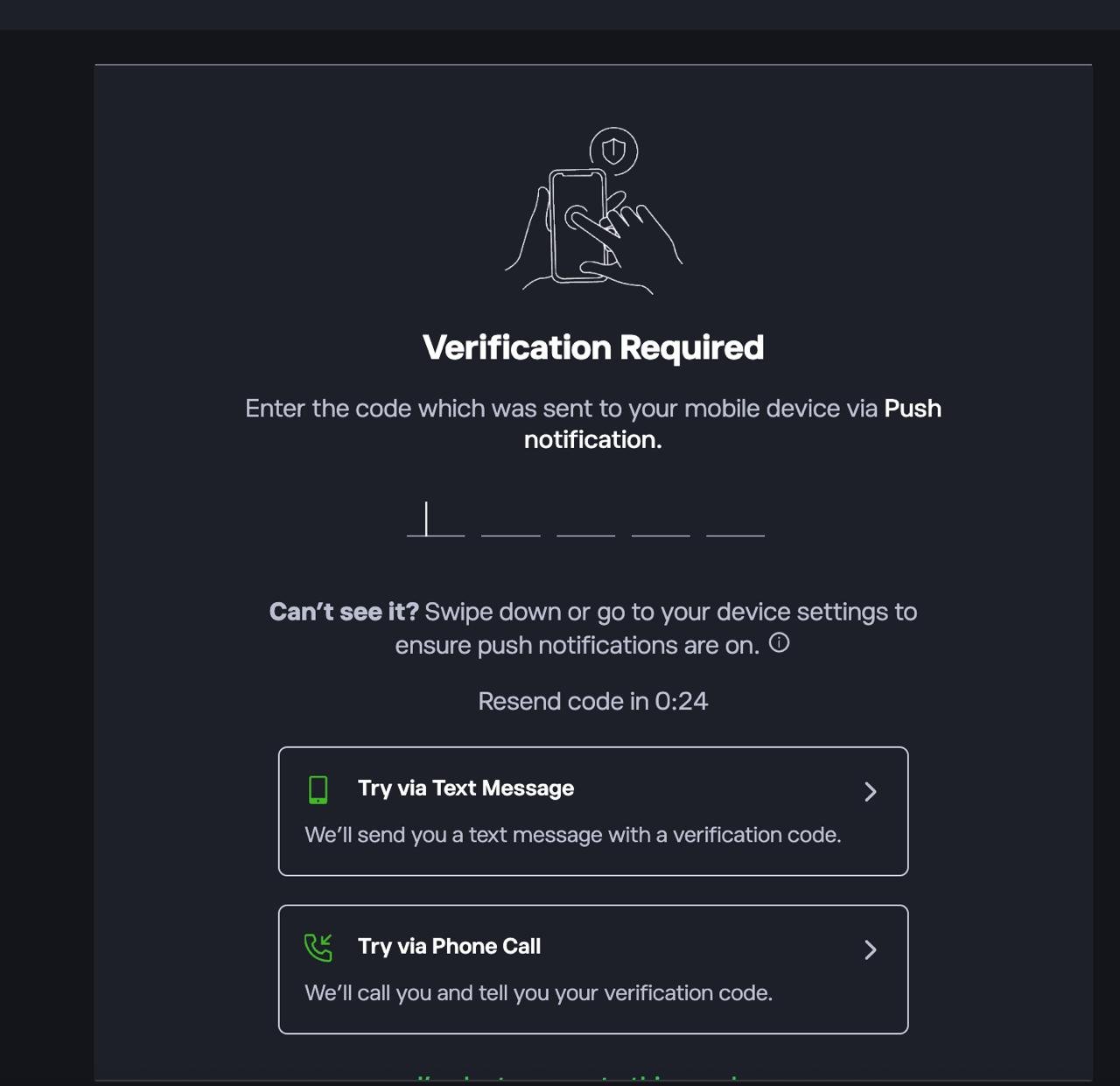
1. Log in to the platform
If prompted, complete 2FA by entering the code sent via push notification, SMS, or phone call.
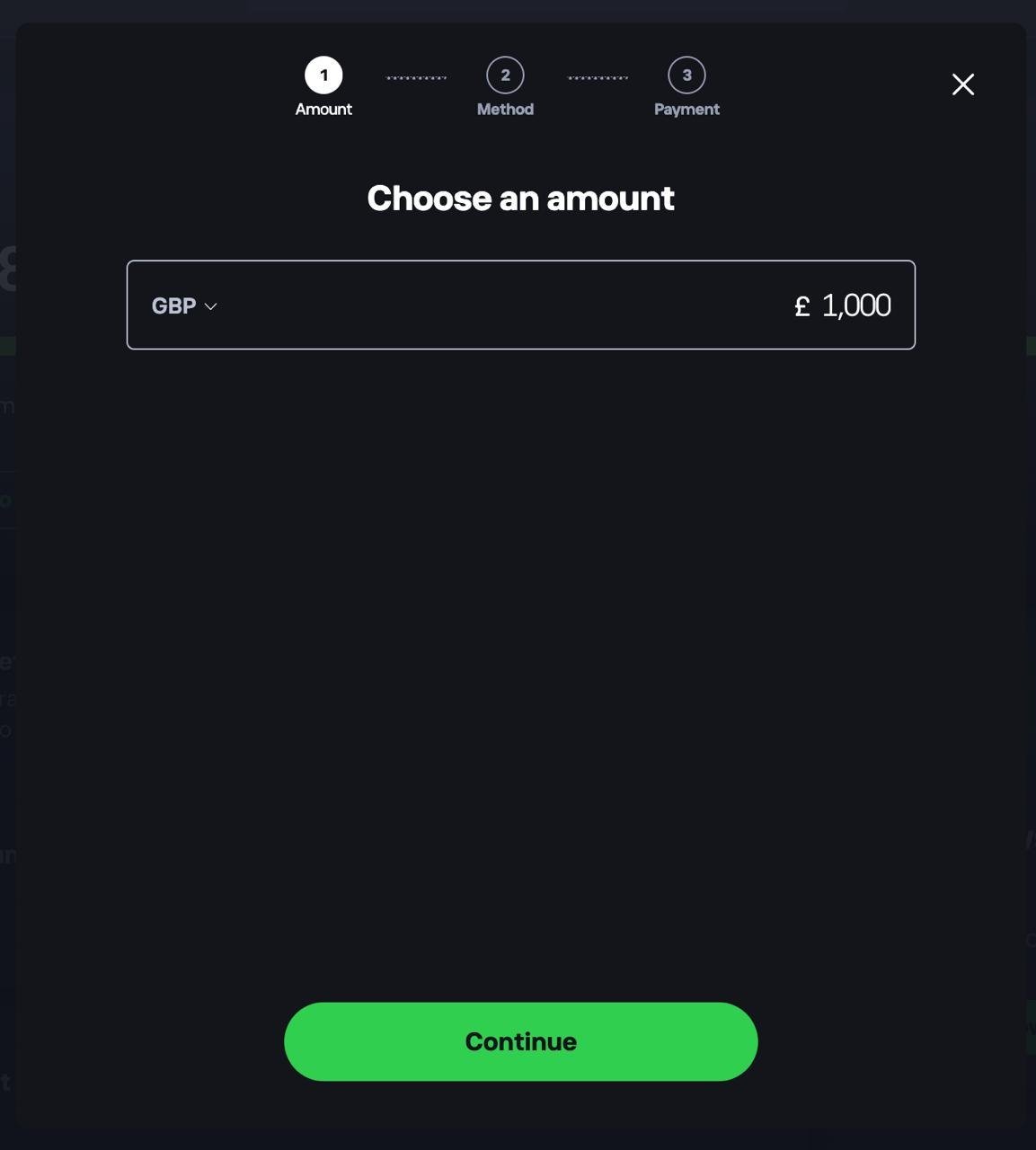
2. Deposit funds into your account
Head to your dashboard and choose to add funds. Select your currency, enter the amount you want to deposit, tap Continue, then choose a payment method.
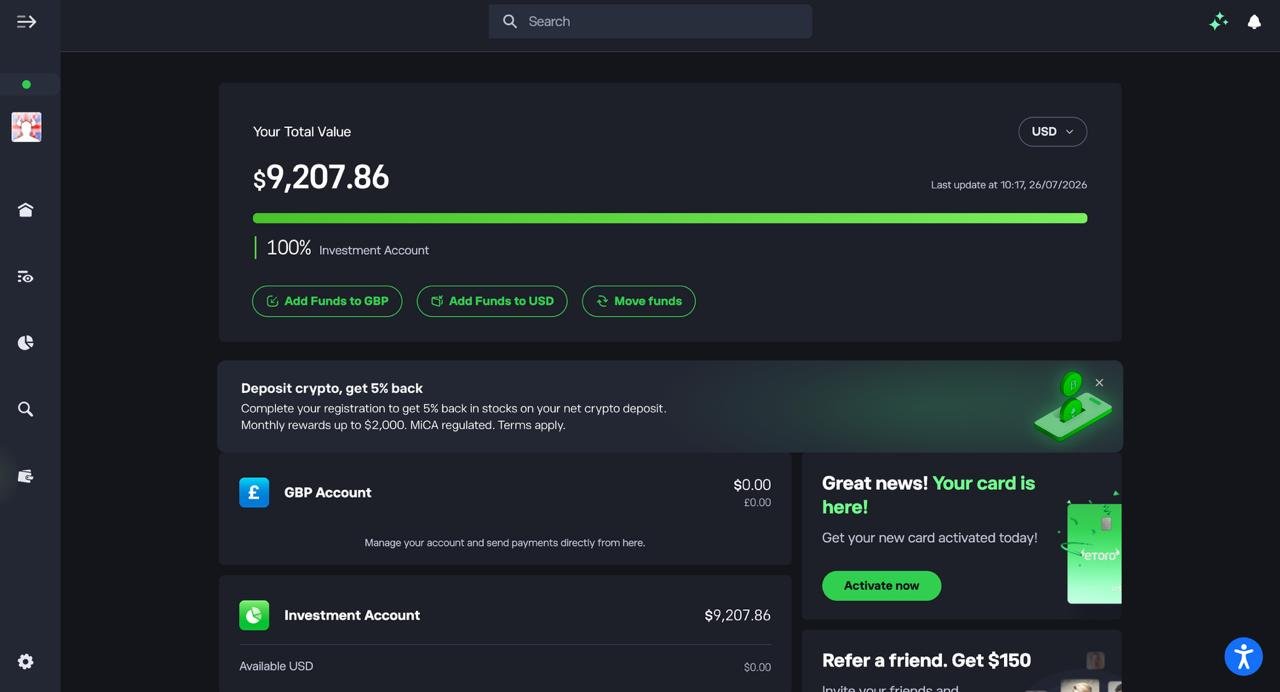
3. Confirm your funds are available
Check your dashboard to make sure your deposit has landed in your Investment Account before you start trading.
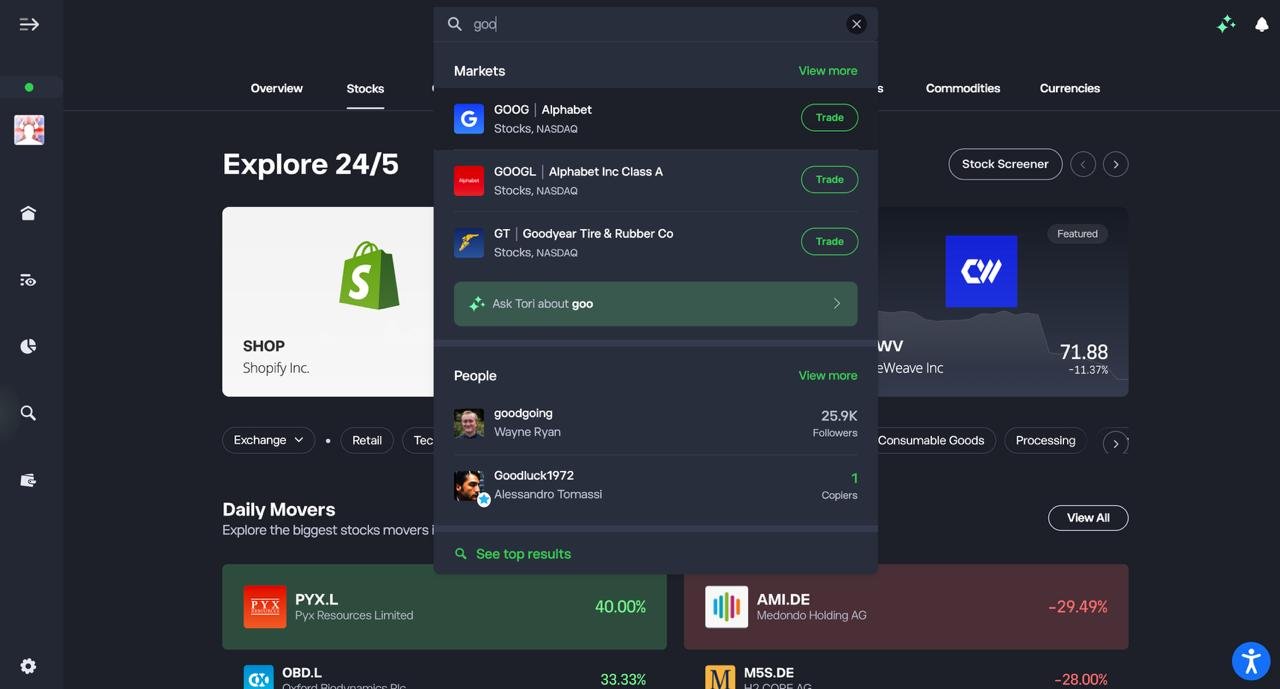
4. Search for the stock you want to trade
Use the search bar to type in the ticker or company name, then select it from the Markets results.
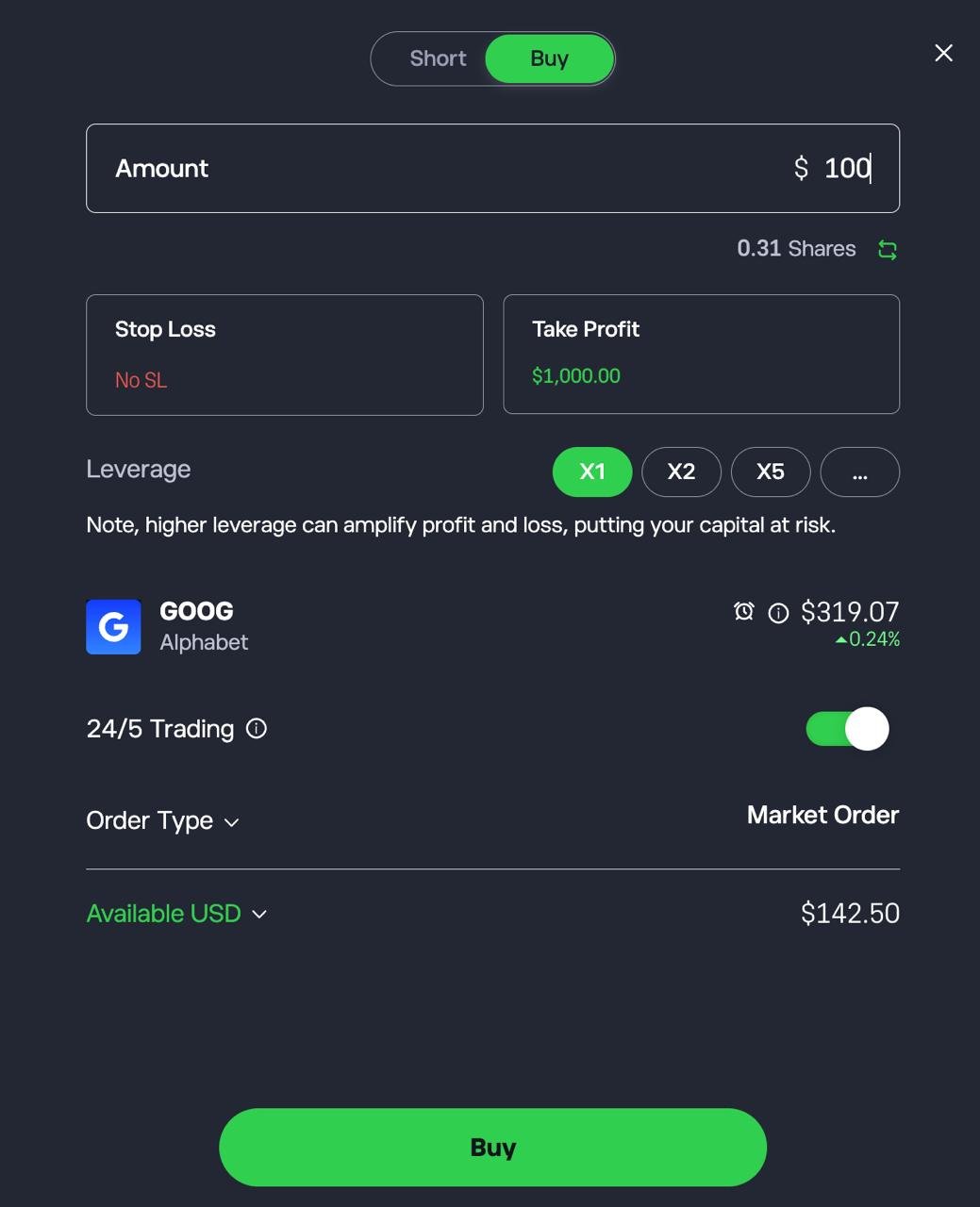
5. Set up and confirm your trade
Choose Buy or Short, enter the amount you want to invest, optionally set a Stop Loss and Take Profit, then tap Buy or Short to confirm.
How to choose a trading platform in Australia?
Choosing a trading platform in Australia comes down to regulation, costs, market access, and how well the platform fits your trading style. The right platform should be ASIC-regulated, offer transparent pricing, and provide the tools you actually need, not just the most features.
Check ASIC regulation and safety
Always choose a platform licensed by the Australian Securities and Investments Commission (ASIC) with a valid AFSL. This ensures client funds are held in segregated accounts and retail protections like leverage limits and negative balance protection apply.
Compare total trading costs
Look beyond headline fees. Compare:
- Spreads and commissions
- FX conversion fees (often 0.5%–1.5%)
- Inactivity or withdrawal fees
Low-cost platforms are not always cheapest once all charges are included.
Understand ownership structure
Decide whether you want to own the underlying asset:
- CHESS-sponsored: Shares held in your name (HIN)
- Custodian model: Platform holds assets on your behalf
- CFDs: No ownership, only price exposure
Long-term investors often prefer CHESS sponsorship for ASX shares.
Check available markets and assets
Not all platforms offer the same access. Consider whether you need:
- ASX shares and ETFs
- US or global markets
- Options or futures
- Forex and CFDs
Choose a platform aligned with your strategy.
Evaluate platform tools and usability
A good trading platform should be reliable and easy to use. Look for:
- Fast execution and stable performance
- Clear charts and order types
- Mobile app quality
- Demo trading account for testing
Advanced traders may also need automation or API access.
Review funding and withdrawals
Check how easy it is to move money:
- AUD base accounts to avoid FX costs
- Payment methods like bank transfer, PayID, or card
- Withdrawal speed and any fees
Smooth funding is essential for active trading.
Match the platform to your strategy
The best platform depends on how you trade:
- Beginners: Simple apps with education and low minimums
- Long-term investors: Low fees, CHESS support, ETF access
- Active traders: Tight spreads, fast execution, advanced tools
Choosing the right platform is about fit, not features. Focus on cost, structure, and usability over marketing claims.
What is the difference between trading and investing for beginners?
Trading focuses on short-term price movements, while investing is about building wealth over the long term by holding assets. The key difference is time horizon, risk level, and strategy.
What is trading?
Trading involves buying and selling assets frequently to profit from short-term price changes. Positions can last from minutes to days or weeks.
Key features of trading:
- Short-term focus
- Higher risk due to frequent decisions and leverage
- Often uses tools like charts, indicators, and technical analysis
- Common in forex, CFDs, and active stock trading
Trading aims to generate quick profits but requires time, discipline, and strong risk management.
What is investing?
Investing involves buying assets and holding them for months or years to benefit from long-term growth and compounding returns.
Key features of investing:
- Long-term focus
- Lower risk compared to trading (no leverage in most cases)
- Focus on fundamentals, diversification, and steady growth
- Common in stocks, ETFs, and retirement accounts
Investing is typically more passive and suited to building wealth over time.
Trading vs investing: key differences
| Factor | Trading | Investing |
|---|---|---|
| Time horizon | Short term (minutes to weeks) | Long term (years) |
| Risk level | Higher | Lower |
| Strategy | Technical analysis | Fundamental analysis |
| Frequency | High | Low |
| Goal | Quick profits | Long-term wealth growth |
Which is better for beginners?
Investing is generally better for beginners because it is simpler, lower risk, and requires less time. Trading can be more complex and volatile, especially when using leverage, so it is usually better suited to experienced users.
What is CHESS sponsorship, and does it matter for beginners?
CHESS sponsorship matters because it determines who legally owns your shares. In Australia, shares can either be held directly in your name through the CHESS system or held on your behalf by a broker under a custodial arrangement. For beginners who plan to invest long term, CHESS sponsorship provides clearer ownership, stronger protections, and fewer moving parts if something goes wrong with the broker.
What a HIN is and how CHESS works
CHESS stands for Clearing House Electronic Subregister System, which is operated by the Australian Securities Exchange. When you open a CHESS-sponsored account, you’re issued a Holder Identification Number (HIN). That HIN links your identity directly to your ASX-listed shares on the ASX register.
In practical terms, this means:
- Shares are registered in your name, not the broker’s
- You receive official statements from the ASX
- You can move your shares between CHESS brokers without selling them
- If the broker fails, your shares remain yours
The broker facilitates trades, but ownership sits with you.
CHESS-sponsored vs custodial brokers explained
With CHESS-sponsored brokers, you hold legal title to the shares via your HIN. With custodial brokers, the broker (or its custodian) holds the shares in a pooled account, and you have a beneficial claim rather than direct ownership.
Custodial models are common with international platforms and can work fine in practice, but they add an extra layer of counterparty risk. If the broker becomes insolvent or restricts transfers, recovering assets can be slower and more complex. You’re relying on the broker’s records rather than the ASX register.
Which ownership model is safer for long-term investors
For long-term Australian investors, CHESS sponsorship is generally the safer and cleaner option. It provides direct legal ownership, easier portability between brokers, and clearer protection if a broker collapses. Custodial models are not inherently unsafe, but they are better suited to active trading or platforms that focus on overseas markets where CHESS doesn’t apply.
For beginners building a long-term ASX portfolio, choosing a CHESS-sponsored broker reduces complexity, improves transparency, and removes a risk you don’t need to take.
Conclusion
The best trading platform in Australia depends on how you plan to invest, but a few clear standouts cover most beginner and intermediate needs.
eToro is a strong starting point for beginners thanks to its simple interface and its standing as one of the leading copy trading platforms in Australia, even if its FX costs are higher. Interactive Brokers is the top pick for cost-conscious and experienced investors who want low fees and broad global market access.
For Australians focused on local shares and long-term ownership, moomoo and Tiger Brokers stand out with low ASX brokerage and CHESS sponsorship.
Active forex traders and those comparing the best CFD brokers will usually find Pepperstone the most suitable.
There’s no single winner, but choosing a platform that matches your investing style, cost sensitivity, and experience level is far more important than chasing features you won’t use.
FAQs
Which is the best trading platform in Australia for beginners?
For most beginners, eToro is one of the easiest platforms to start with thanks to its simple interface, ASIC regulation, and copy trading features that reduce early complexity.
What is the safest trading platform in Australia?
Safety comes from ASIC regulation rather than the platform name. Brokers like Interactive Brokers, Pepperstone, and CHESS-sponsored share platforms such as moomoo operate under strict Australian regulatory rules.
Which trading platform has the lowest fees in Australia?
For global markets and FX, Interactive Brokers consistently offers the lowest overall costs. For ASX shares, platforms like moomoo and Tiger Brokers are among the cheapest, with brokerage starting around $3 per trade.
Do Australian beginners need CHESS sponsorship?
CHESS sponsorship is not mandatory, but it’s strongly preferred for long-term ASX investors. It ensures shares are registered in your name and remain yours even if the broker fails.
