

Tiger Brokers is a popular online brokerage offering Australian investors access to global shares, ETFs, and advanced trading tools at competitive prices.
In this Tiger Brokers Review Australia 2026, we examine fees, safety, regulation, and platform features to help you decide if it suits your investing needs.
We also highlight who Tiger Brokers is best for, key pros and cons, and the final verdict for Aussie users.
Quick verdict: How do we rate Tiger Brokers for users in Australia in 2026?
Tiger Brokers is a strong low-cost share trading platform for Australian investors who want access to ASX, US, and Hong Kong markets with competitive fees and no minimum deposit.
It is best suited to intermediate investors and long-term stockholders who value CHESS sponsorship, fractional US shares, and advanced tools over multi-asset trading.
Beginners may find the platform slightly information-dense, while active traders seeking CFDs, forex, or a crypto exchange will need to look elsewhere.
Overall, Tiger Brokers delivers solid value for cost-conscious Aussie equity investors, with some trade-offs around asset breadth and education.
Overall Rating: 4.1 / 5
Ratings breakdown
| Category | Score | Summary |
|---|---|---|
| Security & Trust | 4.5 / 5 | Regulated by Australian Securities and Investments Commission (AFSL holder). New accounts are CHESS-sponsored, meaning ASX shares are held in your name via the Australian Securities Exchange system. Client funds are segregated. Not covered by government deposit guarantees. |
| Fees & Pricing | 4.5 / 5 | Very competitive pricing. ASX trades from ~0.03–0.055% (minimum ~AUD 5.50–6.45). US shares from US$0.01–0.013 per share (min ~US$2). No minimum deposit, no inactivity, no account fees, which is rare among Australian brokers. |
| Features | 4.0 / 5 | Access to ASX, US, HK stocks, ETFs, US options and futures, plus fractional US shares and a demo account. Proprietary Tiger Trade desktop and mobile platforms offer strong charting and analysis. No CFDs, forex, or crypto. |
| Ease of Use | 4.0 / 5 | Fast digital onboarding and clean mobile app. Desktop platform can feel busy for beginners but is well suited to intermediate investors who want depth, custom charts, and multiple order types. |
| Customer Support | 4.0 / 5 | Phone, email, and in-app support available during Australian business hours. Response times are generally solid, though no 24/7 live chat. |
| Reputation | 3.8 / 5 | Backed by a global group with millions of users. While the broker has faced regulatory scrutiny in past years, it has strengthened compliance and added CHESS sponsorship, improving trust for Australian users. |
Tiger Brokers at a glance
| Category | Details |
|---|---|
| Type | Investing platform (share broker) |
| Best for | Intermediate ASX investors and long-term investors who want ASX + US + HK access with low brokerage and no ongoing account fees |
| Assets available | ASX shares & ETFs, US shares & ETFs (incl. fractional shares), HK stocks, China A-shares (where available), US/HK options, futures (product availability can vary by region/account permissions) |
| Real asset ownership | Yes for shares/ETFs (ASX via CHESS-sponsored HIN on eligible accounts) |
| Derivatives offered | Yes (limited vs multi-asset brokers): options + futures. No CFDs, forex, or crypto (AU offering) |
| Minimum deposit | No minimum deposit |
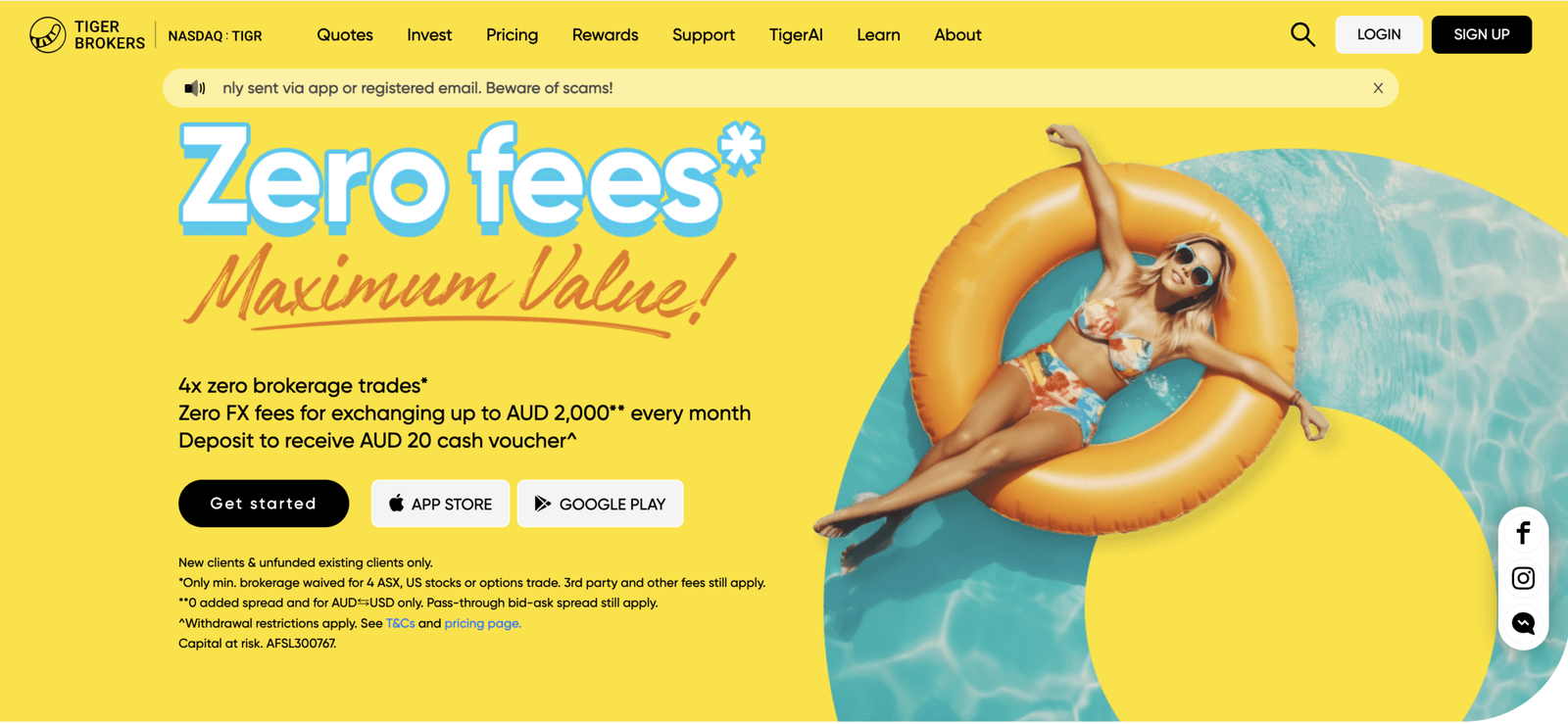
| Stock & ETF fees (headline) | ASX: AUD $3 or ~0.03% (whichever is greater) on common plans; US shares: US$0.01–0.013/share (min ~US$2/order). |
| Options / futures pricing | US options: fixed plans around US$0.75/contract (min US$3/order) or tiered ~US$0.15–0.90/contract (min US$3/order). Pass-through/regulatory fees may apply. |
| FX & conversion fees | FX spread-based pricing is common. |
| Non-trading fees | No inactivity fee and no account maintenance fee. |
| Account types | Cash and margin (margin subject to eligibility; interest rates apply). No ISA-style account in Australia. |
| Platforms | Tiger Trade: Web, mobile (iOS/Android), desktop |
| Regulation (Australia) | ASIC (AFSL holder). Group entities may be regulated in other jurisdictions (e.g., SEC in the US for relevant entities; MAS in Singapore for relevant entities). |
| Investor protection (Australia) | No FSCS-style scheme in Australia for share broker losses. CHESS sponsorship can improve share ownership clarity for ASX holdings (shares held in your name via HIN). |
| Fund segregation | Yes. |
| Customer support | Phone, email, in-app/live chat (weekday business hours; hours vary). |
| Not suitable for | Forex/CFD/crypto traders, ASX options traders, or beginners who want strong structured education/community features |
Who should use Tiger Brokers and who should avoid it?
Tiger Brokers is best for Australian investors who mainly buy and hold shares/ETFs and want low brokerage, no minimum deposit, and access to ASX + US + Hong Kong markets in one stock trading app.
It is less suitable if you want a true multi-asset trading app (forex, CFDs, crypto) or if you prefer a very simple beginner interface with strong step-by-step education.
Good fit if
- You’re an intermediate investor (or an “advanced beginner”) who wants depth without a pro-only platform.
- You mainly want shares and ETFs in Australia and overseas.
- You’re fee-sensitive and hate “surprise” account charges.
- You want to buy expensive US stocks in smaller amounts.
- You care about Australian shareholding structure and prefer CHESS where available.
Avoid if
- You want “everything in one app” including forex, CFDs, indices, or crypto.
- You’re a complete beginner who wants a minimal interface and a strong learning hub.
- You want high-quality social/community investing features.
- You needniche market coverage or specific products.
Is Tiger Brokers suitable for beginners?
Tiger Brokers can be suitable for beginners who want ASX/US shares and ETFs and are willing to learn how to trade with a more “pro-style” interface, but it isn’t a true beginner-first app.
Onboarding is quick, and there’s no minimum deposit, yet the desktop platform can feel busy, and the education hub is fairly limited. If you want the simplest and are still learning how to invest, a beginner-focused investing app may be easier.
Ease of onboarding
- Fully digital sign-up with standard ID checks and tax details.
- No minimum deposit, so you can start small.
Interface simplicity
- Mobile app: relatively clean and usable for basic buy/sell and watchlists.
- Desktop (Tiger Trade): powerful but information-dense, which can overwhelm first-timers.
Demo accounts
- Yes: demo account with $100,000 virtual currency to practise orders and navigation.
Education availability
- Education exists, but it’s more resource/blog-style than structured lessons or beginner pathways.
Risk warnings and safeguards
- As an ASIC-regulated broker, you should see standard investing risk disclosures.
- Beginner-safe approach: start with a cash account, avoid leverage, invest in ETFs for diversification, and consider limit orders.
Brief beginner comparison
Compared with beginner-first platforms, Tiger Brokers offers more tools and market depth, but less hand-holding and a steeper learning curve.
What are the pros and cons of using Tiger Brokers in Australia?
Tiger Brokers is a low-cost, ASIC-regulated share broker that suits Australians who want ASX + US + Hong Kong market access with no minimum deposit and a strong mobile/desktop platform.
The trade-offs are a narrower product range than multi-asset brokers (no forex/CFDs/crypto in AU) and a platform that can feel too complex for brand-new investors.
Pros & Cons
- ASIC-regulated broker (AFSL holder), with standard client-money rules and disclosures
- CHESS-sponsored ASX accounts (HIN) available on eligible accounts — shares registered in your name via ASX CHESS
- No minimum deposit, plus commonly no inactivity / maintenance fees (helps small or infrequent investors avoid fee drag)
- Competitive brokerage for common markets: e.g., ASX ~0.03–0.055% with minimums around AUD $5.50–$6.45 (plan-dependent)
- Low US share pricing around US$0.01–0.013/share (min ~US$2/order, plan-dependent)
- Fractional US shares — useful if you want to invest small amounts into high-priced US companies
- Options + futures available for more experienced users (with per-contract pricing and pass-through fees)
- Demo account available with $100,000 virtual currency to practise orders and platform navigation
- Solid tools: watchlists, charting, stock screening, real-time quotes (often promoted as a strength)
- Not a multi-asset platform: no forex, CFDs, indices, or crypto (AU offering), so traders may need another broker
- Limited education compared with beginner-first apps; learning hub can feel like a blog and is updated less frequently
- FX costs matter when buying overseas shares — spreads can apply (e.g., AUD/USD pricing sometimes expressed as pips, such as ~55 pips)
- Market coverage gaps for some users (e.g., limited access to certain regions/products like European shares or ASX options)
- Community content quality is mixed; some users find the in-app community noisy/incentive-driven
- Reputation headwinds: has faced regulatory scrutiny in past years
- Reputation headwinds: has faced regulatory scrutiny in past years
- Sign-up promos change often and may require conditions (e.g., deposit thresholds); don’t rely on them as a core reason to choose a broker
How regulated and trustworthy is Tiger Brokers in Australia?
Tiger Brokers operates in Australia via Tiger Brokers (AU) Pty Limited, regulated by the Australian Securities and Investments Commission (ASIC) and stating it holds an Australian Financial Services Licence (AFSL 300767).
Client funds are held in segregated accounts (separate from the broker’s operating funds).
Regulation snapshot (Australia)
| Item | Tiger Brokers |
|---|---|
| Local regulator | ASIC |
| Licence status | AFSL 300767 |
| Authorised or registered | Authorised (licensed via AFSL) |
| Fund segregation | Segregated funds |
| Years in operation (group) | Founded 2014 |
| Parent/listing | UP Fintech (Nasdaq-listed) |
What assets can you trade on Tiger Brokers as a user in Australia?
Tiger Brokers Australia is primarily an equities and ETF platform with access to selected listed derivatives (notably options and futures). It is not designed for multi-asset trading like forex, CFDs, or crypto.
Shares and ETFs (core asset classes)
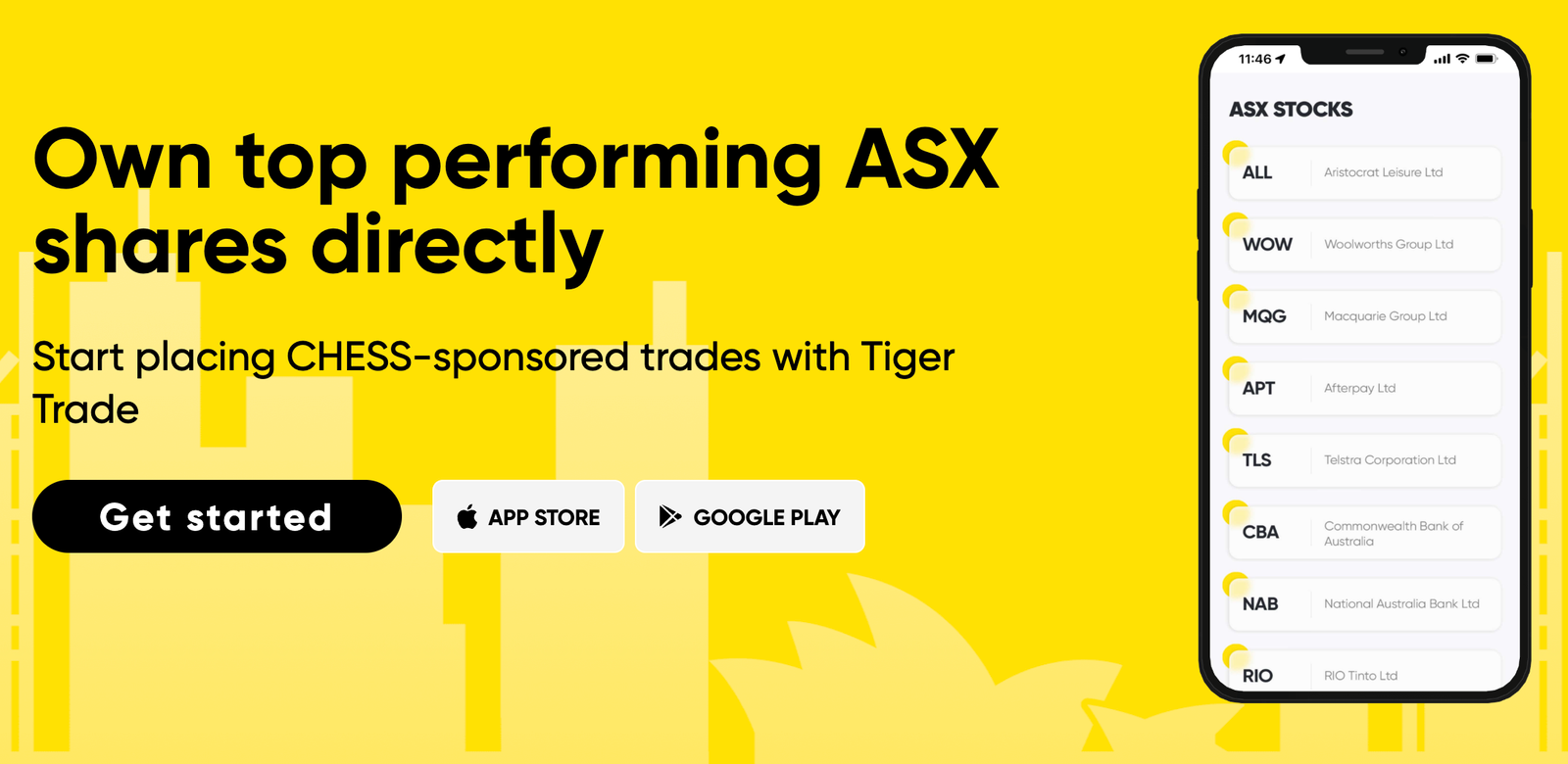
Australian users can trade listed shares and ETFs across several major markets, including:
- ASX-listed shares and ETFs (Australia)
- US-listed shares and ETFs
- Hong Kong-listed shares and ETFs
- China A-shares (mainland China exposure via the platform’s market access)
Tiger also supports fractional investing in selected US stocks, which can help investors gain exposure to higher-priced US companies with smaller amounts per trade. Note that fractional trading often has different fee mechanics than standard whole-share orders, so it’s worth checking the relevant pricing schedule before placing trades.
Listed derivatives (available, higher complexity)
Tiger Brokers offers access to listed derivatives, which are generally more complex and higher risk than buy-and-hold share investing:
- Options (commonly focused on US and Hong Kong markets)
- Futures (available for users approved for derivatives access)
These products require additional permissions/assessments and may involve margin requirements.
Forex and crypto (not available)
For Australian users, Tiger Brokers is not positioned as a crypto or forex trading platform:
- Forex (spot FX trading): Not available
- Cryptocurrency: Not available
- CFDs and index CFD trading: Not available
This makes it better suited to investors building a portfolio of listed securities rather than traders seeking leveraged exposure to currencies, indices, or crypto markets.
Other notable gaps for Australians
Tiger Brokers may not suit users who specifically need:
- ASX options (if your priority is trading options listed on the ASX)
- European exchanges (if you want direct access to European-listed shares/ETFs)
Asset coverage table
| Asset/product | Available on Tiger Brokers (AU)? | Coverage for Australian users | What it means in practice |
|---|---|---|---|
| Shares | Yes | ASX, US, Hong Kong, China A-shares | Strong coverage for AU/US/Asia equity portfolios. |
| ETFs | Yes | ASX, US, Hong Kong (plus China exposure depending on listing) | Suitable for diversified, long-term allocation via listed funds. |
| Fractional US shares | Yes | Selected US stocks | Can reduce the cash required to gain exposure to high-priced US companies; fees may differ from whole-share trades. |
| Options | Yes | US and Hong Kong | Higher complexity and risk; usually requires additional account permissions. |
| Futures | Yes | Futures access for approved users | Margin/leverage increases risk; better suited to experienced users. |
| Bonds | Limited / product-dependent | Availability can vary | May exist as a secondary offering; check in-platform for what’s currently available. |
| Funds (managed products) | Limited / product-dependent | Availability can vary | Not always a core feature in the AU offering; confirm in-platform. |
| Forex (spot FX trading) | No | — | Not designed for currency trading. |
| Crypto | No | — | Not a crypto trading platform. |
| CFDs / index CFDs | No | — | If you want leveraged index/commodity exposure via CFDs, you’ll need a different type of broker. |
| European exchanges | No / limited | — | If European market access is a requirement, this is a key limitation. |
| ASX options | No / limited | — | If you specifically want ASX-listed options, this is likely a mismatch. |
How much does Tiger Brokers cost in Australia?
Tiger Brokers uses a commission-based pricing model. For Australian users, costs mainly come from brokerage on trades and FX conversion when investing in overseas markets. The base account currency is AUD, with trades also settling in USD, HKD, and CNH for international assets.
Trading fees
- Tiger Brokers applies different pricing schedules depending on account type and trade size. For ASX trades, brokerage is commonly AUD $3 up to $10,000, then 0.03% above that.
- For US shares, pricing is commonly structured as either a per-share commission or a flat fee for smaller orders, depending on the selected plan.
- Hong Kong shares and ETFs, brokerage is HKD 15 up to HKD 25,000, then 0.06% above. China A-shares follow a similar structure at CNH 15 up to CNH 25,000, then 0.06% above.
- Fixed pricing is commonly US$0.75 per contract (minimum US$3 per order), while tiered pricing ranges from US$0.15 to US$0.90 per contract, also with a US$3 minimum.
FX and conversion fees
- When converting currencies, Tiger applies an FX spread rather than a flat fee.
Non-trading fees
- Tiger Brokers does not usually charge account maintenance fees, inactivity fees, or minimum deposit requirements. Deposit and withdrawal fees are generally not charged by the platform itself, although bank fees may still apply.
Fees snapshot
| Fee type | Cost |
|---|---|
| ASX shares/ETFs | AUD $3 up to $10,000; then 0.03% (or 0.055% min $5.50) |
| US shares/ETFs | US$0.01/share (min US$2) |
| HK shares/ETFs | HKD 15 up to HKD 25,000; then 0.06% |
| China A-shares | CNH 15 up to CNH 25,000; then 0.06% |
| US options | US$0.75/contract (min US$3) |
| FX conversion | From ~55 pips (AUD/USD) |
| Inactivity/maintenance | None |
| Minimum deposit | None |
How good is Tiger Brokers’ web app for users?
Tiger Brokers’ web app is designed for intermediate investors who want fast access to market data and trading tools in one place. It prioritises information density and speed over simplicity, which makes it powerful once you’re familiar with it, but less beginner-friendly at first glance.
Usability
The interface is functional and efficient, with quick access to watchlists, portfolio data, quotes, charts and order entry. Multiple panels are visible at once, which suits users monitoring several stocks or markets, but the layout can feel busy for those who prefer a minimalist design.
Charting
Charting is solid and practical rather than advanced. Users get candlestick charts, common timeframes and standard technical indicators, which is sufficient for most retail investing and discretionary trading workflows.
Order types
The web app supports the core order types most equity investors need:
- Market
- Limit
- Stop-loss
- Stop-limit
Customisation
Users can customise watchlists, adjust page layouts and choose which data panels are visible. This makes it easier to build a repeatable workflow for tracking multiple instruments and placing trades efficiently.
Known limitations
The web app is focused on equities and ETFs, not multi-asset trading. There is no support for forex, CFDs or crypto. The interface can feel overwhelming for beginners, and educational or community features are relatively basic compared with the trading tools.
How good is the Tiger Brokers mobile app in Australia?
Tiger Brokers’ mobile experience is delivered via the Tiger Trade app on iOS and Android. In Australia, it’s built for self-directed investors who want to research, monitor, and place trades from one app, without relying on a desktop for day-to-day use.
iOS and Android availability
Tiger Trade is available on Apple iOS and Android, with full account functionality (onboarding, funding, portfolio monitoring and trading) accessible in-app.
Key features
For Australian users, the app supports the platform’s core product range:
- ASX shares and ETFs, including CHESS-sponsored accounts for eligible ASX holdings
- US shares and ETFs, including fractional US shares
- Hong Kong shares and China A-shares (where available)
- Options and futures (where enabled for the account)
It also includes practical daily-use tools: watchlists, alerts, portfolio views (cash/positions/P&L), and integrated charts with common indicators.
Stability and performance
The app is designed to handle data-heavy screens (quotes, charts, panels) without forcing a stripped-down interface. The main downside is that it can feel busy for beginners, but intermediate investors benefit from the extra information density.
Security features
Security is in line with what you’d expect from a regulated broker, including:
- Two-factor authentication (2FA) via the Tiger Token security app
- Standard login/session protections
- CHESS sponsorship for supported ASX accounts, which strengthens how Australian equities are recorded and held
How easy is it to open an account with Tiger Brokers in Australia?
Opening an account with Tiger Brokers in Australia is fast and fully digital, with onboarding designed to be completed end-to-end online.
Digital onboarding
Account creation is completed online via the Tiger Brokers onboarding flow (mobile or web). The process is straightforward, and the platform does not require a minimum deposit to open an account, which reduces friction for first-time investors who want to register first and fund later.
KYC steps
During onboarding, most users will be guided through the Australian broker verification steps, including:
- Account setup: email or phone registration
- Personal details: legal name, date of birth, residential address, contact details
- Residency and tax declarations: country of residence, citizenship/place of birth, tax residency (and related declarations)
- Identity verification: upload a government-issued ID (e.g., passport or driver’s licence)
- Address verification: upload proof of address (e.g., utility bill/bank statement where requested)
- Account structure selection (where applicable): individual account details and any required confirmations for market access
If you’re opening an account intended for CHESS sponsorship, you may also be prompted for information needed to create/assign your HIN (Holder Identification Number) for eligible ASX holdings.
Common delays
Most delays we see during online brokerage onboarding tend to come from verification issues rather than the form itself. Common causes include:
- Document quality problems (blurry images, cropped edges, glare, expired ID)
- Details not matching across forms and documents (name order, middle names, address formatting)
- Proof-of-address not accepted (too old, missing your name, not clearly showing the address)
- Complex residency/tax profiles (multiple tax residencies or foreign tax obligations that trigger extra checks)
- Manual review flags, which can happen when automated verification can’t confirm identity immediately
Approval time
Tiger Brokers’ onboarding is designed to be quick. In many cases, accounts are approved within around 3 hours after submitting the application, though some applications can take longer when additional verification or manual review is required.
How do deposits and withdrawals work in Australia (methods, fees, limits, speed)?
Tiger Brokers Australia supports bank-based funding into multi-currency wallets (commonly AUD, USD, HKD and CNH).
- Deposit methods (AU): Bank transfer (AUD) and PayID/PayTo (where available in-app).
- Withdrawals: Bank transfer back to a linked bank account.
- Fees (broker): $0 deposit, $0 withdrawal.
- Limits: Vary by method, currency wallet, and verification status; the most accurate limits are shown in the funding screen.
- Speed: PayID/PayTo is often faster than standard bank transfer; withdrawals depend on internal processing plus bank settlement times.
| Transaction | Method | Broker fee | Speed |
|---|---|---|---|
| Deposit | Bank transfer (AUD) | $0 | Bank-dependent |
| Deposit | PayID/PayTo (AUD) | $0 | Often faster |
| Withdrawal | Bank transfer | $0 | Bank-dependent |
What account types does Tiger Brokers offer users in Australia?
Tiger Brokers’ Australian offering is built around a standard retail brokerage account, with add-ons that change how you hold ASX shares (CHESS vs custody) and whether you can use leverage (margin) or trade derivatives.
Standard accounts
- Individual (retail) trading account: The default account for most users. It supports multi-market investing across ASX, US, Hong Kong, and China A-shares, and can be used for long-term investing or more active trading.
- CHESS-sponsored ASX account (HIN-based): Newer AU accounts can be CHESS-sponsored, meaning ASX holdings sit under your own HIN (Holder Identification Number) rather than a pooled custodial structure.
- Custodial ASX holding model (legacy): Some older setups used a custodial model for ASX holdings. The practical difference vs CHESS is whose name the ASX holdings are recorded under (yours via HIN vs custodian/nominee).
Tax-advantaged accounts
- Tiger Brokers’ AU setup is focused on standard taxable brokerage accounts
Margin vs cash
- Cash trading: You trade with your available balance only. Best for most buy-and-hold investors.
- Margin account/margin trading: Available for users who want to borrow to trade. This is higher risk and involves margin interest.

Professional or special accounts
- Derivatives access (options/futures permissions): Tiger supports US options and futures. Access is enabled via additional account permissions/suitability checks.
- Demo account: A practice account is available with $100,000 virtual currency.
At a glance
| Account type | Best for | Key point |
|---|---|---|
| Individual (retail) | Most investors | Core account |
| CHESS-sponsored (HIN) | AU share investors | ASX holdings under your HIN |
| Custodial (legacy) | Older setups | ASX holdings held via custodian |
| Cash | Lower risk | No borrowing |
| Margin | Advanced users | Leverage + interest costs |
| Options/Futures enabled | Active/advanced traders | Extra permissions needed |
| Demo | Learning/testing | Virtual funds |
Is Tiger Brokers suitable for your trading or investing style?
Tiger Brokers is a low-cost, multi-market share broker for Australians who want to invest in ASX + US + Hong Kong + China A-shares, with US options/futures for more active traders.
It’s strongest for swing trading and long-term investing, thanks to no minimum deposit, no inactivity/maintenance fees, and useful investing features like fractional US shares (good for expensive US stocks while still receiving dividends).
Where it’s weaker is high-frequency “trader” styles that rely on CFDs/forex/crypto, ultra-tight execution tooling, or advanced automation—because Tiger Brokers doesn’t offer CFDs, forex, indices or crypto.
Quick suitability ratings (Australia)
| Style | Suitability (1–5) | Why |
|---|---|---|
| Scalping | 2/5 | You can place market/limit/stop orders, but Tiger isn’t built around ultra-short-term trading across CFDs/FX/indices/crypto (not supported). Best used for exchange-traded products rather than rapid-fire strategies. |
| Day trading | 3/5 | Works for active share traders who want real-time quotes, charting, screeners and US options—but it’s not a specialist day trading platform and market coverage is narrower than “all-asset” brokers. |
| Swing trading | 4/5 | Strong fit: solid charting and analysis tools, multi-market access (ASX/US/HK/China A-shares), and competitive brokerage with no inactivity fees—good for holding positions days/weeks. |
| Long-term investing | 4.5/5 | One of Tiger’s best use cases: no minimum deposit, no maintenance/inactivity fees, fractional US shares, and (for ASX) CHESS-sponsored/HIN accounts on new accounts—all align with buy-and-hold portfolios. |
What styles Tiger suits best (in practice)
Best fit
- ASX investors who care about cost control and want CHESS-sponsored holdings (HIN-based) on newer accounts.
- Diversifiers building a portfolio across Australia + US + Hong Kong + China A-shares.
- Intermediate investors who like a platform that’s feature-rich but still usable.
Less suitable
- Scalpers and pure day traders who want one platform for forex/CFDs/indices/crypto (Tiger doesn’t support these).
- Beginners relying on education/community: the “community” content is low quality, and the education hub is relatively limited.
What education and learning resources are available for users in Australia?
For most users in Australia, Tiger Brokers focuses more on in-platform tools + bite-sized content than on structured, course-style education.
Tutorials (how-to guides + platform walkthroughs)
- In-app and web “Learn” articles cover market topics and product explainers (e.g., options platform comparisons and “how it works” content).
- Help centre / support content: more “how to use the app” than “how to invest”.
- Reality check: the learning centre can feel blog-like and updated infrequently, so it’s best treated as a supplement, not a complete learning pathway.
Webinars (live or recorded)
- Tiger highlights education delivered via webinars and videos through Tiger Academy and Tiger Live (including recorded sessions).
- These are usually best for: platform feature walkthroughs, product explainers (e.g., options), and market commentary—less so for “beginner-to-advanced” structured training.
Demo accounts (practice trading)
- Demo account available for practice trading.
- Tiger Brokers offers a demo trading account with $100,000 in virtual funds, allowing users to practise placing trades and navigating the platform
Summary table
| Resource type | Available on [Platform Name]? | What you actually get | Best for |
|---|---|---|---|
| Courses | Limited | No clear structured “course pathway”; mostly articles/short lessons | Self-directed learners topping up knowledge |
| Tutorials | Yes | Platform guides + investing explainers | Learning the app + basic concepts |
| Webinars | Yes | Webinars/videos via Tiger Academy & Tiger Live | Product walkthroughs + market commentary |
| Demo account | Yes | Demo trading | Practising orders + strategies without risking capital |
What unique or standout features does Tiger Brokers offer in Australia?
One of Tiger Brokers’ most distinctive features for Australian investors is TigerAI, an in-platform AI assistant designed to support research and decision-making directly inside the TigerTrade ecosystem.
TigerAI (built into TigerTrade): TigerAI provides AI-powered market insights without requiring third-party tools. Australian users can:
- Generate stock summaries and company overviews across ASX, US and Asian markets
- View key financial metrics and fundamentals in a simplified format
- Access market and sector insights to quickly understand trends
- Use AI-driven prompts to support idea generation and preliminary research
This is particularly useful for intermediate investors who want faster context around individual stocks without manually compiling data from multiple sources.

Tiger Brokers stands out in Australia by pairing low-cost share investing with Asia market access and a proprietary platform, without the “extra” multi-asset features many brokers focus on.
- Hard-to-find Asia access: Hong Kong stocks + China A-shares.
- Australia-friendly structure: CHESS-sponsored ASX accounts (new accounts)—a key upgrade from a custodial model.
- Low barriers + fewer nuisance fees: No minimum deposit, and no inactivity/maintenance fees (compared in the data to $50 on eToro and $100 on Interactive Brokers).
- Proprietary tools: Tiger Trade (desktop + mobile) with charting + custom panels and common order types (market, limit, stop-loss, stop-loss limit), plus TigerAI for research/summaries.
- Investor extras: fractional US shares, a demo account with $100,000 virtual currency, Auto-Invest (from USD $2 via fractionals), and a cash feature offering up to ~3% p.a. on uninvested cash (rate time-sensitive).
How good is Tiger Brokers customer support for users in Australia?
Tiger Brokers offers reliable, weekday-focused support for Australian users, with multiple contact options and service that suits most retail investors.
Support channels
Australian users can access support via:
- Web-based help centre
- Phone
- Live chat
Availability
Support is available 5 days a week (weekdays) during business hours:
- Phone support: 9am–5pm
- Live chat: 9am–8:30pm
Response quality
Overall, Tiger Brokers delivers a solid customer support experience, scoring 4.0/5 for Customer Service. For most account, trading, and platform questions, the available channels and hours should be sufficient—especially for investors who trade mainly during standard market and business hours.
Known issues to be aware of
A couple of areas may lead Australian users to contact support more often than expected:
- Regulatory and reputation concerns: Tiger Brokers has had public clashes with regulators/lawmakers, particularly noted in 2023, which may matter for users who want extra reassurance around account structure and processes.
- Fees and charges clarity: When trading internationally, currency conversion fees and other third-party fees can apply. These are common friction points where users may need extra clarification from support.
How does Tiger Brokers compare to competitors in Australia?
In Australia, Tiger Brokers sits in a clear niche: low-cost share investing (especially ASX + US + Hong Kong + China A-shares) with no minimum deposit, no inactivity/maintenance fees, and a platform that suits intermediate investors who want solid tools without paying “premium broker” pricing.
Two common alternatives are eToro (more “all-round” and multi-asset, with a copy trading platform) and Interactive Brokers (better for advanced and algorithmic traders who want broader instruments like CFDs and forex).
Comparison table
| Platform | Fees | Assets | Regulation | Best use case in Australia |
|---|---|---|---|---|
| Tiger Brokers | ASX shares/ETFs: from 0.055% (min AU$5.50) and also shown as 0.025% (min AU$6.45) / or AU$3 or 0.03% (whichever is greater), depending on pricing/market. | Australian & US shares/ETFs, Hong Kong stocks, China A-shares, US options, futures. Also listed as available: bonds and funds. Not supported: forex, crypto, CFDs, indices. | ASIC regulated in Australia. | Cost-conscious ASX investors and retail investors building a long-term portfolio across AU/US/HK/China. Particularly good if you want fractional US shares, CHESS-sponsored ASX accounts, and no minimum deposit. |
| eToro | Minimum deposit: $50. | Supporting stocks, ETFs, CFDs, forex, and crypto; notable for copy trading. | ASIC regulated | Best for Australians who want a more flexible all-round broker, especially if copy trading and multi-asset exposure (including crypto/CFDs/forex) matter. |
| Interactive Brokers | Minimum deposit: $100. | Better for advanced, algorithmic traders who want equities, CFDs and forex on proprietary platforms. | ASIC regulated | Best for Australians who are advanced/technical, trade more complex strategies, or need broader instrument access (e.g., CFDs/forex) and strong tooling for systematic trading. |
Key takeaways (Australia)
- Tiger Brokers wins on investor-friendly pricing mechanics for many users: no minimum deposit, no inactivity/maintenance fees, and low brokerage across ASX and US markets.
- Tiger is an “investor” platform, not a multi-asset trading hub: it doesn’t offer crypto, forex, CFDs, or indices, so it’s not ideal if you want to trade across everything in one account.
- China/HK access is a differentiator: Chinese stocks are harder for Australian investors to access via Western platforms like eToro, Pepperstone and AvaTrade, which makes Tiger more compelling for Asia-tilted diversification.
- Platform fit: Tiger’s TigerTrade is positioned as a good balance of usability and depth—more data-dense on desktop, but comfortable for intermediate/advanced users.
Conclusion
Tiger Brokers is a strong choice for Australian investors who want low-cost access to ASX, US, Hong Kong and China A-shares, with the added benefits of no minimum deposit, no inactivity fees, and CHESS-sponsored ASX accounts on new accounts. Its proprietary TigerTrade platform and support for fractional US shares make it particularly well suited to intermediate investors building medium- to long-term portfolios.
However, it’s less suitable for users who want to trade forex, CFDs, indices or crypto, or those seeking extensive education and community features.
Overall, for cost-conscious Australian share investors focused on listed markets rather than active trading, Tiger Brokers remains a competitive and credible option.
FAQs
Is Tiger Brokers regulated in Australia?
Yes. Tiger Brokers operates in Australia under an Australian Financial Services Licence and is regulated by ASIC, with client funds held in segregated accounts.
Does Tiger Brokers offer CHESS-sponsored ASX accounts?
Yes. New Australian accounts are CHESS-sponsored, meaning ASX shares are held under your own HIN and registered in your name.
Can beginners use Tiger Brokers?
Beginners can use Tiger Brokers, but the platform is best suited to intermediate investors
