

After testing each platform, breaking down fees, and comparing features side by side, the best crypto wallets in Australia in 2026 are Ledger (best for long-term security), Trezor (best for open-source security), Kraken (best custodial wallet), CoinSpot (best for simple AUD access), Swyftx (best for beginners), Binance (best for active traders), and eToro (best for casual investors).
These wallets and platforms vary in security model, asset control, and ease of use depending on whether you prefer self-custody or exchange-based storage.
Choosing the right wallet depends on how much control you want over your crypto, how often you trade, and the level of security you need.
Hardware wallets generally offer the strongest protection for long-term holdings, while exchange wallets prioritise simplicity and AUD support for Australian users.
- Earn passive rewards by staking ETH, SOL, ADA, and more
- Access Web3 lending and tokenization through eToro's wallet
- Themed crypto Smart Portfolios for diversified exposure
Capital at risk. T&Cs apply.
Top crypto wallets in Australia (2026)
- Ledger: Best for long-term holders and large balances. Ledger hardware wallets support 5,500+ assets, include Secure Element protection, and offer mobile management through Bluetooth-enabled devices.
- Trezor: Best for security-focused users who prefer open-source design and advanced recovery options rather than mobile convenience.
- Kraken: Best custodial wallet for safety-focused users who still want an exchange, known for strong security practices, proof-of-reserves, and a long operating history.
- CoinSpot: Best for Australians who want a simple AUD-based wallet experience, with an easy interface and strong local recognition.
- Swyftx: Best for beginners learning crypto, offering demo mode, educational tools, and local customer support for Australian users.
- Binance: Best for active traders who want low fees, deep liquidity, and advanced trading tools alongside wallet functionality.
- eToro: Best for casual investors who want crypto exposure inside a broader investing platform, including copy trading features.
Types of cryptocurrency wallets
- Hardware wallets (cold storage): Physical devices such as Ledger and Trezor that keep private keys offline. These are considered the safest option for long-term storage and high-value holdings.
- Custodial wallets (exchange wallets): Wallets provided by exchanges such as Kraken, CoinSpot, Swyftx, Binance, and eToro, where the platform holds the private keys but provides easier buying, selling, and AUD integration.
Key considerations when choosing a crypto wallet in Australia
- Security: Hardware wallets provide the strongest protection because private keys remain offline. Exchange wallets rely on the platform’s security systems.
- Control: Self-custody wallets like Ledger and Trezor give full control over private keys. Custodial wallets manage keys for you but require trust in the exchange.
- Ease of use: Beginners may prefer exchange wallets with integrated buying, selling, and AUD deposits.
- Supported assets: Some wallets support thousands of cryptocurrencies, while others focus mainly on major assets such as Bitcoin and Ethereum.
- How often you transact: Long-term holders often choose hardware wallets, while active traders may prefer exchange wallets for convenience.
Top 7 Bitcoin wallets compared (Australia)
| Wallet | Custody type | Security level | Ease of use | Best for |
|---|---|---|---|---|
| Ledger | Non-custodial (cold) | Very high | Medium | Long-term holders, large balances, maximum control |
| Trezor | Non-custodial (cold) | Very high | Medium | Security purists, open-source advocates |
| Kraken | Custodial (hot) | High | Medium–High | Safety-focused users who still want an exchange |
| CoinSpot | Custodial (hot) | Medium | Very high | Simple AUD buy-and-hold for Australians |
| Swyftx | Custodial (hot) | Medium | Very high | Beginners learning crypto with local support |
| Binance | Custodial (hot) | Medium | Low–Medium | Active traders chasing low fees and liquidity |
| eToro | Custodial (hot) | Low–Medium | Very high | Casual investors wanting convenience only |
Best crypto wallet reviews
Compare the top crypto and Bitcoin wallets based on security, ease of use, supported coins, and overall value for different types of users.
1. eToro — Best for convenience

Platform overview
| Feature | Details |
|---|---|
| Wallet type | Custodial crypto wallet |
| Private key ownership | No |
| Supported assets | 140+ cryptocurrencies |
| Supported networks | Bitcoin, Ethereum, selected major chains |
| Mobile app | iOS and Android |
| Desktop access | Web platform |
| Minimum deposit | USD $50 |
| Crypto trading fee | 1% per trade |
| Withdrawal fee | USD $5 |
| Australian regulation | ASIC AFSL 491139 |
| Government crypto protection | None |
Does this wallet give you full control of your private keys?
No. eToro does not give Australian users control of their private keys. Crypto held on the platform is custodied by eToro, meaning transactions and withdrawals depend on platform approval. This reduces technical friction but removes true self-custody, which will matter to users who prioritise full ownership and independent transaction signing.
How secure is this wallet and what recovery options are available?
eToro has a long operating history and is regulated in Australia by ASIC. Security includes SSL encryption, two-factor authentication, biometric login on mobile, and segregated client funds. Crypto holdings are not covered by any Australian compensation scheme, and recovery relies on account verification rather than seed phrases, reinforcing the custodial model.
How easy is this wallet to use on mobile and desktop?
Usability is a strong point. The mobile app is clean, fast, and intuitive, with a near-identical experience on desktop. The interface is trading-focused rather than blockchain-native, so advanced controls like gas management or custom network settings are not available.
Which cryptocurrencies, networks, and features does this wallet support?
Australian users can access over 140 cryptocurrencies, including Bitcoin, Ethereum, Solana, Cardano, and XRP. Spot crypto can be bought and held on-platform, with limited support for transfers to external wallets depending on the asset. Features like its copy trading platform and crypto-themed portfolios are integrated, but DeFi-style functionality is minimal.
What fees apply and how reliable is the wallet long term?
Crypto trades incur a 1% fee, which is high compared with dedicated crypto wallets. Accounts are USD-based, so Australian users may also face currency conversion costs, plus a USD $5 withdrawal fee. eToro is publicly listed, well-capitalised, and unlikely to exit the market suddenly, but long-term holders may find costs add up.
Who is this wallet best for?
This wallet suits Australians who value convenience and a familiar crypto investing interface over full control. It works well for users already using eToro for shares or ETFs who want straightforward crypto exposure. It is less suitable for users focused on self-custody, DeFi access, or advanced on-chain features.
Read the complete eToro review here.
Pros and cons
- Very easy to use for beginners
- ASIC-regulated Australian entity
- Strong mobile and desktop apps
- Large range of supported cryptocurrencies
- No private key control
- 1% crypto trading fee
- Limited external wallet transfers
- Crypto assets not government protected
2. CoinSpot — Best simple AUD wallet

Platform overview
| Feature | Details |
|---|---|
| Wallet type | Custodial crypto wallet |
| Private key ownership | No |
| Supported assets | 530+ cryptocurrencies |
| Supported networks | Major blockchains including BTC, ETH, SOL, ADA, XRP, BNB |
| Mobile app | iOS and Android |
| Desktop access | Web platform |
| Fiat support | AUD only |
| Trading fees | Instant Buy/Sell/Swap: 1.00% |
| Exchange fees | Maker 0.01% / Taker 0.01% |
| AUD deposits | Free via bank transfer and PayID |
| Regulation | AUSTRAC-registered digital currency exchange |
| Insurance | None for crypto or fiat |
Does this wallet give you full control of your private keys?
No. CoinSpot is a custodial wallet, meaning CoinSpot controls the private keys while your crypto is held on the platform. You can withdraw to an external wallet, but on-platform assets are managed by CoinSpot. This simplifies account recovery and usability but removes full self-custody.
How secure is this wallet and what recovery options are available?
CoinSpot has operated since 2013 with no known security breaches. Most assets are held in cold storage, two-factor authentication is supported, and the platform holds ISO 27001 certification. CoinSpot has also completed an external statutory financial audit under Australian Auditing Standards. Account recovery relies on identity verification, not seed phrases. Crypto holdings are not insured and are not government protected.
How easy is this wallet to use on mobile and desktop?
CoinSpot is one of the easiest crypto wallets to use in Australia. The interface is clean and clearly laid out, with the mobile app closely matching the desktop experience. Features like price alerts, recurring buys, and dark mode make everyday use straightforward without overwhelming new users.
Which cryptocurrencies, networks, and features does this wallet support?
Australian users get access to 530+ cryptocurrencies, covering most major assets and a wide range of altcoins. Features include instant buys, exchange-style spot trading, recurring purchases, crypto bundles, an NFT marketplace, a crypto spending card, and SMSF support. There is no leverage, derivatives trading, or DeFi tooling.
What fees apply and how reliable is the wallet long term?
Fees depend on how you trade. Instant Buy/Sell/Swap costs 1.00%, while the exchange interface offers very low maker and taker fees at 0.01%. AUD deposits and withdrawals via bank transfer and PayID are free, while card, cash, and PayPal deposits incur fees. CoinSpot is well established, with over 2.5 million registered users and more than a decade of operating history.
Who is this wallet best for?
CoinSpot is best for Australians who want a simple, AUD-based crypto wallet with broad coin access and strong local support. It suits beginners, long-term holders, and SMSF users. It is less suitable for fee-sensitive active traders or users who want full self-custody or advanced trading tools.
Read the complete CoinSpot review here.
Pros and cons
- Very large crypto selection (530+ assets)
- Free AUD deposits and withdrawals
- Strong Australian security track record
- Beginner-friendly apps
- Local 24/7 customer support
- No private key control
- 1% fee on Instant Buy/Sell/Swap
- Crypto not insured or government protected
- Limited advanced trading features
- Small NFT marketplace
3. Binance — Best for active traders

Platform overview
| Feature | Details |
|---|---|
| Wallet type | Custodial crypto wallet |
| Private key ownership | No |
| Supported assets | 440+ cryptocurrencies |
| Supported networks | BTC, ETH, BNB Chain, SOL, ADA, XRP and more |
| Mobile app | iOS and Android (Lite & Pro modes) |
| Desktop access | Web platform |
| Fiat support (AU) | AUD via PayID & bank transfer (returning 2026), cards |
| Spot trading fees | Maker 0.10% / Taker 0.10% |
| Regulation | AUSTRAC-registered |
| Insurance | SAFU fund (~US$1B target, fluctuates) |
Does this wallet give you full control of your private keys?
No. Binance is a custodial wallet. Binance controls the private keys while your crypto is held on the platform. You can withdraw to a self-custody wallet, but on-platform balances rely on Binance’s custody and operational controls.
How secure is this wallet and what recovery options are available?
Binance uses majority cold storage, mandatory two-factor authentication, and a public proof-of-reserves system using Merkle Tree verification. It also operates the Secure Asset Fund for Users (SAFU), topped up to around US$1 billion in 2022, which has previously covered user losses after security incidents. Account recovery is handled via identity verification, not seed phrases. Crypto holdings are not government protected.
How easy is this wallet to use on mobile and desktop?
Ease of use depends on experience. Lite mode on mobile is beginner-friendly and strips things back to basic buying and selling. Pro mode and the desktop platform offer full trading functionality, including charts and order books, but can feel busy and overwhelming for new users.
Which cryptocurrencies, networks, and features does this wallet support?
Australian users can access 440+ cryptocurrencies, including most major assets and a wide range of altcoins. Features include spot trading, instant swaps, P2P trading, staking and earn products on 180+ assets, trading bots, recurring buys, and an NFT marketplace. Crypto derivatives are not available to Australian retail users.
What fees apply and how reliable is the wallet long term?
Spot trading fees are low at 0.10% maker and taker, with further discounts for high-volume traders. Crypto deposits are free, while withdrawal fees vary by network. AUD on-ramps via PayID and bank transfer began returning in January 2026. Binance is the world’s largest exchange by trading volume and has operated in Australia since 2020, but it remains a centralised, privately held platform.
Who is this wallet best for?
Binance is best for Australian users who want low fees, deep liquidity, and access to a very large range of cryptocurrencies. It suits active and confident users who are comfortable with a feature-rich platform. It is less suitable for beginners seeking simplicity or users who want full self-custody.
Read the complete Binance review here.
Pros and cons
- 440+ cryptocurrencies supported
- Low spot trading fees (0.10%)
- Strong security stack and SAFU fund
- Lite and Pro app modes
- AUD PayID and bank transfer returning
- No private key control
- Interface can overwhelm beginners
- No derivatives for AU retail users
- Crypto not government protected
- Custodial counterparty risk
4. Kraken — Best custodial wallet for safety

Platform overview
| Feature | Details |
|---|---|
| Wallet type | Custodial crypto wallet |
| Private key ownership | No |
| Supported assets | 420+ cryptocurrencies |
| Supported networks | BTC, ETH, SOL, ADA, XRP, BNB and more |
| Mobile apps | Kraken (beginner) and Kraken Pro |
| Desktop access | Web platform (standard + Pro) |
| Fiat support (AU) | AUD via PayID, Osko, bank transfer |
| Spot trading fees | Maker ~0.20–0.25% / Taker ~0.35–0.40% |
| Regulation | AUSTRAC-registered DCE |
| Insurance | No disclosed insurance fund |
Does this wallet give you full control of your private keys?
No. Kraken is a custodial wallet. Kraken controls the private keys for assets held on the platform. You can withdraw crypto to a self-custody wallet at any time, but while funds remain on Kraken, custody and transaction signing are handled by the exchange.
How secure is this wallet and what recovery options are available?
Kraken has one of the strongest security reputations in the industry. Around 95% of assets are held in cold storage, accounts support two-factor authentication, and the platform runs regular proof-of-reserves audits using Merkle Tree verification. Kraken has not suffered a large-scale loss of customer funds, though it has experienced isolated security incidents. Account recovery is handled through identity verification, not seed phrases. Crypto balances are not insured and are not government-protected.
How easy is this wallet to use on mobile and desktop?
Kraken strikes a good balance between simplicity and depth. The standard Kraken app and desktop interface are beginner-friendly, with clean layouts and clear buy/sell flows. More experienced users can switch to Kraken Pro, which adds advanced charts, order books, and order types. The learning curve is gentler than Binance, but steeper than beginner-only platforms.
Which cryptocurrencies, networks, and features does this wallet support?
Australian users can access 420+ cryptocurrencies, including most major assets and a broad range of altcoins. Kraken supports spot trading, staking on multiple assets, recurring buys, instant purchases, and advanced order types on Kraken Pro. It does not offer crypto derivatives to Australian retail users. Educational content through Kraken Learn is a standout feature.
What fees apply and how reliable is the wallet long term?
Kraken’s spot fees are higher than some competitors, starting around 0.20–0.25% maker and 0.35–0.40% taker, with discounts at higher volumes. AUD deposits via PayID, Osko, and bank transfer are free, while card purchases and crypto withdrawals incur variable fees. Founded in 2013, Kraken is one of the longest-running global exchanges, with over 13 million users and a strong track record of operational resilience.
Who is this wallet best for?
Kraken is best for Australians who want a secure, well-established crypto wallet with strong education, reliable AUD funding, and a clear upgrade path from beginner to advanced trading. It suits long-term investors and careful traders more than fee-sensitive high-frequency traders or users seeking self-custody.
Read the complete Kraken review here.
Pros and cons
- Long operating history since 2013
- Strong security and proof-of-reserves
- Free AUD deposits via PayID and Osko
- Beginner and Pro platforms available
- Phone, chat, and ticket support
- No private key control
- No insurance on crypto holdings
- Higher spot fees than some rivals
- Limited AUD trading pairs
- Custodial counterparty risk
5. Swyftx — Best beginner platform

Platform overview
| Feature | Details |
|---|---|
| Wallet type | Custodial crypto wallet |
| Private key ownership | No |
| Supported assets | 420+ cryptocurrencies |
| Supported networks | BTC, ETH, SOL, ADA, XRP, BNB and more |
| Mobile app | iOS and Android |
| Desktop access | Web platform |
| Fiat support | AUD, USD, NZD |
| Trading fees | 0.6% standard, down to ~0.1% (volume-based) |
| AUD deposits | Free via bank transfer, PayID, Osko |
| Regulation | AUSTRAC-registered DCE |
| Insurance | None |
Does this wallet give you full control of your private keys?
No. Swyftx is a custodial wallet. Swyftx holds the private keys while your crypto is on the platform. You can withdraw to an external wallet, but balances held on Swyftx are not self-custodied.
How secure is this wallet and what recovery options are available?
Swyftx has a strong local security record. It uses cold storage, two-factor authentication, penetration testing, and holds ISO 27001 certification. It is AUSTRAC-registered and has no reported hacks since launch. Account recovery is handled via identity verification. Crypto balances are not insured and are not government protected.
How easy is this wallet to use on mobile and desktop?
This is Swyftx’s biggest strength. The interface is clean, intuitive, and clearly built for Australian users. The mobile app closely mirrors desktop, with portfolio tracking, demo mode, recurring orders, and clear visuals. It is far less overwhelming than large global exchanges.
Which cryptocurrencies, networks, and features does this wallet support?
Australian users get access to 420+ cryptocurrencies, covering most major coins and many altcoins. Features include instant buys and sells, recurring buys, trigger orders, crypto bundles, a demo trading account with virtual funds, SMSF and business accounts, OTC trading, and tax report exports. There are no derivatives or leverage products.
What fees apply and how reliable is the wallet long term?
Trading fees start at 0.6% and can reduce to around 0.1% at higher volumes. AUD deposits and withdrawals via bank transfer, PayID, and Osko are free. Crypto withdrawals only incur network fees. Founded in 2018 and based in Brisbane, Swyftx has grown to 700,000+ users and is considered one of the more stable Australian platforms.
Who is this wallet best for?
Swyftx is best for Australian beginners and long-term investors who want a simple, AUD-based crypto wallet with strong local support. It is less suitable for advanced traders chasing the lowest global fees or derivatives access.
Read the complete Swyftx review here.
Pros and cons
- Very beginner-friendly
- 420+ cryptocurrencies supported
- Free AUD deposits and withdrawals
- Demo trading and recurring buys
- Australian-based support and ISO 27001 security
- No private key control
- Higher fees than global exchanges
- No derivatives or leverage
- No insurance on crypto holdings
- Custodial counterparty risk
6. Ledger — Best overall for long-term security

Wallet overview
| Feature | Details |
|---|---|
| Wallet type | Hardware (cold storage) wallet |
| Private key ownership | Yes |
| Supported assets | 5,500+ cryptocurrencies and NFTs |
| Supported networks | BTC, ETH, SOL, ADA, XRP, Polygon and more |
| Mobile support | iOS and Android (Bluetooth) |
| Desktop support | Windows, macOS, Linux (Ledger Live) |
| Security rating | CC EAL 5+ Secure Element |
| Price | ~US$99 |
| Regulation | Not regulated (self-custody device) |
Does this wallet give you full control of your private keys?
Yes. Ledger gives you full control of your private keys. Keys are generated and stored on the device and never leave it. All transactions require physical confirmation on the wallet, removing reliance on any third party.
How secure is this wallet and what recovery options are available?
The Nano X uses a Secure Element chip with a CC EAL 5+ security rating, independently assessed under French cybersecurity standards. Recovery is handled via a 24-word recovery phrase generated offline. Ledger also offers an optional Ledger Recover backup service, which some users avoid due to privacy concerns. There is no insurance or government protection.
How easy is this wallet to use on mobile and desktop?
Ledger Live makes day-to-day use relatively simple for a hardware wallet. Bluetooth support allows mobile use without cables, including on iOS. Navigation relies on physical buttons, which is secure but slower than app-only wallets.
Which cryptocurrencies, networks, and features does this wallet support?
Ledger supports over 5,500 assets and NFTs. NFTs can be viewed natively for Ethereum and Polygon, with broader support via third-party apps like MetaMask. The Nano X can run up to 100 apps at once and supports buying, selling, and swapping crypto through integrated providers.
What fees apply and how reliable is the wallet long term?
There are no ongoing wallet fees. You pay a one-off hardware cost plus standard blockchain network fees. Any trading fees come from third-party services used within Ledger Live. Ledger has operated since 2014 and remains one of the most widely used hardware wallet brands globally.
Who is this wallet best for?
Ledger is best for Australians who prioritise security and full self-custody, particularly long-term or high-balance holders. It is less suitable for users who want maximum convenience or minimal setup.
Pros and cons
- Full control of private keys
- Supports 5,500+ assets and NFTs
- CC EAL 5+ certified security
- Mobile use via Bluetooth
- No ongoing wallet fees
- Not ideal for beginners
- No touchscreen
- Button navigation can feel slow
- Staking via Ledger Live is limited
- Optional recovery feature concerns some users
7. Trezor — Best for security purists

Wallet overview
| Feature | Details |
|---|---|
| Wallet type | Hardware (cold storage) wallet |
| Private key ownership | Yes |
| Supported assets | Thousands of cryptocurrencies |
| Supported networks | BTC, ETH, SOL, ADA, XRP, AVAX, DOGE, Monero and more |
| Mobile support | Android (full), iOS (view-only) |
| Desktop support | Windows, macOS, Linux (Trezor Suite) |
| Connectivity | USB-C (no Bluetooth) |
| Security chip | Secure Element EAL6+ |
| Price | ~US$169 (≈ AU$270) |
| Regulation | Not regulated (self-custody device) |
Does this wallet give you full control of your private keys?
Yes. Trezor is a fully self-custodial wallet. Private keys are generated and stored on the device and never leave it. All transactions must be approved on-device, meaning no third party can access or move your funds.
How secure is this wallet and what recovery options are available?
Security is the main focus of the Trezor Safe 5. It uses a Secure Element chip rated EAL6+, PIN and passphrase protection, and supports advanced recovery options including multi-share backups. Recovery is handled via offline recovery phrases generated during setup. There is no insurance or government protection, which is expected for a self-custody device.
How easy is this wallet to use on mobile and desktop?
The Safe 5 is the most user-friendly Trezor to date. The colour touchscreen, haptic feedback, and Gorilla Glass display make on-device confirmation clearer than older button-based models. Trezor Suite on desktop is clean and intuitive. Android support is solid, while iOS is limited to view-only due to platform restrictions. The lack of Bluetooth improves security but reduces mobile convenience.
Which cryptocurrencies, networks, and features does this wallet support?
Trezor supports thousands of assets across most major blockchains, including Bitcoin, Ethereum, Solana, Cardano, Avalanche, XRP, and Layer 2 networks like Arbitrum and Optimism. Assets are managed through Trezor Suite without needing third-party wallets for basic use. NFT and DeFi interactions typically require external integrations.
What fees apply and how reliable is the wallet long term?
There are no ongoing wallet fees. You pay a one-off hardware cost and standard blockchain network fees when transacting. Any swap or buy fees come from third-party providers used within Trezor Suite. Trezor has been operating since 2014 and is one of the longest-standing hardware wallet brands, with long-term software and security update commitments.
Who is this wallet best for?
Trezor Safe 5 is best for security-focused Australians who want full self-custody and a modern touchscreen experience. It suits long-term holders and users who value transparency and open-source design over mobile convenience. It is less suitable for users who want Bluetooth connectivity or full iOS functionality.
Pros and cons
- Full self-custody of private keys
- Secure Element EAL6+ chip
- Colour touchscreen with haptics
- Supports thousands of assets
- Strong recovery and backup options
- No Bluetooth support
- iOS is view-only
- Expensive compared to entry models
- Less mobile-friendly than Ledger
- No insurance or government protection
How to buy crypto using an Australian crypto wallet?
1. Log in to the platform
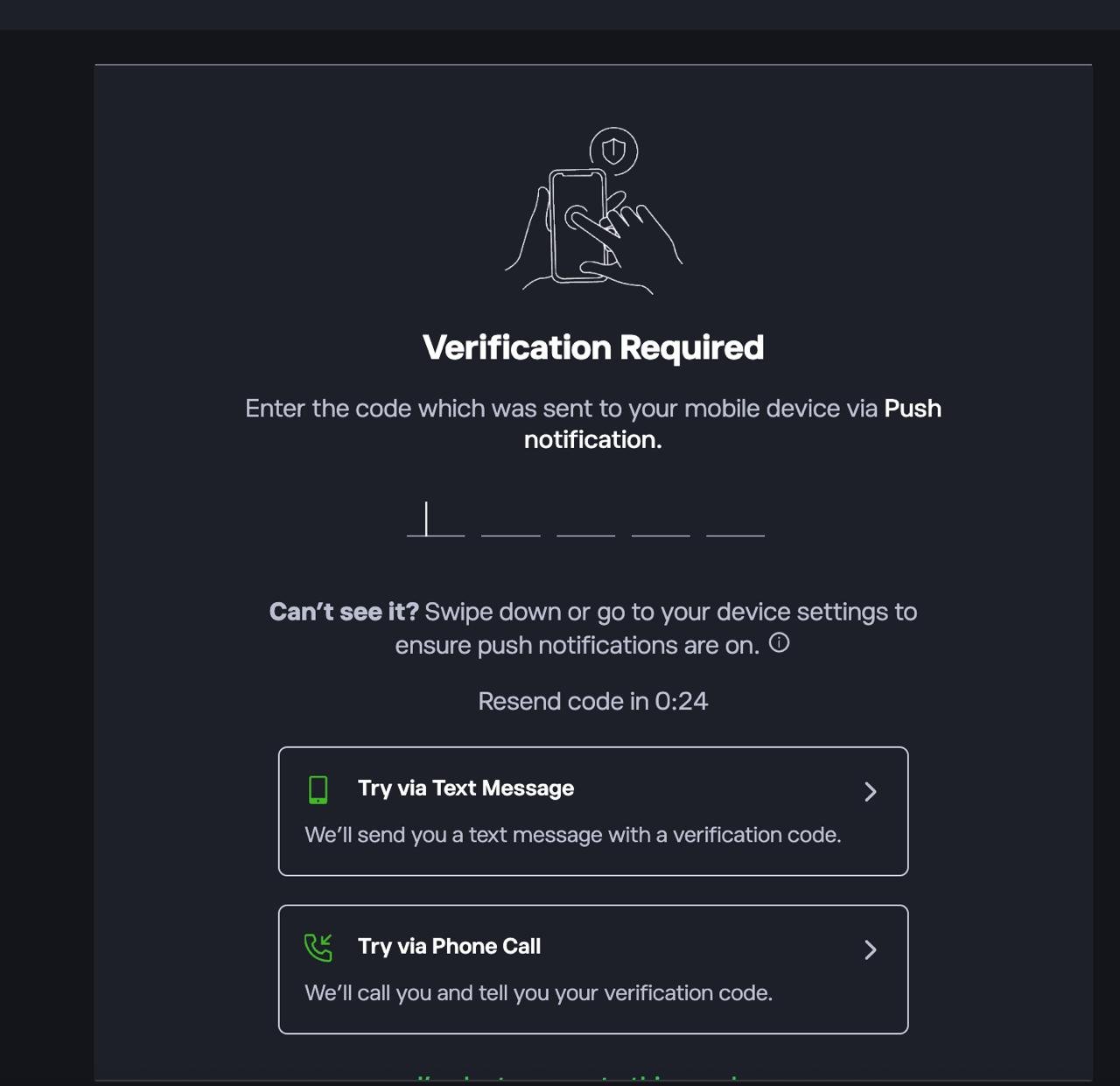
First sign up or log in to the platform. If prompted, complete 2FA by entering the code sent via push notification, SMS, or phone call.
2. Deposit funds into your account
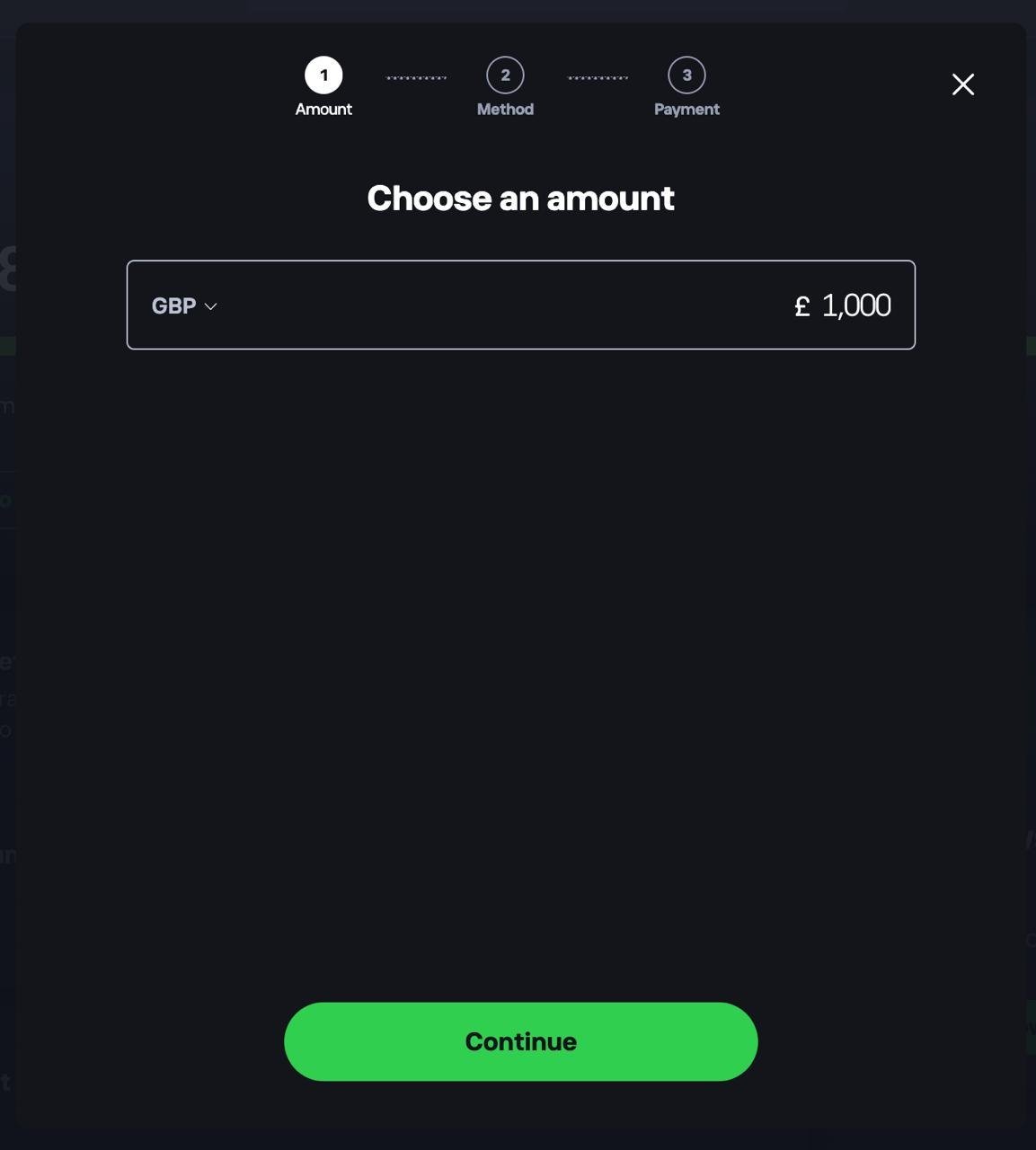
Head to your dashboard and choose to add funds. Select your currency, enter the amount you want to deposit, tap Continue, then choose a payment method.
3. Confirm your funds are available
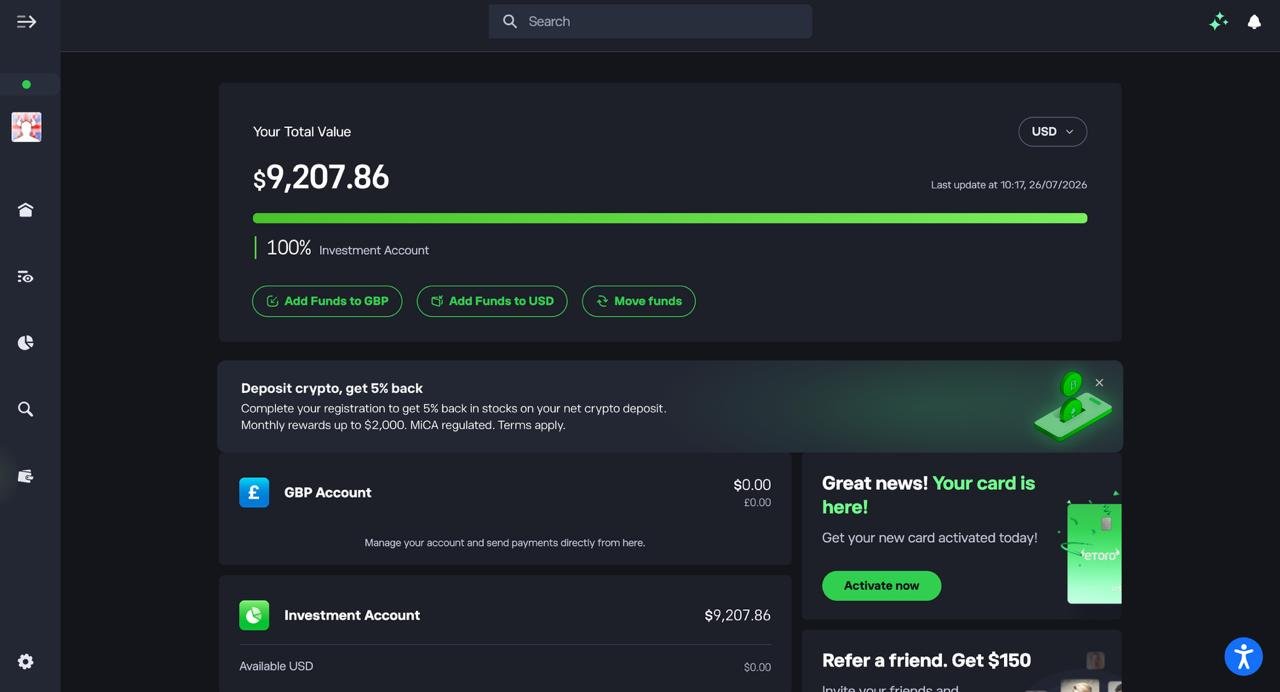
Check your dashboard to make sure your deposit has landed in your Investment Account before you start buying crypto.
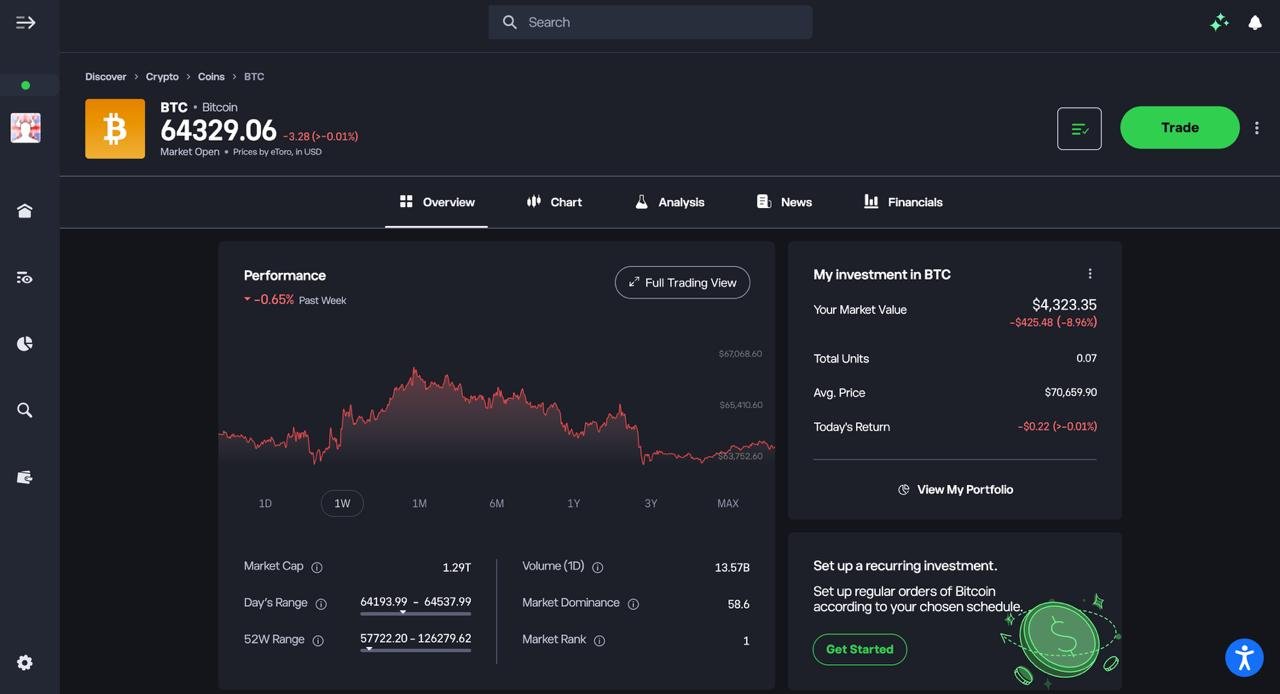
4. Find the crypto you want to buy
Search for the coin you’re after, such as Bitcoin, and open its overview page to check the current price and performance.
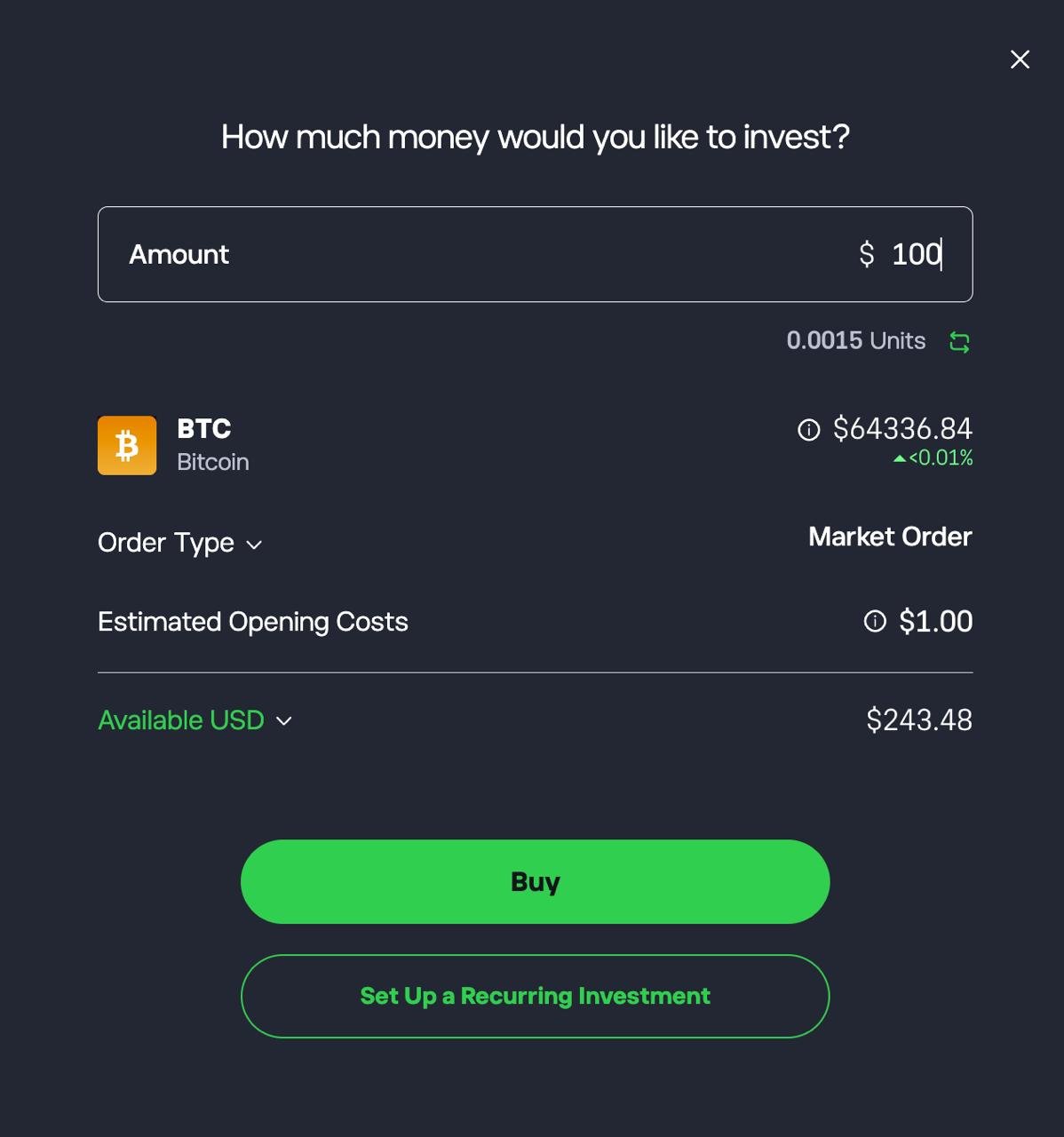
5. Set up and confirm your purchase
Enter the amount you want to invest, review the estimated units and opening costs, then tap Buy. You can also set up a recurring investment if you want to buy on a regular schedule.
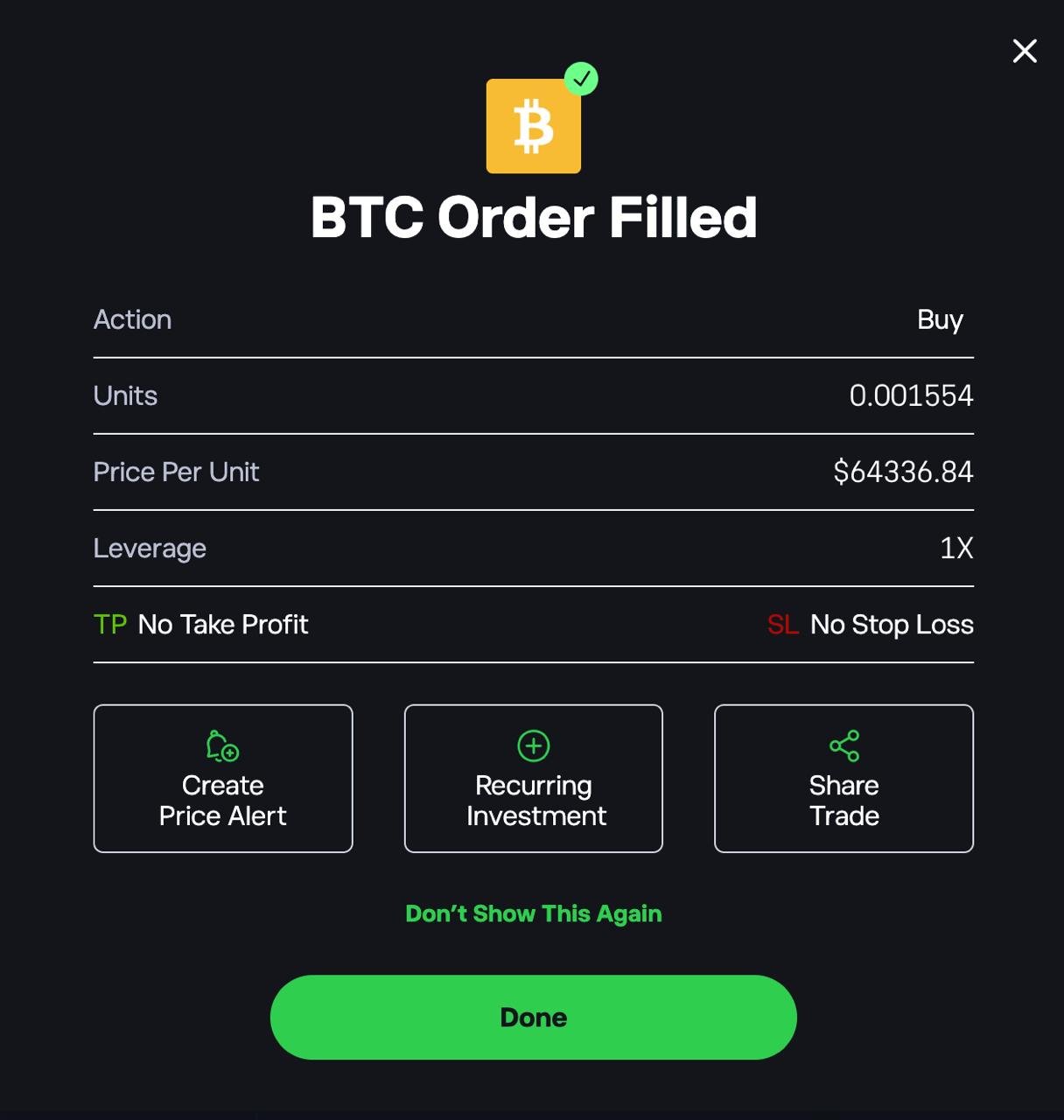
6. Check your order confirmation
Once your order goes through, you’ll see a confirmation showing the units bought, price per unit, and leverage. From here you can also set a price alert or share the trade.
What is a crypto wallet?
A crypto wallet is a tool that stores and manages the private keys that prove your ownership of cryptocurrency, not the coins themselves. Your crypto always lives on the blockchain. The wallet simply gives you the ability to access, send, receive, and approve transactions tied to your addresses.
In practical terms, a wallet is how you interact with crypto. It lets you check balances, sign transactions, connect to crypto exchanges or apps, and move funds between platforms. Lose access to your private keys and you lose access to your crypto, permanently. That is why wallet choice matters far more than brand names or bonus offers.
What is the difference between custodial and non-custodial wallets, and hot vs cold wallets?
The key distinction is who controls the private keys and how the wallet connects to the internet.
Custodial wallets are provided by exchanges or platforms. The provider controls the private keys on your behalf. This makes them easy to use and recover, but it introduces counterparty risk. If the platform is hacked, frozen, or collapses, your access depends on them. Examples include exchange wallets and trading apps.
Non-custodial wallets give you full control of your private keys. No third party can move your funds without your approval. This removes platform risk but shifts responsibility entirely to you. If you lose your recovery phrase, there is no reset button.
Hot wallets are connected to the internet. They include mobile apps, desktop wallets, and web wallets. They are convenient for frequent transactions but more exposed to malware, phishing, and device compromise.
Cold wallets keep private keys offline. Hardware wallets and paper backups fall into this category. They are widely considered the safest option for long-term storage, especially for larger balances, because keys never touch an internet-connected device.
| Type | Who controls keys | Internet connection | Risk profile |
|---|---|---|---|
| Custodial hot wallet | Platform | Online | Lowest effort, highest counterparty risk |
| Non-custodial hot wallet | You | Online | Convenient, higher device risk |
| Non-custodial cold wallet | You | Offline | Most secure, least convenient |
There is no “best” category. The right choice depends on how often you transact, how much you hold, and how comfortable you are managing security yourself.
How do you pick a crypto wallet suitable for your needs?
The right wallet is the one that matches your behaviour, not someone else’s strategy.
How much are you holding?
Small balances used for trading or learning can justify a simpler hot wallet. Larger or long-term holdings almost always warrant cold storage. As a rule of thumb, amounts you would be uncomfortable losing should not live permanently on an exchange.
How often do you transact?
If you buy occasionally and hold, convenience matters less than security. If you trade frequently, a hot wallet or exchange wallet may be unavoidable, but that increases the importance of risk controls like two-factor authentication and withdrawal whitelists.
What is your technical comfort level?
Non-custodial wallets require you to manage recovery phrases, device security, and backups. If that responsibility feels stressful, a hybrid approach often works better. Many experienced users keep a small “spending” balance in a hot or custodial wallet and the majority in cold storage.
What is the asset support and ecosystem access?
Not all wallets support every blockchain, NFT standard, or DeFi app. A wallet that works well for Bitcoin-only storage may be frustrating for multi-chain or NFT users.
How is your risk tolerance?
Convenience always comes with trade-offs. The more you outsource custody, the more you rely on external systems you do not control. The more control you take, the more disciplined you must be.
A common, practical setup for Australians looks like this:
- Cold hardware wallet for long-term holdings
- Reputable exchange wallet for buying, selling, and short-term liquidity
- Minimal balances left online, moved out regularly
How do you keep your crypto wallet safe?
- Never share your recovery phrase with anyone
- Store your seed phrase offline (not in screenshots or cloud storage)
- Use hardware wallets for large amounts
- Enable two-factor authentication (2FA) where possible
- Double-check wallet addresses before sending funds
- Beware of phishing sites and fake wallet apps
What Australian tax and regulatory rules should crypto wallet users know?
In Australia, cryptocurrency is regulated primarily by the Australian Taxation Office (ATO), which treats assets like Bitcoin and Ethereum as property rather than currency.
Most transactions involving crypto can trigger tax obligations in Australia. This includes selling assets for AUD, swapping one cryptocurrency for another, or using crypto to pay for goods and services. For example, when buying Bitcoin or buying Ethereum, any later disposal or swap is typically treated as a Capital Gains Tax (CGT) event.
If you earn crypto through staking, airdrops, or DeFi activities, the value is usually treated as assessable income at the time you receive it, and may also be subject to CGT when you later sell or trade those assets.
Accurate record-keeping is critical. You should track transaction dates, AUD values at the time of each transaction, wallet addresses, and the purpose of each activity. The ATO has data-sharing agreements with exchanges and can request user information, so reporting correctly is important.
Non-custodial wallets are not regulated financial products in Australia, and holdings of Bitcoin, Ethereum, or other crypto are not protected by government compensation schemes. When using exchanges, Australians should prioritise platforms registered with AUSTRAC, which enforces anti-money laundering compliance.
Conclusion
Choosing the right crypto wallet in Australia comes down to how much control you want, how often you transact, and how much risk you’re prepared to manage. There is no single “best” wallet for everyone, but there are clear standouts for different use cases.
For maximum security and long-term storage, Ledger and Trezor remain the top picks. Both offer true self-custody and offline protection, with Ledger leaning toward convenience and Trezor appealing to security purists.
If you prefer a custodial option, Kraken stands out for its strong security practices and long operating history, while CoinSpot is hard to beat for Australians who want a simple, AUD-based experience.
The most sensible approach for many users is a combination: an exchange wallet for buying and short-term use, paired with a hardware wallet for long-term holdings. That balance gives you flexibility without taking on unnecessary risk.
FAQs
Do I need a crypto wallet if I use an exchange?
No, but exchange wallets are custodial. For long-term holdings, many Australians use a separate non-custodial wallet.
Are crypto wallets regulated in Australia?
Non-custodial wallets aren’t regulated. Exchanges must register with AUSTRAC, but crypto isn’t government-protected.
What happens if I lose my recovery phrase?
For non-custodial wallets, your crypto is permanently inaccessible. There is no recovery process.
Are hardware wallets safer than mobile wallets?
Yes. Hardware wallets keep private keys offline, reducing hacking and malware risk.
What wallet setup suits most Australians?
An exchange for buying and selling, plus a hardware wallet for long-term storage.
