

Coinbase is one of the most well-known cryptocurrency exchanges available to Australians, offering a simple way to buy, sell and hold digital assets using AUD.
In this Coinbase review Australia, we assess how the platform performs for local users in terms of fees, security, regulation and ease of use, and whether it still makes sense for Australian users in 2026.
If you’re deciding whether Coinbase is safe, cost-effective and suitable for beginners or active traders, this review breaks down what you need to know.
Quick verdict: How do we rate Coinbase for users in Australia in 2026?
Overall Rating: 4.3 / 5
Coinbase rates well for Australians in 2026 if you want the smoothest beginner experience, strong security, and easy AUD access via PayID, but costs can be higher if you use the standard buy and sell screen.
The platform is best for first-time buyers and casual investors who value simplicity, while active traders are usually better off using Coinbase Advanced to keep trading fees down.
Coinbase is AUSTRAC-registered for AML/CTF purposes, but it is not ASIC-regulated for crypto investing, and crypto balances are not protected by Australia’s Financial Claims Scheme.
Ratings breakdown
| Category | Score | Summary |
|---|---|---|
| Security & Trust | 4.6 / 5 | Strong account security, widespread use of cold storage, and a long global operating history. As with all centralised exchanges, funds remain exposed to counterparty risk. |
| Fees & Pricing | 3.5 / 5 | Higher costs on instant buys and card payments. More competitive pricing on Coinbase Advanced with 0.40% maker / 0.60% taker fees. |
| Features | 4.3 / 5 | Broad crypto support, recurring buys, staking on selected assets, wallet options, and beginner-focused tools like Learn and Earn. Some advanced trading features are more limited than specialist platforms. |
| Ease of Use | 4.8 / 5 | One of the easiest crypto platforms to use, with fast onboarding, a clean interface, and simple AUD funding via PayID. |
| Customer Support | 3.8 / 5 | 24/7 in-app support is available, but getting a human agent can take time. |
| Reputation | 4.4 / 5 | A globally recognised exchange with a long operating history and a public company track record, giving it strong brand trust despite past isolated incidents. |
Coinbase at a glance
| Category | Details |
|---|---|
| Best for | Buying, selling, and trading cryptocurrency with a simple, beginner-friendly platform |
| Crypto assets supported | 250+ cryptocurrencies, including Bitcoin (BTC), Ethereum (ETH), Solana (SOL), XRP, Cardano (ADA), Dogecoin (DOGE), USDT and USDC |
| Spot trading | Yes |
| Derivatives trading | Limited (access depends on your account and eligibility settings) |
| Trading fees | Maker: 0.40% / Taker: 0.60% on Coinbase Advanced; higher fees apply to instant buys |
| Fiat on/off ramps | Yes, via PayID and bank transfer (typically free) and debit card (usually higher cost |
| Minimum deposit | A$2 minimum trade size (no formal minimum deposit via PayID or bank transfer) |
| Wallet custody | Custodial exchange wallet by default; optional non-custodial Coinbase Wallet available |
| Staking / earn | Yes, staking on selected assets plus Learn & Earn education rewards |
| Regulation status | AUSTRAC-registered as a Digital Currency Exchange (AML/CTF only); not ASIC-regulated for crypto investing |
| Investor protection | None – crypto holdings are not covered by the Australian Financial Claims Scheme |
| Security features | Two-factor authentication (2FA), majority cold storage, regular security audits, account monitoring |
| Not suitable for | Traditional investors seeking regulated products, capital protection, or the lowest possible trading fees |
Who should use Coinbase and who should avoid it?
Coinbase is best suited to Australians who prioritise simplicity, security, and easy AUD access over the lowest possible trading fees. It’s designed to make crypto approachable, but that same simplicity can work against more experienced or fee-sensitive users.
Good fit if…
- You’re new to crypto or a casual investor: Coinbase’s clean interface, guided onboarding, and low A$2 minimum trade size make it one of the easiest ways for Australians to buy Bitcoin or Ethereum without technical setup.
- You want simple AUD funding and withdrawals: Support for PayID and bank transfers means you can move money in and out using familiar Australian payment methods, with no deposit fees on standard transfers.
- You mainly trade major cryptocurrencies: With 250+ supported assets, Coinbase comfortably covers popular coins like BTC, ETH, SOL, XRP, ADA, DOGE, USDT and USDC, which suits investors focused on large-cap and mid-cap projects rather than obscure tokens.
- You value security and brand reputation: As a globally recognised exchange and publicly listed company, Coinbase appeals to users who prefer established platforms with strong security controls, including mandatory 2FA and extensive cold storage.
- You like learning and passive features: Educational tools such as Learn and Earn and basic staking options make Coinbase appealing if you want to learn while investing small amounts over time.
Avoid if…
- You’re highly fee-sensitive or trade frequently: Instant buys can be expensive, and even on Coinbase Advanced, 0.40% maker / 0.60% taker fees are higher than some Australian and global competitors. Active traders focused on tight spreads and low commissions may find better value elsewhere.
- You want advanced or professional trading tools: While Coinbase Advanced improves charting and order types, it’s still lighter than platforms built specifically for professional or high-frequency traders.
- You prefer broad access to niche or emerging tokens: Coinbase’s listings are curated, so some smaller or newer tokens may not be available.
- You expect traditional investor protections: Coinbase is AUSTRAC-registered for AML/CTF purposes only. It is not ASIC-regulated for crypto investing, and holdings are not covered by the Australian Financial Claims Scheme, which matters if you want traditional investor protections.
- You want a fully non-custodial experience by default: Coinbase uses a custodial exchange crypto wallet unless you actively move funds to a non-custodial wallet, which may not suit users who want full self-custody from day one.
Is Coinbase suitable for beginners?
Yes, Coinbase is one of the most beginner-friendly crypto platforms available to Australians, thanks to simple onboarding, a clean interface, and strong education tools, but new users need to be mindful of fees and crypto risks.
It removes much of the technical friction that first-time investors struggle with, while still offering clear safeguards and learning resources.

Ease of onboarding
Getting started on Coinbase is straightforward and typically takes under 10 minutes for most Australian users. Account creation involves:
- Email signup and password creation
- Mandatory two-factor authentication (2FA)
- Identity verification using a passport or driver’s licence (KYC)
- Linking an AUD payment method such as PayID or bank transfer
There is a minimum trade size of A$2, allowing beginners to start with very small amounts rather than committing large sums upfront.
Interface simplicity
Coinbase’s interface is one of its biggest strengths for beginners. The main dashboard focuses on:
- Clear buy and sell buttons
- Simple portfolio balances
- Basic price charts and performance indicators
Advanced tools are kept separate in Coinbase Advanced, meaning beginners are not overwhelmed by complex order books or technical indicators unless they choose to explore them.
Demo accounts
Coinbase does not offer a paper or demo trading account. Instead, beginners can use the low A$2 minimum trade to test the platform with real funds. While this is not risk-free, it allows users to learn how trades execute, how fees work, and how wallets operate with minimal exposure.
Education availability
Coinbase stands out for education through its Learn and Earn program, which allows users to:
- Watch short educational videos
- Complete quizzes on crypto basics
- Earn small amounts of cryptocurrency as rewards
In addition, the platform offers beginner guides, glossaries, and in-app explanations of common crypto concepts, making it easier for new users to understand what they’re buying.
Risk warnings and safeguards
Coinbase clearly communicates crypto risk to users and includes several built-in safeguards:
- Mandatory 2FA on accounts
- Withdrawal confirmations and device verification
- Prominent warnings that crypto prices are volatile and capital is at risk
However, beginners should understand that Coinbase is AUSTRAC-registered, not ASIC-regulated for crypto investing, and crypto holdings are not protected by Australia’s Financial Claims Scheme. Losses due to market movements are entirely the user’s responsibility.
What are the pros and cons of using Coinbase in Australia?
Coinbase offers Australians an easy, secure way to buy and trade cryptocurrency with AUD support, but its simplicity comes with higher costs and fewer investor protections.
The table below breaks down the main advantages and drawbacks clearly, without combining headings and explanations in the same cell.
- Very beginner-friendly interface with simple buy and sell flows
- Low A$2 minimum trade size, making it easy to start small
- Fast AUD deposits and withdrawals via PayID and bank transfer
- Strong security features including mandatory 2FA and extensive cold storage
- Supports 250+ cryptocurrencies, covering all major coins and popular altcoins
- Education tools such as Learn and Earn and beginner guides
- Optional non-custodial wallet for users who want more control
- Well-established global exchange with a strong reputation
- Higher fees on instant buys and debit card transactions compared with local exchanges
- Fee structure can feel unclear, with final costs often only shown at checkout
- Active traders must use Coinbase Advanced to avoid higher standard fees
- Crypto holdings are not protected by the Australian Financial Claims Scheme
- Smaller or newly launched tokens may not be listed due to conservative asset selection
- No demo or paper trading account for risk-free practice
- Custodial exchange wallet is used by default
- Not ASIC-regulated for crypto investing in Australia
How regulated and trustworthy is Coinbase in Australia?
Coinbase is legal to use in Australia and is registered with AUSTRAC as a Digital Currency Exchange, but it is not ASIC-licensed for crypto investing and does not offer Financial Claims Scheme protection.
This means Coinbase must meet Australian AML and counter-terrorism financing requirements, while users still bear full market and counterparty risk when holding crypto on the platform.
Local regulator and licence status
In Australia, Coinbase operates under AUSTRAC registration, which allows it to provide digital currency exchange services to Australian residents. Its registration covers identity verification, transaction monitoring, and reporting obligations under AML/CTF laws.
Importantly, this is not the same as being regulated by ASIC as a share broker or bank. Spot cryptocurrency trading is not regulated as a financial product in Australia, so consumer protections differ significantly from traditional investments.
Authorised vs registered
Coinbase Australia is registered, not authorised under an Australian Financial Services Licence for crypto investing. This distinction matters because:
- AUSTRAC registration focuses on financial crime prevention, not investor protection
- Dispute resolution and compensation mechanisms are more limited than for ASIC-regulated products
Fund segregation and custody
Coinbase operates as a custodial exchange by default, meaning it holds customer crypto on users’ behalf unless they move assets to a self-custody wallet. Customer assets are held 1:1 in reserve and are not lent out without user permission.
While this approach reduces certain risks, it does not eliminate counterparty risk. As with any centralised exchange, holding large balances on-platform increases counterparty risk.
Years in operation
Coinbase was founded in 2012, giving it one of the longest operating histories among major crypto exchanges.
As of 2026, the platform has been operating for 14 years, which helps when assessing trust.
Parent company and listing status
Coinbase is owned by Coinbase Global, Inc., which has been publicly listed on the Nasdaq since 2021 under the ticker COIN.
Public listing brings higher transparency requirements, including audited financial reporting and ongoing disclosure obligations, which adds an extra layer of corporate transparency.
Regulation snapshot (Australia)
| Regulation/trust factor | Coinbase in Australia | What it means for users |
|---|---|---|
| Local regulator | AUSTRAC | Required to meet AML/CTF rules, including KYC and transaction monitoring |
| Local status | Registered Digital Currency Exchange | Allowed to legally operate in Australia |
| AUSTRAC DCE number | DCE100784914-001 | Identifies Coinbase’s Australian registration |
| ASIC licence for crypto investing | No | Not regulated like shares, ETFs, or bank products |
| Fund segregation/reserves | Customer assets stated as held 1:1 | Helps reduce misuse risk but does not remove counterparty risk |
| Investor protection (FCS) | None | Crypto holdings are not protected by the Financial Claims Scheme |
| Years operating | Since 2012 (14+ years) | Longer track record than most crypto platforms |
| Parent/listing | Coinbase Global, Inc. (Nasdaq: COIN) | Public company with higher transparency standards |
What assets can you trade on Coinbase as a user in Australia?
In Australia, Coinbase is a crypto-only platform focused on spot cryptocurrency trading, with limited access to crypto derivatives for eligible users.
You cannot trade shares, ETFs, forex, commodities, or indices on Coinbase, so it functions very differently from a traditional broker or CFD trading platform.
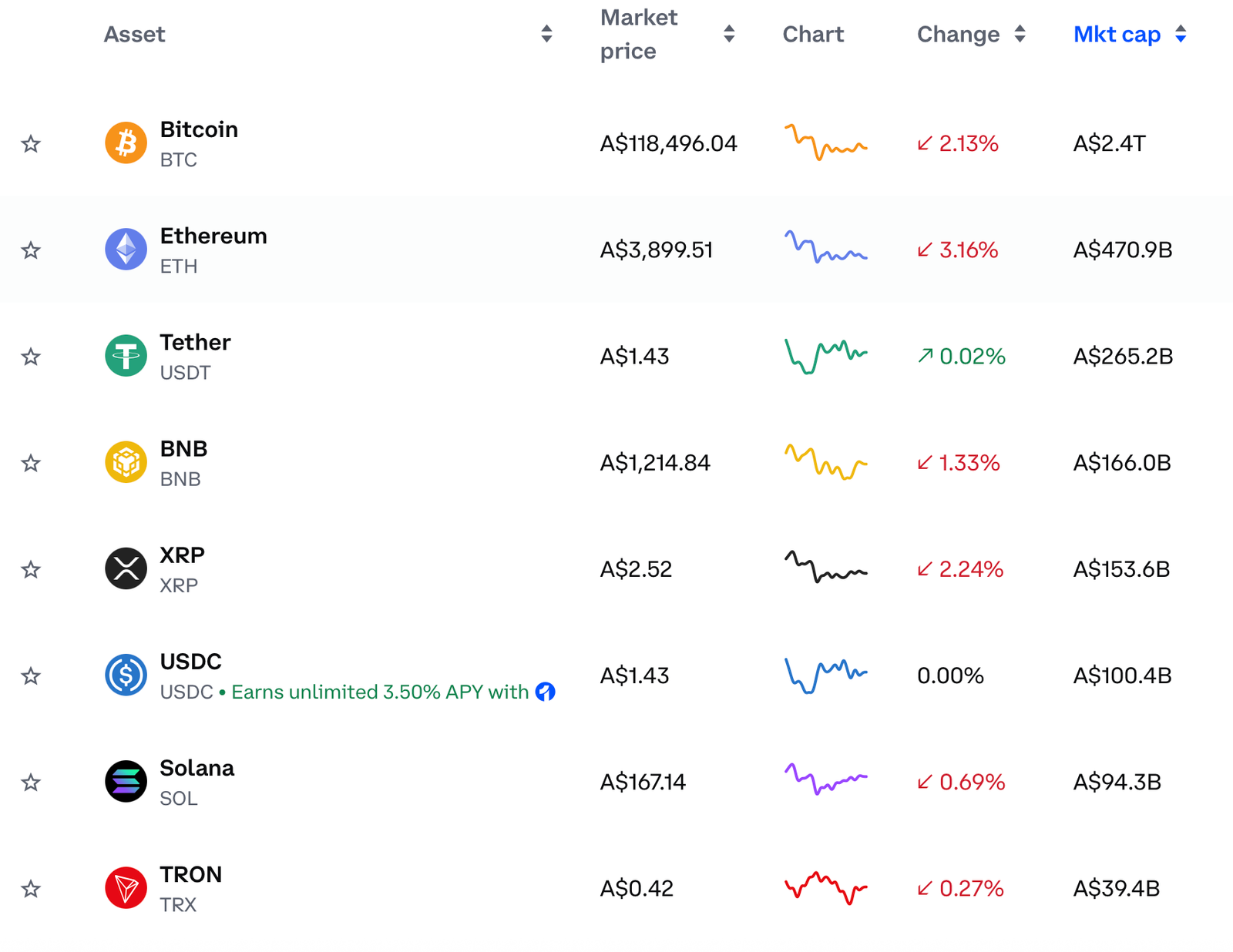
Asset coverage on Coinbase
| Asset type | Available on Coinbase in Australia? | What you can trade | Notes/limitations |
|---|---|---|---|
| Shares & ETFs | No | N/A | Coinbase does not offer ASX, US shares, or ETFs to Australian users |
| Forex | No | N/A | No direct FX trading (e.g. AUD/USD); FX exposure is indirect via crypto and stablecoins |
| Crypto (spot) | Yes | BTC, ETH, SOL, XRP, ADA, DOGE, USDT, USDC and many more | Australians can access 250+ cryptocurrencies, mainly large and mid-cap assets |
| Crypto-to-crypto swaps | Yes | Conversions between supported coins | Simple swaps available, but costs may include spreads and conversion fees |
| Derivatives (crypto futures / perpetuals) | Limited | Perpetual futures via advanced products | Availability is eligibility- and GEO-dependent and not available to all users |
| NFTs / on-chain assets | Limited / separate | On-chain assets via wallet and dApps | Typically accessed via wallet tools rather than the main exchange |
Crypto trading: what Australian users can access
Most Australians use Coinbase for spot crypto trading, which includes:
- Major cryptocurrencies: Bitcoin (BTC), Ethereum (ETH), Solana (SOL), XRP
- Established altcoins: Cardano (ADA), Dogecoin (DOGE), Chainlink (LINK), Avalanche (AVAX)
- Stablecoins: USDC, USDT
Coinbase’s Australian offering focuses on quality and compliance rather than sheer quantity, so while coverage is broad, it is more curated than some altcoin-heavy exchanges.
Derivatives: are they available in Australia?
Coinbase does offer crypto derivatives and perpetual futures through advanced trading products, but access in Australia is not guaranteed. In practice:
- Availability depends on user eligibility and account permissions
- Products may be restricted based on regulatory and risk rules
- Many retail users will only see spot trading enabled
Derivatives access is limited and depends on your account permissions.
Assets you can’t trade on Coinbase in Australia
Coinbase does not provide access to traditional or multi-asset markets, including:
- ASX or US shares
- ETFs
- Forex pairs
- Commodities or stock indices
If you’re looking for an all-in-one investing platform, Coinbase will feel limited. It is best understood as a crypto-specialist exchange, not a general investing app.
How much does Coinbase cost in Australia?
Coinbase is free to open and fund via PayID or bank transfer in Australia, but trading costs vary depending on how you buy and sell crypto. Simple “instant buy” trades are convenient but expensive, while Coinbase Advanced offers much lower maker–taker fees.
Trading fees
Coinbase uses two different pricing models depending on the trading interface:
- Standard Coinbase (simple buy/sell):
Fees are bundled into a spread plus a transaction fee. The final cost is shown at checkout and can feel opaque. Instant buys are the most expensive option. - Coinbase Advanced:
Uses a transparent maker–taker fee model, which is significantly cheaper and preferred by active traders.
Coinbase Advanced trading fees (spot crypto):
| Order type | Fee |
|---|---|
| Maker | 0.40% |
| Taker | 0.60% |
Fees can decrease for higher-volume traders, but most Australian retail users will sit at these base rates.
Spreads and commissions
- Spreads: On standard Coinbase trades, a spread is usually built into the quoted price on simple trades.
- Commission visibility: On simple trades, you often won’t see a clean fee breakdown until the final confirmation screen. On Coinbase Advanced, fees are explicit and easier to track.
FX and conversion fees
- AUD to crypto: PayID and bank transfer deposits are free, but converting AUD into crypto includes a spread in the quoted rate on simple trades.
- Crypto-to-crypto swaps: Conversions between coins can include spreads and/or trading fees, depending on whether you use simple conversion or Advanced trading.
- Debit card purchases: Card buys are instant but can include higher transaction and FX-related fees, making them one of the most expensive funding methods.
Non-trading fees
Coinbase has relatively few non-trading fees, but there are some to be aware of:
- Deposits (AUD via PayID or bank transfer): Free
- Withdrawals (AUD): Free
- Crypto withdrawals: Network (blockchain) fees apply and vary by asset
- Inactivity fees: None
- Account maintenance: None
Typical Coinbase costs for Australian users
| Activity | Typical cost (AUD) |
|---|---|
| Open account | $0 |
| PayID or bank transfer deposit | $0 |
| Simple instant buy | Spread + variable fee (can be relatively high on simple trades) |
| Advanced trade (maker) | 0.40% |
| Advanced trade (taker) | 0.60% |
| Debit card purchase | Higher fees than PayID (varies by transaction) |
| AUD withdrawal | $0 |
| Crypto withdrawal | Variable network fee |
How good is Coinbase’s web app for users?
Coinbase’s web app is one of the most user-friendly crypto platforms available, particularly for beginners, while still offering a separate advanced interface for more experienced traders.
It prioritises clarity and ease of navigation over deep professional tooling, which makes it accessible but not best-in-class for highly technical trading.

Usability
The Coinbase web app is clean, fast, and intuitive. Core actions such as buying, selling, converting crypto, and viewing balances are clearly labelled and easy to find. The default interface avoids clutter, which reduces the learning curve for new users.
For more experienced traders, Coinbase separates complexity into Coinbase Advanced, allowing users to switch interfaces without needing a different account. This keeps the main platform beginner-friendly while still supporting progression.
Charting
Charting quality depends on which interface you use:
- Standard Coinbase:
Basic price charts with limited indicators, suitable for tracking price movements but not detailed technical analysis. - Coinbase Advanced:
Uses TradingView-powered charts, offering common indicators such as moving averages, RSI, MACD, Bollinger Bands, and volume overlays. This is sufficient for most retail traders, though still lighter than professional trading terminals.
Timeframes and chart layouts are easy to adjust, but deep multi-chart layouts are limited.
Order types
Order functionality improves significantly on Coinbase Advanced.
Available order types include:
- Market orders
- Limit orders
- Stop-limit orders
This covers the needs of most spot crypto traders. However, advanced conditional orders, algorithmic strategies, and complex execution tools are not available on the standard web interface.
Customisation
Customisation is moderate rather than extensive:
- Users can set preferred trading pairs
- Watchlists can be created for favourite assets
- Chart indicators and layouts can be adjusted in Advanced mode
There is no deep workspace customisation such as multi-window layouts, detachable charts, or fully configurable dashboards, which active traders may miss.
Known limitations
Despite its strengths, the web app has some clear limitations:
- The standard interface lacks advanced analytics, pushing serious traders toward Coinbase Advanced
- Fewer technical indicators compared with specialist trading platforms
- No paper trading or demo mode
- Advanced features may feel limited for professional or high-frequency traders
- Some advanced products and derivatives are eligibility- and GEO-dependent for Australian users
How good is the Coinbase mobile app in Australia?
The Coinbase mobile app is one of the strongest parts of the platform for Australian users, offering a smooth, secure, and beginner-friendly experience on both iOS and Android.
It mirrors most core web functionality while remaining fast and easy to use, making it well suited to everyday crypto management and trading on the go.

iOS and Android availability
The Coinbase mobile app is available on:
- iOS (Apple App Store)
- Android (Google Play Store)
Australian users get full access to account management, AUD deposits, trading, staking (where supported), and wallet features through the app. There is no functional split between operating systems, and updates are rolled out consistently across both platforms.
Key features
The Coinbase mobile app includes nearly all features most users need day to day:
- Buy, sell, and convert crypto using AUD
- PayID and bank-linked funding
- Real-time price tracking and portfolio overview
- Price alerts and market notifications
- Access to Learn and Earn rewards
- Basic staking controls for supported assets
- Seamless access to Coinbase Advanced for lower-fee trading
Navigation is simple, with large buttons and clear prompts, making it accessible even for first-time crypto buyers.
Stability and performance
Performance is strong on both iOS and Android:
- Fast load times for balances and prices
- Trades typically execute smoothly with minimal lag
- Stable performance even during periods of high market activity
That said, like most crypto apps, brief slowdowns can occur during extreme volatility when trading volumes spike. These are usually temporary rather than persistent issues.
Security features
Security is a major focus of the Coinbase mobile app, especially for Australian users managing real funds:
- Mandatory two-factor authentication (2FA)
- Biometric login support (Face ID / fingerprint)
- Device verification for new logins
- Withdrawal confirmations and security alerts
- Session monitoring and account activity tracking
These features provide a solid layer of protection for mobile users, particularly those trading or holding crypto frequently from their phone.
How easy is it to open an account with Coinbase in Australia?
Opening an account with Coinbase in Australia is quick, fully digital, and designed to be completed in minutes rather than days. Most users can create and verify an account without paperwork, although approval times can vary depending on identity checks and demand.
Digital onboarding
Account registration with Coinbase is completed entirely online via the website or mobile app. The process is guided step by step and clearly explains what information is required at each stage.
To get started, Australian users:
- Sign up with an email address and password
- Secure the account with two-factor authentication (2FA)
- Confirm their email and phone number
There is no minimum deposit required to open an account, and users can browse the platform before funding.
KYC steps
As an AUSTRAC-registered Digital Currency Exchange, Coinbase must verify customer identities. The KYC process typically involves:
- Providing basic personal details (name, date of birth, address)
- Uploading a government-issued ID, such as an Australian driver’s licence or passport
- Completing a short liveness or selfie check using the device camera
This process is designed to meet AML and counter-terrorism financing requirements while remaining simple for most users.
Common delays
While many accounts are approved quickly, delays can occur in certain situations:
- Blurry or incomplete ID uploads
- Mismatched personal details between documents
- Technical issues during selfie verification
- Periods of high signup demand during volatile market conditions
If verification fails, Coinbase usually prompts users to re-submit documents rather than restarting the entire application.
Typical approval time
For most Australian users, identity verification is completed within minutes, allowing trading access shortly after signup. In some cases, manual review may be required, extending approval to 24–48 hours.
Once approved, users can immediately:
- Deposit AUD via PayID or bank transfer
- Trade crypto with a minimum trade size of A$2
- Access both the standard platform and Coinbase Advanced
How do deposits and withdrawals work on Coinbase in Australia?
Coinbase makes deposits and withdrawals relatively simple for Australian users, with free AUD funding via PayID or bank transfer and fast access once your account is approved. Speeds and limits depend on the payment method used, with PayID being the fastest and most cost-effective option for most people.
Minimum deposit and account approval (Australia)
There is no minimum deposit requirement to open or fund a Coinbase account in Australia. However:
- The minimum trade size is A$2, which effectively acts as the entry point for beginners.
- Most accounts are approved within minutes after identity verification.
- In some cases, approval may take up to 24–48 hours if manual review is required.
Once approved, users can deposit AUD and start trading immediately.
Deposit methods, fees, and speed
Australian users can fund their Coinbase account using the following methods:
| Deposit method | Minimum deposit | Fee | Typical speed | Notes |
|---|---|---|---|---|
| PayID | $0 | Free | Instant to minutes | Best option for most Australians |
| Bank transfer | $0 | Free | 1–3 business days | Slower than PayID but reliable |
| Debit card | Varies | Higher fees apply | Instant | Convenient but expensive |
| Crypto transfer | Network minimum | Network fee only | Minutes to hours | Depends on blockchain congestion |
Key takeaway: PayID is the fastest and cheapest way to fund a Coinbase account in Australia.
Withdrawal methods, fees, and speed
Coinbase supports both AUD and crypto withdrawals. Processing times vary depending on the withdrawal type.
| Withdrawal method | Fee | Typical speed | Notes |
|---|---|---|---|
| AUD to bank account | Free | 1–3 business days | Timing depends on bank processing |
| Crypto to external wallet | Network fee | Minutes to hours | Speed depends on the blockchain |
There are no Coinbase withdrawal fees for AUD, but crypto withdrawals incur standard blockchain network fees, which vary by asset and network conditions.
Limits and exceptions
Some limits and conditions to be aware of:
- Deposit and withdrawal limits can vary based on account verification level and payment method
- New accounts may have temporary limits during the first few days
- Debit card limits are often lower than PayID or bank transfers
- Crypto withdrawals may be temporarily restricted if additional security checks are triggered
Coinbase may also apply short holding periods after certain deposits for fraud prevention, particularly with card payments.
What account types does Coinbase offer users in Australia?
Coinbase offers Australian users a small number of clearly defined account types focused on spot crypto trading, with no tax-advantaged, margin, or traditional investment accounts available. The structure is simple by design, which suits beginners, but limits flexibility for advanced or professional users.
Standard retail account (default)
Most Australians use the standard Coinbase account, which provides access to:
- Spot cryptocurrency buying, selling, and holding
- AUD funding via PayID, bank transfer, or debit card
- Basic staking on supported assets
- Education features such as Learn and Earn
This account operates on a cash-only basis. You can only trade with funds you deposit, and there is no margin lending for Australian retail users.
Coinbase Advanced (same account, advanced interface)

Coinbase Advanced is not a separate account type, but an upgraded trading interface available to standard account holders. With Coinbase Advanced, users get:
- Lower maker–taker fees (0.40% / 0.60%)
- Advanced order types (market, limit, stop-limit)
- TradingView-powered charts
- Deeper market data
Funds are shared between standard Coinbase and Advanced. You can switch interfaces instantly without opening a new account.
Subscription-based account: Coinbase One
Coinbase also offers Coinbase One, a paid subscription layered on top of a standard account. Key features include:
- Zero trading fees on eligible simple trades
- Boosted staking rewards on selected assets
- Priority customer support
Coinbase One is priced in USD, not AUD, and benefits vary by region. It is best suited to frequent traders who can offset the monthly fee through reduced trading costs.
Professional or institutional accounts
For larger entities, Coinbase offers institutional-grade accounts globally, including:
- Custody solutions
- OTC trading
- Prime brokerage services
These are designed for companies, funds, and high-net-worth clients rather than everyday Australian retail investors, and onboarding requirements are significantly more complex.
Account types not available in Australia
Australian users should be aware of what Coinbase does not offer:
- Tax-advantaged accounts (e.g. superannuation or ISA-style wrappers)
- Margin trading for retail users
- Crypto lending or borrowing products
- Joint or trust investment accounts (retail-focused platform)
Account type snapshot
| Account type | Available in Australia | Key notes |
|---|---|---|
| Standard retail account | Yes | Cash-only spot crypto trading |
| Coinbase Advanced | Yes | Same account, lower fees and advanced tools |
| Coinbase One (subscription) | Yes | Monthly fee, zero-fee simple trades |
| Margin trading | No | Not offered to Australian retail users |
| Tax-advantaged accounts | No | Crypto not eligible in Australia |
| Institutional / Prime accounts | Limited | For businesses and large investors only |
Is Coinbase suitable for your trading or investing style?
Coinbase is best suited to long-term and casual crypto investors rather than short-term or high-frequency traders. Its strengths lie in simplicity, security, and ease of use, while its higher fees and limited advanced tooling make it less ideal for fast, cost-sensitive trading strategies.
How Coinbase fits different trading styles
| Trading style | Suitability | Explanation |
|---|---|---|
| Scalping | Poor | Scalping relies on ultra-low fees, tight spreads, and advanced execution tools. Coinbase’s instant buy fees are too high, and even Coinbase Advanced (0.40% / 0.60%) is expensive for rapid in-and-out trades. Limited order customisation also works against scalpers. |
| Day trading | Limited | Day traders can use Coinbase Advanced with limit and stop-limit orders, but fees remain higher than many competitors and charting, while solid, is not professional-grade. Suitable only for light or occasional day trading, not high-frequency strategies. |
| Swing trading | Good | Swing traders benefit from Coinbase Advanced’s lower fees, TradingView charts, and clear portfolio tracking. Holding positions over days or weeks reduces the impact of fees, making Coinbase a reasonable option for medium-term strategies. |
| Long-term investing | Very good | Coinbase is well suited to buy-and-hold investors who prioritise security, ease of use, and AUD access. Features such as recurring buys, staking on supported assets, and a clean interface support long-term accumulation. |
What education and learning resources are available for Coinbase users in Australia?
Coinbase offers some of the strongest beginner-focused education tools in the crypto industry, with structured learning content, in-app tutorials, and rewards-based education, but it does not provide live webinars or demo trading.
The education offering is designed to help new Australian users understand crypto basics rather than train advanced trading strategies.
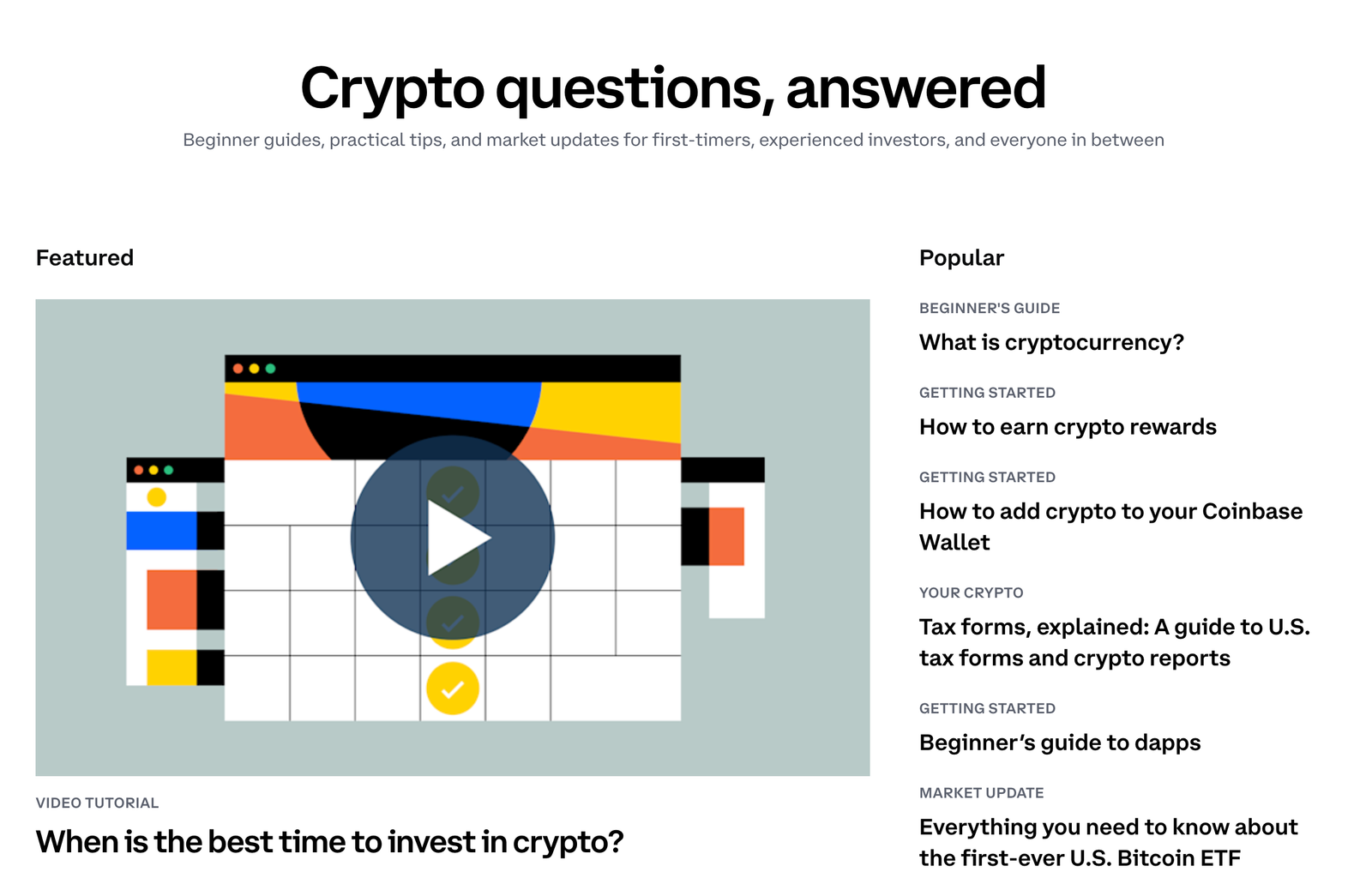
Courses and structured learning
Education on Coinbase is centred around short, structured learning modules that explain:
- How cryptocurrencies and blockchains work
- The purpose of major crypto assets and protocols
- Wallets, security, and basic risk concepts
These modules are designed to be consumed in minutes rather than hours, making them accessible for beginners. Content is written in plain English and avoids heavy technical jargon.
Tutorials and in-app guidance
Coinbase provides extensive in-app tutorials that guide users through:
- Buying and selling crypto
- Converting between assets
- Setting up recurring buys
- Understanding balances, price movements, and fees
Tooltips and prompts appear directly inside the app and web platform, helping users learn by doing rather than relying solely on external guides.
Learn and Earn rewards
One of Coinbase’s standout education features is Learn and Earn, which allows Australian users to:
- Watch short educational videos
- Complete simple quizzes
- Earn small amounts of cryptocurrency as a reward
Rewards typically range from a few dollars’ worth of crypto per lesson. Availability can vary over time and by asset, but this feature lowers the barrier to learning by letting users gain hands-on exposure with minimal risk.
Webinars and live training
Coinbase does not currently offer regular live webinars, trading workshops, or instructor-led sessions for Australian retail users. Education is largely self-paced and on-demand.
This makes Coinbase less suitable for users who prefer:
- Live Q&A sessions
- Real-time market walkthroughs
- Instructor-led trading education
Demo accounts and practice trading
Coinbase does not provide a demo or paper trading account. Users cannot simulate trades with virtual funds.
Instead:
- The minimum trade size is A$2, allowing beginners to experiment with very small real trades
- This approach offers real market exposure but does involve financial risk
Education snapshot (Australia)
| Education feature | Available? | Notes |
|---|---|---|
| Structured courses | Yes | Short, beginner-focused modules |
| In-app tutorials | Yes | Step-by-step guidance inside the platform |
| Learn and Earn rewards | Yes | Earn small amounts of crypto for learning |
| Webinars / live training | No | No regular live education |
| Demo or paper trading | No | $2 minimum trade used instead |
What unique or standout features does Coinbase offer in Australia?
Coinbase stands out in Australia for its combination of beginner-first design, education-driven incentives, and institutional-grade infrastructure that few competitors match in one platform.
While it isn’t the cheapest exchange, it offers several features and advantages that are either rare or uniquely well executed for Australian users.
Learn and Earn (education with real incentives)
One of Coinbase’s most distinctive features is Learn and Earn, which is still uncommon among Australian-accessible exchanges. Key points:
- Users complete short lessons and quizzes on specific crypto projects
- Rewards are paid in real cryptocurrency, not demo credits
- Lessons are beginner-focused and updated as new assets launch
For new users, this provides hands-on exposure without needing to risk meaningful capital, something most local competitors do not offer.
Seamless AUD access with global liquidity
While many global exchanges struggle with local banking, Coinbase offers:
- PayID support for instant AUD deposits
- Free AUD deposits and withdrawals via bank transfer
- Direct access to deep global liquidity pools, not Australia-only order books
This combination is a practical advantage. Australian users get the convenience of local payments alongside the tighter spreads and execution reliability that come with a large global exchange.
Single account, multiple platform layers
Unlike platforms that force users to open separate “basic” and “pro” accounts, Coinbase uses a single account structure with multiple interfaces:
- Standard Coinbase for simple buying and selling
- Coinbase Advanced for lower fees, TradingView charts, and advanced order types
Funds move instantly between modes, allowing users to start simple and scale up without friction. Many competitors require full platform migrations to access similar features.
Strong focus on security transparency
Coinbase differentiates itself by being unusually transparent for a crypto exchange:
- Operates as a publicly listed company with audited financial reporting
- States that customer assets are held 1:1 in reserve
- Enforces mandatory 2FA and supports hardware security keys
While this doesn’t remove crypto risk, it provides a level of disclosure and accountability that many privately owned exchanges do not match.
Wallet ecosystem and on-chain access
Coinbase offers more than just an exchange account:
- Custodial exchange wallet for convenience
- Non-custodial Coinbase Wallet for self-custody
- Easy access to on-chain apps, NFTs, and DeFi through wallet integration
This ecosystem approach makes it easier for Australian users to move from basic crypto buying into on-chain activity without switching providers.
Subscription-based zero-fee trading option
Coinbase One is unusual in the Australian market:
- Monthly subscription priced in USD
- Zero trading fees on eligible simple trades
- Boosted staking rewards and priority support
While not cost-effective for everyone, it offers a predictable, flat-cost model that few Australian-accessible exchanges provide.
Standout features snapshot (Australia)
| Feature | Why it stands out |
|---|---|
| Learn and Earn | Earn real crypto for learning, not widely offered locally |
| PayID + global liquidity | Local payments with global order books |
| Single account with Advanced mode | No separate “pro” account required |
| Public company transparency | Higher disclosure than private exchanges |
| Wallet ecosystem | Easy transition from exchange to self-custody |
| Coinbase One subscription | Flat-fee alternative to per-trade pricing |
How good is Coinbase customer support for users in Australia?
Coinbase offers multiple support channels for Australian users with 24/7 availability, but response quality can be inconsistent, especially for complex or account-specific issues.
Support is adequate for common problems, though it is not a standout strength compared with some Australia-first exchanges.
Support channels
Australian users of Coinbase can access support through several channels:
- In-app live chat (primary support channel)
- Email support via the help centre
- Automated help centre and FAQs
- Account recovery tools for login or security issues
Phone support is limited and reserved for specific security or account recovery situations rather than general trading queries.
Availability
Customer support is available 24/7, which is a positive for Australian users trading outside standard business hours. However:
- Live chat typically starts with an automated assistant
- Escalation to a human agent can take time
- Response speed varies based on issue complexity and market conditions
During periods of high market volatility, wait times can increase noticeably.
Customer support snapshot
| Support factor | Coinbase in Australia | What to expect |
|---|---|---|
| Support channels | Live chat, email, help centre | No full-service local phone desk |
| Availability | 24/7 | Coverage outside AU business hours |
| First response | Automated, then human | Bot interaction is common |
| Resolution speed | Variable | Fast for simple issues, slower for complex cases |
| Priority support | Available via subscription | Coinbase One only |
How does Coinbase compare to competitors in Australia?
Coinbase competes well in Australia on ease of use, security posture, and overall app quality, but it’s usually not the cheapest option unless you use Coinbase Advanced.
Australian-first exchanges often win on AUD cash-out experience and simpler pricing, while global competitors can offer lower fees and a wider range of advanced trading tools.
Coinbase vs key competitors (Australia)
| Platform | Fees (typical) | Assets (approx.) | Regulation (Australia) | Best use case |
|---|---|---|---|---|
| Coinbase | Instant buys can be high; Advanced: 0.40% maker / 0.60% taker | 250+ | AUSTRAC registered (AML/CTF) | Beginners who want the easiest UX and strong security; use Advanced for better pricing |
| Binance | Often among the lowest; spot trading can be as low as 0.1% | 400+ | AUSTRAC registered (AML/CTF) | Fee-sensitive traders who want low-cost spot trading and broad functionality |
| Kraken | Competitive “pro” fees around 0.25% / 0.40% | 400+ | AUSTRAC registered (AML/CTF) | Active traders wanting lower fees and a more trading-first experience |
| CoinSpot | Simple fees around 1% for instant buys; lower on markets | 400+ | AUSTRAC registered (AML/CTF) | Australians who want a local platform and straightforward buying |
| Swyftx | Flat trading fee around 0.6% | 350+ | AUSTRAC registered (AML/CTF) | Users who want simple pricing and an AU-focused platform |
What Coinbase does better
- Best-in-class beginner experience: One of the simplest ways to buy crypto in AUD, especially for first-time users.
- Polished app and platform design: The web and mobile experience is cleaner and less intimidating than most trading-first platforms.
- Education features: Learn and Earn is still relatively uncommon among Australia-accessible exchanges.
- Clear upgrade path: Standard Coinbase is simple, while Coinbase Advanced adds TradingView charts and lower fees without creating a separate account.
Where competitors tend to win
- Lower fees for active trading: Binance and Kraken undercut Coinbase Advanced on maker–taker pricing.
- AU-first support and cash-out experience: Local platforms often feel smoother for AUD withdrawals and support expectations.
- More advanced tools: Trading-focused exchanges can offer deeper charting, order types, and market analytics than Coinbase’s standard interface.
What are the main limitations users in Australia should be aware of?
Coinbase is a strong all-round crypto platform, but Australian users should understand its practical limitations before opening an account. These drawbacks won’t affect everyone, but they are important depending on how you plan to trade or invest.
- Higher costs for convenience trades: Instant buys and card purchases can be significantly more expensive than local alternatives. While Coinbase Advanced reduces fees to 0.40% maker / 0.60% taker, users who rely on the standard buy/sell screen pay a clear convenience premium.
- No traditional investor protections: Coinbase is AUSTRAC-registered, not ASIC-regulated for crypto investing. This means crypto holdings are not covered by the Australian Financial Claims Scheme, and losses from hacks, insolvency, or market moves are not compensated.
- Limited appeal for active or professional traders: Although Coinbase Advanced improves charting and order types, the platform still lacks the depth, execution tools, and fee structure required by high-frequency or professional traders.
- Custodial by default: Assets are held in a custodial exchange wallet unless users actively move funds to a self-custody wallet. This introduces counterparty risk, particularly for long-term holders keeping large balances on the exchange.
- Feature availability varies by region and eligibility: Some products, such as derivatives, staking on certain assets, or subscription benefits, may be restricted or unavailable for Australian users depending on regulatory and eligibility requirements.
Conclusion: Is Coinbase the right choice for users in Australia in 2026?
For Australians in 2026, Coinbase is the right choice if you value simplicity, security, and easy AUD access more than the lowest possible fees.
It remains one of the most approachable ways to buy and hold crypto in Australia, particularly for newcomers, but it is not designed to be the cheapest or most advanced trading platform on the market.
FAQs
Is Coinbase legal to use in Australia?
Yes. Coinbase is registered with AUSTRAC as a Digital Currency Exchange, which allows it to legally provide crypto exchange services to Australian residents. However, it is not ASIC-regulated for crypto investing, and crypto assets are not covered by the Financial Claims Scheme.
Does Coinbase support AUD deposits and withdrawals?
Yes. Australian users can deposit and withdraw AUD using PayID and bank transfer, with no Coinbase fees for standard AUD deposits or withdrawals. Debit card deposits are also supported but usually incur higher fees.
What fees will Australians actually pay on Coinbase?
Fees depend on how you trade. Instant buys on the standard interface can be expensive due to spreads and transaction fees, while Coinbase Advanced uses a clearer 0.40% maker / 0.60% taker fee model. PayID deposits are free, but crypto withdrawals incur standard network fees.
Is Coinbase safe for Australian users?
Coinbase is considered one of the more secure global crypto exchanges, with features like mandatory 2FA, cold storage, and a long operating history. That said, it is still a centralised exchange, so Australian users should understand that crypto holdings carry counterparty risk and are not protected like bank deposits.
References
- https://www.austrac.gov.au/business/your-industry/digital-currency-cryptocurrency/digital-currency-exchange-providers
- https://asic.gov.au/regulatory-resources/digital-assets/crypto-assets/
- https://treasury.gov.au/digital-assets
- https://www.ato.gov.au/individuals/investments-and-assets/crypto-asset-investments/
