

Using our analysis of spreads, execution speed, and ASIC-regulated broker performance, the best forex brokers in Australia in 2026 are Pepperstone and IG as the strongest all-round choices, Interactive Brokers for professional traders, CMC Markets for forex pair variety and advanced charting, and eToro for beginners interested in copy trading.
These brokers provide competitive spreads, strong trading platforms, and operate under recognised regulatory frameworks suitable for Australian traders.
Choosing the right forex broker depends on spreads, execution speed, trading platforms, and the type of trading strategy you use.
Some brokers are designed for high-frequency or algorithmic trading, while others focus on research tools, platform usability, or beginner-friendly copy trading.
- CopyTrading lets you mirror experienced investors' trades
- Multi-asset access: stocks, crypto, ETFs, forex, commodities
- Beginner-friendly interface with social/community sentiment feed
Capital at risk. T&Cs apply.
Top forex brokers in Australia (2026)
- Best for platform quality and research tools: IG offers a polished proprietary trading platform, strong market research, and risk management features such as guaranteed stop-loss orders.
- Best for active and algorithmic traders: Pepperstone provides tight spreads and fast execution, especially on its Razor account, making it popular with scalpers and automated trading strategies.
- Best for professional and high-volume traders: Interactive Brokers offers institutional-style pricing and deep global market access, appealing to experienced traders seeking advanced tools and low costs.
- Best for forex pair variety and advanced charting: CMC Markets supports a large range of forex pairs and advanced charting tools, making it suitable for traders who rely heavily on technical analysis.
- Best for social and copy trading: eToro provides a simple platform and copy trading functionality, allowing beginners to replicate the strategies of experienced traders.
Key considerations when choosing a forex broker in Australia
- Regulation: Choose brokers operating under ASIC oversight, which sets standards for Australian financial services providers.
- Trading costs: Compare spreads and commissions, as these determine the true cost of each trade.
- Leverage limits: ASIC regulations typically limit retail traders to 30:1 leverage on major currency pairs, helping reduce excessive risk.
- Trading platforms: Many brokers support platforms such as MetaTrader 4, MetaTrader 5, or proprietary trading platforms with different charting and execution tools.
- Execution quality: Fast execution and minimal slippage are important for active traders, particularly those using short-term strategies.
What are the best forex brokers in Australia in 2026?
| Broker | Minimum Deposit | Typical EUR/USD Spread | Platform Options | Best For |
|---|---|---|---|---|
| IG | $0 (bank transfer) | From 0.6–0.9 pips | IG Platform, MT4, ProRealTime, TradingView | Platform quality & research tools |
| Pepperstone | $0 (recommended $200) | From 0.0 pips (Razor) | MT4, MT5, cTrader, TradingView | Active & algorithmic traders |
| Interactive Brokers | $0 | From 0.1 pip + commission | TWS, IBKR Desktop, Web, Mobile | High-volume & professional traders |
| CMC Markets | $0 | From 0.6 pips | Next Generation, MT4, TradingView | Large forex range & advanced charting |
| eToro | USD $50 | From 1.0 pip | eToro Web & Mobile | Social & copy trading |
Forex broker Australia reviews
These forex broker Australia reviews compare leading platforms based on spreads, execution quality, regulation, and which brokers suit different trading styles.
1. eToro – Best for social and copy trading

Platform overview
| Features | Details |
|---|---|
| Regulator (AU) | Australian Securities and Investments Commission |
| AFSL | 491139 |
| Minimum Deposit | USD $50 |
| Base Currency | USD only |
| Forex Pairs | 56+ |
| Typical EUR/USD Spread | From 1.0 pip |
| Commission (Forex) | None, spread-only |
| Retail Max Leverage | 30:1 |
| Platforms | eToro Web, iOS, Android |
| Copy Trading | Yes |
| Withdrawal Fee | USD $5 |
| Negative Balance Protection | Yes (retail clients) |
Is this broker properly regulated in Australia, and how are client funds protected?
Yes. Australian clients trade under eToro AUS Capital Ltd, which holds AFSL 491139 issued by the Australian Securities and Investments Commission. Client funds are held in segregated trust accounts.
Retail traders receive negative balance protection, meaning losses cannot exceed deposits. Australia does not provide a statutory compensation scheme like the UK’s Financial Services Compensation Scheme.
How competitive are the spreads, commissions, and overall trading costs?
Forex pricing is spread-only. Major pairs such as EUR/USD start from around 1.0 pip, which is reasonable but not ultra-tight.
Other costs include:
- USD $5 withdrawal fee
- USD $10 inactivity fee after 12 months
- Overnight financing on leveraged trades
The main cost for Australians is currency conversion. Accounts are USD-based, so depositing AUD typically incurs a conversion fee of about 1.5 percent per side.
Suitable for casual and swing traders. Less ideal for scalpers chasing the lowest spreads.
What trading platforms are available, and how strong is execution quality?
eToro uses its own proprietary web platform and mobile trading apps. It does not support MetaTrader 4 or 5.
The interface is clean and intuitive. Order types include market, limit, stop-loss and trailing stop-loss. Charting offers 70+ indicators but limited deep customisation.
CopyTrader, its copy trading platform, is the key differentiator. You can automatically mirror other traders’ forex positions with a minimum allocation of USD $200.
Execution is stable for retail trading but not designed for high-frequency or algorithmic strategies.
What leverage limits, margin rules, and risk management tools are offered?
Under ASIC rules, retail leverage is capped at:
- 30:1 for major forex pairs
- 20:1 for minor pairs
Risk tools include adjustable leverage, mandatory stop-loss settings, margin monitoring and negative balance protection.
CFDs are high-risk and many retail accounts lose money trading leveraged products.
How easy is it to deposit and withdraw AUD funds?
Deposits are available via bank transfer, card and selected e-wallets. Minimum deposit is USD $50.
Because accounts are USD-based, AUD deposits are converted to USD, which adds cost.
Withdrawals:
- USD $5 fee
- Minimum USD $30
- Bank withdrawals typically processed within a few business days
The process is straightforward, but USD-only accounts remain the main friction point.
Who is this broker best for?
eToro suits beginner and intermediate traders who want forex alongside stocks and crypto, and who value copy trading.
Best for:
- Traders who prefer a simple interface
- Investors building diversified portfolios
- Users interested in social trading
Less suitable for:
- High-frequency scalpers
- Traders requiring MetaTrader automation
- Those sensitive to currency conversion fees
Read the complete eToro review here.
Pros and cons
- ASIC regulated (AFSL 491139)
- Negative balance protection for retail clients
- Strong copy trading ecosystem
- Beginner-friendly platform and app
- Access to forex, stocks, ETFs and crypto in one account
- USD-only base account
- Currency conversion fees on AUD deposits
- No MetaTrader 4 or 5 support
- Spreads not the lowest in market
2. Interactive Brokers – Best for professional and high-volume traders

Platform overview
| Feature | Detail |
|---|---|
| Regulator (AU) | Australian Securities and Investments Commission |
| AFSL | 453554 |
| Minimum Deposit | $0 |
| Base Currencies | 20+ including AUD |
| Forex Pairs | 100+ |
| Typical EUR/USD Spread | From 0.1 pip |
| Commission (Forex) | From 0.08–0.20 bps (min USD $2) |
| Retail Max Leverage | 30:1 |
| Platforms | TWS, IBKR Desktop, Web, Mobile |
| Execution Model | Direct market access |
| Withdrawal Fee | 1 free per month, then approx. AUD $15 |
| Negative Balance Protection | Yes (retail clients) |
Is this broker properly regulated in Australia, and how are client funds protected?
Yes. Australian clients trade through Interactive Brokers Australia Pty Ltd, which holds AFSL 453554 issued by the Australian Securities and Investments Commission. The firm is also a participant in the ASX and ASX 24.
Client funds are held in segregated trust accounts under ASIC rules. Retail CFD traders receive negative balance protection, meaning losses cannot exceed deposited funds. Australia does not operate a statutory investor compensation scheme.
Interactive Brokers Group is publicly listed on Nasdaq and has operated since 1977, adding financial transparency and scale rarely matched by retail brokers.
How competitive are the spreads, commissions, and overall trading costs?
Forex pricing is commission-based with interbank spreads. EUR/USD spreads can be as low as 0.1 pip, with commissions starting from 0.08 to 0.20 basis points of trade value, subject to a USD $2 minimum per order.
There are no added spread markups. That makes pricing extremely competitive for active traders and high-volume accounts.
Other costs:
- USD $2 minimum FX conversion fee
- One free withdrawal per month, then approx. AUD $15
- No inactivity fees
The minimum FX conversion fee can be expensive for very small transfers. For larger trades, IBKR is among the cheapest forex providers available in Australia.
This structure suits serious traders. Casual users placing small, infrequent trades may prefer simpler spread-only pricing.
What trading platforms are available, and how strong is execution quality?
Interactive Brokers offers only proprietary platforms. There is no MetaTrader 4 or 5.
Platforms include:
- Trader Workstation (TWS)
- IBKR Desktop
- Client Portal (web)
- IBKR Mobile
TWS supports over 90 order types and advanced algorithmic routing. IBKR Desktop provides a more modern interface while retaining deep functionality.
Execution quality is a key strength. IBKR uses smart order routing and direct market access, helping reduce slippage and improve fill quality.
For beginners, the forex trading platform can feel complex. For experienced traders, it is one of the most powerful retail trading systems available.
What leverage limits, margin rules, and risk management tools are offered?
Retail forex leverage is capped at 30:1 under ASIC rules.
Professional clients can apply for higher leverage but must meet wealth and experience thresholds.
Risk tools include:
- Advanced stop and trailing orders
- Real-time margin monitoring
- Portfolio-level risk analytics
- Stress testing tools
Margin loan rates are competitive and tiered. CFDs are high risk and a significant percentage of retail traders lose money trading leveraged products.
How easy is it to deposit and withdraw AUD funds?
There is no minimum deposit requirement. Accounts can be funded via domestic bank transfer and BPAY.
IBKR does not support card or PayPal deposits in Australia.
Withdrawals:
- One free withdrawal per month
- Subsequent withdrawals approx. AUD $15
- Typically processed within 1–2 business days
AUD is available as a base currency, reducing unnecessary FX conversions. The funding system is efficient, though not instant.
Who is this broker best for?
Interactive Brokers is best suited to intermediate and advanced forex traders who prioritise pricing efficiency and global market access.
Best for:
- Active forex traders seeking tight spreads
- Algorithmic and systematic traders
- Investors managing multi-asset global portfolios
- Traders who want AUD base accounts
Less suitable for:
- Beginners wanting a simple interface
- Traders who prefer MetaTrader
- Users making very small FX conversions
Interactive Brokers is not built to be flashy. It is built to be efficient, scalable and institutionally priced. For serious forex traders in Australia, it remains one of the strongest options available.
Read the complete Interactive Brokers review here.
Pros and cons
- ASIC regulated (AFSL 453554)
- Extremely tight forex spreads
- Direct market access execution
- No inactivity fees
- 100+ currency pairs
- Platforms can feel complex
- No MetaTrader support
- $2 minimum FX commission
- Fee structure can be complex
3. Pepperstone – Best for active and algorithmic traders

Platform overview
| Feature | Detail |
|---|---|
| Regulator (AU) | Australian Securities and Investments Commission |
| AFSL | 414530 |
| Minimum Deposit | $0 (recommended $200) |
| Base Currencies | 10 including AUD |
| Forex Pairs | 90+ |
| Typical EUR/USD Spread | From 0.0 pips (Razor) |
| Commission (Forex) | $3.50 per lot per side (MT4/MT5) |
| Retail Max Leverage | 30:1 |
| Platforms | MT4, MT5, cTrader, TradingView |
| Execution Model | ECN, no dealing desk |
| Withdrawal Fee | $0 (AU clients) |
| Negative Balance Protection | Yes (retail clients) |
Is this broker properly regulated in Australia, and how are client funds protected?
Yes. Australian clients trade under Pepperstone Group Limited, AFSL 414530, authorised by the Australian Securities and Investments Commission. Client funds are held in segregated trust accounts.
Retail clients receive negative balance protection. Australia does not offer a statutory compensation scheme.
Pepperstone was founded in Melbourne in 2010 and is also regulated in the UK and EU.
How competitive are the spreads, commissions, and overall trading costs?
Pepperstone offers two pricing models.
Standard account:
- Spreads around 0.6–0.9 pips on EUR/USD
- No commission
Razor account:
- Raw spreads from 0.0 pips
- $3.50 per lot per side on MT4/MT5
- $3.00 per lot per side on cTrader
Round-turn commission is typically $7 per lot on MetaTrader. That makes Razor competitive for active traders.
There are:
- No inactivity fees
- No deposit fees
- No withdrawal fees (AU clients)
Overnight financing applies to leveraged CFD positions.
What trading platforms are available, and how strong is execution quality?
Pepperstone supports MT4, MT5, cTrader, and TradingView. Platform choice is one of its strengths.
It operates an ECN, no-dealing-desk model with pricing sourced from multiple liquidity providers. Infrastructure is hosted in Equinix data centres, with low-latency execution.
Scalping, hedgin,g and algorithmic trading are allowed. Guaranteed stop losses are not offered.
What leverage limits, margin rules, and risk management tools are offered?
Under ASIC rules, retail leverage is capped at:
- 30:1 major forex pairs
- 20:1 minor pairs
- 10:1 commodities
- 5:1 equities
- 2:1 crypto CFDs
Risk tools include adjustable leverage, stop and limit orders, margin monitoring and automatic stop-out protection.
How easy is it to deposit and withdraw AUD funds?
Pepperstone offers strong funding support in Australia.
Deposit methods:
- Bank transfer
- PayID
- BPAY
- Credit/debit card
- PayPal
- Skrill and Neteller
There are no deposit fees. Card deposits are typically instant.
Withdrawals:
- $0 for Australian clients
- Usually processed within 1 business day
AUD is available as a base currency, reducing conversion costs.
Who is this broker best for?
Pepperstone suits active forex and CFD traders who want tight spreads and platform flexibility.
Best for:
- Scalpers and algorithmic traders
- MetaTrader and cTrader users
- High-volume forex traders
Less suitable for:
- Buy-and-hold investors
- Traders needing guaranteed stops
- Those wanting real share ownership
Pepperstone is execution-focused. For serious forex traders in Australia, it remains one of the strongest ASIC-regulated forex brokers.
Read the complete Pepperstone review.
Pros and cons
- ASIC regulated (AFSL 414530)
- 0.0 pip spreads on Razor
- Strong ECN execution
- Wide platform choice
- No inactivity or AU withdrawal fees
- Only CFDs, no real shares
- Overnight CFD fees apply
- No investor compensation scheme
4. CMC Markets – Best for forex pair variety and advanced charting

Platform overview
| Feature | Detail |
|---|---|
| Regulator (AU) | Australian Securities and Investments Commission |
| AFSL | 238054 |
| Founded | 1989 |
| Minimum Deposit | $0 |
| Base Currencies | 10 including AUD |
| Forex Pairs | 330+ |
| Typical EUR/USD Spread | From 0.6 pips |
| Commission (Forex) | None (spread-only) |
| Retail Max Leverage | 30:1 |
| Platforms | Next Generation, MT4, TradingView |
| Withdrawal Fee | $0 |
| Negative Balance Protection | Yes (retail clients) |
Is this broker properly regulated in Australia and how are client funds protected?
Yes. Australian clients trade through CMC Markets Asia Pacific Pty Ltd, AFSL 238054, regulated by the Australian Securities and Investments Commission.
Client funds are held in segregated trust accounts. Retail clients receive negative balance protection under ASIC rules. Australia does not operate a statutory compensation scheme.
CMC Markets is listed on the London Stock Exchange, which adds financial transparency through public reporting. It is also regulated in the UK by the FCA and in multiple other jurisdictions globally.
How competitive are the spreads, commissions, and overall trading costs?
Forex pricing is built entirely into the spread. There is no separate commission.
Typical spreads:
- EUR/USD from 0.6 pips
- S&P 500 CFD from 0.6
- Major indices and forex pairs generally competitive
Forex pricing is low relative to many Australian competitors. However, stock CFD commissions can be high, typically $0.02 per share with a $10 minimum.
There are:
- No deposit fees
- No withdrawal fees
- $15 monthly inactivity fee after 12 months
Overnight financing applies to leveraged positions. Overall, forex costs are strong, but CFD pricing outside FX can become expensive.
What trading platforms are available, and how strong is execution quality?
CMC’s proprietary Next Generation platform is its standout feature. It is highly customisable and packed with tools.
Key features:
- 80+ technical indicators
- 40+ drawing tools
- Advanced order panel
- Integrated Morningstar research
- Price alerts and economic calendar alerts
- Guaranteed stop-loss orders (with premium)
MetaTrader 4 and TradingView integration are also available.
Execution quality is strong. CMC publishes execution quality reports, including data on speed and price improvement, which is rare among retail brokers.
The platform can feel dense at first. Once mastered, it is one of the most capable retail trading systems available.
What leverage limits, margin rules, and risk management tools are offered?
Retail leverage is capped at 30:1 for major forex pairs under ASIC rules.
Leverage is preset and cannot be manually reduced per trade, which may frustrate risk-conscious traders.
Risk tools include:
- Stop-loss
- Trailing stop
- Guaranteed stop-loss (premium applies)
- Margin monitoring
- Negative balance protection
Professional accounts are available but remove certain retail protections.
How easy is it to deposit and withdraw AUD funds?
CMC Markets offers strong funding flexibility.
Deposit methods:
- Bank transfer
- Credit and debit card
There are no deposit fees in most cases. Card deposits are typically instant, while bank transfers take several business days.
Withdrawals:
- No withdrawal fee
- Often processed the same day in testing
- Maximum $40,000 per 24 hours to cards
AUD is available as a base currency, reducing conversion costs for local traders.
The funding process is efficient and largely frictionless.
Who is this broker best for?
CMC Markets suits active forex and CFD traders who want a powerful proprietary platform and competitive FX spreads.
Best for:
- Experienced forex traders
- Traders who value advanced charting tools
- Those wanting guaranteed stop-loss orders
- Active CFD traders
Less suitable for:
- Investors wanting real share ownership via CHESS
- Traders who prefer ultra-simple fee structures
- Beginners who want a minimalist interface
CMC Markets is platform-driven. For traders willing to engage with its feature-rich system, it offers one of the deepest retail forex environments available in Australia.
Read the complete CMC Markets review.
Pros and cons
- ASIC regulated (AFSL 238054)
- 330+ forex pairs
- Competitive FX spreads
- Advanced Next Generation platform
- Guaranteed stop-loss available
- Only CFDs for forex exposure
- Platform can feel complex
- Preset leverage levels
- $15 inactivity fee after 12 months
5. IG – Best for platform quality and research tools

Platform overview
| Feature | Detail |
|---|---|
| Regulator (AU) | Australian Securities and Investments Commission |
| AFSL | 220440 |
| Founded | 1974 |
| Minimum Deposit | $0 (bank transfer) |
| Base Currencies | AUD, USD, GBP, EUR, SGD, HKD |
| Forex Pairs | 80+ |
| Typical EUR/USD Spread | From 0.6–0.9 pips |
| Commission (Forex) | None (spread-only) |
| Retail Max Leverage | 30:1 |
| Platforms | IG Platform, MT4, ProRealTime, TradingView |
| Withdrawal Fee | $0 |
| Negative Balance Protection | Yes (retail clients) |
Is this broker properly regulated in Australia and how are client funds protected?
Yes. IG Markets Ltd (Australia branch) operates under an Australian Financial Services Licence issued by the Australian Securities and Investments Commission. Client money is held in segregated trust accounts with major banks.
ASIC rules require negative balance protection for retail CFD traders. That means losses cannot exceed your deposited funds. Australia does not provide a statutory compensation scheme.
IG Group is publicly listed (LSE: IGG), which adds transparency through audited financial reporting and capital requirements. It is also regulated in multiple tier-one jurisdictions including the UK FCA.
How competitive are the spreads, commissions, and overall trading costs?
IG uses a spread-only model for forex CFDs. There is no separate commission.
Typical spreads:
- EUR/USD from 0.6–0.9 pips
- GBP/USD around 0.9 pips
- Major indices from 0.4 points
Forex pricing is competitive but not the lowest available. Brokers like Pepperstone or Fusion Markets may offer tighter raw spreads for high-volume traders.
Other costs:
- No deposit fee
- No withdrawal fee
- Inactivity fee only after 24 months ($12–$18 per month depending on entity)
- Guaranteed stop-loss premium (if used)
IG’s FX conversion fee on real share trades (0.7%) is relatively high, but this does not affect forex CFD trading directly.
What trading platforms are available, and how strong is execution quality?
IG offers one of the strongest trading platform lineups in Australia.
Platforms include:
- IG proprietary web platform
- IG mobile app
- MetaTrader 4
- ProRealTime
- TradingView integration
- L2 Dealer (DMA platform)
The proprietary IG platform is intuitive yet powerful. It includes advanced charting, price alerts, Reuters news integration, and economic calendar notifications.
Order types:
- Market
- Limit
- Stop
- Trailing stop
- Guaranteed stop
Execution speed averages around 0.014 seconds according to IG disclosures. Infrastructure is built to handle high trade volumes, with millions of trades processed annually.
The forex trading platform balances accessibility for beginners with tools suitable for experienced traders.
What leverage limits, margin rules, and risk management tools are offered?
Retail leverage is capped at 30:1 for major forex pairs under ASIC rules.
Leverage cannot be manually reduced per position, which is a limitation for some risk-focused traders.
Risk tools include:
- Guaranteed stop-loss orders
- Trailing stops
- Margin monitoring
- Negative balance protection
IG also offers a “limited risk” account option, requiring guaranteed stops on positions. Professional accounts are available but remove certain retail protections.
How easy is it to deposit and withdraw AUD funds?
IG offers strong funding flexibility.
Deposit methods:
- Bank transfer
- BPAY
- Credit/debit card
- Apple Pay
- PayPal
Minimum deposit:
- $0 via bank transfer
- $100–$300 via card/PayPal (varies by method)
Withdrawals:
- No withdrawal fee
- Minimum withdrawal typically $200
- Same-day bank transfer available (minimum $2,000, $15 fee)
- Standard withdrawals processed within 1–2 business days
AUD is available as a base currency, reducing unnecessary FX conversion for local traders.
Funding is straightforward and reliable.
Who is this broker best for?
IG suits traders who value platform quality, regulatory strength and broad market access.
Best for:
- Intermediate to advanced forex traders
- Traders wanting guaranteed stop-loss protection
- Investors combining CFDs and direct shares
- Traders who value research and education tools
Less suitable for:
- High-frequency traders chasing ultra-tight spreads
- Pure forex scalpers
- Traders seeking copy trading
IG is not the cheapest forex broker in Australia. But it is one of the most established, technologically refined and regulatorily robust options available.
Read the complete IG review here.
Pros and cons
- ASIC regulated and London-listed parent
- Strong proprietary trading platform
- Guaranteed stop-loss available
- Wide platform choice including MT4
- Higher FX conversion fees on share trades
- Spreads not the lowest in market
- No manual leverage adjustment
How to place a trade on an Australian forex broker?
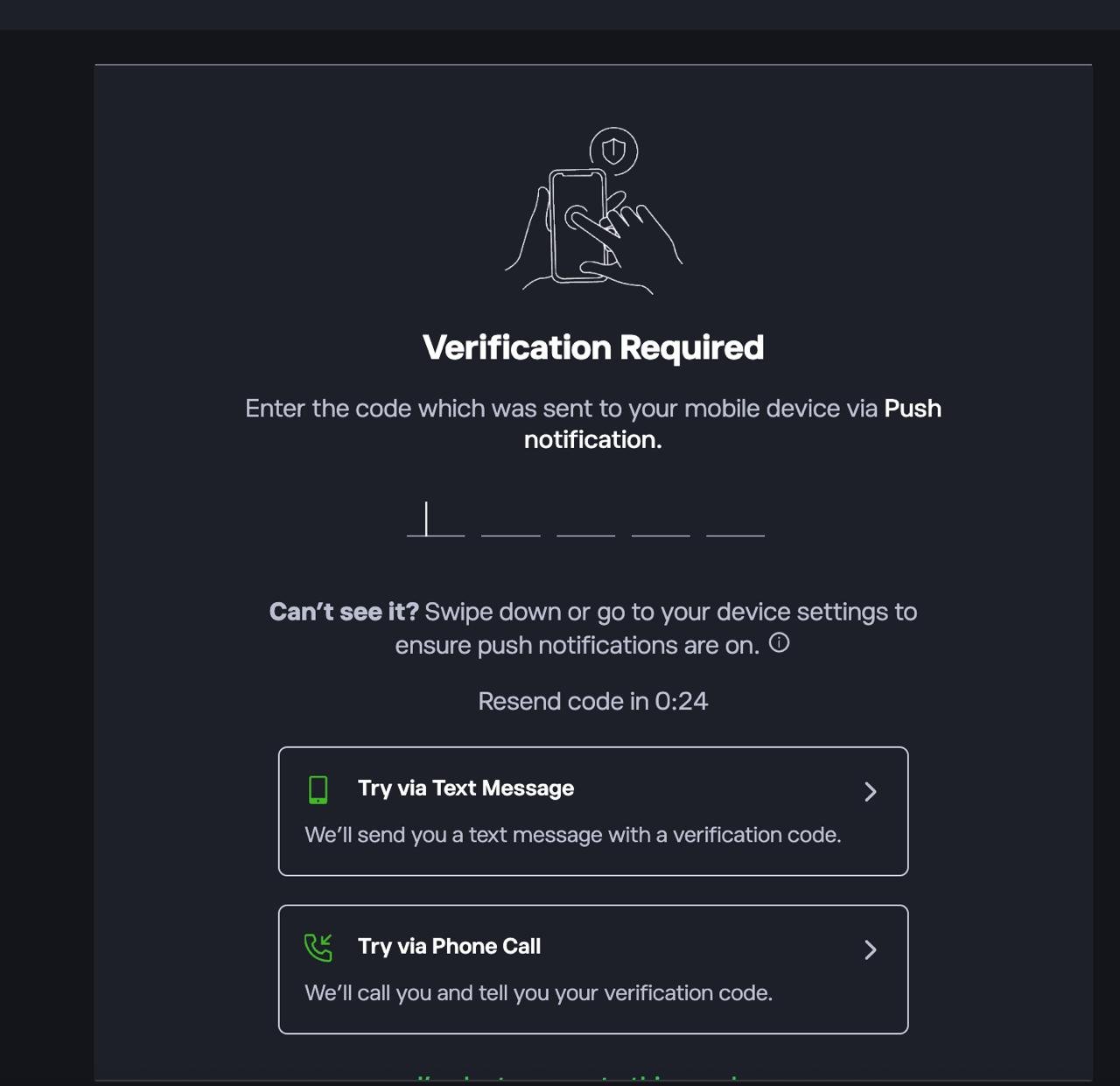
1. Log in to the platform
If prompted, complete 2FA by entering the code sent via push notification, SMS, or phone call.
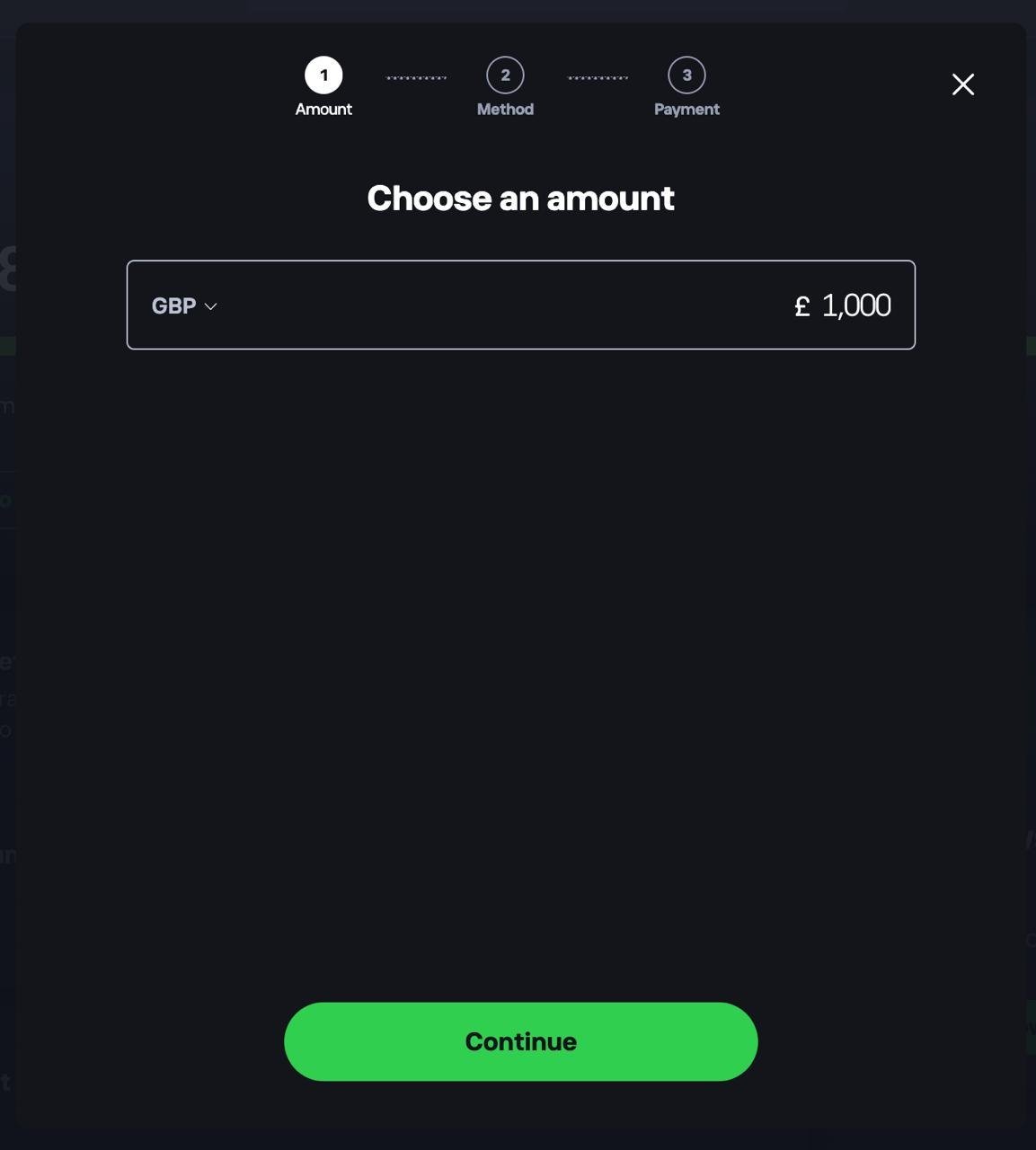
2. Deposit funds into your account
Head to your dashboard and choose to add funds. Select your currency, enter the amount you want to deposit, tap Continue, then choose a payment method.
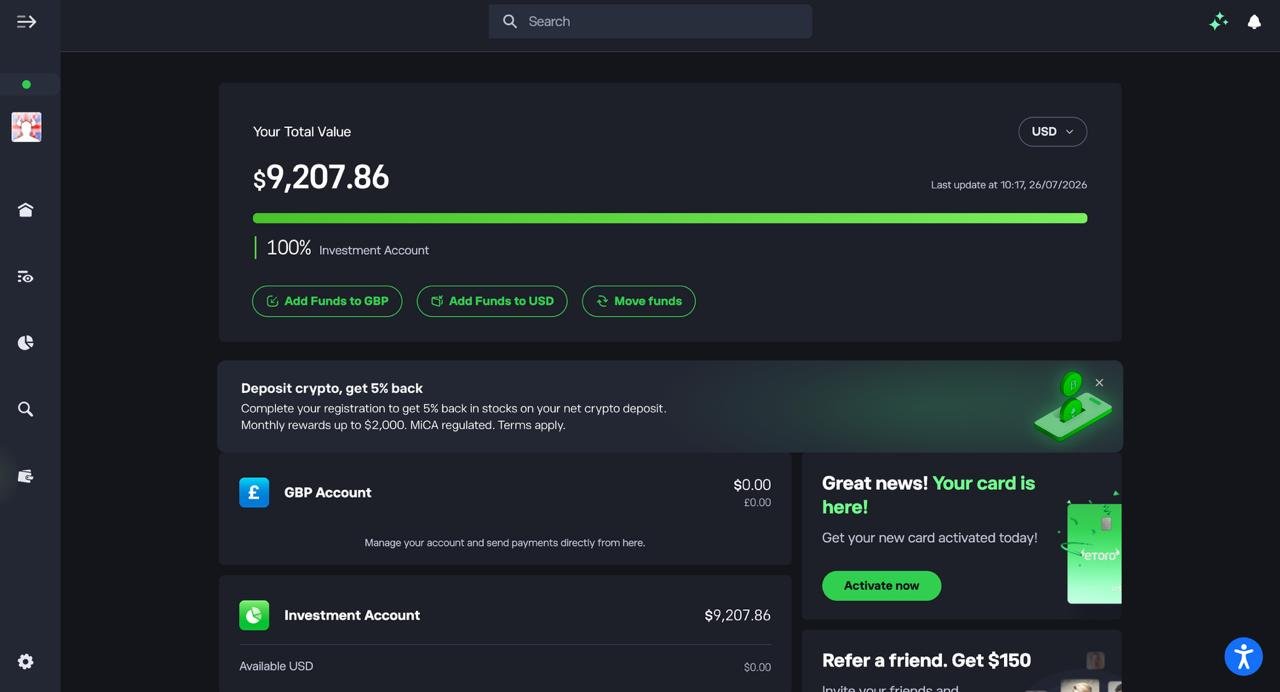
3. Confirm your funds are available
Check your dashboard to make sure your deposit has landed in your Investment Account before you start trading.
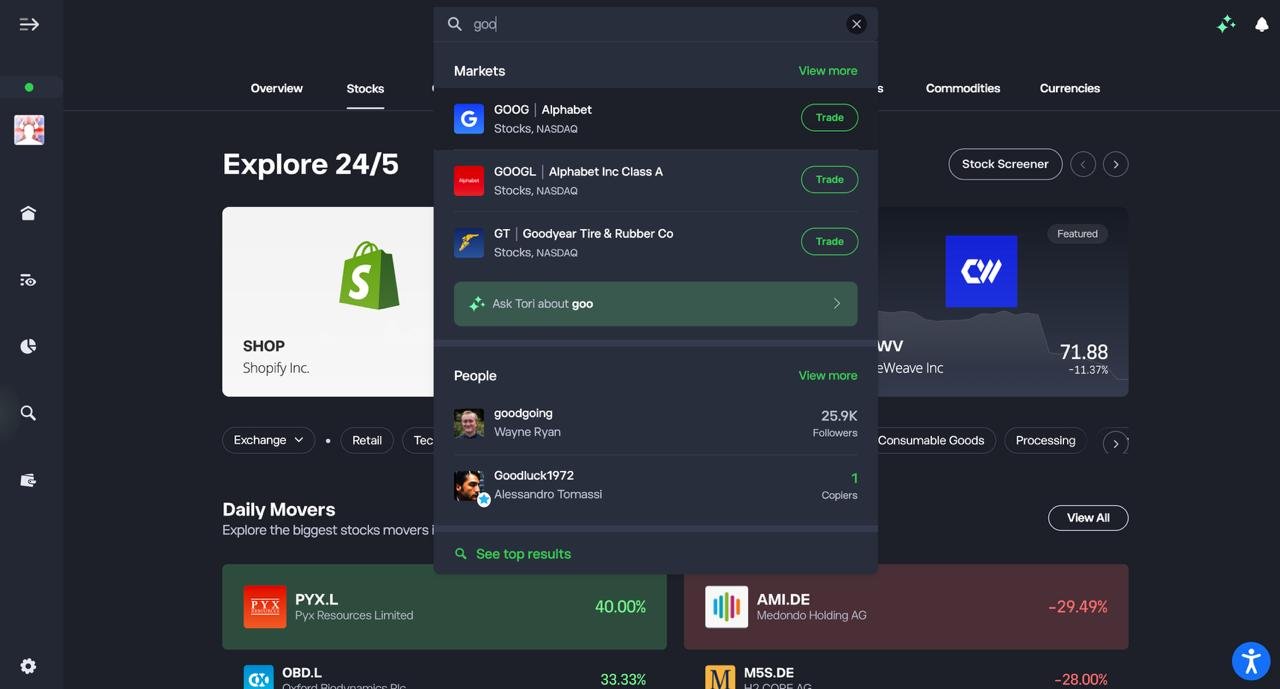
4. Search for the asset you want to trade
Use the search bar to type in the ticker or company name, then select it from the Markets results.
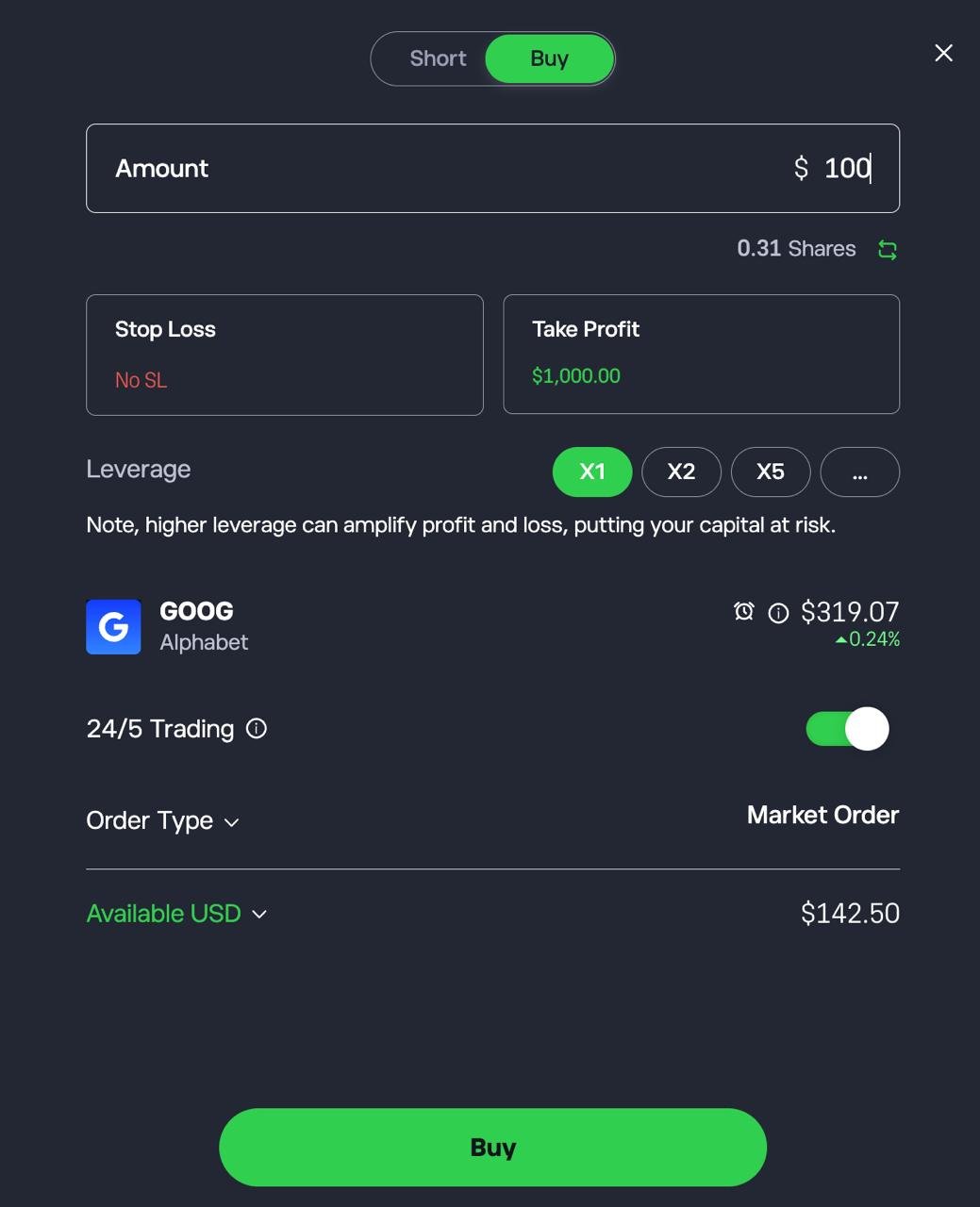
5. Set up and confirm your trade
Choose Buy or Short, enter the amount you want to invest, optionally set a Stop Loss and Take Profit, then tap Buy or Short to confirm.
How does forex trading work in Australia?
Forex trading in Australia usually means trading CFDs on currency pairs, not physically exchanging money at a bank. You speculate on whether one currency will rise or fall against another, using leverage, and profit or lose based on price movement measured in pips.
CFDs explained
Most retail forex trading in Australia is done through Contracts for Difference (CFDs). A CFD is a derivative product. You do not own the underlying currency. Instead, you enter a contract with your CFD broker to exchange the difference in price between when you open and close the trade.
If you buy AUD/USD at 0.6500 and close at 0.6550, you receive the price difference. If it falls to 0.6450, you pay the difference.
CFDs are popular because they allow:
- Leverage
- Short selling
- Small trade sizes
- Access to global markets from one account
Under rules enforced by the Australian Securities and Investments Commission (ASIC), retail forex CFDs are capped at 30:1 leverage on major currency pairs. This regulation came into effect in March 2021 to reduce excessive risk-taking.
CFDs are high-risk products. You are trading price movement, not owning assets.
Currency pairs: Base vs quote
Currencies are always quoted in pairs. For example:
AUD/USD = 0.65
The first currency is the base currency.
The second currency is the quote currency.
In AUD/USD:
- AUD is the base
- USD is the quote
The price tells you how many US dollars are needed to buy 1 Australian dollar. At 0.65, one AUD equals 0.65 USD.
If you believe the Australian dollar will strengthen against the US dollar, you buy AUD/USD. If you believe it will weaken, you sell it.
Major pairs typically include:
- EUR/USD
- GBP/USD
- AUD/USD
- USD/JPY
These pairs usually have tighter spreads and higher liquidity than exotic currencies.
Leverage and margin
Leverage allows you to control a larger position with a smaller deposit.
If you use 30:1 leverage, a $1,000 deposit allows you to control up to $30,000 worth of currency exposure.
That sounds powerful. It is. It is also dangerous.
Because currencies move in small increments, leverage magnifies both gains and losses. A 1 percent move against you on a fully leveraged position can wipe out a large portion of your capital.
ASIC rules require:
- Maximum 30:1 leverage on major pairs
- Margin call at 50 percent
- Stop-out at 20 percent
- Negative balance protection
Negative balance protection means you cannot lose more than your deposited funds as a retail client.
Margin is simply the portion of your funds set aside to maintain the trade. If your account equity drops below required levels, positions are automatically closed.
Long vs short positions
Forex trading is directional.
You can:
- Go long if you expect the base currency to rise.
- Go short if you expect it to fall.
Unlike traditional investing, you are not limited to buying first. Selling is just as straightforward.
Example:
- Buy EUR/USD at 1.1000 → profit if it rises.
- Sell EUR/USD at 1.1000 → profit if it falls.
Because forex trades two currencies simultaneously, every trade is effectively both a buy and a sell.
What is a pip?
A pip is the standard unit of price movement in forex.
For most currency pairs, one pip equals 0.0001.
If EUR/USD moves from 1.1000 to 1.1001, that is a one-pip move.
For JPY pairs, a pip is typically 0.01.
Pip value depends on:
- Trade size
- Currency pair
- Account currency
For a standard lot of 100,000 units, one pip in a major pair is often worth around USD $10. Micro lots of 1,000 units reduce that exposure significantly, making them more suitable for beginners.
Understanding pip value is critical. It determines how much money you actually gain or lose per price movement.
What leverage can forex brokers offer in Australia?
Retail forex leverage in Australia is capped at 30:1 on major currency pairs, with lower limits on more volatile assets. These restrictions were introduced in March 2021 by the Australian Securities and Investments Commission to reduce retail trading losses and align Australia more closely with European standards.
Leverage limits apply to all ASIC-regulated CFD brokers offering products to retail clients.
ASIC retail leverage limits
Under current ASIC product intervention rules, maximum leverage for retail clients is:
| Asset Class | Maximum Leverage | Margin Required |
|---|---|---|
| Major forex pairs | 30:1 | 3.33% |
| Minor forex pairs | 20:1 | 5% |
| Gold | 20:1 | 5% |
| Major indices | 20:1 | 5% |
| Other commodities | 10:1 | 10% |
| Individual shares | 5:1 | 20% |
| Crypto CFDs | 2:1 | 50% |
Major forex pairs include EUR/USD, GBP/USD, USD/JPY and AUD/USD. These are considered the most liquid and typically carry the tightest spreads.
Minor pairs, such as AUD/NZD or EUR/GBP, are slightly less liquid and therefore capped at 20:1.
Crypto CFDs are capped at 2:1 due to their extreme volatility.
What does 30:1 leverage actually mean?
At 30:1 leverage, you can control $30,000 of currency exposure with just $1,000 in margin.
This is why forex is attractive. It allows traders to amplify small price movements into meaningful gains.
It is also why forex is dangerous.
A 1 percent move against a fully leveraged 30:1 position can result in a 30 percent loss of your capital. A 3.33 percent adverse move can wipe out your entire margin allocation.
ASIC also mandates:
- Margin call at 50 percent of required margin
- Automatic stop-out at 20 percent
- Negative balance protection for retail clients
Negative balance protection means you cannot lose more than your deposited funds. That safeguard did not exist in Australia before 2021.
Why high leverage is risky
Currencies rarely move 5 percent in a single day. That creates a false sense of safety.
In reality, leveraged trading magnifies small fluctuations. Events such as central bank announcements, geopolitical shocks or surprise inflation data can trigger sharp price swings in seconds.
Professional traders treat leverage as a tool. Many retail traders treat it as opportunity.
The difference is discipline.
Higher leverage increases:
- Volatility of account equity
- Probability of forced liquidation
- Emotional decision-making
Retail vs professional leverage
ASIC-regulated brokers may offer higher leverage to clients classified as wholesale or professional investors.
To qualify, you generally must meet at least one of the following criteria:
- Net assets of AUD $2.5 million
- Gross income of AUD $250,000 per year for the past two years
- Certification from a qualified accountant
Professional clients can access leverage above 30:1, sometimes up to 400:1, depending on the broker.
However, this comes at a cost.
Professional classification removes:
- Negative balance protection
- Certain disclosure protections
- Access to retail dispute mechanisms in some cases
In other words, you gain leverage but lose safeguards.
What features should you look for in the best forex trading platforms in Australia?
The best forex trading platforms in Australia combine strong regulation, competitive pricing, fast execution and reliable platform performance. Marketing claims mean little. Structure, cost and risk controls matter far more over time.
ASIC regulation and client protection
Always choose a broker licensed by the Australian Securities and Investments Commission.
ASIC requires:
- Segregated client funds
- Negative balance protection
- 30:1 leverage cap on major pairs
- Margin call at 50 percent
- Stop-out at 20 percent
Regulation does not remove trading risk, but it reduces counterparty risk.
Spreads and commissions
Forex costs come from spreads, commissions and overnight financing.
Two common models:
| Account Type | EUR/USD Typical Spread | Commission | Best For |
|---|---|---|---|
| Standard | 0.8–1.4 pips | None | Casual traders |
| Raw/ECN | 0.0–0.3 pips | $6–$7 round turn | Active traders |
Focus on average spreads, not headline “from” numbers.
Execution speed
Execution quality affects profitability, especially in volatile markets.
Look for:
- Fast order execution
- Minimal slippage
- No excessive requotes
- Transparent execution policies
Poor execution can cost more than slightly wider spreads.
Trading platform quality
Your platform should be stable, intuitive and fully featured.
Most brokers offer:
- MetaTrader 4 or 5
- cTrader
- Proprietary web platforms
Key features include advanced charting, stop-loss tools, mobile access and a demo trading account. If the platform feels clunky, it will affect decision-making.
Risk management tools
A serious broker provides:
- Stop-loss and take-profit orders
- Trailing stops
- Margin monitoring
- Optional guaranteed stop-loss orders
Risk tools are essential in leveraged markets.
Deposits, withdrawals and base currency
Look for:
- AUD base accounts
- Bank transfer, BPAY, card or PayID support
- No withdrawal friction
- Clear fee disclosures
Fast withdrawals and transparent pricing are non-negotiable.
What is the best time of day to trade forex from Australia?
The best time to trade forex from Australia is during the London session and the London–New York overlap, when global liquidity is highest and spreads are typically tightest. For Australian traders, this usually means late afternoon to midnight AEST.
Forex trades 24 hours a day, but volume is concentrated around major financial centres.
London session
The London session runs roughly from 3:00pm to 12:00am AEST, depending on daylight saving.
This is when:
- European banks are active
- EUR and GBP pairs see strong volume
- Breakouts and trend moves often develop
London accounts for the largest share of global FX turnover, making it the most consistently liquid session.
New York session
The New York session runs approximately 10:00pm to 7:00am AEST.
During this window:
- US economic data is released
- USD pairs become highly active
- Volatility increases around major announcements
The overlap between London and New York, roughly 10:00pm to 12:00am AEST, is typically the most active period of the day.
Liquidity vs volatility
Liquidity means tighter spreads and smoother execution. Volatility means larger price swings.
The London and New York sessions provide both. Thin Asian-session markets can produce wider spreads and less reliable moves, especially outside JPY pairs.
What affects the AUD/USD exchange rate?
The AUD/USD exchange rate is mainly driven by interest rate differences between Australia and the US, commodity prices, Chinese economic demand and Australia’s trade balance. When Australia’s outlook strengthens relative to the US, the AUD tends to rise. When the US has the advantage, the pair usually falls.
RBA interest rates
Policy decisions from the Reserve Bank of Australia directly influence the Australian dollar.
If the RBA raises rates:
- Australian bond yields increase
- The AUD becomes more attractive
- AUD/USD often strengthens
If rates are cut, the currency typically weakens. Markets also react to forward guidance, not just actual decisions.
US Federal Reserve policy
The Federal Reserve controls the other side of the pair.
If US interest rates rise faster than Australia’s, the USD strengthens and AUD/USD usually falls. The interest rate differential between the two countries is often the dominant medium-term driver.
Commodity prices
Australia is a major exporter of iron ore, coal and LNG. Rising commodity prices improve export revenues and often support the AUD. Iron ore, in particular, has a strong historical relationship with AUD movements.
The Chinese economy
China is Australia’s largest trading partner. Strong Chinese industrial demand supports Australian exports and the AUD. Economic slowdowns in China tend to weigh on the currency.
Trade balance
A trade surplus supports the AUD because foreign buyers must purchase Australian dollars to pay for exports. A shrinking surplus or deficit can pressure the currency.
How do we test Australian forex brokers?
We test Australian forex brokers by analysing regulation, pricing, execution, platform stability and withdrawal reliability under real trading conditions. The focus is on what directly affects Australian traders, not marketing claims.
Regulation
We verify each broker holds an Australian Financial Services Licence issued by the Australian Securities and Investments Commission and complies with retail leverage caps, client fund segregation and negative balance protection rules.
Pricing
We compare:
- Average spreads on major pairs
- Commission structure
- Swap rates
- Inactivity and withdrawal fees
We assess real trading costs during active sessions, not promotional “from” spreads.
Execution and platform
We evaluate:
- Order speed and slippage
- Platform reliability on desktop and mobile
- Charting tools and risk controls
- Demo account availability
Funding
We test deposits and withdrawals for speed, transparency and AUD support.
Conclusion
The best forex broker in Australia depends on how you trade, but a few platforms consistently stand out. Pepperstone is a strong choice for active traders who want tight raw spreads and fast execution.
IG remains one of the most well-rounded options, with a powerful proprietary platform, strong research tools and guaranteed stop-loss availability.
Interactive Brokers suits experienced, high-volume traders looking for institutional-style pricing, while CMC Markets appeals to those who value advanced charting and a broad forex pair selection.
FAQs
Is forex trading legal in Australia?
Yes. Forex trading is legal in Australia and regulated by the Australian Securities and Investments Commission. Retail brokers must hold an Australian Financial Services Licence and comply with leverage caps, client fund segregation and negative balance protection rules.
What is the maximum leverage for forex trading in Australia?
Retail clients are capped at 30:1 leverage on major currency pairs, 20:1 on minor pairs and 2:1 on crypto CFDs. These limits were introduced in 2021 to reduce excessive risk.
Can I trade forex with $100 in Australia?
Yes, many brokers allow minimum deposits of around $100 and offer micro lots of 1,000 units. However, small accounts combined with leverage carry high risk and limited margin for error.
Do I pay tax on forex trading profits in Australia?
Yes. Forex trading profits must be reported to the Australian Taxation Office. Depending on your circumstances, gains may be treated as income or capital gains. Losses may also be deductible. A registered tax professional should confirm your situation.
How do I check if a forex broker is ASIC-regulated?
You can verify a broker’s licence number directly on the ASIC Professional Registers website. Always confirm the AFSL number and legal entity before opening an account.
What is the best forex trading app in Australia?
The best forex trading app in Australia is Pepperstone for active traders due to its tight spreads, fast execution, and support for MT4, MT5, and cTrader. For a simpler, mobile-first experience, eToro is a strong alternative with an easy app and copy trading features.
What is the best forex trading platform in Australia for beginners?
The best forex trading platform in Australia for beginners is eToro, as it offers a simple interface, copy trading tools, and low barriers to entry. IG is another strong option for beginners who want more education, research tools, and a scalable platform as they gain experience.
