

Interactive Brokers is a globally established online broker offering Australian investors low-cost access to 90+ international markets, advanced trading platforms in Australia, and a wide range of assets from ASX shares to US stocks, options, ETFs and forex.
Regulated by ASIC and backed by a publicly listed US parent company, it is widely used by both serious long-term investors and active traders in Australia. In this Interactive Brokers Review Australia 2026, we assess fees, safety, platforms, and usability to determine whether it is genuinely worth using for Australian investors today.
Quick verdict: How do we rate Interactive Brokers for users in Australia in 2026?
Interactive Brokers is best for cost-conscious investors and active traders who value international diversification and advanced tools.
It is less suitable for users who want a simple, CHESS-sponsored, buy-and-hold platform with minimal learning curve. Overall, it delivers excellent value if you’re prepared to spend time learning the platform.
Overall Rating: 4.4 / 5
Australia ratings breakdown
| Category | Score | Summary |
|---|---|---|
| Security & Trust | 4.5 / 5 | ASIC-regulated Australian entity with client funds held in segregated trust accounts. Backed by a large, publicly listed global parent company. Not a bank, so cash is not covered by the government deposit guarantee. |
| Fees & Pricing | 4.6 / 5 | Highly competitive pricing. ASX shares from 0.08% (min AU$6), US shares from US$0.005 per share, and very low FX conversion fees. One free withdrawal per month, then AU$15 + GST. |
| Features | 4.8 / 5 | Exceptional asset range across 90+ markets, including shares, ETFs, options, futures, forex trading, CFDs (eligibility applies), fractional shares, recurring investments, and advanced analysis tools. |
| Ease of Use | 3.9 / 5 | Powerful but complex. Multiple platforms (Client Portal, IBKR Desktop, TWS, mobile apps) can feel overwhelming at first, though IBKR Desktop is more beginner-friendly than TWS. |
| Customer Support | 4.1 / 5 | Email, live chat and phone support available, with Australian-time phone coverage on weekdays. Support is capable but not as streamlined as simpler local brokers. |
| Reputation | 4.4 / 5 | Well-established global broker with a strong reputation for low costs, deep market access and professional-grade tools, especially among serious investors and traders. |
Key info table: What does Interactive Brokers offer in Australia?
| Category | Details |
|---|---|
| Best for | Mixed investing and trading across Australian and global markets |
| Assets offered | Shares, ETFs, options, futures, CFDs, forex, bonds, spot crypto (via approved partners) |
| Real assets vs CFDs | Both, with cash securities and CFDs clearly separated |
| Stock & ETF fees | ASX shares 0.08% per trade (min AU$6) on fixed pricing. US shares from US$0.005 per share (min US$1) |
| Derivatives pricing | Options and futures charged per contract. Forex uses tight spreads plus low commission |
| Minimum deposit | AU$0 to open a cash account |
| Account types | Cash and margin accounts. Individual, joint, trust and SMSF supported |
| Platforms | Web (Client Portal), desktop (IBKR Desktop, Trader Workstation), mobile (IBKR Mobile, GlobalTrader) |
| Regulation | ASIC (Australia). Also regulated globally by SEC, FCA, MAS and others |
| Investor protection | No Australian compensation scheme. US-held securities may be covered by SIPC up to US$500,000 (limits apply) |
| Fund segregation | Yes. Client funds held in segregated trust accounts |
| Customer support | Email and secure messaging 24/7. Phone support Mon–Fri 9:30am–7:0b0pm AEST. Live chat via account |
| Not suitable for | Investors wanting a simple, CHESS-sponsored, single-asset platform |
Who should use Interactive Brokers and who should avoid it?
Interactive Brokers is best suited to Australians who want low-cost access to global markets and are comfortable using feature-rich trading platforms.
It offers strong value for multi-asset investors and active traders, but its complexity means it is not ideal for everyone.
Good fit if
- You want international diversification: You plan to invest beyond the ASX into US, European or Asian shares and ETFs, with access to 90+ exchanges from a single account.
- You are fee-sensitive and trade regularly: You benefit from low brokerage (ASX shares from 0.08% with AU$6 minimum, US shares from US$0.005 per share) and very low FX conversion fees (~0.0022%), especially when trading overseas.
- You are an intermediate or advanced investor: You’re comfortable learning platforms like IBKR Desktop or Trader Workstation (TWS) and want advanced order types, portfolio analytics, options chains, futures, and forex tools.
- You invest across multiple asset classes: You want access to shares, ETFs, options, futures, forex, bonds, CFDs and spot crypto (via approved providers), with clear separation between cash securities and derivatives.
- You use an SMSF or trust structure: You need support for SMSFs, joint or trust accounts, and value detailed reporting and global asset coverage for larger or more complex portfolios.
Avoid if
- You are a complete beginner wanting simplicity: You prefer a very simple, trading app with minimal settings, no platform choice, and straightforward flat fees.
- You only want ASX shares with CHESS sponsorship: Interactive Brokers uses a custodian model for ASX holdings rather than individual CHESS HINs, which may not suit investors who strongly prefer direct CHESS sponsorship.
- You trade infrequently with small amounts: Fixed minimums (for example AU$6 on ASX trades and a US$2.20 minimum FX conversion) can be less efficient if you make very small or occasional trades.
- You want hand-holding customer support: Support is professional but mostly digital, and not as personalised or locally focused as some Australian bank-owned or beginner-oriented brokers.
- You only need one simple asset type: If your goal is simply investing in ETFs or a small number of Australian shares, the platform’s depth and choice may be unnecessary.
Is Interactive Brokers suitable for beginners?
Interactive Brokers can work for beginners, but it is better suited to those learning how to invest who want to grow into a more advanced platform. It offers strong education, demo trading, and beginner-accessible interfaces, but overall complexity is higher than most beginner-first Australian brokers.
Ease of onboarding
Account opening is fully online with no minimum deposit for cash accounts, though the process is more detailed than local apps and usually takes 1–2 business days due to additional compliance checks.
Interface simplicity
Beginners have several entry points:
- Client Portal (web) and IBKR GlobalTrader (mobile) are the simplest starting options
- IBKR Desktop is powerful but manageable with time
- Trader Workstation (TWS) is best left to experienced users
The flexibility is useful, but the number of platforms can feel overwhelming at first.
Demo accounts and education
Interactive Brokers offers a free demo account with simulated funds, allowing beginners to practise without risk. Its IBKR Campus provides courses, videos, webinars, and written guides covering investing basics, products, and risk management.
Risk controls
Beginners default to cash accounts, which prevents margin use and limits losses to deposited funds. Clear risk warnings apply to derivatives, CFDs, and leveraged products.
Comparison to beginner-first platforms
Compared with beginner-first platforms, Interactive Brokers is cheaper for global investing and far more powerful, but less simple, and requires more self-direction.
What are the pros and cons of using Interactive Brokers in Australia?
Interactive Brokers offers Australian investors exceptional global access and low fees, but this comes with added complexity compared to local, beginner-first platforms. The table below summarises the main advantages and drawbacks for users in Australia.
Pros and cons
- ASIC-regulated Australian entity
- Access to 90+ global markets including ASX, NASDAQ, NYSE, LSE, Euronext and HKEX
- Very low brokerage fees. ASX shares from 0.08% (min AU$6), US shares from US$0.005 per share
- Extremely low FX conversion costs around 0.0022% (min US$2.20)
- Wide asset coverage: shares, ETFs, options, futures, forex, bonds, CFDs and spot crypto (via partners)
- Advanced trading platforms (IBKR Desktop, Trader Workstation) with sophisticated order types
- Fractional shares and recurring investments support dollar-cost averaging
- Free demo account and strong education via IBKR Campus
- No inactivity fees and no minimum deposit for cash accounts
- Not CHESS-sponsored for ASX shares. Uses a custodian model, which may not suit investors who want their own HIN
- Steep learning curve due to multiple platforms and professional-grade tools
- Complex fee structure across asset classes, regions and pricing tiers
- Minimum FX fee can be inefficient for small, frequent currency conversions
- Overkill for simple investors who only want to buy and hold a few Australian ETFs
- Trader Workstation is not beginner-friendly and can feel dated or overwhelming
- One free withdrawal per month, then AU$15 + GST per withdrawal
- Customer support is mostly online, with limited local, hands-on assistance
- Not a bank, so cash balances are not covered by the Australian government deposit guarantee
How regulated and trustworthy is Interactive Brokers in Australia?
Interactive Brokers is considered highly trustworthy in Australia because the local entity holds an Australian Financial Services Licence (AFSL) and is regulated by ASIC, while the broader group is a long-established, publicly listed global broker. Client money is held in segregated trust accounts, and the firm has decades of operating history, which adds credibility for Australian investors using it for global markets.
Local regulator and licence status (Australia)
- Regulator: Australian Securities and Investments Commission (ASIC)
- Licence status: Authorised to provide financial services in Australia via an AFSL (Interactive Brokers Australia Pty Ltd, AFSL 453554)
- External dispute resolution: Member of the Australian Financial Complaints Authority (AFCA)
Years in operation and track record
- Interactive Brokers has over 40 years of operating history, with roots dating back to 1977
- Interactive Brokers has operated in Australia since the 1990s, including establishing an office in Australia in 1997.
Parent company and listing status
- Parent group: Interactive Brokers Group, Inc.
- Public listing: NASDAQ-listed (ticker: IBKR)
- Interactive Brokers operates at global scale, with millions of client accounts and high daily trade volumes
Regulation snapshot (Australia)
| Item | Details |
|---|---|
| Local entity | Interactive Brokers Australia Pty Ltd |
| Primary regulator | ASIC |
| Licence status | AFSL holder (authorised) |
| AFSL number | 453554 |
| Complaints body | AFCA member |
| Client fund segregation | Yes (client money held in trust accounts) |
| Bank deposit guarantee | No (broker, not a bank) |
| Parent company | Interactive Brokers Group, Inc. |
| Listing | Publicly listed (NASDAQ: IBKR) |
| Operating history | Operating history Decades-long, with roots dating back to 1977 and extensive global operations |
What assets can you trade on Interactive Brokers as a user in Australia?
Interactive Brokers gives Australian users access to one of the broadest asset ranges on the market, including shares and ETFs across 90+ exchanges, plus options, futures, forex, bonds and CFDs (eligibility applies). Crypto access exists but is more restricted and often delivered via approved third-party providers or through crypto-linked products rather than a full “crypto exchange” experience.
Shares and ETFs (Australia and global)
Interactive Brokers is strongest for global shares and ETFs. From Australia you can invest on the ASX plus major overseas exchanges such as NASDAQ, NYSE, AMEX, LSE, Euronext and HKEX, with access often described as 90+ markets from one account. It also supports fractional shares on eligible US, European and some Canadian listings, which helps Australians invest smaller amounts into expensive US stocks.
Derivatives (options, futures, CFDs)
If you want derivatives, IBKR is one of the few platforms in Australia that offers deep coverage:
- Options (equity and index options depending on market access)
- Futures (including global futures venues)
- CFDs (including share and index CFDs; access depends on your eligibility, approvals, and regulatory limits)
This is a key reason IBKR is popular with advanced traders, but it also increases platform complexity.
Forex (currency trading + conversions)
IBKR offers:
- 100+ forex pairs across 24 currencies
- Very low FX conversion pricing for investors converting AUD to USD/EUR etc. (commission-based, with a minimum fee), which is particularly relevant for Australians buying US shares and ETFs. If you’re comparing dedicated forex brokers in Australia, see our full guide.
Bonds and fixed income
Interactive Brokers supports bonds (including government and corporate fixed income instruments) as part of its multi-asset offering. This matters for Australians building diversified portfolios beyond shares and ETFs.
Crypto (and Australia-specific restrictions)
Crypto exposure via IBKR is possible in a few ways:
- Crypto access is offered through approved custodial partners, with availability varying by account setup and region.
- Bitcoin futures and other exchange-traded crypto-linked products may also be available depending on permissions and your IBKR entity
Important: In Australia, crypto availability can depend on regulatory requirements, your account approvals, and the specific IBKR entity you’re onboarded to. Check the assets enabled inside Client Portal before funding your account if crypto is a key requirement, or consider a dedicated crypto exchange for more direct access.
What you may not get (or may be limited)
Interactive Brokers is comprehensive, but Australians should be aware of common gaps or limits:
- No MetaTrader (MT4/MT5) or cTrader (IBKR uses proprietary platforms)
- Some products may be restricted by eligibility, experience level, or regulatory rules (especially leveraged products, certain funds, or crypto features)
Asset coverage table (Australia)
| Asset type | Available to Australian users | Notes |
|---|---|---|
| ASX shares | Yes | Access via IBKR using a custodian model rather than an individual CHESS HIN |
| Global shares | Yes | Access to 90+ markets including the US, UK, Europe and Asia |
| ETFs | Yes | Australian and international ETFs supported |
| Fractional shares | Yes | Available on eligible US, European and some Canadian listings |
| Options | Yes | Broad global coverage; approvals and experience checks apply |
| Futures | Yes | Access to major global futures venues |
| CFDs | Yes (eligibility applies) | Share and index CFDs available depending on client classification |
| Forex (FX trading) | Yes | 100+ currency pairs plus low-cost FX conversion |
| Bonds and fixed income | Yes | Government and corporate bonds available |
| Crypto | Limited/conditional | Availability depends on IBKR entity, approvals and Australian regulations |
| Managed funds / mutual funds | Limited/conditional | Access varies by region and eligibility |
| Australian options | Limited | Not a core strength compared with global derivatives |
How much does Interactive Brokers cost in Australia?
Interactive Brokers is one of the lowest-cost global brokers available to Australian investors, using a transparent commission-based pricing model rather than marked-up spreads. Costs are generally very competitive, especially for international investing, but can feel complex due to different fee structures by asset and region. All figures below are shown in Australian dollars (AUD) unless stated otherwise.
Trading fees (shares, ETFs, and derivatives)
Interactive Brokers offers fixed and tiered pricing. Most Australian retail investors use fixed pricing.
- ASX shares & ETFs: 0.08% per trade, minimum AU$6 (fixed pricing)
- US shares & ETFs: US$0.005 per share, minimum US$1, maximum 1% of trade value
- Options: From AU$2.00 per contract (fixed) or lower on tiered pricing plus exchange fees
- Futures: From AU$5 per contract (fixed pricing)
- CFDs: Commission-based pricing, e.g. Australian share CFDs from 0.05% (min AU$5), with lower rates at higher volumes
Spreads and commissions
Interactive Brokers does not add artificial spreads to most products. Instead:
- Shares, ETFs, options and futures use explicit commissions
- Forex uses raw interbank spreads plus a small commission
FX and currency conversion fees
For Australians investing internationally, FX pricing is a major strength:
- FX conversion fee: ~0.0022%, minimum US$2.20
- No hidden FX spread markup
This is significantly cheaper than most Australian brokers and banks, but the minimum fee can be inefficient for very small, frequent conversions.
Non-trading fees
- Account minimum: AU$0
- Inactivity fee: None
- Deposits: Free (bank transfer / BPAY)
- Withdrawals: 1 free withdrawal per month, then AU$15 + GST per withdrawal
- Asset transfer out: Minimum AU$50
- Market data: Some real-time data feeds may require optional subscriptions
Typical fees table (Australia)
| Fee type | Cost |
|---|---|
| ASX shares & ETFs | 0.08% per trade (min AU$6) |
| US shares & ETFs | US$0.005 per share (min US$1) |
| Options | From AU$2 per contract |
| Futures | From AU$5 per contract |
| FX conversion | ~0.0022% (min US$2.20) |
| Account fee | AU$0 |
| Inactivity fee | None |
| Deposit fee | AU$0 |
| Withdrawal fee | 1 free per month, then AU$15 + GST |
How good is Interactive Brokers’ web app for users?
Interactive Brokers’ web app is adequate for casual trading, portfolio monitoring, and account management, especially for investors who want browser-based access without installing software. However, it is not where IBKR shines.
Australians who want advanced charting, deep customisation, or complex order strategies will get far more value from IBKR Desktop or Trader Workstation, using the web app mainly as a supporting tool rather than a primary trading platform.
Usability
The Client Portal is web-based and requires no download, making it accessible from any browser. Navigation is logical once you’re familiar with IBKR’s ecosystem, but first-time users may find menus dense and terminology technical. For simple actions like buying ASX or US shares, checking balances, or managing funding, it performs well. However, it is less intuitive than beginner-first web platforms offered by some Australian brokers.
Charting
Charting in the web app is functional but basic:
- Standard price charts with common timeframes
- Limited technical indicators compared with IBKR Desktop or TWS
- Suitable for quick price checks, not deep technical analysis
Investors who rely heavily on chart-based decision-making will likely find the web charts restrictive.
Order types
The Client Portal supports core order functionality, including:
- Market and limit orders
- Stop and stop-limit orders
- Basic time-in-force settings
That said, many of Interactive Brokers’ advanced order types and algorithms (one of its key strengths) are not fully available in the web app and require IBKR Desktop or Trader Workstation.
Customisation
Customisation options are limited compared with IBKR’s desktop platforms:
- Watchlists can be created and edited
- Layouts and dashboards are largely fixed
- No deep workspace or multi-panel customisation
This makes the web app better suited to monitoring and execution rather than full portfolio analysis or strategy building.
Known limitations
Australian users should be aware of several practical constraints:
- Fewer charting tools and indicators than desktop platforms
- Reduced access to advanced order types and trading algorithms
- Interface can feel dated and less responsive than modern trading web apps
- Not ideal for active traders or derivatives-heavy strategies
How good is Interactive Brokers’ desktop app for users?
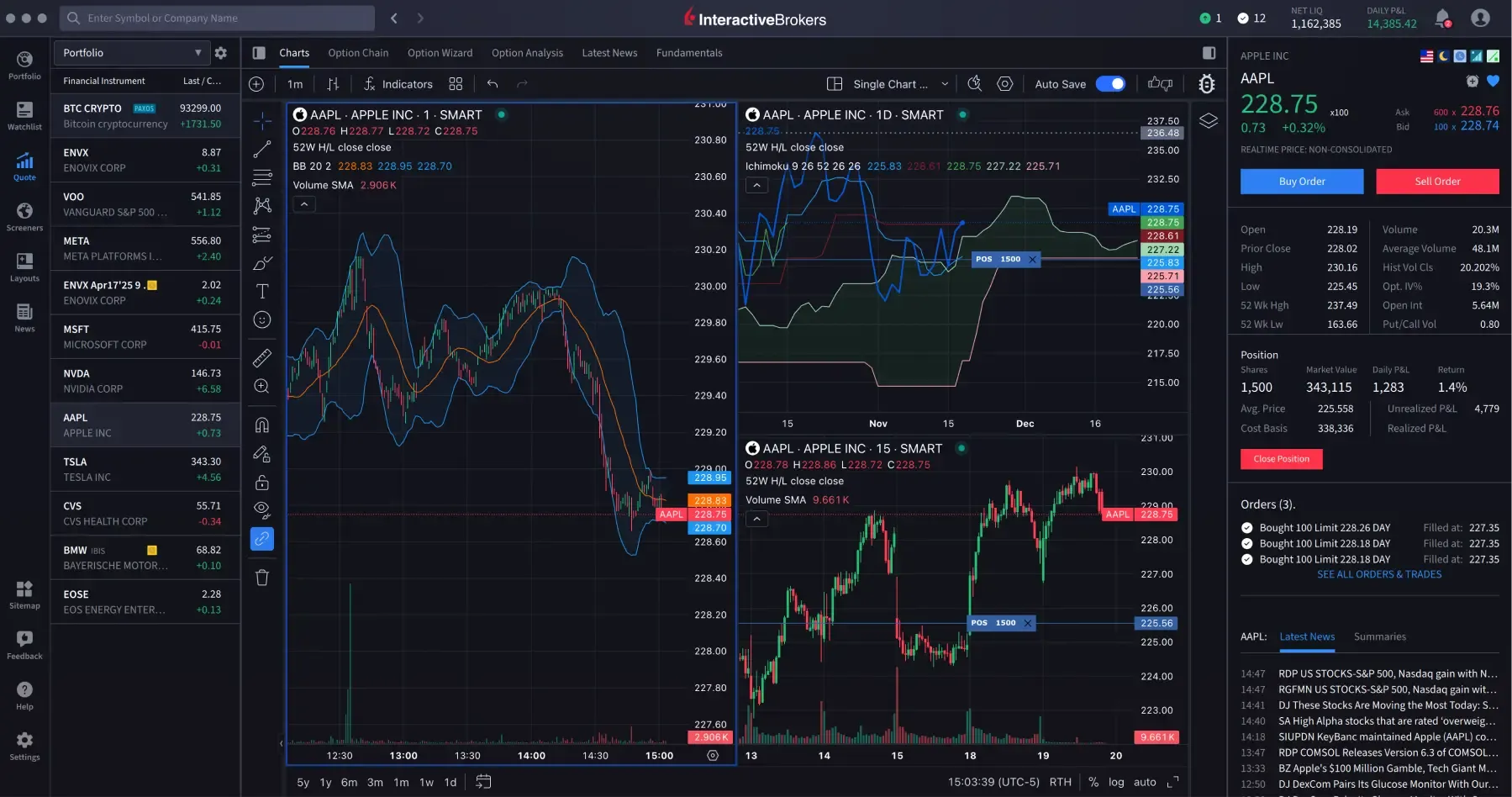
Interactive Brokers’ desktop app, IBKR Desktop, is one of the strongest desktop trading platforms available to Australian investors, especially those who want advanced tools without the steep learning curve of Trader Workstation (TWS). It combines professional-grade functionality with a more modern, approachable interface, making it suitable for intermediate investors and active traders.
Usability
IBKR Desktop is significantly more user-friendly than the older TWS platform. The layout is clean, responsive, and modular, allowing users to navigate portfolios, charts, news, and order tickets without constant menu digging. While beginners may still find it complex at first, it’s far more intuitive than traditional professional terminals and well-suited to users upgrading from simpler platforms.
Charting
Charting is a standout feature:
- Multiple chart types and timeframes
- A wide range of technical indicators and drawing tools
- Ability to view charts, fundamentals, and news side by side
The charting experience is often compared favourably to TradingView-style layouts, making it suitable for both technical and mixed-strategy investors.
Order types
IBKR Desktop supports a very broad range of order types, including:
- Market, limit, stop, and stop-limit orders
- Trailing stops and conditional orders
- Advanced time-in-force options
While some ultra-specialised algorithms still live exclusively in Trader Workstation, IBKR Desktop covers the needs of most active retail traders.
Customisation
Customisation is a major strength:
- Fully adjustable layouts and panels
- Custom watchlists and screeners
- Ability to save workspace setups
This flexibility allows Australian users to tailor the platform to different strategies, such as long-term investing, options trading, or active share trading.
Known limitations
Despite its strengths, there are a few drawbacks:
- Still more complex than beginner-first desktop platforms
- Some legacy tools and advanced algos remain exclusive to TWS
- Requires a learning period to fully unlock its potential
How good is the Interactive Brokers mobile app in Australia?
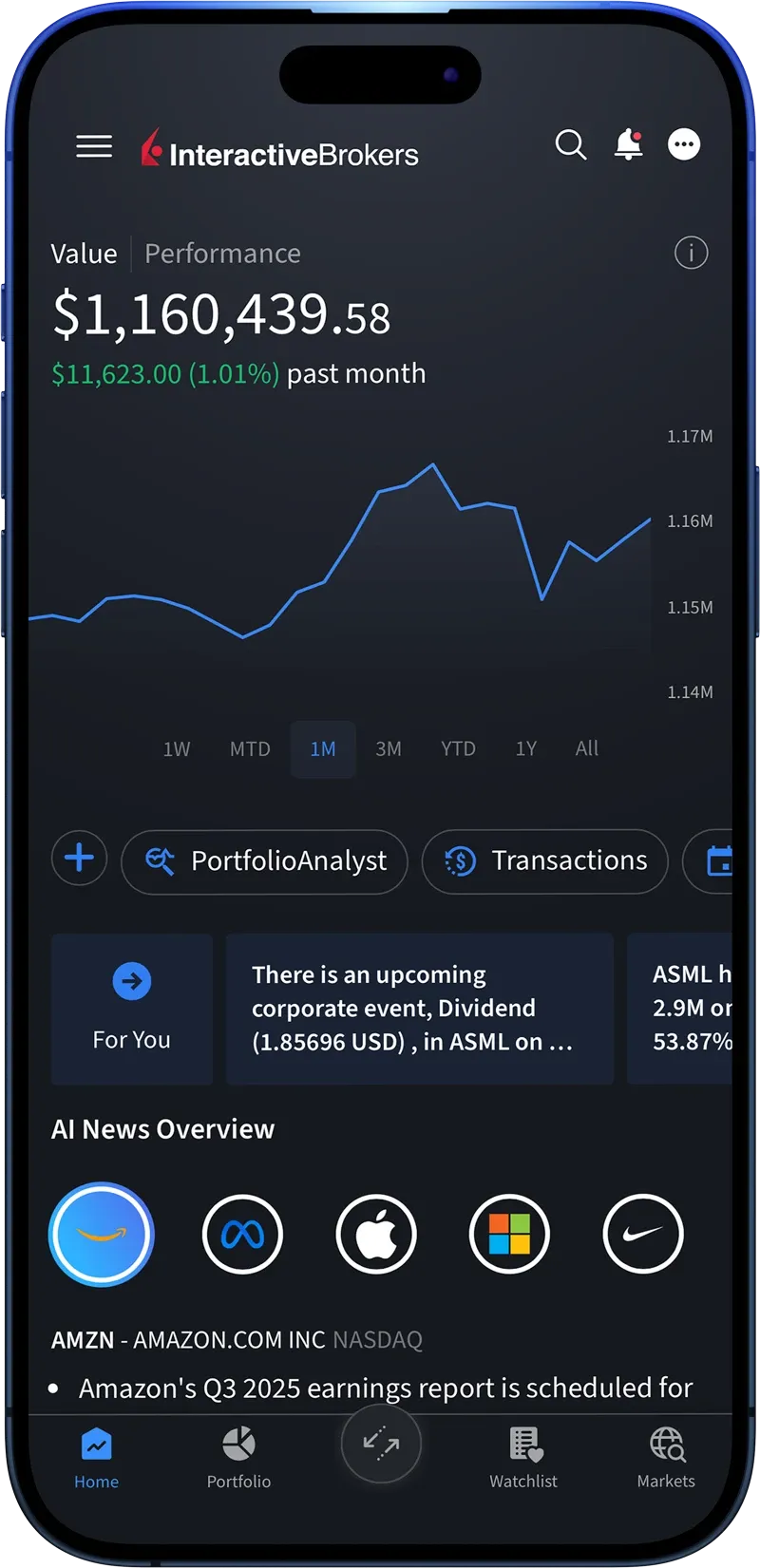
Interactive Brokers’ mobile offering is excellent for experienced investors and solid for beginners who start with IBKR GlobalTrader. It delivers far more functionality than most Australian broker apps, but that power comes with added complexity. If you want simple mobile investing, GlobalTrader works well.
If you want near-desktop-level control on your phone, IBKR Mobile is one of the strongest options available in Australia.
iOS and Android availability
Interactive Brokers provides full-featured mobile support on iOS and Android:
- IBKR GlobalTrader: simplified app designed for beginners and long-term investors
- IBKR Mobile: advanced app mirroring many desktop features for active traders
Both apps are free to download and work with Australian IBKR accounts funded in AUD.
Key features
Across the two apps, Australian users can access:
- ASX and global share trading across 90+ markets
- ETFs, options, futures, forex, and eligible crypto products
- Real-time quotes (subject to data subscriptions)
- Interactive charts and basic technical indicators
- Watchlists, alerts, and portfolio performance tracking
- Order types including market, limit, stop, and trailing orders
- FX conversion and multi-currency account management
GlobalTrader focuses on simplicity and guided flows, while IBKR Mobile exposes deeper tools such as options chains, advanced order tickets, and strategy views.
Stability and performance
The apps are considered highly stable, even during volatile market conditions. Orders execute reliably, data refresh is fast, and crashes are rare. Performance is strongest on newer devices, though older phones may feel some lag when loading charts or complex option screens.
Security features
Security is a major strength:
- Two-factor authentication (2FA) via IBKR Secure Login
- Biometric login (Face ID / fingerprint)
- Device authorisation and login alerts
- Encrypted connections and session timeouts
These measures align with IBKR’s global security standards and ASIC expectations for Australian users.
How easy is it to open an account with Interactive Brokers in Australia?
Opening an Interactive Brokers account in Australia is fully digital and secure, but more detailed than most local beginner platforms due to ASIC compliance and IBKR’s global standards. Most users complete the process in 1–2 business days if documents are ready.
Digital onboarding
The entire application is completed online via Interactive Brokers’ website or mobile apps. There is no minimum deposit for a cash account, and Australian users can choose AUD as their base currency. During signup, you’ll select your account type (individual, joint, trust, SMSF) and the products you want to trade, which affects approvals later.
KYC steps (what you’ll need)
Interactive Brokers applies strict KYC and AML checks, which typically include:
- Proof of identity (passport or Australian driver’s licence)
- Proof of address (utility bill, bank statement, or rates notice)
- Tax residency details (Australian TFN optional but recommended)
- Financial background and trading experience questionnaires
These steps are standard for ASIC-regulated brokers but more extensive than app-only platforms.
Common delays and friction points
While the process is straightforward, delays can occur due to:
- Incomplete or unclear document uploads
- Selecting complex products (options, futures, margin), which triggers extra suitability checks
- Applying for trust or SMSF accounts, which require additional documentation
- Verification queues during periods of high demand
Most standard individual cash accounts are approved within 24–48 hours, while more complex structures can take several business days.
How do deposits and withdrawals work in Australia (methods, fees, limits, speed)?
Interactive Brokers offers secure, low-cost deposits and withdrawals for Australian users, but only via bank-based methods. There are no instant card deposits, which keeps costs low but makes funding slower than app-first brokers. Overall, the system is reliable and well-suited to larger or international portfolios.
Minimum deposit and account approval speed
- Minimum deposit: AU$0 for a standard cash account
- Margin trading: Requires a higher funding level and additional approvals
- Account approval time:
- Individual cash accounts are typically approved within 24–48 hours once documents are verified
- Trust and SMSF accounts may take several business days due to extra compliance checks
There is no requirement to fund the account immediately after approval.
Deposit methods (Australia)
Australian users can fund their Interactive Brokers account using the following methods:
| Deposit method | Fee | Speed | Notes |
|---|---|---|---|
| Bank transfer (AUD) | Free | 1–2 business days | Most common method |
| BPAY | Free | 1–2 business days | Must use unique IBKR reference |
| International wire (SWIFT) | Free from IBKR | 2–5 business days | Bank fees may apply |
| Debit/credit card | Not available | – | Not supported for AU users |
| PayPal / e-wallets | Not available | – | Not supported |
All deposits must come from a bank account in your own name, in line with ASIC anti–money laundering rules.
Withdrawal methods and fees
Withdrawals are processed back to a bank account in your name using bank transfer.
| Withdrawal detail | Information |
|---|---|
| Free withdrawals | 1 per calendar month |
| Additional withdrawals | AU$15 + GST per withdrawal |
| Processing time (AUD) | 1–2 business days |
| International withdrawals | 3–5 business days (bank dependent) |
There are no percentage-based withdrawal fees, which benefits users moving larger amounts.
Limits and exceptions to note
- Withdrawals may be temporarily restricted if funds are unsettled or recently converted between currencies
- Additional verification may be required for large withdrawals
- Currency conversions occur at IBKR’s low FX rates if withdrawing in a different currency from your base account
- Asset transfers out (moving shares to another broker) incur a minimum AU$50 fee
What account types does Interactive Brokers offer users in Australia?
Interactive Brokers offers Australian users a wide range of account types, including standard individual accounts, joint and trust structures, and specialised setups like SMSFs. Most Australians can choose between a cash account (no borrowing) and a margin account (borrowing/leverage, subject to approval), with additional “professional” style features available for higher-balance or more experienced traders.
Standard accounts (Australia)
Interactive Brokers supports common Australian ownership structures, including:
- Individual accounts (most common for retail investors)
- Joint accounts (shared ownership)
- Trust accounts (for family trusts and other trust structures)
- Company/corporate accounts (for businesses)
- SMSF accounts (Self-Managed Super Funds), which is a key AU-specific offering
These accounts can generally be funded in AUD and used to access ASX and global markets from a single login.
Margin vs cash accounts
Your most important “account type” decision is whether you use cash or margin.
| Account type | Can you borrow to invest? | Best for | Key trade-offs |
|---|---|---|---|
| Cash account | No | Beginners, long-term investors, buy-and-hold portfolios | No leverage or short selling; simpler risk profile |
| Margin account | Yes (subject to approval) | Experienced traders, active investors, larger portfolios | Higher risk, interest charged on borrowed funds, stricter eligibility and monitoring |
Interactive Brokers offers relatively low margin rates versus many competitors, but Australians should still treat margin as higher risk due to leverage.
Professional or special accounts
For more complex needs, Interactive Brokers also supports structures and permissions that suit advanced users, including:
- Professional-style access and tooling via platforms like Trader Workstation (TWS), IBKR Desktop, and IBKR APIs (often used for an automated trading platform)
- Higher-tier features tied to account size or approvals, such as interest on larger idle cash balances (rates and eligibility depend on balance and currency)
- Power of Attorney (PoA) access options, allowing designated users to help manage an account (useful for family or adviser-style arrangements)
Tax-advantaged accounts
In Australia, Interactive Brokers’ key tax-advantaged structure is the SMSF account, which allows trustees to self-direct superannuation investments across global markets. Traditional overseas tax wrappers like ISA (UK) or IRA (US) are not Australian products and generally aren’t the focus for Australian residents.
Summary table (Australia account availability)
| Account type | Available in Australia? | Notes |
|---|---|---|
| Individual | Yes | Standard retail account |
| Joint | Yes | Shared ownership |
| Trust | Yes | For family trusts and other structures |
| Company / corporate | Yes | For businesses and entities |
| SMSF | Yes | AU-specific self-managed super structure |
| Cash account | Yes | No leverage or borrowing |
| Margin account | Yes (approval required) | Borrowing, short selling and leverage features |
| API / algorithmic access | Yes | For advanced users; technical setup required |
Is Interactive Brokers suitable for your trading or investing style?
Interactive Brokers is one of the most style-flexible platforms available to Australian investors, supporting everything from active trading to long-term global investing. Its suitability depends on how frequently you trade, the assets you use, and whether you value advanced tools over simplicity.
Suitability by trading and investing style
| Trading style | Suitability | Why it works (or doesn’t) |
|---|---|---|
| Scalping | High | Very low commissions, tight FX pricing, fast execution, and advanced order types. Best used via IBKR Desktop or Trader Workstation (TWS). Not ideal for beginners due to complexity. |
| Day trading | Very high | Strong support for intraday strategies with real-time data (subscriptions may apply), advanced charting, conditional orders, and access to global markets across time zones. Margin accounts and derivatives are available with approval. |
| Swing trading | High | Excellent charting, broad order types (stop, trailing stop, conditional), and access to shares, ETFs, options and CFDs. Works well for traders holding positions from days to weeks. |
| Long-term investing | Medium–High | Low ongoing costs, fractional shares, recurring investments, and access to ASX plus global ETFs. Platform may feel overpowered for simple buy-and-hold investors focused only on Australian assets. |
What this means in practice
- Active traders (scalpers and those exploring day trading platforms) benefit most from IBKR’s low fees, execution quality, and professional-grade tools.
- Swing traders gain flexibility from advanced order controls and global market access.
- Long-term investors benefit from low costs and diversification, but may prefer a simpler platform if they only invest in a few ASX ETFs.
What education and learning resources are available for users in Australia?
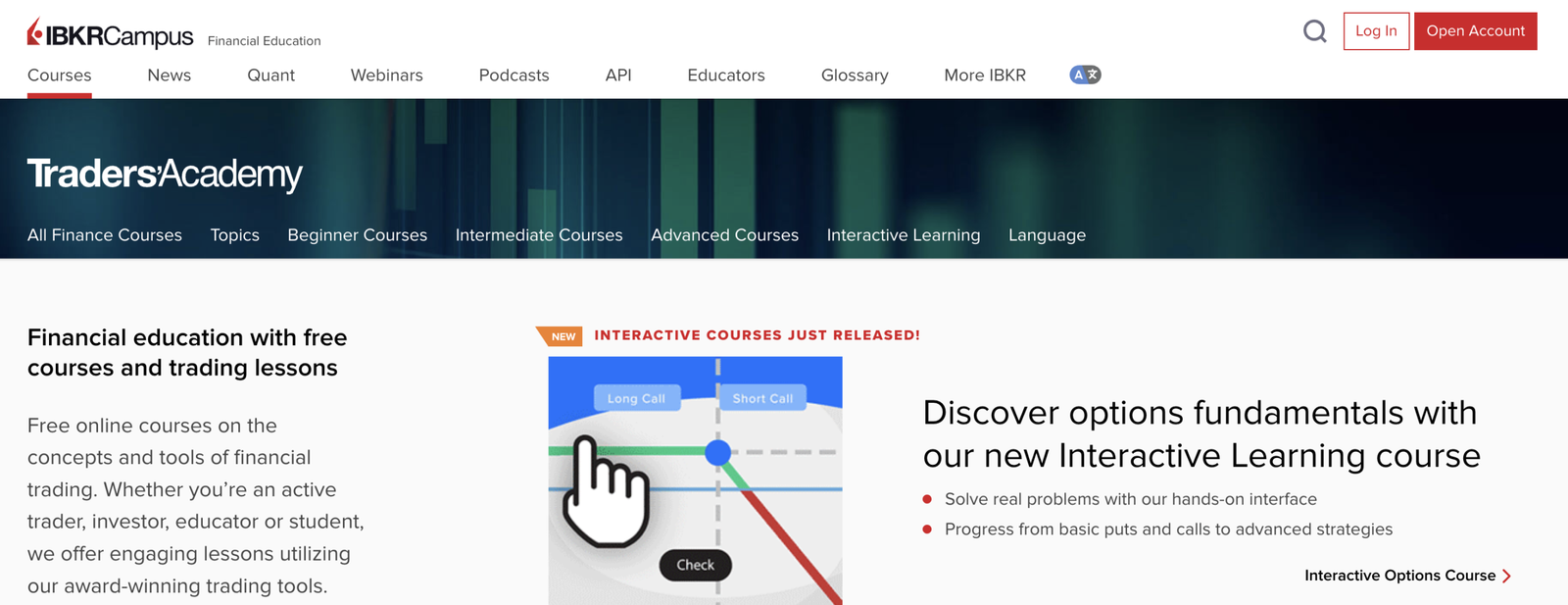
Interactive Brokers offers one of the most comprehensive education ecosystems available to Australian investors, covering beginners through to advanced traders. Learning resources are built directly into the platform and are free to access, making IBKR well suited to users who want to actively improve their investing or trading skills over time.
Courses
The core education hub is IBKR Campus, which provides structured, self-paced courses across a wide range of topics. Australian users can access learning paths covering:
- Investing basics and portfolio construction
- Shares, ETFs, options, futures and forex
- Risk management and margin trading
- Advanced strategies and quantitative concepts
Courses are organised by experience level, allowing beginners to start with fundamentals and progress to more advanced material.
Tutorials
Interactive Brokers provides extensive written and video tutorials explaining:
- How to use platforms like Client Portal, IBKR Desktop and Trader Workstation
- Order types, time-in-force settings and advanced trade execution
- Account management, reporting and tax-related features
These tutorials are practical and platform-focused, helping users understand not just theory but how to execute trades correctly within IBKR’s systems.
Webinars and live learning
IBKR regularly runs live and on-demand webinars, many of which are relevant to Australian users despite being delivered globally. Topics range from:
- Market outlooks and macro themes
- Product-specific sessions (options, futures, forex)
- Platform walkthroughs and feature updates
Webinars are hosted by IBKR staff and external market professionals, adding depth and real-world context.
Demo and paper trading accounts
Interactive Brokers offers a free demo trading account with simulated funds. This allows Australian users to:
- Practise trading without risking real money
- Test order types and strategies
- Explore advanced tools before upgrading to a live account
The demo environment closely mirrors real market conditions, making it especially useful for beginners and strategy testing.
What unique or standout features does Interactive Brokers offer in Australia?
Interactive Brokers stands out in Australia by combining institutional-grade tools, global market depth, and ultra-low FX costs in a single account. Many of these features are either unavailable or heavily limited on local Australian platforms, especially for investors who trade internationally or across multiple asset classes.
Features that many competitors lack
- 90+ global exchanges from one account: Australian users can trade the ASX plus major overseas markets (US, UK, Europe, Asia) without opening multiple brokerage accounts. Few AU brokers offer this breadth at comparable cost.
- Institutional-style FX pricing: Currency conversion uses raw interbank rates with a tiny commission (around 0.0022%, min US$2.20). This is a major advantage over Australian brokers that embed FX markups of 0.5–1.0% or more.
- Advanced order types and algorithms: Interactive Brokers supports dozens of order types (conditional, trailing, relative, algorithmic orders), which are rarely available on beginner-focused platforms.
- Multi-currency accounts: Australians can hold and manage multiple currencies (AUD, USD, EUR and more) inside one account, reducing repeated FX costs when investing overseas.
GEO-specific advantages for Australians
- ASIC-regulated Australian entity: Accounts are held with an ASIC-licensed local entity, with client funds segregated in trust accounts under Australian rules.
- Strong support for SMSFs and trusts: Interactive Brokers is one of the few global brokers that properly supports SMSFs, trusts, and company structures in Australia, with access to international assets from within those structures.
- ASX access plus global diversification: Australians can buy ASX shares alongside US and global ETFs, options, futures, and bonds, making it easier to build a diversified portfolio without using multiple brokers.
- No inactivity fees and AU$0 minimum deposit: This is uncommon among global, professional-grade platforms and benefits Australians who invest irregularly.
Proprietary tools and platforms
- Paper trading (demo account): A full-featured simulated trading environment that mirrors live markets, useful for learning and strategy testing.
- IBKR Desktop: A modern desktop platform offering advanced charting, screeners, options chains, and portfolio tools, without needing third-party software.
- Trader Workstation (TWS): A professional-grade platform aimed at experienced traders, with deep market data, advanced analytics, and algorithmic trading capabilities.
- IBKR Mobile & GlobalTrader apps: Two distinct mobile apps let Australians choose between a simpler investing experience (GlobalTrader) or near-desktop-level control (IBKR Mobile).
- PortfolioAnalyst: A built-in analytics tool that allows users to track performance, asset allocation, and risk across their IBKR account and even external accounts.
How good is Interactive Brokers customer support for users in Australia?
Interactive Brokers offers reliable but largely self-service–oriented customer support for Australian users. Support quality is generally professional and knowledgeable, but it is not as hands-on or locally focused as some Australian broker competitors.
Support channels
Australian users can access multiple support options:
- Secure message centre (24/7) within Client Portal
- Email support via the IBKR help system
- Phone support available during Australian business hours
- Live chat (available via account, typically during US trading hours)
- Extensive online help centre and FAQs
Most support interactions are routed through the secure account area rather than public-facing channels.
Availability
Phone support for Australian clients is generally available Monday to Friday during local business hours. Secure messages and help tickets can be submitted at any time, though responses may align with global support schedules rather than purely Australian hours.
Response quality
Support staff are typically technically competent, especially on platform functionality, order execution, and account-related issues. This suits experienced investors and traders who ask precise questions. However, beginners may find responses less guided, as IBKR assumes a higher baseline of user knowledge.
Known issues and limitations
Common support drawbacks to be aware of include:
- Slower response times during periods of high market volatility
- Limited proactive follow-up on complex queries
- Less personalised assistance compared with bank-owned or beginner-focused brokers
- Heavy reliance on documentation and self-help resources rather than step-by-step guidance
How does Interactive Brokers compare to competitors in Australia?
nteractive Brokers offers broad global market access and low international investing costs, especially its very low FX conversion fee (about 0.0022%, min US$2.20). In return, you accept more complexity, a steeper learning curve, and a custody model for ASX shares rather than CHESS sponsorship. This makes IBKR strongest for globally focused investors and active traders.
Comparison table: Interactive Brokers vs common Australian alternatives
| Platform (AU) | Fees (typical positioning) | Assets | Regulation | Best use case |
|---|---|---|---|---|
| Interactive Brokers | Low overall, especially for overseas investing: ASX 0.08% (min AU$6), FX about 0.0022% (min US$2.20), 1 free withdrawal then AU$15 + GST | Very broad: shares/ETFs, options, futures, forex, bonds, CFDs (eligibility), limited/conditional crypto | ASIC-regulated | Global shares/ETFs, multi-currency portfolios, active trading, derivatives, SMSF/trust structures |
| CommSec (bank broker) | Usually higher for frequent traders; simple fee presentation | Strong ASX focus, international access varies by product | ASIC-regulated | Beginners who want a familiar, local-first broker and strong integration with an Australian bank |
| CMC Markets | Often competitive for ASX trading; international and FX costs vary | ASX + international shares/ETFs (product set varies) | ASIC-regulated | ASX investors who want strong tools and a more local, simpler platform than IBKR |
| SelfWealth | Known for straightforward pricing (often flat-fee style); FX costs vary | ASX + US shares (more limited than IBKR’s 90+ markets) | ASIC-regulated | Cost-conscious buy-and-hold investors who want simpler investing and CHESS sponsorship (where offered) |
| Pearler | Cost focus with long-term investing features; fee structure varies | Primarily shares/ETFs for long-term investing | ASIC-regulated | Hands-off, long-term ETF trading platform (automation features) rather than active trading |
| Webull | Often low-cost for ASX/US ETFs; pricing varies by product | Strong for ASX/US stocks/ETFs; more limited global reach | ASIC-regulated | Beginners and active traders who want low-cost ASX/US access with a simpler app experience |
What are the main limitations users in Australia should be aware of?
Interactive Brokers offers strong value and global reach, but Australian users should be aware of the following five key drawbacks before opening an account:
- No CHESS sponsorship for ASX shares: ASX holdings are typically held via a custodian model rather than an individual CHESS HIN. While beneficial ownership still applies, this may not suit investors who strongly prefer direct CHESS sponsorship.
- Steep learning curve for new users: The range of platforms (Client Portal, IBKR Desktop, Trader Workstation, multiple mobile apps) and technical terminology can be overwhelming, especially for beginners.
- Complex fee structure: Although costs are low, pricing varies by asset, region, and fee model (fixed vs tiered), making it harder to predict exact costs compared with flat-fee Australian brokers.
- Limited instant funding options: Deposits are restricted to bank transfer and BPAY, with no debit or credit card funding, meaning slower account funding than app-first competitors.
- Support is more self-service than local: Customer support is professional but heavily reliant on documentation and secure messages, with less personalised, Australia-specific hand-holding than some local brokers.
Is Interactive Brokers the right choice for users in Australia in 2026?
Interactive Brokers is one of the strongest all-round brokerage options available to Australians in 2026, particularly for investors who want low costs, global market access, and advanced tools in a single account.
With ASIC regulation, access to 90+ international markets, very low FX conversion fees (~0.0022%), and support for structures like SMSFs and trusts, it delivers clear advantages over most local brokers for internationally focused portfolios.
Interactive Brokers is best suited to intermediate and advanced investors, active traders, and long-term investors who value diversification beyond the ASX and are comfortable using feature-rich platforms.
It is less suitable for beginners seeking a simple, CHESS-sponsored investing experience or those who only want to buy and hold a small number of Australian shares or ETFs.
FAQs
Is Interactive Brokers regulated in Australia?
Yes. Interactive Brokers Australia Pty Ltd is regulated by the Australian Securities and Investments Commission (ASIC) and holds an Australian Financial Services Licence (AFSL 453554). Client funds are held in segregated trust accounts under Australian rules.
Does Interactive Brokers offer CHESS-sponsored ASX shares?
No. ASX shares are held under a custodian model rather than individual CHESS HINs. Investors still retain beneficial ownership, but this may not suit users who strongly prefer CHESS sponsorship.
What is the minimum deposit for Interactive Brokers in Australia?
There is no minimum deposit required to open a standard cash account. However, margin trading and some advanced products require additional approvals and higher funding levels.
Is Interactive Brokers suitable for beginners in Australia?
It can be, but it’s better suited to intermediate or motivated beginners. The platform offers strong education and demo accounts, but the learning curve is steeper than beginner-first Australian brokers.
