

CoinSpot is an Australian-based cryptocurrency exchange that has been operating since 2013, offering access to hundreds of digital assets and AUD-friendly payment methods.
Here, we analyse CoinSpot’s fees, safety standards, regulation, and key features from an Australian user perspective to help Australian users understand where CoinSpot delivers value and where trade-offs exist.
Quick verdict: How do we rate CoinSpot for users in Australia in 2026?
Overall Rating: ⭐ 4.2 / 5
CoinSpot is a strong all-round crypto exchange for Australians who want a simple AUD on-ramp, a huge coin list (about 537 assets), and responsive local support. It’s best for beginners and long-term holders, but less ideal for frequent traders who rely on “instant” buys due to the 1% trade fee.
CoinSpot suits Australians who value an easy app, recurring buys, and broad altcoin access without needing multiple exchanges. It’s not the best fit if you’re fee-sensitive and mostly use Instant Buy/Sell/Swap, or if you want deep pro-trading tools and liquidity features.
On trust, it benefits from being registered with AUSTRAC and having recognised security certifications such as ISO 27001, but crypto balances are not government-guaranteed and it does not offer insurance on funds held on-platform.
Ratings breakdown
| Category | Score | Summary |
|---|---|---|
| Security & Trust | 4.5/5 | AUSTRAC-registered digital currency exchange, strong security posture (cold storage, 2FA guidance), ISO 27001 certification and additional audit history. No insurance for fiat or crypto held on the exchange. |
| Fees & Pricing | 3.8/5 | Clear trade pricing, but it can be expensive depending on how you buy. Instant Buy/Sell/Swap is 1%; card deposits are 1.22%, cash deposits 2.5%, PayPal deposits 0.5%. Free AUD deposits via bank transfer/PayID and free AUD withdrawals. |
| Features | 4.2/5 | Strong feature set for Australians: recurring buys, crypto spending card, SMSF support, NFT hub, price alerts, and broad asset coverage (about 537 coins). NFT marketplace is relatively limited (around 50 collections). |
| Ease of Use | 4.6/5 | Beginner-friendly UI and straightforward onboarding with KYC steps (account setup → add payment method → verify ID → start trading). App experience broadly mirrors desktop features, plus dark mode and card controls. |
| Customer Support | 4.7/5 | 24/7 live chat and ticket support, with live chat responses under a minute. No phone support, which may matter for users who prefer voice-based help. |
| Reputation | 4.3/5 | Established Australian exchange founded in 2013 with over 2.5 million registered users; member of Blockchain Australia and voluntary member of Australian Financial Complaints Authority. Public-facing trust signals include independent auditing references and long operating history. |
CoinSpot at a glance
| Category | Details |
|---|---|
| Best for | Buying, selling, and trading crypto (beginner-friendly AUD platform with broad coin coverage) |
| Crypto assets supported | 537 (Such as: BTC, ETH, USDT, XRP, BNB, SOL, USDC, ADA, DOGE, TRX) |
| Spot trading | Yes |
| Derivatives trading | No (Australia) |
| Trading fees | Instant Buy/Sell/Swap: 1.00%. Spot maker/taker (exchange): 0.01% / 0.01% |
| Fiat on/off ramps | Yes (Australia): AUD via bank transfer, PayID, POLi, card, PayPal, cash (fees apply to some methods) |
| Minimum deposit | $1 AUD for PayID, Direct Deposit, Paypal, Card Payments $50 for cash deposits |
| Wallet custody | Custodial (assets held on-platform unless withdrawn to an external wallet) |
| Staking / earn | Earn program suspended, Staking available for eligible coins |
| Regulation status | Registered with AUSTRAC; ASIC oversees certain crypto-related financial products in Australia, while CoinSpot itself operates as an AUSTRAC-registered digital currency exchange |
| Investor protection | None. Crypto is not covered by government deposit protection and CoinSpot does not offer insurance on fiat or crypto held on the exchange. |
| Security features | 2FA support, majority of assets stored in cold storage, security audits and certifications including ISO 27001 (2020) and data centre ISO 27018; external statutory financial audit ref |
Who should use CoinSpot and who should avoid it?
CoinSpot suits Australian beginners and long-term holders who want an easy AUD on-ramp and access to hundreds of cryptocurrencies.
It’s less suitable for fee-sensitive active traders or investors looking for advanced trading tools or non-crypto assets.

Good fit if…
- You’re new to crypto and want a clean, simple platform with local support.
- You want broad coin access, with around 537 cryptocurrencies including BTC, ETH, SOL, ADA and DOGE.
- You prefer easy AUD deposits, using free bank transfer or PayID, plus straightforward AUD withdrawals.
- You value Australian compliance, with registration under AUSTRAC and a long operating history since 2013.
Avoid if…
- You’re highly fee-sensitive, especially if you rely on Instant Buy/Sell, which carries a 1% fee.
- You’re an advanced trader looking for deep liquidity, complex order types, or pro-level trading tools.
- You want extensive NFT or DeFi features, as CoinSpot’s NFT marketplace is relatively limited.
- You expect investor protections or insurance, as crypto holdings on CoinSpot are not insured or government-protected.
Is CoinSpot suitable for beginners?
Yes. CoinSpot is well suited to beginners, particularly Australian users buying crypto for the first time. The platform prioritises simplicity, local AUD access, and support, while still offering enough depth to grow into over time.
Ease of onboarding
Account setup follows a clear KYC flow: create an account, add a payment method, verify ID, and start trading.
Verification uses standard Australian ID and is aligned with requirements under AUSTRAC registration, which adds friction compared to unregulated platforms but improves legitimacy and account recovery options.
Interface simplicity
CoinSpot’s interface is intentionally clean. Buying and selling crypto can be done via Instant Buy/Sell, with clear pricing shown upfront, or via the exchange view for lower fees.
The mobile app closely mirrors the desktop experience and is well rated (around 4.7–4.8 stars across app stores), which helps beginners avoid confusion when switching devices.
Demo accounts
CoinSpot does not offer a paper or demo trading account. Beginners must trade with real funds from the outset, which increases risk compared to platforms that allow practice trading first.
Education availability
Each supported asset includes plain-English explanations and basic educational material, which helps new users understand what they are buying.
While this is not a structured “academy”, it is more guidance than many exchanges provide and is sufficient for entry-level learning.
Risk warnings and safeguards
CoinSpot clearly states that crypto is high risk, not government-protected, and not insured. Security safeguards include cold storage for most assets, encouragement of 2FA, and a strong audit trail including ISO-aligned security standards.
These measures reduce operational risk but do not remove market risk, which beginners still need to manage themselves.
Beginner comparison
Compared with beginner-first platforms like Coinbase or Swyftx, CoinSpot offers a similarly simple interface and stronger Australia-specific features such as PayID deposits and local support. However, its 1% Instant Buy/Sell fee is higher than Swyftx’s standard trading fees, making cost awareness important for new users.
In short
CoinSpot is a strong beginner platform for Australians who value ease of use, local support, and a large coin selection.
The lack of a demo account and higher instant fees mean beginners should start small and understand costs. Still, overall, the platform is accessible, transparent, and suited to first-time crypto users. If you’re new to crypto, check out our guide on how to buy cryptocurrencies.
What are the pros and cons of using CoinSpot in Australia?
CoinSpot is a well-established Australian crypto exchange (founded in 2013) with a very large coin list (about 537 assets), easy AUD funding options, and 24/7 local support.
The main trade-off is pricing and depth: Instant Buy/Sell/Swap carries a 1% fee, some deposit methods add extra costs, and advanced traders may want more sophisticated tools or deeper markets.
- Large crypto selection: around 537 assets (e.g., BTC, ETH, XRP, SOL, ADA, DOGE) and 17 of the top 20 by market cap available.
- AUD-friendly funding: free deposits via bank transfer and PayID, plus POLi support; free AUD withdrawals listed.
- Strong local presence: Australian company based in Melbourne with 24/7 live chat and ticket support; with live chat responses under a minute
- Security posture and audit history: cold storage for most assets, 2FA guidance, and security certifications including ISO 27001 (2020) plus data centre ISO 27018 references; CoinSpot has completed an external statutory financial audit under Australian Auditing Standards
- Regulatory alignment: registered with AUSTRAC;ASIC oversees certain crypto-related financial products in Australia, while CoinSpot itself operates as an AUSTRAC-registered digital currency exchange, member of Blockchain Australia; voluntary member of Australian Financial Complaints Authority.
- Instant trading can be expensive: Instant Buy/Sell/Swap fee is 1.00%, which adds up for frequent or small purchases.
- Some deposit methods carry fees: cash deposits 2.5%, card deposits 1.22%, PayPal deposits 0.5%.
- Crypto has no investor protections: crypto holdings aren’t government-protected, and CoinSpot states it does not offer insurance for fiat or crypto held on-platform.
- NFT offering is limited: NFT marketplace is about 50 collections, smaller than dedicated NFT marketplaces.
- Not ideal for traditional investing: no shares/ETFs or broader “all-in-one” investing products.
How regulated and trustworthy is CoinSpot in Australia?
CoinSpot is registered with AUSTRAC as a Digital Currency Exchange (DCE), has operated in Australia since 2013, and has built trust signals through independent security standards (ISO 27001) and long market tenure.
However, AUSTRAC registration is not the same as an AFSL-style “licence” for crypto investing, and crypto holdings on exchanges don’t receive Australian investor protections.
Regulation snapshot
| Item | Status | What it means for Aussie users |
|---|---|---|
| Local AML/CTF regulator | AUSTRAC DCE registered | Registration is required to operate as an exchange and focuses on AML/CTF compliance, not investment suitability or product oversight. |
| Corporate/investing regulator | ASIC | Crypto spot trading is not automatically “AFSL-licensed”. Some crypto-related products (eg, cards or other financial products) may sit under an AFSL held by a provider. |
| External dispute resolution | Australian Financial Complaints Authority (relevant for card product via issuer) | The CoinSpot Mastercard documentation points to AFCA via its issuer’s arrangements, which is different from crypto exchange protections. |
| Authorised vs registered | Registered (AUSTRAC DCE) | “Registered” here = AML/CTF registration, not “authorised” to provide regulated financial product advice. |
| Years in operation | Since 2013 | Longer operating history can reduce “new venue” risk, but doesn’t remove market/custody risk. |
| Parent company / listing | Privately held (not publicly listed) | CoinSpot is privately held under Casey Block Services, with no public market disclosure obligations |
| Fund segregation | Not clearly confirmed in public exchange info | Many exchanges pool custody arrangements; unless clearly stated, assume no guaranteed statutory segregation and rely on platform controls plus your own custody decisions. |
| Investor protection | None for crypto | Crypto held on an exchange is not covered by government-backed deposit protection schemes. |
| Security audits / standards | ISO 27001 | ISO 27001 indicates audited information-security controls; helpful, but not insurance and not a guarantee against loss. |
What assets can you trade on CoinSpot as a user in Australia?
CoinSpot is a crypto-only platform for Australians, so your tradable universe is focused on spot cryptocurrencies (buy/sell/swap) plus a limited NFT marketplace.
You can deposit/withdraw in AUD (CoinSpot’s only supported fiat currency) and access a very large coin list, 537+ supported crypto assets, including major large-caps like BTC, ETH, XRP, SOL, BNB, ADA, and key stablecoins like USDT, USDC.
CoinSpot also covers 17 of the top 20 cryptocurrencies by market cap, but a few notable large tokens are not available.
Asset coverage
| Asset class / market | Available on CoinSpot (AU) | What you can do | Notes for Australians |
|---|---|---|---|
| Shares & ETFs | No | — | Not a share broker; no ASX/US equities or ETFs. |
| Forex (FX) | No | — | No FX pairs or leveraged currency trading. |
| Derivatives (futures/options/perps/CFDs) | No | — | CoinSpot is primarily a spot exchange; no derivatives desk for AU users. |
| Crypto (spot) | Yes | Buy / sell / swap | 537+ coins supported; AUD is the base fiat. Instant Buy/Sell/Swap sits alongside the exchange-style spot market. |
| Stablecoins | Yes | Spot trading | Such as: USDT, USDC (availability depends on the specific coin list at the time). |
| NFTs | Limited | Buy/sell NFTs | NFT hub is smaller than dedicated NFT marketplaces: ~50 collections mentioned in the supplied data. |
| Staking / earn (on-platform) | Yes (feature) | Earn/staking tools | Offered as a platform feature (exact products vary by coin). |
| Crypto bundles / thematic baskets | Yes (feature) | Buy grouped allocations | Available as a simplified “bundle” style purchase option (still crypto spot exposure). |
How much does CoinSpot cost?
For Australian users, CoinSpot runs in AUD (Australian dollars) as the only supported fiat currency. Costs mainly come from how you trade (Instant vs Exchange) and how you fund/withdraw (bank vs card/cash/PayPal).
Trading fees (commissions)
CoinSpot effectively has two common pricing paths:
- Instant Buy/Sell/Swap: 1.00% trading fee (simple “one-click” trading).
- CoinSpot Exchange (spot market): maker 0.01% / taker 0.01% (very low posted fees on the order book).
Practical impact: beginners often default to Instant (higher fee, simpler), while fee-sensitive users place orders on the Exchange.
Spreads (important hidden cost)
CoinSpot’s published fees don’t capture spread (the difference between buy and sell pricing), which can vary by:
- coin liquidity (large caps vs small caps),
- order size,
- market volatility,
- whether you use Instant vs Exchange.
CoinSpot doesn’t provide a single fixed spread figure in the supplied data, so the clean way to treat it is: expect spread to be an additional cost, especially on Instant trades and smaller tokens.
FX and conversion fees
- No multi-fiat setup: CoinSpot supports AUD only, so there’s no platform FX fee schedule for converting between multiple fiat currencies.
- Where FX can still happen: If you fund with a non-AUD card or bank, your bank/card provider may apply its own FX rate/fee (external to CoinSpot).
Non-trading fees (deposits, withdrawals, extras)
Deposits (AUD):
- Bank transfer / PayID: Free
- Cash: 2.5%
- Card (credit/debit): 1.22%
- PayPal: 0.5%
- Crypto deposit: Free
Withdrawals:
- AUD to bank: Free
- Crypto withdrawal: Fees vary (network-based; depends on the coin)
- PayPal withdrawal: 0.5%
Typical fees table (AUD)
| Activity (Australia) | Typical fee | What it means |
|---|---|---|
| Instant Buy/Sell/Swap | 1.00% | Simple flow, higher cost per trade. |
| Exchange spot trade (maker) | 0.01% | Limit orders placed on the book. |
| Exchange spot trade (taker) | 0.01% | Market orders / immediate fills. |
| AUD deposit (Bank transfer / PayID) | $0 | Cheapest way to fund. |
| AUD deposit (Card) | 1.22% | Convenience fee for card funding. |
| AUD deposit (Cash) | 2.5% | Highest funding cost method listed. |
| AUD deposit (PayPal) | 0.5% | Smaller convenience fee than card/cash. |
| AUD withdrawal (bank) | $0 | No CoinSpot fee listed for AUD withdrawals. |
| Crypto deposit | $0 | No CoinSpot fee listed. |
| Crypto withdrawal | Varies | Depends on the asset/network conditions. |
| PayPal withdrawal | 0.5% | Fee applies if withdrawing via PayPal. |
Cost takeaway: If you want the lowest ongoing cost, the usual “cheap path” is PayID/bank transfer funding + Exchange orders (0.01% maker/taker).
If you prioritise speed and simplicity, Instant is the easy route, but the 1% fee + spread can make it materially more expensive over time.
How good is CoinSpot’s web app for users?
CoinSpot’s web app is simple, fast, and beginner-friendly, designed primarily for Australian users who want to buy and manage crypto without complexity.
It balances ease of use with a basic exchange view for lower-fee trading, but it’s not built for advanced or high-frequency traders.
Usability
The interface is clean and intuitive, with clear navigation for buying, selling, swapping, and tracking a portfolio.
AUD funding via bank transfer or PayID is easy to access, and most actions can be completed in a few clicks.
Charting
CoinSpot includes TradingView-powered charts, which are adequate for basic technical analysis and price tracking.
However, charting depth and layout options are limited compared with professional trading platforms.
Order types
Users can choose between:
- Instant Buy/Sell/Swap (simple, higher cost), and
- Exchange trading with basic spot orders and very low maker/taker fees.
There are no advanced order types such as futures, options, or leveraged products.
Customisation
Customisation is minimal. Users can set alerts and manage security settings, but the web app does not offer advanced layout controls or multi-chart workspaces.
Known limitations
- No derivatives, forex, or non-crypto assets
- Limited advanced trading tools
- Higher costs when using Instant Buy/Sell
- NFT marketplace is relatively small
How good is the CoinSpot mobile app in Australia?
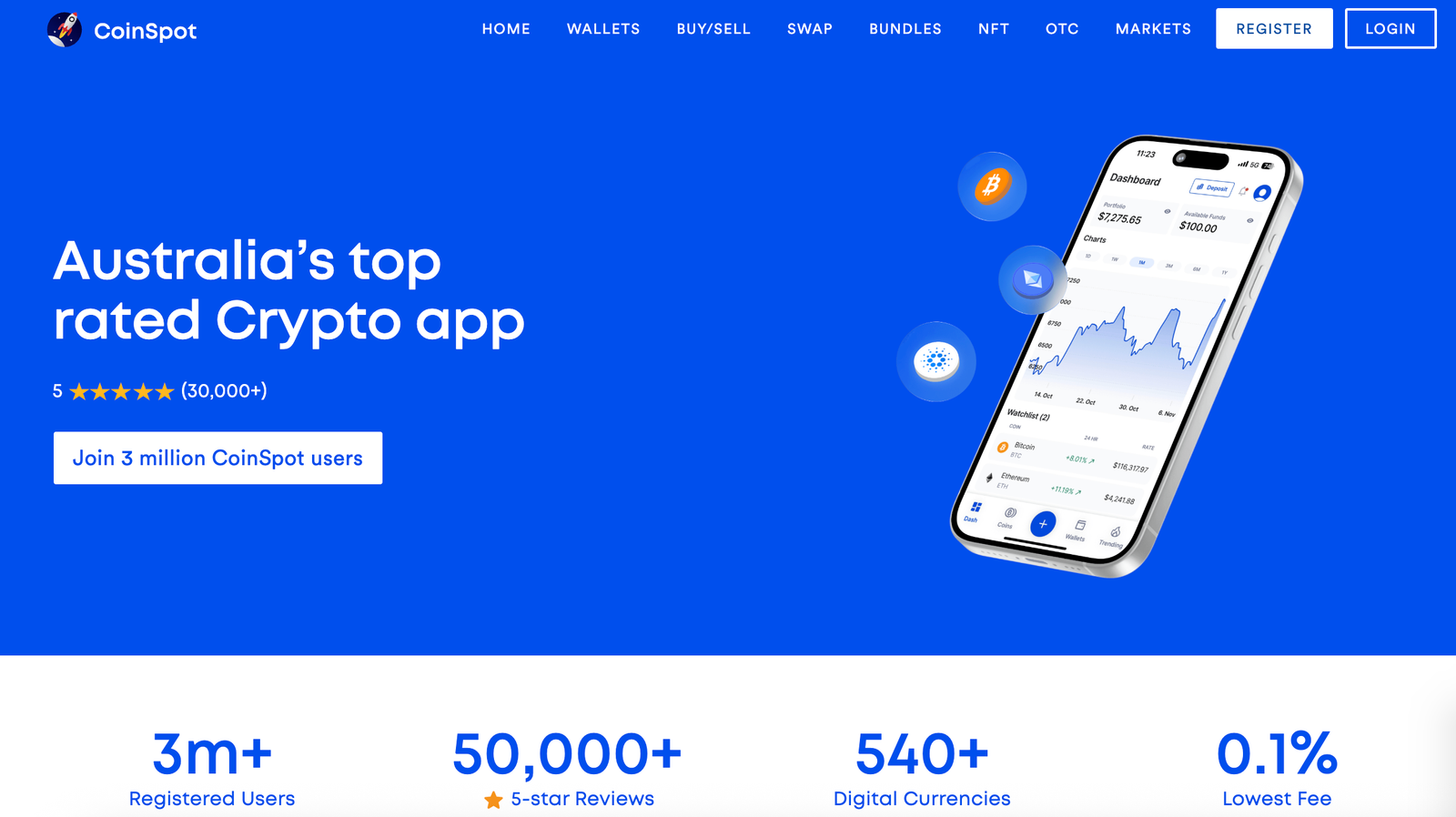
The CoinSpot mobile app closely mirrors the web platform, delivering a simple, stable, and beginner-friendly experience for Australian crypto users. It’s designed for everyday buying, selling, and portfolio tracking rather than advanced trading.
iOS and Android availability
- iOS (Apple App Store): ~4.8★ rating from 40,000+ reviews
- Android (Google Play): ~4.7★ rating from 16,500+ reviews and 500k+ downloads
Both versions are actively maintained and widely used in Australia.
Key features
- Buy, sell, and swap 537+ cryptocurrencies
- Portfolio tracking, price alerts, and transaction history
- AUD deposits and withdrawals (bank transfer, PayID, cards, PayPal)
- Support for CoinSpot Card management (Apple Pay / Google Pay)
- NFT hub access (limited collection range)
- Dark mode
Stability and performance
The app is fast and reliable, with strong user ratings indicating few widespread performance issues. Most everyday actions (buys, sells, withdrawals) complete smoothly, even during normal market volatility.
Security features
- Two-factor authentication (2FA)
- Biometric login (fingerprint / Face ID on supported devices)
- Account-level security controls and withdrawal restrictions
- Backed by CoinSpot’s broader security framework (cold storage, ISO 27001-certified systems)
Bottom line: CoinSpot’s mobile app is one of the stronger options for Australian beginners and long-term crypto holders. It’s secure and easy to use, but advanced traders may find it too basic for active or technical trading.
How easy is it to open an account with CoinSpot in Australia?
Opening a CoinSpot account is fully digital and beginner-friendly, but like all Australian crypto exchanges, you’ll need to complete identity verification (KYC) before you can withdraw funds and access higher limits.
Digital onboarding (sign-up flow)
The process is straightforward and can be done on desktop or the CoinSpot mobile trading app:
- Create an account (email + password, basic details)
- Link a funding method (e.g., bank transfer/PayID; cards and PayPal also available)
- Complete verification to unlock withdrawals and higher transaction limits
CoinSpot is designed around AUD (Australia’s only supported fiat currency on the platform), so onboarding is streamlined for Australian bank transfers and PayID deposits.
KYC steps (identity verification)
To comply with Australian AML/CTF rules (AUSTRAC-regulated), CoinSpot runs a standard KYC process. Typical steps include:
- Personal details (legal name, DOB, address)
- Photo ID upload: commonly Australian driver licence or passport
- Address verification (often required for higher limits / withdrawals)
- In some cases, additional documents or manual checks may be requested if details don’t match
Common delays (what slows approval down)
Most onboarding friction happens during KYC. Common causes include:
- Blurry photos / glare on ID images or selfies
- Name/address mismatch (e.g., nickname vs legal name, recent move)
- Expired ID or cropped document edges
- Manual review triggers (higher-risk profiles, repeat attempts, unusual deposit activity)
Typical approval time
- Account creation: usually minutes (email registration is immediate)
- KYC approval: often same day for clean submissions, but can take longer if manual review is required (e.g., mismatched details or unclear documents)
If you upload clear ID images and your details match your documents, CoinSpot is quick to set up, with the main variable being how fast KYC clears.
How do deposits and withdrawals work in Australia (methods, fees, limits, speed)?
CoinSpot supports AUD funding and withdrawals for Australian users, with the fastest options being PayID and bank transfer (including Osko/NPP where supported by your bank).
Most AUD methods are online, but CoinSpot also supports cash deposits (fee applies).
Minimum deposit in Australia
- Minimum practical deposit: CoinSpot allows fractional crypto buying, so you can start with as little as $1 (AUD).
- By payment method: Minimums can be constrained by your bank/payment provider (not CoinSpot), but CoinSpot’s own “start from $1” positioning means small deposits are supported on AUD rails.
Deposit methods (fees, limits, speed)
| Method (AUD) | CoinSpot fee | Typical speed | Notable limits / notes |
|---|---|---|---|
| Bank transfer (Direct Deposit / Osko where available) | $0 | Same day to near-instant (bank-dependent) | Higher daily limits are available on bank transfer rails (CoinSpot shows up to $100,000 per 24h for direct deposit). |
| PayID | $0 | Fast (often minutes) | CoinSpot shows PayID daily limits (e.g., up to $20,000 per 24h) depending on your account status. |
| POLi | $0 | Fast (near real-time) | Bank login-based payment flow (availability depends on your bank). (Fee and availability per your supplied dataset.) |
| Card (credit/debit) | 1.22% | Instant | Higher fee; card limits can be tighter than bank transfer. (Fee per your supplied dataset.) |
| PayPal | 0.5% | Fast | Convenience option; 0.5% fee applies. (Fee per your supplied dataset.) |
| Cash deposit | 2.5% | Slower (agent/processing dependent) | Highest fee; useful if you need a cash option. (Fee per your supplied dataset.) |
Withdrawals (AUD + crypto)
- AUD withdrawals: CoinSpot lists $0 fee for AUD withdrawals to an Australian bank account (per your dataset). Processing is same-business-day if lodged early enough, otherwise next business day (timing depends on cut-off times and bank rails).
- Crypto withdrawals: Network fees vary by asset/blockchain (per your dataset). Expect confirmations to depend on the chain and current congestion.
How fast is account approval in Australia?
CoinSpot onboarding is fully digital and includes identity verification (KYC). In CoinSpot’s help guidance:
- Initial verification can complete in minutes, with an initial deposit capability that may be capped (e.g., $2,000 per 24h) until verification is fully cleared.
- If extra documents are required, CoinSpot will review them within ~24 hours.
Common delays (what usually causes them)
- Document mismatch (name/address doesn’t match your submission)
- Unclear photos/scans of ID
- Manual review triggered by risk checks or unusual funding patterns (more common with large first deposits)
What account types does CoinSpot offer users in Australia?
CoinSpot is built around spot crypto trading in AUD (cash-only), so you’re not choosing between “cash vs margin” like you would on a CFD/derivatives platform.
Instead, the main “account types” are about who is investing (individual vs entity vs super) and what verification pathway you’ll use.
Account types available to Australians
- Standard (Individual) account
- The default account for everyday users buying/selling crypto in AUD.
- You pick your verification path during onboarding (“Individual” is one of the selectable options).
- SMSF account (Self-Managed Super Fund)
- A dedicated setup for investing via an SMSF structure (CoinSpot provides an SMSF flow/resources and references services used by SMSF users such as portfolio tracking access for accountants/fund managers).
- Business / Trust accounts
- Designed for entities that need business/trust verification (CoinSpot’s verification guidance references entity identifiers such as ABN/ACN and business/trust-specific onboarding).
Margin vs cash (and what’s not offered)
- Cash/spot only: CoinSpot is positioned primarily for spot crypto trading (buy/sell/swap) rather than leveraged derivatives.
- No traditional “professional trading account” tier required for higher volume, but CoinSpot does reference OTC access as a service for high-volume users.
Professional or special access
- OTC (Over-the-Counter) service: Referenced by CoinSpot as available for high-volume trading.
- Read-only portfolio access for accountants/fund managers (API-style access): Highlighted in CoinSpot’s SMSF information for reporting/monitoring workflows.
Quick account-type summary table (Australia)
| Account type | Who it’s for | Key notes |
|---|---|---|
| Individual (Standard) | Personal investors | AUD spot crypto trading; default onboarding option |
| SMSF | Self-managed super funds | SMSF-focused resources + portfolio tracking access for accountants/fund managers |
| Business / Trust | Companies, trusts, entities | Business/trust verification pathway (incl. ABN/ACN references) |
| OTC access (service) | High-volume users | OTC referenced for high-volume trading (service layer, not a separate “account type”) |
Is CoinSpot suitable for your trading/investing style?
CoinSpot is primarily built for spot crypto investing in AUD (not leveraged margin/derivatives). It suits best when your edge is simple execution + broad coin access (537+ assets) and you’re happy to trade less frequently, use recurring buys, and hold long-term.
It’s less ideal when you need ultra-low all-in costs, tight spreads, deep liquidity, and advanced order controls (especially if you rely on the Instant Buy/Sell/Swap flow with a 1.00% trading fee).
Suitability by style
| Style | Suitability (1–5) | Why |
|---|---|---|
| Scalping | 1/5 | Scalping is highly sensitive to fees + spread + fill quality. CoinSpot’s Instant trades can cost 1.00%, and the platform isn’t positioned as a high-frequency venue (limited pro-style controls; liquidity can feel thinner on some smaller assets compared with major global venues). |
| Day trading | 2/5 | You can trade actively, but results depend heavily on which execution route you use. Lower-fee exchange-style trading is available (around ~0.1%), but if your workflow triggers higher-fee “instant” execution you’ll feel costs quickly. |
| Swing trading | 3/5 | More workable because you trade less often. CoinSpot’s wide asset list (537+) helps with rotation, and AUD funding is straightforward (bank transfer/PayID free). Still, costs can bite if you repeatedly use Instant trades. |
| Long-term investing | 4/5 | Strong fit for DCA/holding: beginner-friendly UX, recurring buys, broad coin coverage, and simple AUD on/off-ramps. Great if you prioritise convenience over pro-grade trading depth. |
What education and learning resources are available for users in Australia?
CoinSpot’s education offering is practical and beginner-focused, designed to help Australian users understand crypto assets and use the platform safely rather than complete formal courses.
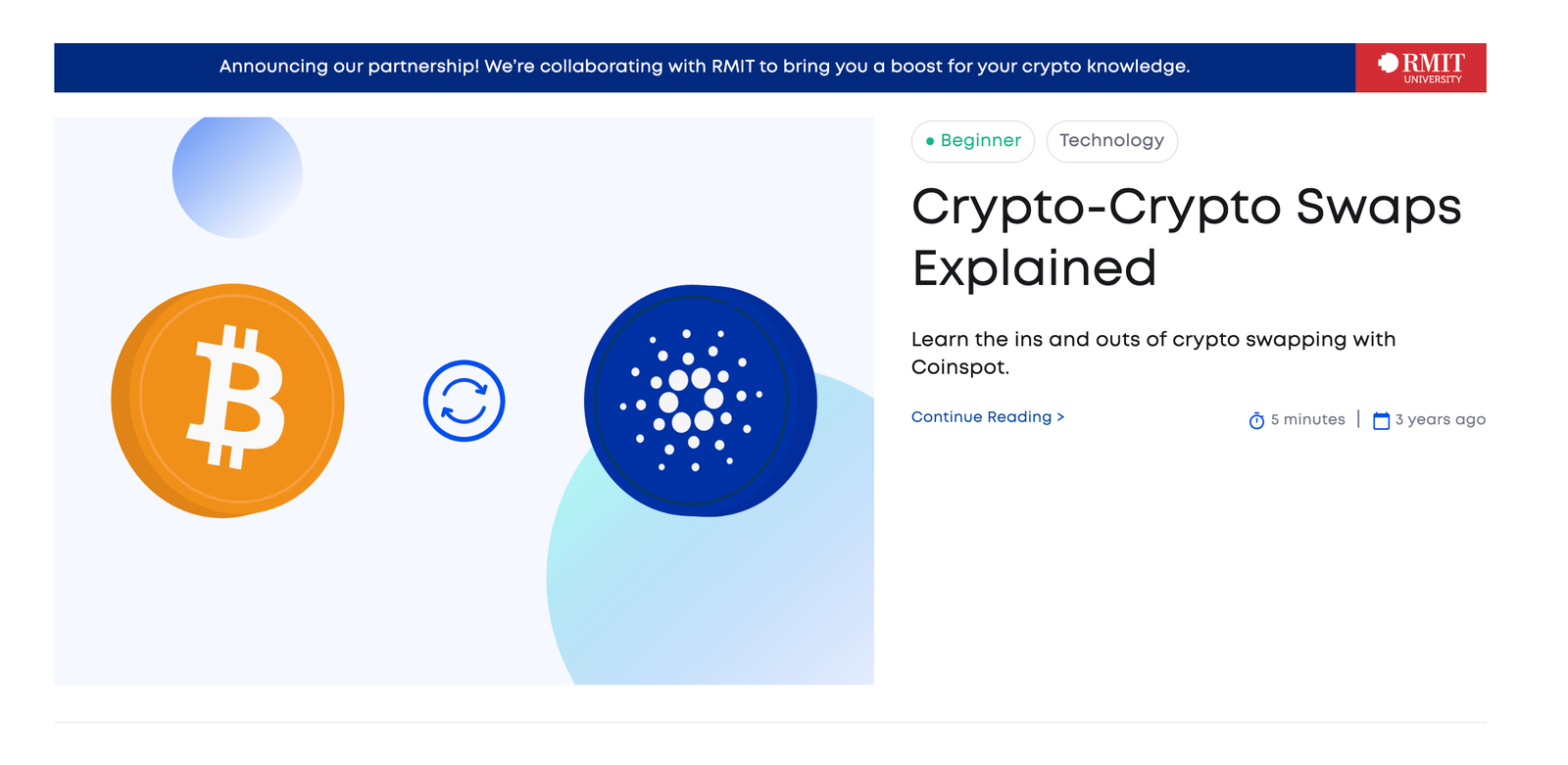
Learning is built directly into the platform and support content, which suits users who prefer to learn while investing rather than follow a structured curriculum.
- Courses: CoinSpot does not offer a dedicated, multi-module “academy” or formal courses. Instead, education is delivered in smaller, targeted formats across the platform, prioritising accessibility over depth. This approach lowers the barrier for first-time crypto investors but may feel limited for users seeking structured progression.
- Tutorials: Tutorials are CoinSpot’s strongest learning resource. Most of the 537 supported cryptocurrencies include educational material explaining the asset’s purpose, use cases, and risks. In addition, the help centre provides step-by-step guides covering account setup, identity verification, AUD deposits (bank transfer and PayID), buying and selling crypto, withdrawals, and basic security settings such as two-factor authentication.
- Webinars: CoinSpot does not position live webinars or regular training sessions as a core part of its education strategy. Learning is largely self-guided through written resources and in-platform prompts rather than scheduled live events.
- Demo accounts: There is no demo or paper trading account available. As a spot-only exchange, users learn by trading with real funds, which is why CoinSpot supports small-value purchases and recurring buys to help beginners gain experience gradually without committing large amounts upfront.
Overall, CoinSpot’s learning resources are well suited to beginners and long-term investors who want clear explanations and practical guidance, but less suitable for advanced traders looking for in-depth courses, simulations, or live training.
What unique or standout features does CoinSpot offer in Australia?
CoinSpot stands out by being built specifically for Australian users, combining local regulation, AUD-first banking, and beginner-friendly tools with one of the largest crypto selections in Australia (537+ assets).
Instead of advanced derivatives or leverage, the platform prioritises simplicity, accessibility, and compliance.
Australia-specific advantages
CoinSpot is Melbourne-based and registered with AUSTRAC. It was the first Australian exchange to complete an External Statutory Financial Audit under Australian Auditing Standards and holds ISO 27001 certification.
Users benefit from clear local accountability, free AUD deposits and withdrawals (bank transfer and PayID), and fast funding via Australian banking rails.
Features many competitors lack
Asset coverage is a major differentiator, with 537 cryptocurrencies available, more than most local exchanges.
CoinSpot also offers SMSF support, which remains uncommon in the crypto space, and local 24/7 live chat support rather than offshore or email-only help desks.
Proprietary and platform tools
CoinSpot’s Instant Buy/Sell/Swap feature offers fast, guaranteed execution without order-book complexity, appealing to beginners. Additional tools include recurring buys, a crypto spending card (Apple Pay and Google Pay), an integrated NFT marketplace, and tax-reporting exports compatible with Australian crypto tax software.
Overall, CoinSpot’s edge comes from regulatory transparency, AUD-native design, wide asset access, and Australia-specific features, rather than advanced trading functionality.
How good is CoinSpot customer support for users in Australia?
CoinSpot offers strong, Australia-focused customer support, centred on fast access to real humans rather than automated systems.
Support is handled by a Melbourne-based team, which gives Australian users better familiarity with local banking and compliance issues.
Support channels
Users can contact CoinSpot via 24/7 live chat, submit support tickets, or use the online help centre. There is no phone support, which is the main limitation for users who prefer voice escalation.
Availability and response quality
Live chat operates 24/7, and response times are very fast, often under one minute to reach a human agent. More complex issues, such as verification or account changes, are escalated through the ticket system with follow-up responses rather than handled instantly.
Known issues
Delays most commonly occur during identity verification reviews or periods of high market activity. The lack of phone support can also be frustrating for urgent security-related concerns.
How does CoinSpot compare to competitors in Australia?
CoinSpot positions itself as a beginner-friendly, Australia-first crypto exchange, prioritising regulation, AUD access, and asset breadth over advanced trading features.
Compared with local and global competitors, it trades higher convenience fees for simplicity, compliance transparency, and one of the largest coin selections available to Australians.
Key differences at a glance
- Asset coverage: CoinSpot supports 537+ cryptocurrencies, more than most Australian exchanges and many global platforms operating locally.
- Fees: Instant Buy/Sell carries a 1% fee, which is higher than some competitors, but exchange trading can be as low as 0.1%.
- Regulation: Strong local positioning with AUSTRAC registration, Australian banking rails, and an external statutory audit history.
- Target user: Beginners, long-term holders, and SMSF investors rather than active or professional traders.
Comparison with major Australian alternatives
| Platform | Fees (spot / instant) | Assets | Regulation (AU) | Best use case |
|---|---|---|---|---|
| CoinSpot | 0.1% exchange / 1% instant | 537+ | AUSTRAC registered, Australian audit history | Beginners, altcoin investors, SMSFs |
| Swyftx | ~0.6% | ~380+ | AUSTRAC registered | Lower instant fees, simpler altcoin trading |
| Independent Reserve | ~0.5% | ~30–40 | AUSTRAC registered | Bitcoin-focused, OTC & advanced users |
| Coinbase Australia | ~1%+ spreads | ~270+ | AUSTRAC registered | Brand trust, beginners, global access |
| Binance Australia | ~0.1% | 350+ | AUSTRAC registered | Active traders, lower fees, deeper tools |
What are the main limitations users in Australia should be aware of?
- Instant trading is expensive compared to “exchange” style platforms: CoinSpot’s convenience-first Instant Buy/Sell/Swap charges 1% per trade, which can materially add up for frequent traders or anyone dollar-cost averaging in small, regular amounts (especially compared with platforms that price standard buys well below 1% or lower on standard buys).
- Non-free funding methods can be costly: While bank transfer and PayID deposits are free, fees apply to other common options — cash deposits 2.5%, card deposits 1.22%, and PayPal deposits 0.5%. If you rely on these rails, CoinSpot becomes meaningfully more expensive than it first appears.
- Limited “advanced trading” experience: CoinSpot is built for simplicity, not heavy technical trading. If you want deep order-book tooling, advanced order types, or a pro-grade trading interface, CoinSpot can feel restrictive — even if you use the lower-fee exchange option (e.g., ~0.1% trading) rather than Instant.
- NFT offering is small versus dedicated marketplaces: CoinSpot’s NFT hub exists, but it’s limited to ~50 collections, which is tiny compared to purpose-built NFT venues. If NFTs are a core use case, CoinSpot’s native marketplace can feel like an add-on rather than a full ecosystem.
- Crypto withdrawals can still be a cost variable: AUD withdrawals are free, but crypto withdrawal fees vary by asset/network, so the final cost depends on what you’re moving and when (network congestion). For users frequently transferring crypto off-platform to self-custody crypto wallets, this can become a recurring friction point.
Conclusion: Is CoinSpot the right choice for users in Australia in 2026?
CoinSpot is still one of the most straightforward “set-and-forget” crypto platforms for Australians in 2026, especially if you want an AUD-first exchange with strong local operational signals (Australian base, AUSTRAC registration, Blockchain Australia membership, voluntary Australian Financial Complaints Authority (AFCA) membership), plus a very broad coin list (537+ assets) and a large local user base (2.5+ million registered users).
Where it falls short is for traders who care most about ultra-low costs, deep liquidity, and advanced tools, because CoinSpot’s convenience pricing is real (1% Instant Buy/Sell/Swap) even though lower trading fees are available on its exchange-style interface (as low as ~0.1%).
Ideal user
CoinSpot makes the most sense if you’re:
- A beginner or casual investor who values a clean UI, simple execution, and fewer moving parts over pro-grade trading features.
- An AUD-first user who wants free PayID/bank transfer deposits, free AUD withdrawals, and local-first workflows that feel built for Australia.
- An altcoin investor who prefers having “most coins in one place” (537+ supported) rather than juggling multiple accounts.
- A user who values local support (including 24/7 live chat) and clearer accountability versus offshore-only help desks.
- Someone who wants extra AU-specific utility like recurring buys, SMSF support, and the spending card (plus a basic NFT hub).
Best alternatives
If CoinSpot isn’t a perfect fit, these are the most common “switch points”:
- Lower-cost, more active trading focus (often cheaper standard fees than CoinSpot Instant): Swyftx, Independent Reserve, Digital Surge.
- Global brand + large ecosystem, but a different AU experience and smaller coin range than CoinSpot: Coinbase.
- Multi-asset investing + simpler “investor-style” interface (less of a pure-crypto power user setup): eToro.
Final recommendation
Choose CoinSpot if you want a simple, Australia-built on-ramp to spot crypto with easy AUD funding and access to a very large coin range (537+).
It suits beginners and long-term holders who value an established exchange with a long operating history, AUSTRAC registration, and a strong security posture including ISO 27001.
Avoid CoinSpot if you trade frequently and are highly fee-sensitive. The 1% Instant Buy/Sell/Swap fee adds up quickly, and paid deposit methods such as card (1.22%), cash (2.5%) and PayPal (0.5%) can materially increase costs over time.
In that case, a lower-fee Australian exchange or a platform built for active trading is usually a better fit.
FAQs
Is CoinSpot regulated in Australia?
CoinSpot is registered with AUSTRAC and operates under Australia’s AML/CTF rules. Crypto exchanges aren’t licensed like banks, but AUSTRAC registration is the key local requirement.
Can I deposit and withdraw AUD easily from Australia?
Yes. Bank transfer and PayID deposits are free, and AUD withdrawals to an Australian bank account are also free.
What are CoinSpot’s main fees Australians should expect?
Instant Buy/Sell/Swap trades incur a 1% fee. Bank transfer and PayID deposits are free, while card, cash, and PayPal deposits carry fees. Crypto withdrawal fees vary by asset.
Do I need to report CoinSpot crypto activity to the ATO?
Crypto tax obligations sit with the user. CoinSpot provides transaction exports to support Australian tax reporting.
